
1723534562.png)

CLAT 2027: Exam Date, Syllabus, Eligibility, Pattern & Full Guide
August 3, 2026

The official notification for CLAT 2027 has been released by the Consortium, along with the registration schedule, eligibility details, and important examination guidelines. Students should keep track of every update related to the CLAT 2027 exam date, application process, syllabus, and counselling schedule to avoid missing any deadlines.
CLAT 2027 will be held on Sunday, 6 December 2026, from 2:00 PM to 4:00 PM in offline mode. The notification was released on 22 July 2026, and CLAT registration process started from today 3 August 10 AM to 31 October 2026 on consortiumofnlus.ac.in. The syllabus and pattern remain unchanged for 2027.
Key Highlights - CLAT 2027
- Exam Date: 6 December 2026 (Sunday)
- Exam Time: 2:00 PM – 4:00 PM
- Mode: Offline (Pen-and-Paper)
- Notification Released: 22 July 2026
- Registration: 3 August – 31 October 2026
- Official Website: consortiumofnlus.ac.in
- Total Questions: 120 MCQs
- Courses: UG (5-Year LLB) & PG (LLM)
- Participating Institutes: 24 NLUs, including NLSIU Bengaluru and NALSAR Hyderabad
- Syllabus & Pattern: No changes for CLAT 2027
- Eligibility: 45% in Class 12 (40% for SC/ST)
- Age Limit: No upper age limit
Official Update: CLAT 2027 Notification Released
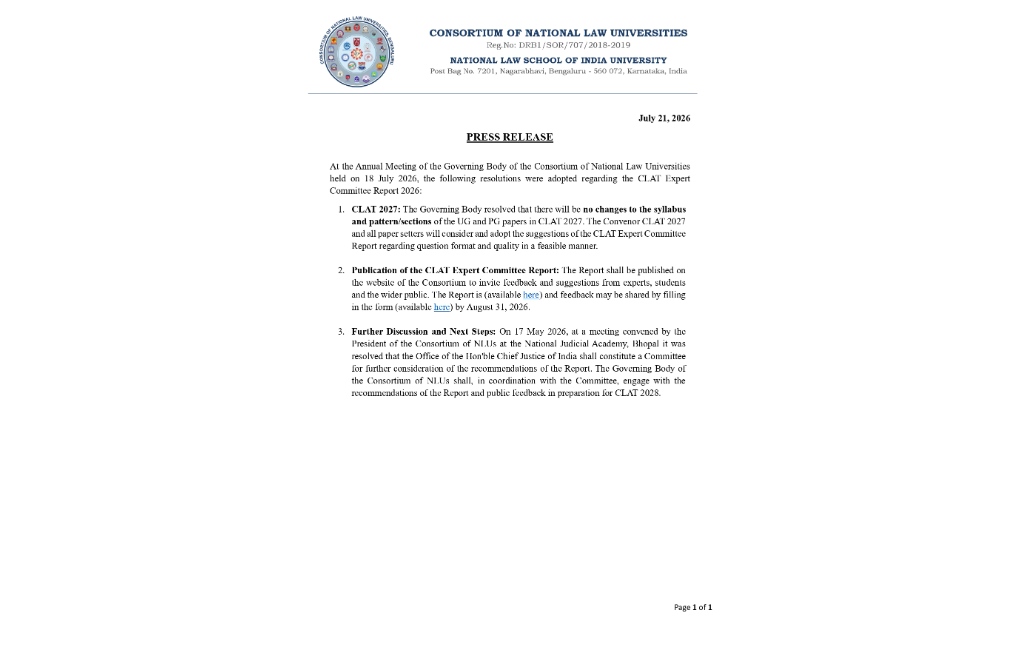
CLAT Expert Committee Review: Key Updates
-
No changes for CLAT 2027: The syllabus and pattern/sections of both UG and PG papers remain unchanged. Paper setters will only adopt the Expert Committee's suggestions on question format and quality where feasible.
- CLAT Expert Committee Report published: It's available on the Consortium's website for public feedback. Feedback can be submitted via the online form by August 31, 2026.
- Changes possible for CLAT 2028: The CJI's office will constitute a committee to consider the Report's recommendations. The Governing Body will engage with these recommendations and public feedback while preparing for CLAT 2028.
- Bottom line: CLAT 2027 aspirants can prepare with the existing pattern; any reforms would affect CLAT 2028 onward.
The Consortium of National Law Universities has officially released the notification for CLAT 2027, ending months of speculation among aspirants. Along with confirming the examination process, the notification provides complete details regarding registrations, eligibility, syllabus, exam pattern, counselling, and participating National Law Universities.
Students are advised to read the official notification carefully before proceeding with CLAT registration 2027. Since thousands of aspirants compete every year for limited NLU seats, completing the application accurately and before the deadline is extremely important.
The notification confirms the following:
- Registration process
- Eligibility requirements
- Examination pattern
- Application fee
- Counselling process
- Reservation policy
- Important dates
As the examination approaches, the Consortium may also release notifications regarding admit cards, answer keys, result declarations, and counselling schedules. Therefore, candidates should regularly check the official website as well as trusted preparation platforms like Toprankers for verified updates.
Expected impact on CLAT 2027:
- Possible restructuring of the question paper for better analytical balance.
- Updates to the CLAT 2027 syllabus, potentially aligned with international benchmarks.
- Greater transparency and improved evaluation quality.
Source: Official Consortium of NLUs communication. Final reforms will be confirmed in the official CLAT 2027 notification. Bookmark this page — TopRankers updates it as soon as new details are released.
CLAT 2027 Notification: Official Updates
CLAT notification for 2027 is out, and the exam is on 6th December. The Consortium of NLUs has published the official notification PDF on its official website.
| Particular | Details |
|---|---|
| Exam Name | Common Law Admission Test (CLAT) |
| Conducting Body | Consortium of NLUs |
| Exam Level | National Level |
| Mode of Application | Online |
| Exam Mode | Offline |
| Duration | 2 Hours |
| Questions | 120 |
| Participating NLUs | 27 |
| Number of Seats | 3700+ Seats (as of 2025) |
| Official Website | consortiumofnlus.ac.in |
CLAT 2027 Exam Dates: Important Updates
CLAT 2027 will be conducted on 6th December 2026, 2 to 4 pm on offline mode, application forms are open now, last late to apply is 31st October 2026.
| Event | Tentative Date |
|---|---|
| Notification Release | 22 July 2026 |
| CLAT registration 2027 | 3 August 2026 10 AM |
| Last Date to Apply | 31 October 2026 |
| Application Correction | November First Week |
| Admit Card Release | November |
| CLAT 2027 exam date | 6 December 2026 |
| Provisional Answer Key | December 2026 |
| Objection Window | December 2026 |
| Final Answer Key | December 2026 |
| Result Declaration | December Last week |
| Counselling Registration | January 2027 |
| Seat Allotment Begins | January 2027 |
What is CLAT Exam? Law Entrance Exam Explained
The Common Law Admission Test (CLAT) is a national-level entrance exam conducted by the Consortium of National Law Universities for admission to undergraduate (UG) and postgraduate (PG) law programmes offered by 27 National Law Universities (NLUs) and several participating private law colleges. The CLAT 2027 exam evaluates candidates in English, Current Affairs & General Knowledge, Legal Reasoning, Logical Reasoning, and Quantitative Techniques to assess their aptitude for legal education.
A good CLAT 2027 rank can secure admission to India's top law schools and is also accepted by several Public Sector Undertakings (PSUs) for legal officer recruitment. As it focuses on analytical thinking, reading comprehension, and reasoning skills rather than rote learning, CLAT remains the most preferred law entrance exam for aspiring lawyers in India.
CLAT 2027 Exam Highlights
| Particular | Details |
|---|---|
| Exam Name | CLAT 2027 |
| Conducting Body | Consortium of National Law Universities |
| Exam Level | National |
| Courses Offered | 5-Year Integrated LLB & LLM |
| Exam Mode | Offline (Pen & Paper) |
| Duration | 2 Hours |
| Questions | 120 |
| Question Type | Multiple Choice Questions |
| Marking Scheme | +1 for Correct, -0.25 for Incorrect |
| Medium | English |
| Participating NLUs | 24 |
| Official Website | consortiumofnlus.ac.in |
CLAT 2027 continues to focus on comprehension-based learning rather than memorisation, making reading speed and analytical reasoning crucial for success.
CLAT 2027 Eligibility Criteria
Before filling out the application form, every candidate must carefully understand the eligibility norms. Meeting the CLAT criteria and satisfying all CLAT requirements is mandatory for admission through the entrance examination.
The Consortium prescribes the educational qualifications, CLAT age limit, and other CLAT exam eligibility conditions every year.
CLAT 2027 Educational Qualification
Candidates applying for CLAT 2027 should have passed or be appearing in the Class 12 examination from a recognised board.
The educational CLAT criteria are summarised below.
| Category | Minimum Marks |
|---|---|
| General/OBC/PWD/NRI | 45% |
| SC/ST | 40% |
Students appearing for the Class 12 board examination in 2027 are also eligible to apply, provided they produce the qualifying certificate during admission.
These educational qualifications form an essential part of the CLAT exam eligibility requirements.
CLAT 2027 Age Limit
One of the most searched questions every year is regarding the CLAT age limit.
The good news is that there is no upper age limit prescribed for appearing in CLAT 2027.
Whether you are:
- A Class 12 student
- A drop-year student
- Someone returning to academics after a break
You can appear for the examination as long as you fulfil the educational CLAT requirements.
Important Facts about CLAT Age Limit
| Particular | Details |
|---|---|
| Upper CLAT age limit | No Limit |
| Lower Age | Must have completed Class 12 |
| Gap Year Allowed | Yes |
| Appearing Candidates Eligible | Yes |
Since there is no prescribed CLAT age limit, candidates should instead focus on meeting the academic eligibility requirements.
Important Points to Appear in CLAT 2027
Before applying, remember these important points regarding CLAT exam eligibility:
- You must satisfy all CLAT criteria announced by the Consortium.
- Ensure all educational certificates are valid.
- Upload correct documents during CLAT registration 2027.
- There is no upper CLAT age limit.
- Candidates awaiting Class 12 results may also apply.
- Failure to meet CLAT requirements during counselling may lead to cancellation of admission.
Always verify your documents before submission to avoid issues later during counselling.
CLAT 2027 Exam Pattern
Understanding the CLAT exam pattern 2027 is one of the first steps towards effective preparation. The paper evaluates comprehension, analytical ability, logical reasoning, legal aptitude, quantitative techniques, and current affairs.
The latest CLAT exam pattern 2027 is shown below.
| Particular | Details |
|---|---|
| Mode | Offline |
| Duration | 120 Minutes |
| Total Questions | 120 |
| Question Type | MCQs |
| Total Marks | 120 |
| Correct Answer | +1 |
| Incorrect Answer | -0.25 |
| Language | English |
Section-wise CLAT Exam Pattern 2027
| Section | Questions |
|---|---|
| English Language | 22–26 |
| Current Affairs including GK | 28–32 |
| Legal Reasoning | 28–32 |
| Logical Reasoning | 22–26 |
| Quantitative Techniques | 10–14 |
The CLAT exam subjects are entirely comprehension-based. Instead of asking direct factual questions, passages are provided from which candidates answer multiple-choice questions.
What are the CLAT Subjects?
The major CLAT subjects include:
- English Language
- Current Affairs & General Knowledge
- Legal Reasoning
- Logical Reasoning
- Quantitative Techniques
These CLAT exam subjects assess reading comprehension, analytical thinking, interpretation skills, and numerical ability.
CLAT 2027 Registration Process
CLAT 2027 registration is now open on the Consortium of NLUs portal. The application window runs from August 3 to October 31, 2026.
Once you've confirmed that you meet the CLAT exam eligibility, the next step is to complete CLAT registration 2027 through the official Consortium portal. The registration process is entirely online and requires candidates to create an account, fill in personal and academic details, upload documents, and pay the application fee.
Before starting the application, keep the following documents ready:
- Class 10 and 12 mark sheets (or equivalent details)
- Recent passport-size photograph
- Scanned signature
- Valid email ID and mobile number
- Category or PwD certificate (if applicable)
- Valid ID proof
Candidates must ensure that the information entered during CLAT registration 2027 exactly matches their official documents. Incorrect details can create problems during counselling and admission.
Steps to Fill CLAT 2027 Application Form?
Follow these simple steps to complete your application successfully:
| Step | Process |
|---|---|
| Step 1 | Visit the official Consortium website and register using your email ID and mobile number. |
| Step 2 | Verify your account using the OTP sent to your registered contact details. |
| Step 3 | Log in and enter your personal information. |
| Step 4 | Fill in your academic qualifications carefully. |
| Step 5 | Choose your preferred communication details and category. |
| Step 6 | Upload your photograph, signature, and supporting documents. |
| Step 7 | Select your preferred examination centre. |
| Step 8 | Pay the application fee online. |
| Step 9 | Submit the form and download the confirmation page for future reference. |
Before clicking the final submit button, review every detail carefully. A small mistake in your application can become difficult to correct later.
CLAT 2027 Application Fee
The application fee is payable online through debit card, credit card, net banking, or UPI. Candidates should complete the payment within the prescribed deadline to ensure their application is accepted.
| Category | Application Fee (Expected) |
|---|---|
| General/OBC/PwD/NRI | ₹4,000 |
| SC/ST/BPL | ₹3,500 |
In addition to the application fee, candidates may choose to purchase previous years' question papers at an additional cost, if offered by the Consortium.
Remember that the CLAT application fee is generally non-refundable. Therefore, make sure you satisfy all CLAT requirements before making the payment.
CLAT 2027 Application Correction Window
The Consortium may provide an application correction window after the registration deadline. If announced, candidates can edit selected fields in their submitted application form.
Typically, the correction facility allows candidates to update details such as:
- Photograph
- Signature
- Communication details
- Category information (subject to guidelines)
However, certain fields like name, email ID, and registered mobile number may not be editable. Always fill the form carefully during the initial submission instead of relying on the correction window.
CLAT 2027 Syllabus
Understanding the CLAT syllabus 2027 is just as important as knowing the exam pattern. Rather than testing memorised facts, the exam focuses on reading comprehension, analytical ability, interpretation, and reasoning.
The CLAT 2027 syllabus remains comprehension-oriented, requiring candidates to read passages and answer questions based on them. If you prepare according to the official CLAT syllabus, you'll be better equipped to tackle passage-based questions across all sections.
Section-wise CLAT 2027 Syllabus
| Important Subjects | Detailed Overview |
| English Language | 450 words passage based on contemporary or historically significant fiction and non-fiction writing |
| 5-6 questions testing comprehension and language skills | |
| Read and comprehend the main points, arguments, and viewpoints in the passage | |
| Draw inferences and conclusions, summarize, compare and contrast arguments or viewpoints | |
| Understand the meaning of words and phrases used in the passage | |
| Current Affairs & GK | 450 words passage based on news, journalistic sources, current affairs, and general knowledge, covering: |
| Contemporary events of significance from India and the world | |
| Arts and Culture | |
| International affairs | |
| Historical events of continuing significance | |
| Legal Reasoning | 450 words passage involving legal matters, public policy questions, or moral philosophical enquiry |
| Identify and infer rules and principles in the passage | |
| Apply rules and principles to various fact situations | |
| Understand how changes to laws or principles may alter their application to different fact situations | |
| Logical Reasoning | Series of short passages (about 300 words each) |
| Recognize arguments, premises, and conclusions | |
| Read and identify arguments in the passage | |
| Critically analyze patterns of reasoning and assess the effectiveness of arguments | |
| Infer from the passage, apply inferences to new situations, draw relationships, and identify contradictions or equivalences. | |
| Quantitative Techniques | Short sets of facts or propositions, graphs, or other textual, pictorial, or diagrammatic representations |
| Derive, infer, and manipulate numerical information from passages, graphs, or other representations. | |
| Apply 10th-standard mathematical operations, such as ratios and proportions, introductory algebra, measurement, and statistical estimation. |
CLAT 2027 Exam Difficulty
Many first-time aspirants wonder whether CLAT 2027 will be easy or difficult. The answer depends less on the level of questions and more on your preparation and time management.
In recent years, the exam has shifted from direct factual questions to lengthy comprehension passages. This means that reading speed, accuracy, and analytical ability play a much bigger role than memorisation.
Here's a general idea of the expected difficulty level:
| Section | Expected Difficulty |
|---|---|
| English Language | Moderate |
| Current Affairs & GK | Moderate to Difficult |
| Legal Reasoning | Moderate |
| Logical Reasoning | Moderate |
| Quantitative Techniques | Moderate |
Overall, CLAT 2027 is expected to be of moderate difficulty, with Legal Reasoning and Current Affairs likely to influence overall rankings.
How to Prepare for CLAT 2027
Preparing for CLAT 2027 requires consistency rather than long study hours. Instead of trying to complete everything at once, divide your CLAT preparation into manageable phases.
A Smart Preparation Strategy
| Phase | Focus |
|---|---|
| Foundation | Build reading habits and strengthen concepts. |
| Practice | Solve sectional tests and topic-wise questions. |
| Revision | Revise notes, current affairs, and weak topics. |
| Mock Phase | Attempt full-length mocks and analyse mistakes. |
Practical Tips
- Read an editorial every day.
- Maintain short notes for current affairs.
- Solve Logical and Legal Reasoning passages daily.
- Revise Quantitative Techniques regularly.
- Analyse every mock instead of only checking your score.
- Focus on improving reading speed and comprehension.
Consistency over several months is far more effective than studying for long hours occasionally.
Best Books and Study Material for CLAT 2027
Choosing the right resources can make your preparation more efficient. Avoid collecting too many books; instead, revise a few quality resources multiple times.
| Section | Recommended Resources |
|---|---|
| English | Editorials, vocabulary books, reading comprehension practice |
| Current Affairs | Newspapers, monthly current affairs magazines |
| Legal Reasoning | Passage-based legal reasoning books and practice sets |
| Logical Reasoning | Analytical reasoning and critical reasoning books |
| Quantitative Techniques | Basic mathematics books and DI practice |
Along with Best CLAT books, online lectures, quizzes, and sectional tests can help reinforce concepts.
Start Solving CLAT 2027 Mock Tests and Practice Papers
One of the biggest differences between toppers and average aspirants is the number of quality CLAT mock tests they attempt.
You should begin taking mock tests once your basic concepts are clear. Initially, focus on accuracy. As the exam approaches, shift your attention to speed and strategy.
Why Mock Tests Matter
- Improve time management.
- Build exam temperament.
- Identify weak sections.
- Increase reading speed.
- Improve question selection.
- Boost confidence before the actual exam.
A good target is to solve one mock every week during the early stages of preparation and increase the frequency to two or three mocks per week in the final months.
CLAT 2027 Admit Card
The CLAT admit card 2027 is a mandatory document that candidates must carry to the examination centre. It is expected to be released a few weeks before the CLAT 2027 exam date.
The admit card generally contains:
- Candidate's name
- Roll number
- Photograph
- Examination centre
- Reporting time
- Important exam-day instructions
Candidates should carefully verify all the details after downloading the admit card. In case of any discrepancy, they should immediately contact the Consortium for assistance.
Steps to Download CLAT 2027 Admit Card
- Visit the official Consortium website.
- Log in using your registered credentials.
- Click on the Admit Card link.
- Download the PDF.
- Verify all the information.
- Print multiple copies for future use.
Do not wait until the last moment to download your admit card, as heavy website traffic may cause delays.
CLAT 2027 Exam Centres List
During the application process, candidates can choose their preferred examination cities based on availability.
Some of the major CLAT 2027 exam centres include:
| Agartala | Agra | Allahabad |
| Amravati | Amritsar | Asansol |
| Aurangabad | Bareilly | Barrackpore |
| Bengaluru | Bhopal | Bhubaneswar |
| Bilaspur | Calicut | Chandigarh |
| Chennai | Chittor/Tirupathy | Coimbatore |
| Cuttack | Dehradun | Diu |
| Durg | Ernakulam | Faridabad |
| Gandhinagar | Gangtok | Ghaziabad |
| Gorakhpur | Greater Noida | Gurugram |
| Guwahati | Gwalior | Haldwani |
| Hisar | Hoogly | Hubli |
| Hyderabad | Imphal | Indore |
| Jabalpur | Jaipur | Jalandhar |
| Jammu | Jamshedpur | Jhansi |
| Jodhpur | Kanpur | Kharagpur |
| Kolkata | Kota | Kottayam |
| Kurnool | Kurukshetra | Lucknow |
| Madurai | Malda | Mangalore |
| Meerut | Mohali | Mumbai |
| Muzaffarpur | Mysore | Nagpur |
| Navi Mumbai | New Delhi | Patiala |
| Patna | Puducherry | Pune |
| Raipur | Rajkot | Rajahmundry |
| Ranchi | Salem | Shillong |
| Shimla | Siliguri | Silvassa |
| Sonepat | Srinagar | Surat |
| Thane | Thiruvananthapuram | Tirunelveli |
| Trichy | Vadodara | Varanasi |
| Vijayawada | Vishakhapatnam |
Candidates should select their preferred city while filling out the application form, as allotment is generally based on availability and preferences.
CLAT 2027 Answer Key
The Consortium of National Law Universities releases the provisional answer key shortly after the exam is conducted. This allows candidates to compare their responses, estimate their scores, and raise objections if they find any discrepancies.
Since the CLAT 2027 exam date determines the entire post-exam schedule, candidates should regularly check the official website for updates regarding the CLAT answer key and objection window.
CLAT 2027 Answer Key Timeline
| Event | Expected Timeline |
|---|---|
| Examination Conducted | On the CLAT 2027 exam date |
| Provisional Answer Key | Same day or next day |
| Objection Window | 2–3 Days |
| Final Answer Key | After reviewing objections |
If a candidate identifies an incorrect answer in the provisional key, they can submit an objection by paying the prescribed fee within the specified time.
Once all objections are reviewed, the Consortium publishes the final answer key, which is used for preparing the results.
CLAT 2027 Result
The CLAT 2027 result will be declared online on the official Consortium website. Candidates can log in using their registered credentials to download their scorecard.
The scorecard generally contains:
- Candidate's Name
- Roll Number
- Section-wise Marks
- Overall Score
- All India Rank
- Category Rank
- Qualifying Status
Remember that your score alone does not guarantee admission. Your rank, preferences, reservation category, and seat availability also influence your admission during counselling.
CLAT 2027 Result Calculation
The result is calculated according to the official marking scheme.
| Response | Marks Awarded |
|---|---|
| Correct Answer | +1 |
| Incorrect Answer | -0.25 |
| Unattempted | 0 |
Candidates often search for CLAT passing marks, but it is important to understand that there are no officially prescribed CLAT passing marks.
Admission depends on:
- Overall score
- All India Rank
- Category rank
- NLU preferences
- Seat availability
Therefore, instead of focusing only on CLAT passing marks, aspirants should aim to maximise their score to improve their chances of getting into a top National Law University.
Tie Breaking Criteria
If two or more candidates secure the same score, the Consortium follows tie-breaking rules.
The expected order is:
- Higher marks in Legal Reasoning.
- Higher age (older candidate preferred).
- Computerised draw of lots (if required).
These criteria ensure fairness in the preparation of the final merit list.
CLAT 2027 Cut Off
The CLAT cut off refers to the minimum rank or score required for admission into a particular National Law University. It varies every year based on several factors, including:
- Number of applicants
- Difficulty level of the paper
- Number of available seats
- Reservation policy
- Candidate preferences
The CLAT cut off is released separately for each counselling round.
Expected NLU-wise CLAT 2027 Cut Off
The table of CLAT cut off marks 2026 as per the fifth allotment list for all NLUs:
| NLUs | General (Opening Rank - Closing Rank) | OBC (Opening Rank - Closing Rank) | SC (Opening Rank - Closing Rank) | ST (Opening Rank - Closing Rank) |
| NLSIU Bangalore | 1-108 | 128-1027 | 384-3072 | 357-5000 |
| NALSAR Hyderabad | 17-164 | 407-831 | 712-3259 | 370-2786 |
| WBNUJS [BA LLB] | 102-343 | - | 2878-3833 | 4338-8675 |
| WBNUJS [BSc LLB] | 305-598 | - | 5383-7138 | 8767-13759 |
| NLIU Bhopal [BA LLB] | 149-459 | 1083-1966 | 4190-5713 | 5520-10159 |
| NLIU Bhopal [BSc LLB] | 586-698 | - | 6980-8400 | 8675-12196 |
| NLU Jodhpur | 118-364 | 676-1427 | 1801-4281 | - |
| NLU Jodhpur BBA LLB Hons | 162-406 | 1206-1657 | 4144-5541 | - |
| HNLU Raipur | 434-806 | 1864-2152 | 5435-7216 | 9471-11738 |
| GNLU Gandhinagar | 163-398 | 773-1952 | 3469-5343 | 5059-8797 |
| RMLNLU Lucknow | 411-798 | Reserved for UP Domicile | Reserved for UP Domicile | Reserved for UP Domicile |
| RGNUL Punjab | 464-1141 | - | 3552-9852 | 8880-14067 |
| CNLU Patna [BA LLB] | 367-1235 | - | Reserved for Bihar Domicile | Reserved for Bihar Domicile |
| CNLU Patna [BBA LLB] | 847-1368 | - | Reserved for Bihar Domicile | Reserved for Bihar Domicile |
| NUALS Kochi | 439-1156 | - | Reserved for Kerala Domicile | Reserved for Kerala Domicile |
| NLU Odisha [BA LLB} | 459-848 | - | 6061-9292 | 10714-17359 |
| NLU Odisha [BBA LLB] | 701-828 | - | 7713-9202 | 13787-17986 |
| NUSRL Ranchi [BA LLB] | 853-1440 | 2032-2829 | 8874-11301 | 13210-17623 |
| NUSRL Ranchi [BBA LLB] | 1295-1356 | 1963-2653 | 9292-10338 | 17433-17445 |
| TNNLU Tiruchirappalli [BA LLB] | 989-1528 | 1537-3252 | 6419-12188 | Reserved for Tamil Nadu Domicile |
| TNNLU Tiruchirappalli [BCom LLB] | 1044-1734 | 2758-3889 | 9063-12426 | Reserved for Tamil Nadu Domicile |
| DSNLU Visakhapatnam | 788-1400 | 1896-2731 | 8341-11482 | 12110-14602 |
| MNLU Mumbai | 383-500 | Reserved for Mah Domicile | Reserved for Mah Domicile | Reserved for Mah Domicile |
| MNLU Nagpur [BA LLB] | 564-1404 | Reserved for Mah Domicile | Reserved for Mah Domicile | Reserved for Mah Domicile |
| MNLU Nagpur [BBA LLB] | 841-1491 | Reserved for Mah Domicile | Reserved for Mah Domicile | Reserved for Mah Domicile |
| MNLU Aurangabad [BA LLB] | 822-1784 | Reserved for Mah Domicile | Reserved for Mah Domicile | Reserved for Mah Domicile |
| MNLU Aurangabad [BBA LLB] | 1322-2020 | Reserved for Mah Domicile | Reserved for Mah Domicile | Reserved for Mah Domicile |
| HPNLU Shimla [BA LLB] | 930-2108 | - | 9852-12661 | 14025-22118 |
| HPNLU Shimla [BBA LLB] | 603-2275 | - | 11711-13896 | 20246-23985 |
| NLUJA Assam | 610-2049 | Reserved for Assam Domicile | Reserved for Assam Domicile | Reserved for Assam Domicile |
| MPDNLU Jabalpur | 816-2045 | 2295-3476 | 10249-12966 | 15162-22701 |
| DBRANLU Sonepat | 1115-1810 | 2292-3748 | 8416-13130 | 13302-20400 |
| GNLU, Silvassa | 501-1500 | 1894-2607 | 6256-8902 | 11567-15676 |
| NLUT Agartala | 1540-2410 | - | Reserved for Tripura Domicile | Reserved for Tripura Domicile |
| RPNLU Prayagraj | 951-2268 | Reserved for UP Domicile | Reserved for UP Domicile | Reserved for UP Domicile |
Disclaimer: These ranks do not include Domicile reservations or any other horizontal reservations
CLAT 2027 Counselling
After the results are declared, shortlisted candidates are invited to participate in the counselling process.
The counselling process generally includes:
- Registration for counselling
- Payment of counselling fee
- Publication of merit list
- Seat allotment
- Document verification
- Admission confirmation
Seat allotment takes place in multiple rounds depending on vacancies.
Candidates who fail to complete any stage within the prescribed deadline may lose their allotted seat.
CLAT 2027 Reservation Policy
Each participating NLU follows the reservation policy prescribed by the Consortium along with its own institutional reservations.
Common reservation categories include:
| Category | Reservation Available |
|---|---|
| Scheduled Caste (SC) | Yes |
| Scheduled Tribe (ST) | Yes |
| Other Backward Classes (OBC) | In applicable NLUs |
| Economically Weaker Section (EWS) | Yes |
| Persons with Disabilities (PwD) | Yes |
| State Domicile | Selected NLUs |
| NRI/NRI Sponsored | Selected NLUs |
Candidates claiming reservation must upload valid supporting documents during the admission process.
CLAT 2027 Selection Process
The admission process for CLAT 2027 follows a structured sequence.
| Stage | Description |
|---|---|
| Application | Online registration |
| Admit Card | Download before exam |
| Entrance Test | Offline examination |
| Result | Rank and score declaration |
| Counselling | Registration and preference filling |
| Seat Allotment | Based on merit and preferences |
| Document Verification | Verification of certificates |
| Admission | Confirmation of allotted seat |
Meeting the CLAT criteria, CLAT requirements, and completing every stage within the deadlines is essential for securing admission.
CLAT 2027 vs AILET, SLAT & Other Law Entrance Exams
| Feature | CLAT | AILET | SLAT |
|---|---|---|---|
| Conducting Body | Consortium of NLUs | NLU Delhi | Symbiosis International |
| Exam Level | National | University | University |
| Participating Institutes | 27 NLUs | NLU Delhi | Symbiosis Law Schools |
| Mode | Offline | Offline | Computer-Based |
| Competition | Very High | High | Moderate |
If your goal is admission into most National Law Universities, CLAT 2027 should remain your primary focus.
Why Choose Legaledge By Toprankers for CLAT 2027 Preparation
Thousands of aspirants prepare for CLAT every year, but consistent success comes from structured guidance and smart preparation.
Why students choose Toprankers:
- Experienced CLAT faculty
- Updated study material
- AI-powered performance analysis
- National-level mock tests
- Personal mentorship
- Daily current affairs
- Doubt-solving sessions
- Proven success record in CLAT
Whether you're starting from scratch or aiming to improve your rank, a structured preparation ecosystem can significantly enhance your performance.
How LegalEdge Helps You Crack CLAT 2027 Exam
Toprankers supports aspirants throughout their preparation journey by providing:
| Resource | Benefit |
|---|---|
| Live Classes | Concept clarity |
| Recorded Lectures | Flexible learning |
| Mock Tests | Exam simulation |
| Performance Analytics | Identify weak areas |
| Daily Practice Questions | Regular revision |
| Current Affairs Compilations | Better GK preparation |
| Mentorship Sessions | Personalised guidance |
The combination of expert teaching, continuous assessment, and detailed feedback helps students prepare more effectively for CLAT 2027.
Avoid These Mistakes Before CLAT 2027 Preparation
Many aspirants lose valuable marks due to avoidable errors rather than lack of knowledge.
Avoid these common mistakes:
- Ignoring newspaper reading.
- Delaying mock test practice.
- Studying from too many books.
- Not analysing mock test performance.
- Memorising instead of understanding passages.
- Ignoring Current Affairs.
- Neglecting revision.
- Waiting for the "perfect time" to start preparation.
A disciplined study plan, regular revision, and consistent mock analysis can make a significant difference.
CLAT 2027: Frequently Asked Questions
- Who can apply for the CLAT 2027? Students applying for UG courses must have cleared their class XII or appearing for their class 12 exams in 2027. The criteria also entail that in 10+2 qualifying examinations, you must secure 45% or its equivalent grade if you are from General / OBC / PWD / NRI / PIO / OCI categories and 40% in case you belong to SC/ST categories.
- What does the exam consist of? It is divided into five sections: English Language, Current Affairs, General Knowledge, Legal Reasoning, Logical Reasoning, and Quantitative Techniques.
- I will be in my Class 12 from April 2026, effective April. Am I eligible for CLAT 2027? Yes, you are! Anyone taking their class 12 exams in April/May 2027 can apply for this exam.
- I come from a Science background. Can I apply for CLAT? Yes, this exam is open to all streams. It also gives science students opportunities to explore careers beyond engineering and medicine.
Essential Free Materials by Legaledge for CLAT 2027 Exam
If you're beginning your preparation, make use of free learning resources before investing in paid courses.
Some of the most useful resources include:
- Free CLAT mock tests
- Previous year question papers
- Monthly current affairs PDFs
- Daily quizzes
- Legal Reasoning practice sets
- English vocabulary resources
- Preparation blogs
- Strategy videos
- Exam notifications
- Rank predictor tools
Using these resources consistently will strengthen your concepts and help you prepare in a more structured manner.
Preparing for CLAT 2027 is not just about covering the syllabus—it's about building strong reading habits, practising consistently, and learning from every mock test. Stay updated with official notifications, complete CLAT registration 2027 on time, understand the latest CLAT exam pattern, and revise the CLAT syllabus regularly.
Instead of chasing only CLAT passing marks, aim for the highest possible score, as admissions depend on rank, preferences, and the yearly CLAT cut off. With the right strategy, reliable study material, and consistent practice, you can maximise your chances of securing admission to your dream National Law University.
Are you a PG aspirant? Check more updates on the CLAT PG Exam here
NLU Dream, Zero Cost Start: Free CLAT Demo
Fill your details
Frequently Asked Questions
Is the CLAT 2027 notification out?

What is the CLAT 2027 exam date?
When does CLAT 2027 registration start and end?
What is the last date for the CLAT 2027 application?
Are there any changes in CLAT 2027?
Who is eligible for CLAT 2027 UG?
What is the eligibility for CLAT 2027 PG?

Zubeen Siddiqui
Content Writer | MBA & CAT Preparation
SHARE