
1723534562.png)

CLAT Exam Pattern 2027: Question Paper Format, Subjects-wise Marks & Marking Scheme
October 21, 2026
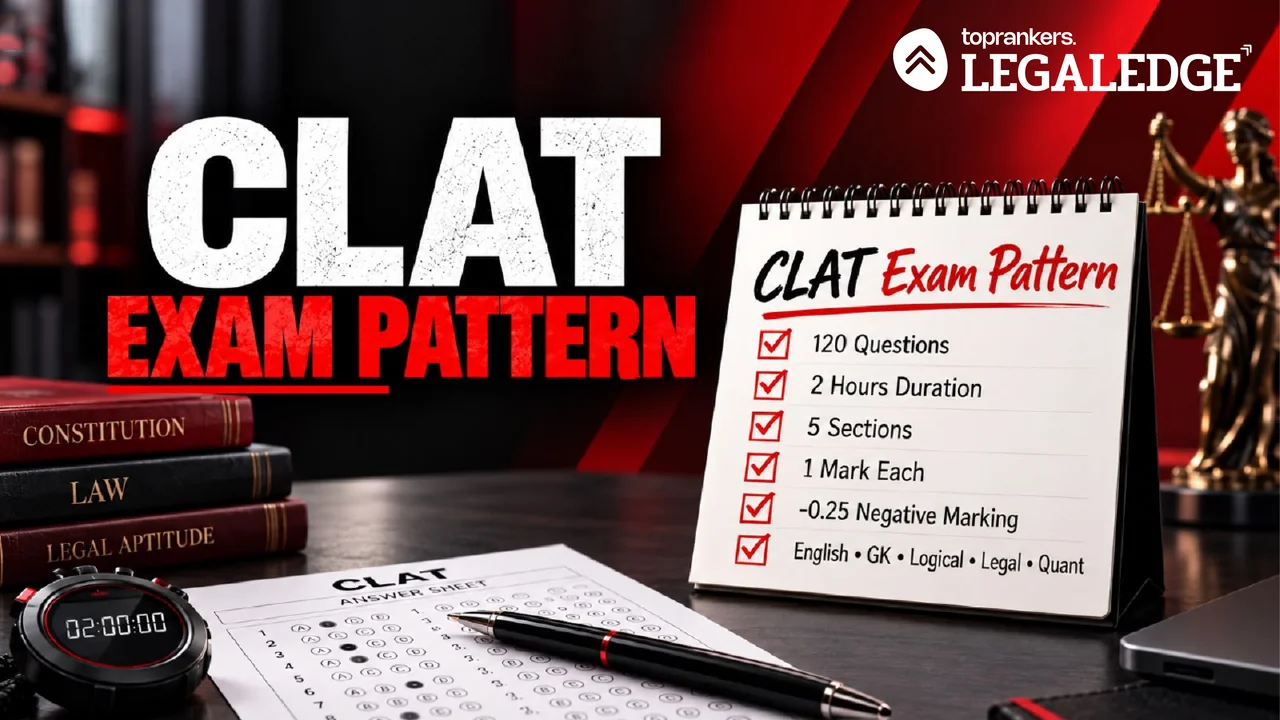
The Consortium of NLUs has set a consistent CLAT Exam Pattern for both the undergraduate and postgraduate exams. The question paper format includes clarity on the total number of questions, total marks, exam duration, marking scheme, and question types.
- CLAT Exam Pattern: MCQ or Written? It is a multiple-choice question exam with passage-based or comprehension-based questions.
- It has 120 questions in total to be solved in 120 minutes (2 hours).
- The exam is conducted in an offline setup in pen-and-paper mode.
- The total marks allocated to both UG and PG exams under CLAT 2027 are 120.
- The maximum weightage in CLAT UG is drawn by the Legal Reasoning and GK & Current Affairs sections. They contribute 50% of the exam.
- Quantitative Techniques carries the least weightage, with nearly 10% of the total questions.
- As per the expert committee report, the CLAT Exam Pattern remains unchanged for 2027. The exam for 2028 admissions will see changes.
CLAT 2027 Exam Pattern: What Changes?
An official press release in August 2026 discussed potential changes to the CLAT exam structure by the Expert Committee. Although the suggested changes are tentative and will be implemented only after seeking public suggestions, here is a quick view of the expected changes in the next session of CLAT.
- The GK and Current Affairs section is likely to be removed from the exam.
- The exam currently has five sections and would be reduced to three if the new reform is implemented.
- The Legal Aptitude and Logical Reasoning sections would merge into one. English Language would change to Language and Comprehension section. While QT remains as is.
- The new CLAT Exam Pattern might have 10-15 questions per section. This would bring the total number of questions to 30-45.
- The total exam duration will remain unchanged. It would still be 120 minutes.
- The exam mode also remains unchanged.
- There is no change in the CLAT Syllabus as well.
CLAT Exam Pattern 2027 Overview
What is the similarity between UG and PG CLAT Exam Pattern? The basic question paper format for both the exams remains same except for the sections. Here is a breakdown of similarities in the CLAT Question Paper format for both UG and PG:
| Basis | Details |
|---|---|
| Mode | Offline/ Pen and Paper |
| Medium/Language of Question Paper | English only |
| Duration | 120 minutes/2 hours |
| Question Type | MCQs |
| Number of Questions | 120 |
| Total Marks | 120 |
CLAT UG Exam Pattern 2027
The dream of pursuing an integrated law programme in top NLUs starts with getting an understanding of CLAT Exam Pattern.
The syllabus designed by the Consortium caters to all the sections in accordance with the pattern:
- The CLAT UG Exam is designed to test your comprehensive and problem-solving skills over reading speed.
- It has passage-based questions which are derived from your understanding of the comprehension given in the question paper.
- The question format is multiple-choice with one correct answer per question.
- The CLAT OMR needs to be filled with the correct option effectively. Any incorrectly marked answer or unfilled question is considered unanswered.
- The mode of the exam is offline. The question paper is made in English.
- The duration to answer the 120 questions in the exam is 120 minutes.
- The total marks for the CLAT Exam are 120.
CLAT PG 2027 Exam Pattern
For the LLM programme supported by NLUs, CLAT PG Exam Pattern needs to be checked and understood before beginning the preparation.
- The CLAT PG exam also tests your understanding of law and effectively implementing it to find the right solution to the questions.
- The question paper is made in English with comprehension-based questions.
- The mode of the exam is offline with a total of 120 questions to be solved in 120 minutes.
- The total marks rewarded for the exam are 120.
- The questions asked in the exam are based on Constitutional law, Jurisprudence, Administrative Law, Law of Contract, Torts, Family Law, Criminal Law, Property Law, Company Law, Public International Law, Tax Law, Environmental Law, and Labour & Industrial Law taught during the under graduation.
CLAT 2027 Marking Scheme
The final score calculation in the CLAT Merit List is based on the marking scheme for the exam set by the authorities.
- Every correct answer is rewarded with 1 mark.
- Since exam has negative marking, for every incorrect answer 0.25 mark is deducted.
- Any unanswered answer is marked 0.
CLAT Subject-wise Weightage
As per the CLAT Exam Pattern 2027, the weightage of each subject/section helps you set your preparation strategy.
Breaking down the section-wise weightage that can be evidently seen in the CLAT Previous Year Question Papers.
Subject-wise Weightage as per CLAT UG Exam Pattern
| Section | Approx. Questions | Weightage |
|---|---|---|
| English Language | 22–26 | ~20% |
| Current Affairs including GK | 28–32 | ~25% |
| Legal Reasoning | 28–32 | ~25% |
| Logical Reasoning | 22–26 | ~20% |
| Quantitative Techniques | 10–14 | ~10% |
| Total | 120 | 120 marks |
PG Subject-wise Weightage as per CLAT Exam Pattern
| Section | Questions | Weightage |
|---|---|---|
| Constitutional Law | 60 | 50% |
| Other Law Subjects include Contracts Law, Law of Torts, Criminal Law, International Law, IPR, and Jurisprudence. | 60 | 50% |
| CLAT Total Marks | 120 | 120 |
CLAT Exam Pattern 2027: Ideal Time to Spend on Each Section
| Subject | Time |
|---|---|
| English Language | 25 Mins |
| Current Affairs, including General Knowledge | 10-12 Mins |
| Legal Reasoning | 35 Mins |
| Logical Reasoning | 25 Mins |
| Quantitative Techniques | 15 Mins |
CLAT Exam Pattern Changes Over Time
The CLAT Exam Pattern has changed significantly over time specifically for the UG Exam.
- The first change in the number of questions happened in 2020 with the shift from 200 MCQs to 150 comprehension-led MCQs.
- Corresponding to the change in number of questions, the total weightage of the exam reduced to 120 from 150.
- From 2024, the number of questions in CLAT were further reduced from 150 to 120 leading to a change in the total marks from 150 to 120.
- The marking scheme excluded negative marking until 2012, the following year introduced the 0.25 negative marking for incorrect answers.
- The exam mode also shifted from offline to online in 2015, then back to offline 2019. From 2020, the mode was again online which changed to a pen and paper setup from 2021.
Here is the effective breakdown and knowledge about these changes in the CLAT Exam pattern:
| Period | Questions / Marks | Major Change |
|---|---|---|
| 2008–2010 | Around 200 marks; 200 questions became the norm | Early CLAT was largely a speed + knowledge-based examination. Section weights varied during the initial years. CLAT 2009, for example, had 200 one-mark questions and no negative marking. |
| 2011 | 200 questions, 200 marks | CLAT tried to reduce rote legal knowledge. Legal Aptitude was intended to assess legal reasoning rather than prior legal knowledge, while GK focused heavily on recent current affairs. |
| 2012 | 200 questions, 200 marks | The familiar 40-50-20-50-40 structure emerged, which subsequently became the standard legacy CLAT format. |
| 2013 | 200 questions, 200 marks | Negative marking was introduced for the first time: −0.25 for every incorrect answer. Static GK also returned to the notified syllabus. |
| 2013–2019 | 200 questions, 200 marks, 2 hours | Pattern remained broadly stable. Candidates effectively had only 36 seconds per question, encouraging speed and shortcut-based solving. CLAT 2019 still used this structure. |
| 2020–2023 | 150 questions, 150 marks, 2 hours | This was the biggest redesign in CLAT history. The paper shifted from short standalone questions to a comprehension- and passage-oriented format. Legal Aptitude became Legal Reasoning and Mathematics became Quantitative Techniques. |
| 2024–2027 | 120 questions, 120 marks, 2 hours | Questions were reduced from 150 to 120 while the duration remained two hours. The Consortium explicitly said this was intended to make CLAT more student-friendly and accessible. |
On the other hand, the CLAT Exam Pattern for PG had seen some unexpected edits from 2013.
- The first was change in the total marks from 200 to 150. The change was primarily because more descriptive questions had been added to the exam from 2 to 4.
- Following this, in 2015, the essays were completely removed adding MCQs to test law subjects effectively.
- In 2019, the essays/descriptive questions were brought back to give more clarity about candidate’s understanding of law. The assessment from MCQs wasn’t justifying that.
- In 2020, due to the shift to online setup, the CLAT PG Exam was moved to the MCQ pattern again removing descriptive questions again.
- The exam mode also shifted from offline to online in 2015, then back to offline 2019. From 2020, the mode was again online which changed to a pen and paper setup from 2021.
| Period | Pattern | Major Change |
|---|---|---|
| Early CLAT / 2009–2012 | Around 200 marks; combination of objective and written questions | PG CLAT originally tested substantive law through a mixture of objective, short-answer and essay questions. In 2011, for example, it had 100 one-mark objective questions + 2 essays worth 50 marks each. |
| 2013–2014 | 150 marks: 50 MCQs + 4 descriptive questions | A highly writing-oriented pattern: 100 marks came from four 25-mark essays on areas such as Constitutional Law and Jurisprudence, while only 50 marks were objective. |
| 2015–2018 | 150 MCQs, 150 marks | Essays were completely removed. The paper became 50 questions Constitutional Law + 50 Jurisprudence + 50 other law subjects. |
| 2019 | 100 MCQs + 2 essays = 150 marks | The Consortium brought subjective assessment back: 100 objective questions plus two 25-mark essays. |
| 2020 | 120 MCQs, 120 marks | Originally, 100 MCQs + 2 essays were planned. Because of the unforeseen situation in the world, the descriptive component was ultimately removed, and the final paper had 120 objective questions. Importantly, PG also shifted towards passage/comprehension questions based on judgments and legal materials. |
| 2021 | 120 MCQs, 120 marks | Essays were initially announced again, but the Consortium reversed that decision in June 2021 because of the widespread virus. The final examination contained only 120 MCQs. |
| 2022–2027 | 120 objective questions, 120 marks, 2 hours | The all-objective, comprehension-based structure became the stable PG CLAT model. Candidates read extracts from judgments, statutes and regulations and answer questions testing comprehension, legal awareness and application. |
How to Attempt a Paper Based on the CLAT Exam Pattern 2027?
Here’s what toppers actually do for an effective CLAT Preparation:
- Step 1: Start with GK since it is quick and less time-consuming
- Step 2: Move to Legal followed by Logical or vice versa since they carry high weightage
- Step 3: Attempt English as it is usually of Moderate difficulty
- Step 4: End with Quant as it is a Time-consuming section
Golden Strategy: Maximize accuracy in high-weightage sections.
Avoid these to maximise your scores:
- Ignoring the practice of reading passages
- Making too many attempts at questions (negative grading trap)
- Ignoring the GK revision
- Ignoring mock analysis
How does CLAT Exam Pattern Impacts Your Preparation?
The CLAT exam pattern clearly tells you:
- You need reading speed + accuracy
- You need conceptual clarity
- You need mock-based learning
Preparation is no longer about “studying more” It’s about “studying smart”
Conclusion
In conclusion, being well-versed in the CLAT exam pattern is crucial for a successful attempt. It enables you to prepare efficiently and effectively, improving scores and increasing your chances of securing admission to prestigious law institutions.
- Familiarise yourself with the sections and weightage of the exam.
- Focus on developing strong comprehension, reasoning, and legal aptitude skills.
- Practice time management to complete all sections within the allotted time.
- Use previous years' question papers and mock tests to get accustomed to the exam format. Then, check the CLAT exam analysis to learn about recurring topics or types of questions.
- Pay attention to the CLAT 2027 marking scheme, avoid negative marking, and attempt questions wisely.
- Use the General Knowledge area to stay informed about current events and legal changes.
- Evaluate your progress on a regular basis and modify your preparation plan as necessary.
You'll be ready to take on the sections with confidence if you apply these lessons to your preparation.
NLU Dream, Zero Cost Start: Free CLAT Demo
Fill your details
Frequently Asked Questions
Is there negative marking in the CLAT exam?

What type of questions are asked in the CLAT exam?
3. How many questions are there in the CLAT exam?
Is the CLAT exam subjective or objective (MCQ or written)?
Is the CLAT exam conducted online or offline?
Is CLAT 2027 a online exam or offline exam?
What is usually the medium of the CLAT Exam?
Are there any modifications that have been observed in the CLAT Exam Pattern by the official authorities?
Is the the exam pattern of AILET and CLAT is exactly similar?
What is the CLAT Marking Scheme?

Samriddhi Pandey
Content Writer
SHARE