


NIFT College List 2026: Top NIFT Campuses in India (Ranking, Fees, Seats, Cut-Off)
October 30, 2026
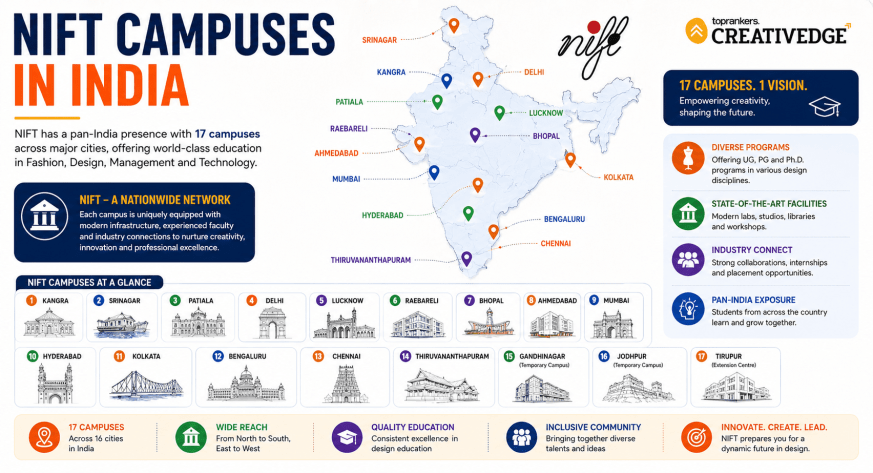
India has 20 NIFT campuses with a combined intake of about 5,076 seats. The top NIFT campuses in India, by India Today's latest placement ranking, are NIFT Delhi (Rank 1), NIFT Bengaluru, NIFT Mumbai, NIFT Hyderabad and NIFT Chennai.
Admission to every campus is through the NIFT Entrance Exam (NIFTEE) - CAT + GAT + Situation Test for- B.Des, and GAT-based rounds for the other programs. Your campus depends on your rank and category during counselling, as the top campuses close earliest.
Key Highlights - Top NIFT Campuses in India 2027
- 20 NIFT campuses across India; ~5,076 seats total.
- Top 5: NIFT Delhi, Bengaluru, Mumbai, Hyderabad, Chennai (India Today 2025).
- Newest campuses: NIFT Daman and NIFT Nava Raipur.
- Admission: single national exam (NIFTEE) → Situation Test (UG) / PI (PG) → counselling.
- Fees: ~₹13.1 lakh (UG, non-NRI) / ~₹6.0 lakh (PG, non-NRI) for the full course.
- Reservation: EWS 10%, OBC-NCL 27%, SC 15%, ST 7.5%, PwD 5% (horizontal).
For choosing the right NIFT colleges, you'll need information about each NIFT campus like their courses offered, seat availability, fees, placement records, etc. Follow along to uncover detailed info on all this and more that'll help you find the perfect NIFT college to ignite your design journey!
NIFT College Predictor 2027
Which NIFT Campus can you get based on your rank? Click below to check NOW:
Rank Wise Top NIFT Campuses in India 2027 - Full Comparison
| Rank | NIFT Campus | Location | Year Established | Key Strength |
|---|---|---|---|---|
| 1 | NIFT Delhi | New Delhi | 1986 | Flagship campus, highest industry exposure, strong alumni network |
| 2 | NIFT Mumbai | Mumbai, Maharashtra | 1995 | Proximity to fashion industry, strong internships and NIFT placements |
| 3 | NIFT Bengaluru | Bengaluru, Karnataka | 1997 | Design innovation, startup ecosystem exposure |
| 4 | NIFT Chennai | Chennai, Tamil Nadu | 1995 | Strong academic culture, regional textile focus |
| 5 | NIFT Hyderabad | Hyderabad, Telangana | 1995 | Balanced academics and placements |
| 6 | NIFT Gandhinagar | Gandhinagar, Gujarat | 2004 | Infrastructure development, industry collaborations |
| 7 | NIFT Kolkata | Kolkata, West Bengal | 1995 | Creative heritage, strong design culture |
| 8 | NIFT Patna | Patna, Bihar | 2008 | Growing campus with improving facilities |
| 9 | NIFT Kannur | Kannur, Kerala | 2008 | Textile craftsmanship exposure |
| 10 | NIFT Shillong | Shillong, Meghalaya | 2008 | Regional design exposure, emerging campus |
This NIFT college ranking India, reflects reputation, job opportunities, alumni outcomes, industry exposure, infrastructure maturity, and historical placement performance.
Why These NIFT Campuses Are Considered Among the Top in India
1. Strong placement performance, supported by NIFT ranking such as India Today’s placement survey published on the official NIFT website.
2. Established academic reputation with experienced faculty, mature curriculum frameworks, and consistent academic governance.
3. Modern infrastructure including advanced design studios, laboratories, hostels, and technology-enabled classrooms.
4. Strategic location advantages providing direct access to fashion industry hubs, export houses, design events, startups, and manufacturing ecosystems.
5. Large and influential alumni networks that contribute to industry credibility, mentoring, and placement opportunities.
6. Official institutional recognition under the Ministry of Textiles, Government of India, ensuring standardized academic quality and governance.
NIFT Campuses Ranking Based on Placement Record (India Today - Official NIFT Source)
India Today publishes an annual ranking of India's top fashion-design colleges based on placement performance, academic quality, infrastructure and industry engagement. In the latest India Today ranking, NIFT Delhi holds Rank 1, followed by NIFT Bengaluru and NIFT Mumbai - with seven NIFT campuses featuring among the country's top ten fashion colleges.
| Rank 2025 | Rank 2024 | Institute Name | Campus Location |
|---|---|---|---|
| 1 | 1 | National Institute of Fashion Technology (NIFT) | New Delhi |
| 2 | 3 | National Institute of Fashion Technology (NIFT) | Bengaluru |
| 3 | 2 | National Institute of Fashion Technology (NIFT) | Mumbai (Navi Mumbai) |
| 4 | 4 | National Institute of Fashion Technology (NIFT) | Hyderabad |
| 5 | 5 | National Institute of Fashion Technology (NIFT) | Chennai |
| 6 | 8 | National Institute of Fashion Technology (NIFT) | Patna |
| 7 | 6 | National Institute of Fashion Technology (NIFT) | Gandhinagar |
| 8 | 7 | National Institute of Fashion Technology (NIFT) | Kolkata |
| 9 | 10 | National Institute of Fashion Technology (NIFT) | Jodhpur |
| 11 | 11 | National Institute of Fashion Technology (NIFT) | Kannur |
| 13 | 14 | National Institute of Fashion Technology (NIFT) | Rae Bareli |
Ranking Sources
The rankings and campus details on this page are based on India Today's latest ranking of India's top fashion-design colleges (by placement performance, academics, infrastructure and industry engagement) and the official NIFT campus directory published on nift.ac.in, under the Ministry of Textiles, Government of India.


Top NIFT Campuses in India 2027: Which One Should You Choose?
With 20 NIFT campuses to pick from during counselling, choosing the right one comes down to matching a campus's strengths to your goals - specialization, location, industry exposure and your rank. Here's a quick comparison of the top NIFT campuses in India, followed by what makes each distinctive and how to decide.
Top NIFT Campuses in India - Quick Comparison
| NIFT Campus | Established | Best Known For | Ideal For |
|---|---|---|---|
| NIFT Delhi | 1986 | Flagship campus, widest specializations, largest alumni network | Maximum industry exposure & networking |
| NIFT Mumbai | 1995 | Fashion business, merchandising, retail proximity | Commercial & fashion-management careers |
| NIFT Bengaluru | 1997 | Design-technology, sustainability, startup ecosystem | Tech-driven, future-focused design |
| NIFT Chennai | 1995 | Textile design, regional craft, apparel exports | Textile & craft-focused students |
| NIFT Hyderabad | 1995 | Balanced academics and placements | Strong all-round campus |
| NIFT Gandhinagar | 2004 | Fully residential, Gujarat textile corridor, technical training | Structured academics & campus life |
What Makes Each Top NIFT Campus Distinctive
1. NIFT Delhi - As the first NIFT (1986) and the flagship campus, Delhi offers the widest range of B.Des specializations and sits closest to national fashion weeks, export houses and the largest concentration of design studios. It delivers the highest frequency of live industry projects and the biggest alumni network of any NIFT campus - the top choice if you want maximum exposure and networking.
2. NIFT Mumbai - Located in India's commercial and fashion capital, NIFT Mumbai is the campus most tied to the business of fashion: retail headquarters, merchandising and apparel manufacturing. It's the strongest fit for students targeting fashion-management, merchandising and commercial-fashion roles rather than pure design.
3. NIFT Bengaluru - Set in India's technology and startup hub, Bengaluru is the NIFT campus most oriented toward design-technology integration and sustainability, with close exposure to design-tech startups and cross-disciplinary innovation, ideal for future-focused, tech-driven design careers.
4. NIFT Chennai - Positioned in Tamil Nadu's textile and handloom belt, NIFT Chennai has a pronounced focus on textile design and regional craft, giving students deeper exposure to traditional techniques and the South Indian apparel-export ecosystem.
5. NIFT Hyderabad - Known for a balanced academic-and-placement profile, NIFT Hyderabad benefits from the city's growing retail and lifestyle-brand presence, making it a consistently strong all-round campus for students who want solid academics without a single narrow focus.
6. NIFT Gandhinagar - A fully residential, modern campus in Gujarat's textile and industrial corridor, Gandhinagar offers strong technical training and proximity to one of India's densest textile-manufacturing ecosystems, well-suited to students prioritizing structured academics and a self-contained campus experience.
How to Choose the Right NIFT Campus for You
Beyond reputation, your decision should weigh your goals, your rank and practical factors. Use this checklist when finalising your counselling preferences:
- Match the campus to your career goal: Delhi for exposure and networking, Mumbai for commercial fashion, Bengaluru for design-tech, Chennai for textiles, Gandhinagar for structured academics.
- Check specialization availability: NIFT Delhi, Mumbai and Bengaluru offer the widest range of B.Des specializations, while newer campuses may offer only a few - so confirm your preferred specialization is available before ranking a campus.
- Be realistic about your rank: the top NIFT campuses close earliest in counselling, so check the NIFT cut-off (campus-wise closing ranks) and keep a balanced mix of ambitious and safe preferences.
- Factor in location and cost: consider city living costs, hostel availability, and distance from home - a residential campus like Gandhinagar suits outstation students well.
- Not sure where your rank places you? Use our NIFT College Predictor to see which campus you can realistically get.
Ultimately, the best NIFT campus is the one where your rank, your specialization and your career goals align, so build your counselling preference list around fit, not just ranking.


Top NIFT Campuses in India Admission Process 2027 - How to get Admission in NIFT Colleges?
Admission to every NIFT campus runs through a single national entrance exam - the NIFTEE (NIFT Entrance Exam).
Before applying, confirm you meet the NIFT eligibility criteria for your chosen course. The exam is not identical for all program: the number of stages depends on whether you're applying for a UG or PG course, as shown below.
The written stage has two papers - CAT (Creative Ability Test) and GAT (General Ability Test).
As explained in the difference between CAT and GAT for NIFT, CAT assesses creativity, observation and design skills through sketching, design thinking and color/pattern work, while GAT evaluates reasoning, language, GK and quantitative ability. Candidates who clear these move to the practical/interview stage.
Course-wise admission stages and weightage:
| Course | Admission Stages | Weightage |
|---|---|---|
| B.Des | GAT + CAT + Situation Test | GAT 30%, CAT 50%, Situation Test 20% |
| M.Des | CAT + GAT + Personal Interview | CAT 40%, GAT 30%, PI 30% |
| B.FTech | GAT only | GAT 100% |
| M.FTech | GAT + Personal Interview | GAT 70%, PI 30% |
| MFM | GAT + Personal Interview | GAT 70%, PI 30% |
The CAT paper runs 3 hours and the GAT paper 2 hours. Only candidates who clear the written stage are called for the Situation Test (a practical 3D model-making and material-handling task) or the Personal Interview, depending on the course.
Step-by-step: How a NIFT Seat is Confirmed
| Step | Stage | What Happens |
|---|---|---|
| 1 | Written Exam | Appear for CAT and/or GAT as per your course |
| 2 | Shortlisting | Qualify the written cut-off to reach the next round |
| 3 | Situation Test / PI | Practical test (UG) or interview (PG) |
| 4 | Merit List | Final rank from combined CAT + GAT + Situation Test/PI scores |
| 5 | Counselling & Seat Allotment | Choose campus and specialization by rank, category and seat availability |
Your final campus depends on where your score places you against each campus's cut-off - the higher-ranked campuses close earliest during counselling.
Worried about fees? See how to get a scholarship at NIFT.
Courses offered by Top NIFT Colleges in India 2027
NIFT is a renowned design college in the country that offers both undergraduate and postgraduate programs to aspirants. The most popular design program offered by NIFTs at the UG level is Bachelor of Design (B.Des), and at the PG level is Master of Design (M.Des). The list of courses offered at NIFT campuses in India is mentioned below.
| List of UG courses offered at NIFTs | |
| Bachelor of Design (BDes) | Bachelor of Fashion Technology (BFTech) |
| List of PG courses offered at NIFTs | |
| Master of Design (MDes) | Master of Fashion Technology (MFTech) |
| Master of Fashion Management (MFM) | |
Candidates are informed that the UG courses offered at NIFT are four years duration whereas the PG courses are of two years duration. B.Des course at NIFT campuses in India is offered in the following specializations:
| List of NIFT B.Des Course Specializations | |
| Accessory Design (AD) | Knitwear Design (KD) |
| Fashion Design (FD) | Leather Design (LD) |
| Textile Design (TD) | Knitwear Design (KD) |
| Fashion Communication (FC) | Fashion Interior (FI) |
Which NIFT Campus Offers Which Specialization?
Not every NIFT campus offers every B.Des specialization - so before ranking a campus, confirm your preferred specialization is actually available there. In general:
- NIFT Delhi, Mumbai and Bengaluru offer the widest range of specializations, including all the major B.Des streams.
- Fashion Design, Textile Design and Accessory Design are offered at most campuses.
- Leather Design, Knitwear Design and Fashion Interiors are offered at only a few campuses - Leather Design in particular has the fewest seats (152 across all NIFTs) and limited campus availability.
- Newer campuses typically start with 2-3 specializations and expand over time.
| B.Des Specialization | Total Seats (All Campuses) | Availability |
|---|---|---|
| Fashion Design | 801 | Most campuses |
| Fashion Communication | 719 | Most campuses |
| Textile Design | 681 | Most campuses |
| Accessory Design | 637 | Most campuses |
| Knitwear Design | 351 | Select campuses |
| Leather Design | 152 | Few campuses |
| Fashion Interiors | 82 | Few campuses |
Confirm the exact specializations at your target campus in the official NIFT seat matrix before locking your counselling choices.
Still exploring your options? See the fashion designing courses after Class 10.
Top NIFT Campuses in India - Total Seats and Course-Wise Seat Intake 2027
The National Institute of Fashion Technology (NIFT) offers admissions across 20 campuses in India for its Undergraduate (B.Des, B.FTech) and Postgraduate (M.Des, MFM, M.FTech) programs.
According to the official NIFT 2027 Admission Handbook, the total intake across all 20 campuses is 5,076 seats:
| Program | Total Seats | Admission Basis |
|---|---|---|
| B.Des | 3,423 | CAT + GAT + Situation Test |
| B.FTech | 591 | GAT only |
| M.Des | 275 | CAT + GAT + PI |
| MFM | 719 | GAT + PI |
| M.FTech | 68 | GAT + PI |
| Total | 5,076 | Across 20 NIFT campuses |
Top NIFT Campuses in India - Course-Wise Seat Matrix for B.Des Specializations
| B.Des Specialization | Approx. Total Seats (Across Campuses) |
|---|---|
| Fashion Design | 801 |
| Textile Design | 681 |
| Accessory Design | 637 |
| Fashion Communication | 719 |
| Knitwear Design | 351 |
| Fashion Interiors | 82 |
| Leather Design | 152 |
| Total B.Des Seats | 3,423 |
| Bachelor of Fashion Technology (Apparel Production) | 591 |
| Total (UG) | 4,014 |
Each NIFT campus offers a selection of these specializations based on available faculty and infrastructure. For example, NIFT Delhi, Mumbai, and Bengaluru offer all six major B.Des specializations, while newer campuses may offer only 2-3 of them.


Top NIFT Campuses in India - Seats Availability for Postgraduate Courses (All Campuses Combined)
| Course | Duration | Approx. Total Seats | Admission Criteria |
|---|---|---|---|
| M.Des (Master of Design) | 2 Years | 275 | GAT + CAT + PI |
| MFM (Master of Fashion Management) | 2 Years | 719 | GAT + PI |
| M.FTech (Master of Fashion Technology) | 2 Years | 68 | GAT + PI |
| Total (PG) | — | 1,062 | — |
Category-Wise Reservation of NIFT College Seats 2027
| Category | Reservation % |
|---|---|
| General-EWS | 10% |
| OBC (Non-Creamy Layer) | 27% |
| SC | 15% |
| ST | 7.5% |
| PwD (Person with Disability) | 5% Horizontal Reservation |
| State Domicile | Up to 20% of total seats (varies by campus) |
| NRI / Foreign Nationals / SAARC / OCI | Supernumerary Seats (Separate Quota) |
A candidate can exercise choice for Domicile during registration only. This choice will be final and no change thereafter will be accepted.
A strong portfolio helps at every NIFT campus - learn how to build a fashion portfolio as a NIFT student.
Top NIFT Colleges in India - Campus-wise Seat Distribution 2027
| Campus | Approx. Total Seats (UG + PG) |
|---|---|
| NIFT New Delhi | 376 |
| NIFT Mumbai | 304 |
| NIFT Bengaluru | 304 |
| NIFT Hyderabad | 266 |
| NIFT Chennai | 338 |
| NIFT Gandhinagar | 266 |
| NIFT Kolkata | 304 |
| NIFT Patna | 246 |
| NIFT Bhubaneswar | 246 |
| NIFT Kannur | 287 |
| NIFT Jodhpur | 246 |
| NIFT Bhopal | 287 |
| NIFT Shillong | 205 |
| NIFT Raebareli | 228 |
| NIFT Kangra | 287 |
| NIFT Srinagar | 230 |
| NIFT Panchkula | 287 |
| NIFT Varanasi | 123 |
| NIFT Daman (New Campus) | 123 |
| NIFT Nava Raipur | 123 |
Note: These numbers are derived from NIFT’s official 2027 admissions handbook. NIFT might revise or update the exact seat matrix yearly in its counselling brochure, released after results.
Supernumerary NIFT Seats 2027 (Additional Quotas)
NIFT also provides supernumerary seats beyond the regular intake for specific categories:
| Quota Type | % / Fixed Number of Seats |
|---|---|
| Foreign Nationals / SAARC / OCI / NRI Candidates | Up to 15% of total seats per program |
| State Domicile Quota | Up to 20% per state (for campuses located within that state) |
| PwD Category | 5% horizontal reservation |
How NIFT Seats Are Allotted
- Candidates qualify through the NIFT Entrance Exam 2027.
- A final merit list is prepared after combining CAT, GAT, and Situation Test / GD / PI scores.
- Candidates participate in centralized counselling, choosing campuses and courses based on rank and seat availability.
- Seats in the top NIFT campuses in India are allotted based on merit + preferences + category.
For instance, a high-rank candidate may get NIFT Delhi (Fashion Design), while a mid-rank candidate might get NIFT Gandhinagar (Accessory Design) or NIFT Chennai (Textile Design).


NIFT Campus Fee Structure 2027
Aspirants often ask, is studying in NIFT costly? It primarily depends on the course you want to enroll in.
However, compared to other government funded colleges like IITs or NITs, NIFT colleges fees may be considered on the higher side, particularly because of the challenging requirements in fashion design education that demands skilled faculty and best-in-class infrastructure.
NIFT require the students to pay the fee every semester for the course they are admitted to. NIFT UG courses have eight semesters, and PG courses have four.
NIFT 2027 Fees (Non-NRI Category)
| Course | Category | Fee (in Rs) |
| UG course fee for all campuses | Non-NRI | 13,10,400 |
| PG course fee for all campuses | Non-NRI | 6,01,600 |
NIFT Fees by Campus Tier (NRI Category)
For non-NRI candidates, the fee is the same across all campuses (~₹13.1 lakh UG / ~₹6.0 lakh PG for the full course). For NRI candidates, the fee differs by campus tier - the older, metro campuses charge more than the newer ones:
| Campus Tier | Campuses | NRI Fee (UG) | NRI Fee (PG) |
|---|---|---|---|
| Older / metro campuses | Delhi, Mumbai, Bengaluru, Chennai, Hyderabad, Gandhinagar, Kolkata, Raebareli, Srinagar | ₹42,25,500 | ₹19,20,600 |
| Newer campuses | Panchkula, Patna, Kangra, Bhopal, Kannur, Shillong, Jodhpur, Bhubaneswar | ₹29,71,700 | ₹13,53,300 |
So for NRI applicants, campus choice has a direct fee impact - the newer campuses are significantly more affordable. Non-NRI fees do not vary by campus. For the full semester-wise breakup, see the NIFT fee structure.
What Rank Do You Need for the Top NIFT Campuses?
Campus allotment depends entirely on your NIFT rank, category and specialization during counselling - and the top campuses close earliest. As a general guide:
- NIFT Delhi, Mumbai and Bengaluru (the highest-demand campuses) close at the lowest ranks, especially for Fashion Design - these need a top AIR.
- NIFT Hyderabad, Chennai and Gandhinagar typically close at moderate ranks and are strong, realistic targets for mid-range scorers.
- Newer campuses (Daman, Nava Raipur, Varanasi, etc.) and less-demanded specializations close at higher ranks, making them valuable safe options in your preference list.
Closing ranks also vary sharply by specialization - Fashion Design closes much earlier than, say, Leather or Knitwear Design at the same campus. For the exact, category-wise closing ranks, check the NIFT cut-off (campus-wise closing ranks) before finalizing your preferences.
Conclusion
With 20 NIFT campuses across India and about 5,076 seats on offer, choosing the right one is one of the most important decisions in your design journey. The top NIFT campuses in India like Delhi, Mumbai, Bengaluru, Chennai, Hyderabad and Gandhinagar, each bring a distinct strength, whether it's Delhi's industry exposure, Mumbai's commercial-fashion ecosystem, or Bengaluru's design-technology focus.
But the "best" campus isn't the same for everyone - it's the one where your rank, your preferred specialization and your career goals line up.
As you build your counselling preference list, weigh reputation against practical factors like specialization availability, closing ranks, location and cost, and keep a balanced mix of ambitious and safe choices, since the top campuses close earliest.
Preparing for NIFT 2027? A strong, strategic preparation is what gets you into a top NIFT campus in the first place. Join the best NIFT online coaching by Creative Edge for expert guidance across CAT, GAT and the Situation Test - and get the roadmap, study material and mentor feedback you need to turn a top rank into your preferred campus.

Attempt a Free NIFT Mock Test
Fill your details
Frequently Asked Questions
How many NIFT campuses are there in India?

Which is the No. 1 NIFT campus in India?
What are the top 5 NIFT colleges in India?
How many seats are available for 2027 admission at NIFT?
How can I get admission to the top NIFT campuses in India in 2027?

Vineeta Agrawal
Communications Executive
SHARE