


NIFT CAT Question Paper with Solution 2027: Check Topic Wise Syllabus
October 22, 2026
The NIFT CAT (Creative Ability Test) is the drawing-based half of the NIFT entrance exam, taken offline on paper for 3 hours.
It tests sketching, perspective, color, composition, visualization and design thinking through three to four open-ended tasks. For B.Des it carries 50% of the final merit; for M.Des about 40%.
NIFT doesn't release official papers, so practice with memory-based previous-year CAT questions and solutions. In NIFT 2026, for example, candidates had to design a bird feeder from given shapes, render a festive scene in colour, and transform an everyday object into a product.
NIFT 2027 update (Oct 2026):
The NIFTEE 2027 notification is out (16 Oct 2026). The exam - including the CAT for B.Des and M.Des - is confirmed for 10 January 2027 (Sunday); registration is open from 16 Oct to 16 Nov 2026. (Source: NTA Public Notice; NIFT Prospectus 2027.)
Key Highlights - NIFT CAT Question Paper
- What it is: CAT is the offline, paper-based drawing test; GAT is the separate online aptitude test.
- Duration & format: 3 hours, three to four open-ended creative tasks (marks vary by year; 2026 was 2 questions for 60 marks and 1 for 40 = total 60).
- Weightage: ~50% of B.Des final merit, ~40% for M.Des.
- Skills tested: sketching, perspective, color, composition, visualization, storytelling, design thinking.
- No official paper: practice with memory-based previous-year CAT questions and solutions.
- 2026 CAT themes: constraint-based product design, scene rendering in color, user-centric object transformation.
Practicing the NIFT CAT question paper with solution is one of the most effective ways to improve performance in the Creative Ability Test (CAT) of the NIFT entrance exam. The CAT section evaluates a candidate’s creativity, drawing ability, visualization skills, design thinking, composition, and problem-solving approach.
By solving NIFT CAT PYQs with detailed solutions, aspirants can clearly understand the actual NIFT paper pattern, question difficulty, time pressure, and evaluation expectations.
Along with downloadable CAT papers, this guide also includes question analysis, important topics, common mistakes, scoring tips, and model approaches aligned with real exam standards, making it a complete practice resource for serious NIFT aspirants.
Table of Contents
- What is NIFT CAT Question Paper 2027?
- NIFT 2027 Exam - Overview
- NIFT CAT Previous Year Question Papers with Solution - FREE Download
- NIFT CAT Question Paper 2027 - Frequently Repeated Topics
- Sample Past CAT Questions
- NIFT 2027 CAT Exam Preparation Tips
- Common Mistakes Students Make in NIFT CAT Question Paper
What is NIFT CAT Question Paper 2027?
The NIFT CAT question paper assesses a candidate's creative potential and problem-solving abilities. It evaluates your:
- Observation skills: How well you can perceive and understand visual information.
- Intuitive abilities: Your ability to grasp concepts and ideas without explicit explanation.
- Design aptitude: Your natural inclination towards creative problem-solving and visual communication.
- Creativity: Your ability to generate unique and innovative ideas.
- Understanding an idea: How effectively you can comprehend and interpret given concepts.
- Color sense and application: Your ability to use colour effectively in your designs.
To succeed in the NIFT CAT exam, you'll need a blend of creativity and logical reasoning.
Since CAT is pure drawing, drill the most-asked NIFT drawing questions alongside these papers.
NIFT 2027 Exam- Overview
The NIFT 2027 entrance exam consists of two parts: the CAT (Creative Ability Test) and the GAT (General Ability Test).
| Particulars | Highlights |
|---|---|
| Exam | NIFT (NIFTEE) entrance - CAT + GAT |
| Mode | Hybrid - CAT offline (paper), GAT online (computer-based) |
| CAT duration | 3 hours |
| GAT duration | 2 hours |
| CAT question types | Perspective drawing, color theory, product sketching, storyboarding |
| CAT tasks | 3-4 open-ended tasks totalling 100 marks (In NIFT 2026, CAT had three tasks of 40 + 30 + 30) |
| CAT weightage | B.Des 50%, M.Des ~40% of final merit |
| Language | English |
CAT is only the creative half of Stage 1 - it's taken alongside the objective NIFT GAT, so your preparation needs to cover both.
NIFT CAT 2027 Paper Pattern for B.Des & M.Des - Section-Wise Questions and Marks
| Program | Skill Tested in CAT Question Paper | Number of Questions | Weightage in Final Merit | Marks |
|---|---|---|---|---|
| B.Des | Drawing, visualization, creativity, design thinking | Varies by Year (3-4) | 50% | 100 |
| M.Des | Conceptual thinking, problem solving, visualization, communication, design maturity | Varies by Year (3-4) | 40% | 100 |
Note: NIFT does not publish fixed question counts or marks distribution for CAT every year. Evaluation parameters are defined in the official admission bulletin.
Knowing what is asked in NIFT CAT papers is half the battle - see how to attempt the CAT paper in NIFT.

NIFT CAT Question Papers with Solution – Free PDF Download
Candidates preparing for the Creative Ability Test can download the solved CAT sets in free PDF format to practice real exam-level questions and evaluate their drawing performance accurately. Solving previous year NIFT CAT question papers with solutions helps aspirants understand actual question patterns, sketching expectations, composition requirements, and time management strategies followed in the exam.
These free downloadable CAT question paper PDFs include:
- Original CAT questions from past NIFT exams
- Step-by-step solution approaches and visual breakdowns
- High-scoring layout and composition techniques
- Common mistakes and improvement tips
- Time allocation guidance for each question
Practicing NIFT CAT solved question papers regularly allows students to benchmark their progress, improve drawing clarity, enhance creativity, and build confidence before the actual exam.
NIFT CAT Question Paper PDFs – B.Des
| Year | PDF Type | Download Link |
|---|---|---|
| NIFT CAT Solved Question Paper 2026 | Question Paper with Solution PDF | |
| NIFT CAT 2025 B.Des | Question Paper with Solution PDF | |
| NIFT CAT 2024 B.Des | Question Paper with Solution PDF | |
| NIFT CAT 2023 B.Des | Question Paper with Solution PDF | |
| NIFT CAT 2022 B.Des | Question Paper PDF | |
| NIFT CAT 2021 B.Des | Question Paper PDF |
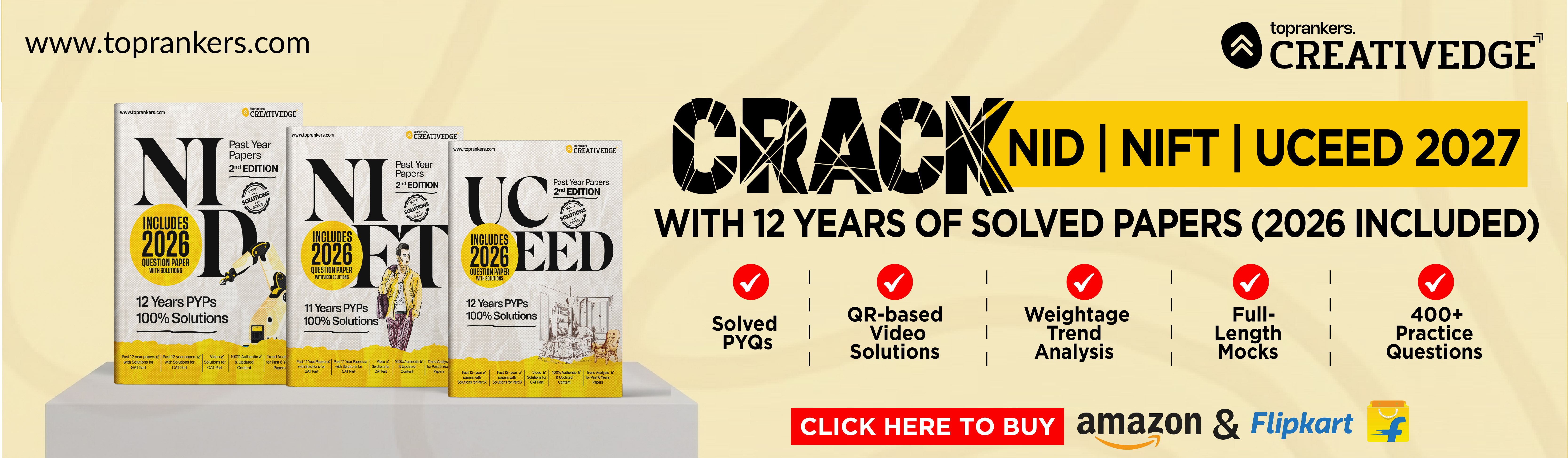
For fully solved NIFT last 10 years question papers with QR-based video solutions of all CAT questions, get yourself the best-selling NIFT Previous Year Papers Book by CreativEdge (Available on Amazon & Flipkart)
CAT is only half the exam - keep your GAT sharp too, including NIFT maths questions.
NIFT CAT Question Paper PDFs – M.Des
Download M.Des previous year NIFT CAT question papers along with the NIFT CAT answer key & solutions to understand expected drawing approaches, evaluation criteria, and scoring patterns. These PDFs help aspirants analyze their performance and refine their execution strategy for higher scores.
| Year | Download Link |
|---|---|
| NIFT CAT 2025 Question Paper - M.Des | |
| NIFT CAT 2024 Question Paper – M.Des | |
| NIFT CAT 2023 Question Paper – M.Des | |
| NIFT CAT 2022 Question Paper – M.Des | |
| NIFT CAT 2021 Question Paper – M.Des |
How to Use These NIFT CAT Solved Question Papers Effectively
- Attempt the question paper in timed conditions before viewing the solution.
- Compare your layout planning, proportions, perspective accuracy, and creativity with the model solution.
- Identify gaps in concept clarity, drawing speed, and visual storytelling.
- Redraw the solution using improved techniques to strengthen muscle memory.
- Track progress across multiple years to observe improvement trends.
Downloading and practicing NIFT CAT papers with solution PDFs consistently is one of the fastest ways to improve CAT performance and creative confidence.
Benchmark your target with the expected NIFT cut-off.
Frequently Repeated Topics in NIFT CAT Question Paper 2027
| Topic Area | Frequency in Past Papers | Typical Question Type |
|---|---|---|
| Perspective Drawing | Very High | Indoor or outdoor scene creation |
| Composition and Layout | High | Visual storytelling using shapes |
| Product Sketching | High | Object rendering and proportion |
| Human Figures | Medium | Gesture and posture drawing |
| Light and Shadow | Medium | Depth and realism enhancement |
| Material Representation | Medium | Texture rendering |
| Visual Problem Solving | Medium | Design thinking scenarios |
| Theme-Based Storyboards | Low–Medium | Narrative illustration |
Use this frequency map to prioritize practice - the "Very High" and "High" areas (perspective, composition, product sketching) appear in almost every CAT paper, so master those first before spending time on the lower‑frequency themes.
Short on time? Our 6‑month NIFT plan shows how to fit CAT practice around GAT.
NIFT CAT Question Paper 2027 Important Topics
| Design Theory | Colour Terminology | Inspiration & Design Development |
| Colour Psychology | Elements & Principles of Design | Mood, Theme & Colour Inter-relationship |
| Natural & Geometrical Form | Innovation in Design | Principles of Composition |
| Creative Thinking & Writing | Optical Illusion | Understanding Light & Shade |
| Visual Logic | Form & Function | Colour, Pattern & Texture |
| Theme Development | Drawing Fundamentals | Picture Analysis |
| Memory Drawing | Ornaments & Motifs | Scale & Proportion |
| Foreshortening & Perspective | 3D Visualization | Presentation Techniques |
| Expression & Emotion | Lateral Thinking | Story Pictures |
| Graphics & Pictograms | Imagination & Doodling | Design Awareness |
Map your prep to the full NIFT syllabus and important topics.
NIFT CAT Sample Question Paper for 2027 Prep
The following are some important questions curated from the previous year's NIFT Question Papers.
Q1. Visualize and draw any of the following as they would be in the year 2050. Colour the product using dry colours.
- Umbrella
- Door Lock
- Lunch box
Q2. Using the following shapes, that is, Circle, rectangle, Hexagon, Teardrop, or triangle, compose any one of the following: (a) Personal Computer, (b) Wind Chime, (c) Letter Box". Accompany it with a write-up of 100 words.
Q3. Depict the process on any one of the following in four frames.
- Budding & blooming of the Rose flower
- A Shirt on a clothing line from wet to dry
- A bird taking flight from ground to sky
Q4. Show one of the following procedures in four steps:
- Placing a bulb on a holder.
- A paper folding into a boat.
Q5. Design and illustrate in colour with details, a bag for yourself for any one of the given topics:
- Wedding
- Picnic
- Shopping
Q6. Depict your personality through a geometric shape in colour.
Q7. Draw any one of the following scenes:
- The view of the traffic signal from inside the car.
- A street play being organised
- A community festival celebration
Q8. Illustrate in colour a print on a T-shirt based on any one of the following themes:
- Music is the soul of life
- Save future wildlife
- Dignity to aged
Q9. Express the contrast between the given pair of words through two separate visuals in given boxes. Out of the given three, one was to be attempted:
- Balanced/ Unbalanced
- Crispy/ Soggy
- Cluttered/ Uncluttered
Q10. Design a mascot for any one of the following topics:
- Keep city clean
- Pulse polio
- India against Corruption
Q11. Attempt any one of the options:
- Within the frames show "The landing of an aircraft."
- Draw landscapes of Spring, summer, autumn and winter. Colour suitably.
Q12. Design a creative poster for any of the following and write a suitable tagline
- Bookshop
- Cybershop
- Fruit shop
Also appearing for NID? The drawing tests differ - see NID vs NIFT.
What Separates a High-Scoring NIFT CAT Answer
Across top CAT sheets, the same habits show up again - and almost none of them are about raw drawing talent. If you can do these five things, you're already ahead of most candidates:
1. Answer the brief, not just the subject
If the task names a user (a street vendor, an elderly person, a child), your design must visibly solve their problem - that's where marks are won or lost.
2. Plan before you draw
Spend the first few minutes on a quick thumbnail layout. A planned composition beats a beautifully rendered but cluttered one every time.
3. Show the idea in use
A product drawn in context - with a human figure, an action, an environment - communicates far more than the same object floating on a blank page.
4. Use color with intent
Highlight the key element and leave the rest restrained. Flooding the sheet with colour reads as decoration, not design thinking.
5. Finish cleanly
Neat linework, clear labels and a complete sheet signal control. An unfinished answer, however creative, loses easy marks.
CAT rewards clear thinking communicated clearly - a skill you build through timed practice with real papers, which is exactly what the solved sets above are for.
NIFT CAT 2027 Exam Preparation Tips
1. Master the fundamentals from the NIFT syllabus first - perspective, proportion, and light‑and‑shade - most marks are lost here, not on creativity.
2. Read the brief twice and underline constraints (user, age group, environment, function) before you draw.
3. Plan a quick thumbnail layout before the final sketch - composition and visual hierarchy carry real weight.
4. Build speed under the clock: solve full past CAT papers in 3‑hour timed sessions. These are great tools for preparing for the NIFT CAT 2027.
5. Use a limited color palette and color with intent - highlight the key element, don't flood the sheet.
6. Add minimal human figures, action cues and context when the task is scenario‑based - storytelling scores.
7. Label neatly with clean arrows and short annotations so the evaluator reads your intent instantly.
8. Keep a sketchbook habit - observe everyday objects and redraw them; this is what separates fast, confident CAT answers from hesitant ones.
Common Mistakes Students Make in NIFT CAT Question Paper
Even strong drawing students lose marks in NIFT CAT not because of poor creativity, but due to avoidable execution and exam-strategy mistakes. Understanding these mistakes early helps aspirants score higher and avoid unnecessary mark loss.
1. Poor Time Management
Many students spend too much time perfecting one part of the drawing and rush the rest of the answer. This leads to incomplete layouts, weak detailing, or unfinished coloring.
How to fix:
Practice solving CAT questions within strict time limits using previous year papers and timed mock tests.
2. Ignoring the Question Brief
A common mistake is focusing on aesthetics while missing key instructions such as user age group, environment, functional requirement, or constraints mentioned in the question.
How to fix:
Underline key requirements before sketching and ensure every visual element supports the problem statement.
3. Weak Perspective and Proportion
Incorrect perspective, distorted furniture sizes, or unrealistic human proportions reduce visual clarity and professionalism.
How to fix:
Regularly practice basic perspective grids, object scaling, and human proportions from solved examples.
4. Overcrowded or Cluttered Layouts
Students often try to show too many ideas in one sheet, resulting in cluttered visuals and poor readability.
How to fix:
Maintain clean composition, proper spacing, and clear visual hierarchy.
5. Lack of Concept Clarity
Some drawings look technically good but fail to communicate a clear idea, story, or problem solution.
How to fix:
Always start with a quick concept plan and ensure your drawing visually explains your solution.
6. Poor Labeling and Annotations
Missing labels, unclear arrows, or messy handwriting makes it difficult for evaluators to understand the design intent.
How to fix:
Use neat labeling, consistent arrow styles, and concise annotations.
7. Overuse or Misuse of Colors
Excessive coloring or incorrect color combinations distract from the concept and reduce visual balance.
How to fix:
Use limited color palettes and highlight only key elements.
8. Ignoring User Comfort and Functionality
Designs sometimes look creative but ignore ergonomics, usability, safety, or accessibility.
How to fix:
Always design from the user’s perspective and justify functionality visually.
9. Incomplete Storytelling
When the question demands scenario-based visualization, students fail to show interaction, context, or emotion.
How to fix:
Include minimal human figures, action cues, and environment details to strengthen storytelling.
10. Lack of Practice with Real Question Papers
Many aspirants rely only on coaching worksheets or random sketches and never practice full CAT papers.
How to fix:
Solve actual NIFT CAT question papers with solutions under timed conditions.
Build these skills with a disciplined practice schedule with our NIFT study plan so CAT practice sits alongside your GAT prep rather than competing with it.
From CAT to the Situation Test: What Comes Next (B.Des)
For B.Des aspirants, the CAT isn't the finish line - it's the gateway to Stage 2, the Situation Test. A strong CAT score shortlists you for this hands-on, in-person round, so the two are worth preparing together.
The Situation Test is a model-making exercise scored out of 100, where you build a 3D model from given materials and write a short concept note:
| Component | What You Do | Marks |
|---|---|---|
| 3D Model | Build a model from the supplied materials - judged on visualization, creative use of material, composition and construction finesse | 50 |
| Write-up | Explain your concept clearly in English | 20 |
| Overall Presentation | The overall finish and presentation of your model | 30 |
| Total | 100 |
The skills CAT builds - visualizing a concept, composing it clearly, and communicating an idea fast - are the same skills the Situation Test rewards in three dimensions. So your CAT practice does double duty. Build the habit of planning a concept before you execute, and you'll walk into both rounds prepared.
Practise with our NIFT Situation Test models once you're through CAT.
NOTE: M.Des aspirants follow a different Stage 2 - after CAT, you appear for a Personal Interview (PI) instead of the Situation Test, so prep a tight portfolio and be ready to talk through your design thinking.
Key Takeaways
- The NIFT CAT primarily assesses a candidate's creative potential and design aptitude.
- The exam emphasizes drawing, observation, colour sense, and composition skills.
- Candidates are evaluated on their ability to think creatively and develop innovative solutions.
- Additionally, practicing with the NIFT CAT question paper will help you familiarize yourself with the exam format and the types of questions asked
Preparing for NIFT 2027? We can help you with exact strategic roadmap, study material and crucial feedback required to ace this exam.
Join best NIFT Online Coaching by Creative Edge and get expert guidance on all NIFT subjects.



Attempt a Free NIFT Mock Test
Fill your details
Frequently Asked Questions
Where can I download the NIFT CAT question paper with solutions 2027?

Are the NIFT CAT 2027 solutions officially released by NIFT?
How accurate are these NIFT CAT solved answers?
Are previous year NIFT CAT question papers with solutions included?
How should I use solved NIFT CAT papers for effective 2027 exam preparation?
Are these NIFT CAT solutions useful for beginners?

Vineeta Agrawal
Communications Executive
SHARE