


NIFT Previous Year Question Papers (NIFT PYQ) PDF Download (2012–2026)
October 25, 2026
You can download NIFT previous year question papers (2012-2026) for B.Des (GAT + CAT), M.Des, M.F.M and M.F.Tech, with GAT answer keys, free on this page.
GAT is objective with +1/−0.25 marking; CAT is a 3‑hour drawing test with no negative marking and no answer key. NIFT also publishes programme‑wise sample papers in the current NIFTEE format on its official site.
The 2027 paper will be added here right after the exam on 10 January 2027.
LIVE Update on NIFT 2027 Exam (as of Oct 2026):
As per the NTA 2027 examination calendar, the NIFT (NIFTEE) 2027 entrance exam is scheduled for 10 January 2027. The registrations are open from 16th October to 16th November 2026.
Download Year-wise NIFT Question Papers PDFs with Solutions for UG (B.Des)
Practicing NIFT previous year question papers for UG (B.Des) is one of the most effective ways to understand the actual exam pattern, difficulty level, and question trends of the NIFT entrance exam. These papers give aspirants a clear picture of what NIFT really tests, beyond what is mentioned in the NIFT syllabus.
By solving previous year NIFT question papers, aspirants can:
- Identify repeated question types and themes
- Judge the speed and accuracy required to crack NIFT GAT
- Judge the level of creativity expected in CAT
- Improve time management
- Reduce exam-day surprises
Get Year-wise NIFT PYQ PDFs (UG + PG) Free Download
| NIFT PYQs | GAT Question Paper Download Link | CAT Question Paper Download Link | NIFT Question Papers Difficulty Level |
| NIFT 2027 Question Paper with Answer Key | Available here after the exam - bookmark this page | Memory‑based CAT set added after the exam | To be updated post‑exam |
| NIFT 2026 Question Paper with Answer Key | Moderate (students found paper lengthy) | ||
| NIFT 2025 Question Paper with Answer Key | Moderate (students found paper lengthy) | ||
| NIFT 2024 Question Paper with Answers | Moderate (GK weightage increased to 25 marks from 15 marks in 2023) | ||
| NIFT 2023 Question Paper with Solutions | Moderate to tough (required strong time management) | ||
| NIFT 2022 Question Paper with Solutions | Moderate (required strong time management) | ||
| NIFT 2021 Question Paper PDF with Answers | Moderate to Easy (required strong time management) | ||
| NIFT 2020 Question Paper B.Des with Answers | Moderate Overall | ||
| NIFT 2019 Question Paper with Solutions | Moderate (students found it slightly lengthy & tricky) | ||
| NIFT 2018 Question Paper with Solutions (GAT + CAT) | Moderate (but lengthy) | ||
| NIFT 2017 Question Paper with Solutions | Moderate to tough (required strong time management) | ||
| NIFT 2016 Question Paper with Solutions | Questions aimed to test creativity & design ability | ||
| NIFT 2015 Question Paper | Download NIFT 2015 CAT Paper PDF | Questions aimed to test creativity & design ability | |
| NIFT 2014 Question Paper | Download NIFT 2014 CAT Paper PDF | Questions aimed to test creativity & design ability | |
| NIFT 2013 Question Paper | Download NIFT 2013 CAT Paper PDF | Questions aimed to test creativity & design ability | |
| NIFT 2012 Question Paper | Download NIFT 2012 CAT Paper PDF | Questions aimed to test creativity & design ability |
The NIFT 2027 question paper will be added here right after the exam on 10 January 2027, along with a memory‑based GAT answer key. Until then, the 2024-2026 papers are your closest benchmark for pattern and difficulty.
NOTE:
- The answer keys are available at the end of each question paper PDF
- Only GAT answers are included in the answer key
- For detail solutions of GAT papers and solutions of CAT papers, get yourself the NIFT Previous Year Papers Book by Creative Edge (includes QR-based video solutions of each CAT question).
Looking for practice papers instead of real past papers?
If you want exam-level practice sets built to mirror the current NIFTEE pattern (rather than actual past-year exams), use our dedicated NIFT sample papers page.
Table of Contents
- NIFT Previous Year Papers Year-wise Download Links - for B.Des
- NIFT Past Year Papers for PG
- Is NIFT Now "NIFTEE" (NTA)?
- Understanding NIFT Exam Structure (Program-wise)
- Questions from NIFT Previous Year Question Papers
- NIFT Papers - Year-Wise Trend Analysis
- How to Download the NIFT Question Papers PDFs
- Best Way to Solve NIFT Question Papers
- Ideal Time Strategy While Solving NIFT GAT Paper
- Ideal Time Strategy While Solving NIFT CAT Paper
Download NIFT Previous Year Question Papers with Solutions PDF for PG (M.Des, MFM, M.FTech)
For serious aspirants, NIFT previous year question papers for PG (M.Des) are not just practice material, they are a direct insight into NIFT’s expectations from postgraduate designers. Consistent analysis of these papers can significantly improve performance in the written exam, interview, and overall selection process.
| NIFT PYQs PDF | Download Link |
| NIFT M.Des 2024 Question Paper | |
| NIFT M.Des 2018 Question Paper | |
| NIFT MFM 2024 Question Paper | |
| NIFT M.FTech |
PG aspirants should confirm they meet the NIFT eligibility criteria before building a paper‑practice plan.
How to Download the NIFT Previous Year Question Papers PDF
The easiest and most aspirant-friendly way to access NIFT previous year question papers PDF is by clicking the links corresponding to year-wise papers in the section above.
- Papers are arranged year-wise and exam-wise (UG & PG)
- Includes expert guidance on how to approach questions, not just PDFs
- Saves time by eliminating the need to search across multiple pages
- Ideal for aspirants who want practice + strategy together
Is NIFT Now "NIFTEE" (NTA)? Which Past Papers Reflect the Current Format
Yes. From the 2024 admission cycle, the NIFT entrance exam is conducted by the National Testing Agency (NTA) under the official name NIFTEE (NIFT Entrance Examination).
Registration, admit cards, the answer-key objection window and results now run through NTA's portal (exams.nta.nic.in/niftee) rather than through NIFT alone.
The exam structure itself - GAT + CAT - has stayed largely the same, so older papers are still useful; what changed is who runs it and where you access it.
For NIFTEE 2026, NTA conducted the exam on 8 February 2026, released the provisional GAT answer key on 17 February 2026, and declared the Stage 1 written result on 20 March 2026. This matters when you choose which past papers to practice from:
| Paper set | Conducted by | Use it for |
|---|---|---|
| 2024-2026 papers | NTA / NIFTEE format | Your primary benchmark - closest to the current 2027 pattern, difficulty and marking |
| 2022-2023 papers | NIFT (pre-NTA) | Good for question types and section practice |
| 2016-2021 papers | NIFT (pre-NTA) | Useful for recognizing recurring themes; treat format as indicative only |
What NIFT officially publishes (from nift.ac.in/sample-question-paper)?
Program‑wise current‑format papers - B.Des (GAT), B.Des CAT, B.F.T, M.Des (GAT), M.Des CAT, M.F.M, M.F.T - plus year‑wise papers for 2012, 2013, 2014, 2015, 2022, 2023, 2024, 2025 (2025 via nta.ac.in), and Ph.D papers 2021-2024.
Note the official set skips 2016–2021 - those years on our page are compiled/memory‑based.
What's Actually Inside a NIFT Paper? (Structure by Program)
1. Creative Ability Test (CAT):
As per the NIFT Exam Pattern, CAT is the first stage of the selection process for B.Des and M.Des courses. It include drawing and design related questions like:
- scene creation & perspective drawing
- sequential drawing
- storyboarding or comic strip
- product design & innovation
- unconventional use of everyday objects & illustration
- poster making
- 2D composition
- pattern making and color theory
2. General Ability Test (GAT):
GAT is a compulsory paper for all 5 disciplines at NIFT - B.Des, B.FTech, M.Des, M.F.M, M.FTech.
You can expect around 100-150 questions in GAT. The general aptitude test mainly has 4 sections - Quantitative Aptitude, Communication Ability / English, Analytical & Logical Reasoning, GK / Current affairs. For details on exact topics asked in each, check out the complete section-wise NIFT GAT syllabus here.
NIFT GAT and CAT Distribution (Program-wise):
NIFT isn't one universal paper- the question count, duration and whether CAT applies all change by program. Here's what you'll find when you download a paper for your course, so you're practicing the right structure from day one.
| Program | GAT questions | GAT duration | CAT required? | Negative marking (GAT) |
|---|---|---|---|---|
| B.Des | 100 | 120 min | Yes | −0.25 per wrong answer |
| M.Des | 120 | 120 min | Yes | −0.25 per wrong answer |
| B.FTech | 150 | 180 min | No | −0.25 per wrong answer |
| M.F.M | 150 | 180 min | No | −0.25 per wrong answer |
| M.FTech | 150 | 180 min | No | −0.25 per wrong answer |
NIFT also hosts program‑wise sample papers in the current NIFTEE format on its official site - the best reference for what the 2027 paper will look like. Access them on the official NIFT sample question paper page.
A few things to know before you attempt a paper:
- GAT is common to every program and is a computer-based objective test covering Quantitative Ability, Communication Ability & English Comprehension, Analytical & Logical Ability, and General Knowledge & Current Affairs.
- CAT is only for B.Des and M.Des. It's a 3-hour, offline (pen-and-paper) design test - subjective, marked holistically, with no negative marking and no answer key.
- Negative marking applies to GAT across all programs (including B.Des): +1 for a correct answer, −0.25 for a wrong one, and 0 for un-attempted. That single rule should shape how aggressively you guess when you practice a past paper.
Actual Questions from NIFT Previous Year Question Papers
Q) Fill in the blank in the given sentence using the most appropriate modal from the options given below. "It's going to be grander than the Great Gatsby's Party. Oh, I insist, you _________ come."
(a) Would (b) might (c) must (d) need
Ans: C
Q) What type of lines adds softness and roundness to a garment?
(a) Horizontal (b) Vertical (c) Curved (d) Diagonal
Ans: C
Q) Identify the pattern in the following sequence and choose the correct figure from the options below which follows the given sequence.
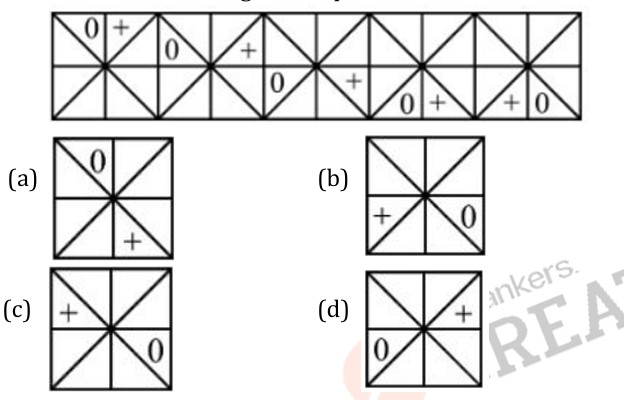
Ans: B
Q) How many Rajya Sabha members are nominated by the President of India?
(a) 15 (b) 18 (c) 20 (d) 12
Ans: D
Q) Choose the most appropriate water image of the given object ( x ) from the following alternatives:
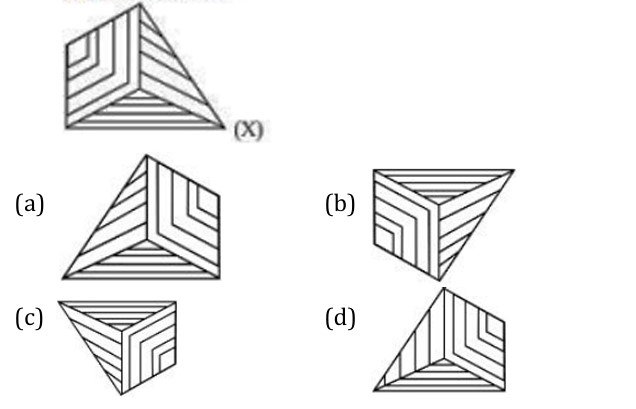
Ans: B
Q) The compound interest on ₹ 5,000 at 10% per annum for __________ (in years) is ₹ 1655 .
(a) 2.5 (b) 4 (c) 3.5 (d) 3
Ans: D
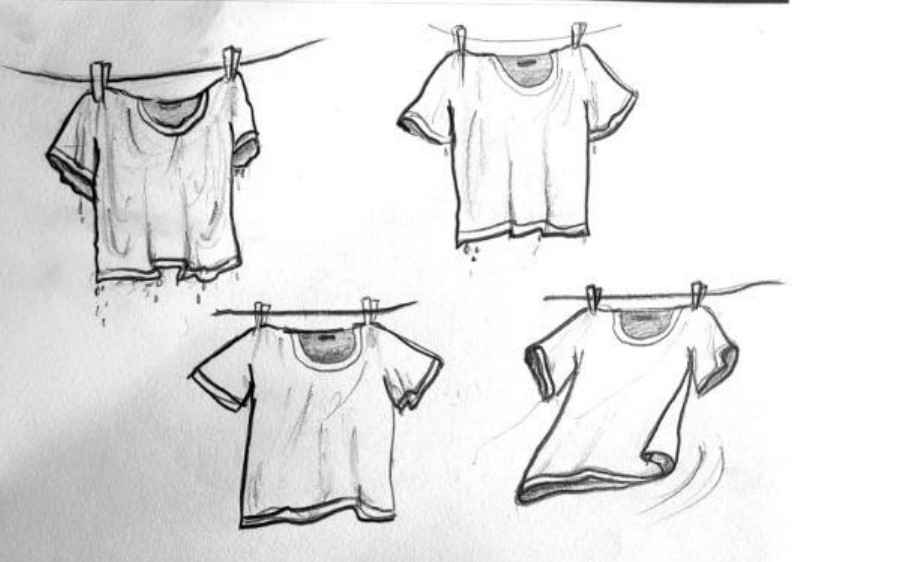
Q) Show the process in 4 different steps. Drying a t-shirt on clothesline –wet to dry.
Solution:
NIFT Previous Year Question Papers - Year-Wise Trend Analysis
Downloading the papers is step one; knowing how they've changed is what turns them into a strategy. Here's how the NIFT papers (for B.Des) have trended year on year, based on our post-exam analysis:
| NIFT Exam Year | CAT Section Trend | GAT Section Trend | GK & Current Affairs Trend | Key Takeaways for Aspirants |
|---|---|---|---|---|
| NIFT 2026 (NTA/NIFTEE) |
Application-led design prompts; usability & real-world themes | Lengthy paper; speed was the deciding factor | Fashion, sustainability & design-led current affairs | Time management mattered more than raw knowledge |
| NIFT 2025 (NTA/NIFTEE) |
High focus user-centric design problems | Students found quant section tricky | Heavy emphasis on fashion industry & contemporary issues | Speed was crucial in GAT. |
| NIFT 2024 | Strong emphasis on product usability, daily life scenarios & creativity under time pressure | Logical reasoning dominant | Current affairs leaned towards fashion, sustainability & design trends | Speed + idea clarity were crucial |
| NIFT 2023 | Concept-driven CAT questions | Unusually lengthy | Static GK more prominent | Well-rounded preparation worked best |
| NIFT 2022 | Practical problem-solving and sketching fundamentals | GAT easier compared to later years | Limited current affairs, more static GK | Scoring year for well-prepared students |
| NIFT 2021 | Observation-heavy CAT with emphasis on idea development | Logical reasoning was slightly tricky | General awareness leaned towards static topics | Conceptual clarity outweighed artistic finesse |
| NIFT 2020 | Traditional CAT questions with straightforward creativity | GAT comparatively simpler | GK weightage relatively low | Basic preparation was sufficient |
| NIFT 2019 & Earlier | Conventional drawing-based CAT questions | GAT predictable and syllabus-centric | Mostly static GK | Pattern stability, less unpredictability |
Key Insights from NIFT Previous Year Question Papers:
- CAT has shifted from pure drawing skills → design thinking, creative expression and storytelling.
- GK questions now demand awareness of fashion, design & current affairs
- GAT difficulty has increased gradually, especially logical reasoning
- Time pressure is becoming a major deciding factor every year
These shifts are easier to see in our full NIFT year‑wise exam analysis, which breaks down each paper section by section.

What is the Best Way to Solve NIFT Question Papers
Solving NIFT PYQs is a crucial step in your preparation journey. It not only familiarizes you with the exam pattern and question types but also helps you identify your strengths and weaknesses. Here's a strategic approach to effectively utilize these papers:
1. Understand the Exam Pattern
Before attempting any NIFT PYQ, thoroughly understand the NIFT exam pattern, including the number of sections, marking scheme, and time duration for each section. This will help you simulate the actual exam environment.
2. Start with a Using NIFT Previous Year Papers as a Mock
Treat your first attempt at a previous year paper as a full-length mock test. Sit in a quiet environment, set a timer, and try to complete the paper within the stipulated time. This will give you a realistic assessment of your current preparation level.
3. Analyze Your Performance
Once you've completed the NIFT PYQ paper, don't just check the answers. Go through each question, especially the ones you got wrong or struggled with. Understand why your answer was incorrect and what the correct approach should have been.
4. Identify Weak Areas
Pay close attention to the topics or question types where you consistently make mistakes. These are your weak areas that require more focused study and practice.
5. Review Concepts
After identifying your weak areas, revisit the relevant study material and concepts. Strengthen your understanding of these topics before attempting another paper.
6. Practice Time Management
As you practice more papers, consciously work on improving your time management skills. Learn to allocate appropriate time to each section and question, ensuring you don't get stuck on a single difficult problem.
7. Focus on Creative Ability Test (CAT) and General Ability Test (GAT)
NIFT papers comprise both CAT and GAT sections. For CAT, practice sketching, design concepts, and color theory. For GAT, focus on quantitative ability, communication ability, English comprehension, analytical ability, and general knowledge.
8. Regular Revision
Regularly revise the concepts and problem-solving techniques you've learned. Consistent practice and revision are key to retaining information and improving your performance.
9. Stay Updated
Keep yourself updated with current affairs and general knowledge, especially for the GAT section.
By diligently following these steps and consistently practicing with NIFT previous year question papers, you can significantly enhance your preparation and boost your confidence for the NIFT entrance exam. Start your preparation today by downloading the NIFT PYQ papers available on TopRankers and take a significant step towards achieving your dream of studying at NIFT!
Pair your paper practice with the right NIFT preparation books so your revision and practice reinforce each other.
Ideal Time Strategy While Solving NIFT Question Papers - GAT
NIFT GAT papers are different depending on the program. For example- NIFT B.Des & M.Des have GAT paper of 2 hours, while B.FTech, M.FTech & MFM, have 3 hours GAT papers.
Here's how you should ideally allot time for the 3-hour GAT section while solving NIFT question papers:
| Section | Ideal Time | Strategy |
|---|---|---|
| English Comprehension | 20 - 25 mins | Speed-based, accuracy matters |
| Logical Reasoning | 30 - 35 mins | High-weight section, give priority |
| Quantitative Ability | 35 - 40 mins | Avoid time traps |
| General Knowledge & Current Affairs | 15 - 20 mins | Attempt only known questions |
| Analytical Ability | 30 - 35 mins | Use elimination & visual logic |
| Review & Buffer | 15 - 20 mins | Crucial for score improvement |
Best Attempt Order:
English → GK → Logical → Analytical → Quant → Review
For the 2‑hour GAT:
- (B.Des, M.Des) - English 12-15 min
- Analytical & Logical 30-35 min
- Quantitative 30-35 min
- GK & Current Affairs 10-12 min
- Review 10-12 min.
Knowing the expected NIFT 2027 cut‑off tells you what score your paper practice should be aiming at.
Ideal Time Allocation Strategy While Solving NIFT Question Papers - CAT
Both B.Des and M.Des have 3 hours of CAT papers in NIFT exam.
Ideal CAT Time Allocation Strategy:
| CAT Stage | Ideal Time | What to Do |
|---|---|---|
| Question Reading & Planning | 15 - 20 mins | Understand theme, plan layout |
| Ideation & Rough Sketching | 35 - 45 mins | Develop strong concepts |
| Final Drawing & Composition | 80 - 90 mins | Clean execution & detailing |
| Colouring / Shading | 25 - 30 mins | Enhance presentation |
| Final Review & Refinement | 10 - 15 mins | Fix proportions & clarity |
For CAT, rehearse with our NIFT drawing questions to build speed on common prompt types.
Conclusion
Incorporating NIFT previous year question papers into your prep strategy is an invaluable tool. By familiarizing yourself with the question format, difficulty level, and recurring themes, you can significantly enhance your speed, accuracy, and confidence on exam day.
Remember, these NIFT last year question papers are a stepping stone, not a crutch. Pair your practice with a strong understanding of the syllabus, a well-rounded portfolio, and awareness of how many students appear for NIFT to solidify your chances of securing a coveted seat.
Preparing for NIFT 2027 or 2028? Creative Edge trains the GAT and CAT as the two separate skills they are - timed objective practice for the GAT, and mentor-reviewed idea-and-composition work for the CAT. Explore NIFT coaching by Creative Edge.



Attempt a Free NIFT Mock Test
Fill your details
Frequently Asked Questions
Can I get previous year NIFT Question papers?

Where can I find previous year NIFT Question Papers with solutions?
What are NIFT previous year question papers?
Is the question paper of NIFT same for UG and PG exam?
Are solutions provided for NIFT past papers?

Vineeta Agrawal
Communications Executive
SHARE