
1723534562.png)

UCEED Drawing Questions: Solved Part B Practice for 2027 + PDF Download
September 1, 2026
UCEED (conducted by IIT Bombay) has two parts. Part A is a 200-mark computer-based test with 57 questions across three sections (NAT, MSQ, MCQ). While, Part B is a 100-mark, one-hour, pen-and-paper section with two subjective questions - a Drawing question (50 marks) and a Design Aptitude question (50 marks).
UCEED drawing questions typically involve sketching scenes, products, human figures, or design solutions based on real-life situations, as per official UCEED syllabus. They evaluate your visualization, perspective, composition, storytelling and design thinking skills - not just clean / perfect drawing.
Questions appear on screen and you draw in the answer book provided to you. There is no negative marking, and your Part B is evaluated only if you clear the Part A cutoff, so your preparation strategy should balance both.
Key Highlights: UCEED Drawing Questions 2027
- UCEED drawing questions are asked in Part B of the exam and focus on creativity and visual communication.
- Common question types include:
- Perspective drawing
- Scene composition
- Product design sketching
- Human figure drawing
- Visual storytelling
- Situation-based sketching
- Evaluation is based on:
- Idea clarity
- Composition
- Perspective
- Proportion
- Creativity
- Scenario-based drawing questions test design thinking and problem-solving ability, not just sketching skills.
- Practicing timed drawing tasks is important because time management plays a major role in UCEED exam Part B performance.
- Solving UCEED drawing questions with expert solutions helps students understand the approach, composition flow, and presentation style expected by examiners.
Product design questions, which are key UCEED subjects, require you to consider functionality and user experience, while the scenario-based UCEED sketching questions demand due focus on spatial reasoning, observation skills, and visual storytelling.
Please note that time management is equally crucial while tackling UCEED drawing questions (part B of the exam). Follow along and check out the UCEED part b questions and tips for your preparation.
What are UCEED Drawing Questions 2027?
UCEED drawing questions fall under the Part B section of the exam, where instead of answering MCQ questions on a computer, you sketch by hand on a booklet. The problem appears on screen and you draw on paper using pencils. There are no specific 'right' answers, these are subjective in nature and have no negative marking.
Part B (100 marks) includes 2 drawing questions of 50 marks each, as per the latest official exam structure. One is a scene creation or perspective drawing question and the other evaluates design aptitude (usually product design / redesign or user centric problem-solving).
One thing worth knowing- your Part B answer book is only evaluated if you clear the Part A cutoff first.
UCEED drawing test goes beyond perfect lines and shading. Here's what the evaluators are looking for:
- Observation Skills: Such UCEED part b questions check if you can capture the essence of an object or scene? And how well do you translate proportions and spatial relationships?
- Composition: How do you arrange elements on the page? Does your drawing have a sense of balance and flow?
- Creativity and Interpretation: Do you uniquely approach the prompt? Can you demonstrate your visual thinking process?
- Communication Skills: Does your drawing effectively communicate the idea or message?
UCEED Part B Exam Structure:
|
Part B question |
Marks |
Time |
What it tests |
|
Drawing question |
50 |
~30 min (of the 60) |
Scenes, objects, people in proportion - line quality, composition, perspective, shading |
|
Design Aptitude question |
50 |
~30 min (of the 60) |
User-centred problem-solving - ideation, functionality, annotation |
|
Part B total |
100 |
1 hour |
Subjective; drawn in the answer booklet; no negative marking |
For the complete Part A + Part B breakdown, see the full UCEED exam pattern.
This structure follows the latest official UCEED pattern (2026). IIT Bombay confirms the exact 2027 pattern and marks in its information brochure, expected around October 2026 at uceed.iitb.ac.in. The exam date has been announced though - 17th January 2027.

Types of UCEED Drawing Questions (Part B)
UCEED Part-B consists of TWO questions to test the candidates’ drawing skills and design aptitude.
1. Scene Creation / Perspective Drawing
UCEED Part B questions on scene creation ask candidates to visually represent a situation, environment, or narrative based on a given prompt. These questions focus on observation, storytelling, and spatial understanding rather than design innovation.
What Scene Creation UCEED Drawing Questions Tests?
- Perspective and proportion
- Human figures and interactions
- Environment detailing and spatial depth
- Visual storytelling and clarity
- Observation and contextual awareness
Common UCEED Drawing Questions on Scene Creation:
- Drawing an indoor or outdoor environment
- Depicting people interacting in a situation
- Illustrating a moment, activity, or event
- Showing depth using one-point or two-point perspective
How to Score Well in UCEED Perspective Drawing Questions:
- Establish perspective early
- Place key elements first, then add details
- Keep human figures simple but expressive
- Focus on clarity over artistic detailing
Because Part B is only evaluated after you clear the Part A cutoff, it helps to know the UCEED marks you need to qualify before you plan your drawing prep."
2. Design Problem-Solving or Design Aptitude
Design problem-solving questions require candidates to think like a designer and solve a user-centric problem visually. These questions test ideation, functionality, and design logic, not artistic skill.
What Design Problem-Solving Tests
- Understanding of user needs
- Ability to generate functional solutions
- Design thinking and innovation
- Visual explanation of ideas
- Clarity of concept and relevance
Common UCEED Drawing Questions on Design Aptitude
- Redesigning or improving an existing product
- Designing a solution for a specific user group
- Visualising multiple uses of an object
- Showing concept through sketches and annotations
How to Score Well in Design Problem-Solving Questions in UCEED
- Clearly identify the problem before drawing
- Show functionality through simple diagrams
- Use multiple views if needed
- Add minimal, clear annotations to explain intent
If ideation is your weakness, the free design-thinking demo class shows how toppers move from identifying a user problem to coming up with a labelled solution in minutes.
Key Difference at a Glance:
|
Aspect |
Scene Creation |
Design Problem-Solving |
|
Core focus |
Observation & storytelling |
Functionality & logic |
|
Creativity type |
Visual imagination |
Conceptual innovation |
|
Drawing style |
Perspective-based scenes |
Diagrammatic & explanatory |
|
Evaluation priority |
Clarity and relevance |
Idea quality and usefulness |
Want to see which of these two question types dominated recent papers? Our UCEED exam analysis breaks down the section trends and their difficulty level year by year.
How Examiners Evaluate UCEED Drawing Questions? (What Matters Most)
Before you start preparing with UCEED drawing test practice questions, its important to understand what examiners look for in both UCEED drawing questions:
1. Idea & Relevance- Does the drawing answer the prompt and constraints?
2. Composition & Readability- Clear focal point, balanced layout, proper scale.
3. Perspective & Proportion- Believable spatial relationships and human scale.
4. Functionality & Usability (Design Aptitude)- Ergonomics, feasibility, user scenario.
5. Creativity & Appropriateness- Original yet practical solutions.
6. Annotations & Labels- Short notes that explain intent/usage.
7. Finish & Neatness- Clean lines, legible labels, controlled shading/hatching.
Understanding the evaluation criteria can help you score better, but it's equally important to know what is a good score in UCEED and where you stand.
How UCEED Part B Is Scored (Tentative Weightage Distribution)
There's no answer key, but evaluators consistently reward the same things. Use this as a self-scoring checklist after every practice attempt:
|
What examiners weigh |
Roughly how much it matters |
What "good" looks like |
|
Idea & relevance to the prompt |
High |
You answered exactly what was asked, with all listed elements present |
|
Composition & readability |
High |
Clear focal point, balanced layout, correct scale and proportion of each element, proper light & shadows |
|
Perspective & proportion |
High |
Believable 1 or 2 point perspective; human scale looks right |
|
Functionality (design-aptitude Q) |
High |
The solution actually works for the stated user |
|
Creativity & appropriateness |
Medium |
Original but practical |
|
Annotations & labels |
Medium |
Short notes explaining intent, especially on the design question |
|
Finish & neatness |
Medium |
Confident lines, minimal erasing, controlled shading |
NOTE: Weightings are indicative (IIT Bombay doesn't publish per criterion marks); they reflect what repeatedly separates high-scoring Part B answers from average ones.
How to Prepare for UCEED Part B Drawing Questions 2027
- Practice Regularly: Sharpen your drawing skills by sketching regularly. Experiment with different mediums like pencils, charcoal, or even ink. We suggest you go through past year papers and solve UCEED drawing questions from part b and seek feedback on them. You can also create your own prompts similar to questions asked in UCEED previous year papers for your practice sessions.
- Develop Observational Skills: To crack UCEED sketching questions most efficiently, intentionally try to train your eyes to observe details, in everyday objects, natural environments, or even bustling city streets.
- Practice Composition: While solving UCEED 2027 drawing questions play with arrangements, perspective, and negative space to create visually pleasing compositions.
- Practice Concept Development: UCEED sketching questions need candidates to instantly think/develop creative visual ideas and translate them into drawing with appropriate techniques. You can prepare yourself for it by seeking inspiration from daily objects and environment to build and strengthen your visually library.
- Don't Be Afraid to Experiment: Explore different drawing styles and techniques. The evaluators value creative expression.
- Time Management is Key: Practice drawing under timed conditions to simulate the exam environment.
- Stay Calm and Focused: Remember that the drawing test showcases your creative potential. Relax, be confident, and express your unique artistic vision boldly.
In the final few days, switch from learning to rehearsing - pair these hacks with our UCEED last-minute preparation tips to peak your performance at the right time.
UCEED 2027 Preparation Toolkit
| Resource | Action |
|---|---|
| UCEED Previous Year's Question Papers with Solutions PDF | |
| UCEED Official Sample Papers | |
| UCEED Preparation Guide & Study Plan | |
| UCEED High Weightage Topics + Practice Questions |
A strong Part B score is what opens the door to the IITs and design schools that accept UCEED, so every hour of drawing practice matters.
Solved UCEED Drawing Questions with Answers for 2027 Prep
Check UCEED drawing questions examples with expert verified solutions and their step-by-step approach:
Q1) Draw a perspective view of the bedroom while your mother is cleaning the room.
Solution:
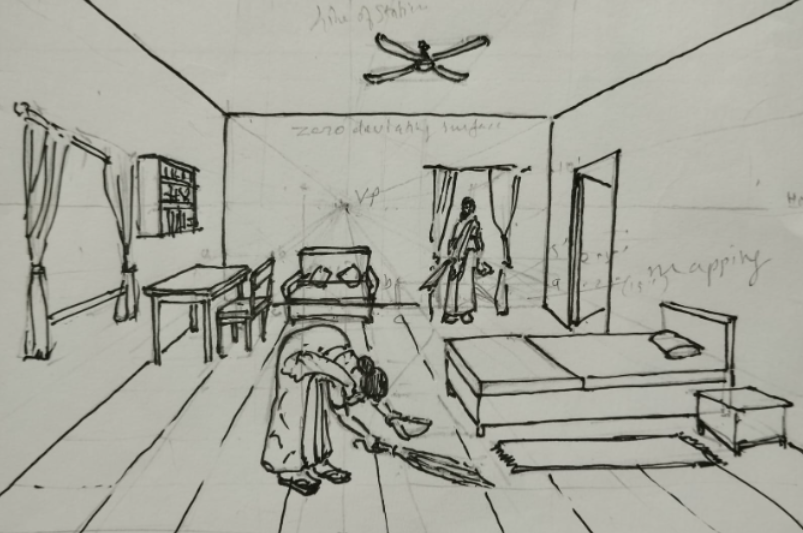
Best approach to solve UCEED Perspective Questions (UCEED scene creation questions):
Step-1: Understand the Core Requirement
- Scene type: Indoor (bedroom)
- Characters: At least 1 person (mother cleaning)
- Action: Cleaning (sweeping, dusting, arranging bed, folding clothes)
- Viewpoint: Perspective view (low, eye-level, or high-angle)
Step-2. Pick the Perspective
- Use 1-point or 2-point perspective depending on your comfort.
- All major details like bed, wardrobe, window, objects on the floor, and mother should be in proper proportions and scale relative to each other and adjusted to the perspective.
Step-3. Composition Planning (Thumbnail in 2 min)
Draw a small rectangle and plan the layout:
- Foreground: Bed edge, chair, or small table for depth.
- Mid-ground: Mother actively cleaning (sweeping)
- Background: Window, cupboard, wall clock, bookshelf.
Step-4. Elements to Add for Realism
- Bed (blanket pulled, pillow slightly tilted)
- Carpet near the bed
- Broom/duster/vacuum in mother’s hand (You can also try cleaning cues: bucket, dustbin, mop, scattered toys/books.)
- Window with curtain on the sides (light entering).
Step-5. Drawing Execution (25-30 min)
1) Start with Horizon line + vanishing point(s). Keep a check on line quality.
2) Outline bed, cupboard, and floor tiles using perspective.
3) Place mother at mid-ground, slightly bent posture, sweeping or folding clothes.
4) Draw the tiles to add more details.
5) Refine details, curtains, lampshade, clock, textures (wood, fabric).
Step-6. Finishing Touches (3-5 min)
- Darken outlines of mother + cleaning tool (main action = focal point).
- Suggest light source (sunlight from window, lamp glow).
- Keep shading minimal but consistent for depth (floor, cupboard). Neat linework > over-shading.
Pro Tip: Always make the human action the focal point. Even if the room is well-drawn, without showing the cleaning activity clearly, marks will drop.
Since Part B is only marked after you clear Part A, keep an eye on the UCEED cut-off so you exactly know the Part A bar you must clear first.
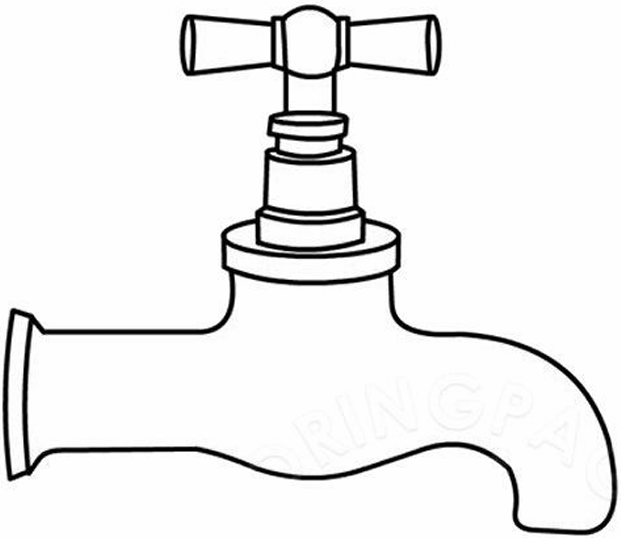
Q2) Modify the given water tap considering the requirements for different users as mentioned below 1.A six year old child 2.An Artist 3.A visually impaired person Draw the modified water tap for each of the users and write 3 points as to why you consider the modified idea of tap suitable for them. Evaluation Criteria Relevance to question innovative solution Product aesthetics.
Solution:
Guidelines for Approaching the answer:
1. Six-year-old child Design
- Could include a shorter, easy-to-reach lever instead of a twist knob.
- Add colorful/animal-shaped handles for fun and attraction.
- Include a soft grip handle to avoid injury
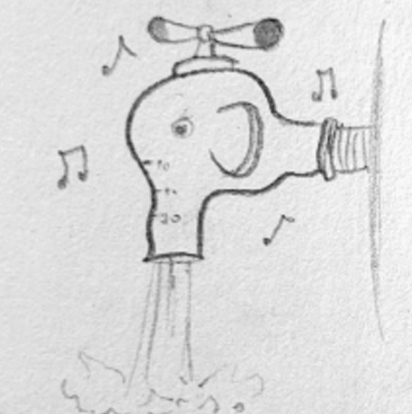
The tap is designed in the shape of an elephant, making it fun and attractive for children. It has musical elements (shown with notes), which means the tap can produce playful sounds when water flows, encouraging kids to use it. The handle is simple and child friendly, requiring minimal effort to turn
2. Visually Impaired Person
- Tap with tactile marks or Braille labels for hot/cold.
- A sensor-based tap that works by hand proximity.
- Distinct textured handle shapes to identify functions easily.
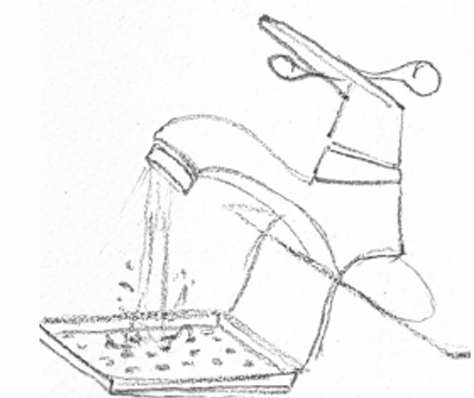
Multi-Flow Control: Provides mist, stream, and shower modes to suit different art needs, like rinsing brushes or fi ling containers. Also a Palette Rinsing Tray: A detachable tray below the tap for easy rinsing of palettes and tools. And an adjustable Neck and Spout: Flexible, rotatable design for precise control over water direction.
3. Artist
- Tap with flexible neck/movable spout for washing brushes, tools, or filling containers.
- Add a spray and stream mode for cleaning or gentle rinsing.
- Aesthetically unique - could have an elegant or minimal artistic design.
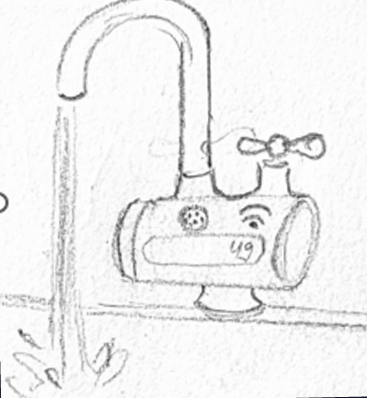
- Textured Control Knob: Differently textured knobs for easy identification of hot and cold by touch.
- Voice Activation: A lows hands-free operation with voice commands for convenience.
- Audio Temperature Indicator: Beeps and sounds signal water temperature to ensure safe use.
Want more of these? Keep practicing with our full bank of UCEED sketching questions.
More Sample UCEED Drawing Test Practice Questions 2027 - Scene Creation
We have curated a few sample UCEED sketching questions from the previous year's papers to help you understand the type & difficulty level of questions asked in the UCEED exam.
Try to practice these UCEED 2027 perspective drawing questions repetitively to improve your perspective drawing skills.
Q1) You are sitting in a well-ventilated drawing room. It is 9 a.m., and sunlight streams through the east window, casting shadows on the floor. A cat is resting on one of the bright patches. A newspaper is placed beside a cup of hot tea on a small side table. The room has three freshly watered potted plants: one on the floor and two on the window sill, with the watering jug next.
From the above description, sketch the scene from your point of view
Q2) Prof. Shastri was checking maths papers when she got a call from her husband. Mr Shastri was upset that she forgot the diet lunch box he had specially prepared. He was also annoyed that she left the dining table in a mess with all her papers and books piled up. He accused her of cheating on her diet by eating canteen Pakoras and Aloo Parathas for lunch. Prof. Shastri tried to soothe him by saying she had been working since morning as she needed to finish checking papers and writing her research proposal by 5 pm that evening. She even had a headache from skipping lunch. Mr Shastri was unconvinced and reminded her that she hadn't even read the diet book he had sent and was probably using it as a paperweight in her office. He concluded that she wasn't serious about her health and declared that he would not cook for her from then on. In frustration, Prof. Shastri hung up the phone and ordered her fifth cup of tea from the canteen and her second plate of Pakoras. From the above description, sketch Prof. Shastri's desk from her usual point of view.
Note: Make pencil sketches only, Do not use colours.
Q3) Draw a classroom view with a few students giving an exam and an invigilator observing the students.
The drawing should also show the view of the classroom board and all.
Q4) Sketch the view of a drawing room with facilities like sitting arrangement, tables, wall plates, etc. All should be in perspective.
Q5) Draw a room scene with at least one person from the early '40s, 1940-1950. The image's look should give the perception that the scene dates back to the '40s.
Q6) Draw a perspective view of a kitchen interior with a stove, kitchen utensils (such as pressure cooker, cooking pans, saucepans, etc.), dining utensils (such as ceramic plates, cups, glasses, etc.), a washbasin, storage racks with stored cooking ingredients (such as spices in small plastic bottles), fresh-cut vegetables kept beside the stove and at least two kitchen gadgets. Make a freehand perspective drawing of this setup, showing all the elements listed above as seen from the point of view of a 5 ½ feet tall person.
Q7) You are standing in a park. It is 6 in the morning, and the sunlight streams through the long trees. A few dogs are resting on one of the bright patches. A person is standing next to you, watering plants. A few kids are playing Badminton on your left. Make a freehand perspective drawing of this setup, showing all the elements listed above as seen from the point of view of a 5-foot-tall person.
Q8) Imagine that your size has been reduced to 2 cm, and you are standing inside a wooden pencil box with a pencil, a pen, a scale, an eraser, and a sharpener. The lid of the pencil box is slightly open. Make a freehand perspective drawing of this setup, showing all the above elements.
Q9) You are standing on your balcony on the first floor. It is Five in the evening, and the sunlight is streaming through the window on the west, casting shadows on the floor. A Dog is resting on one of the bright patches. A newspaper is placed beside a cup of hot tea on a small side table. There are three freshly watered potted plants on the balcony, one on the floor and two on the window sill with the watering jug, and you are looking at the bus stop. Several people are waiting for the bus; sketching this scene is interesting. Make a freehand perspective drawing of this setup, showing all the elements listed above as seen from the point of view of a 6-foot-tall person.
Q10) You are three cm tall inside a five-storey mall. You are standing on the Ground Floor looking at the First floor. Many people are shopping for clothes. Some are standing on the grill, and the other crowds are moving up and down towards the colourful displays. Make a freehand perspective drawing of this setup, showing all the above elements.
Q11) There is an inter-school dance competition in a school assembly. It's eleven in the morning, sunlight is streaming through, and you are sitting on the ground in the first row, watching two girls wearing ethical clothes on the stage giving their performance. Several students are waiting for their turn, sitting next to the stage. The other side of the scene is decorated with posters. Make a freehand perspective drawing of this setup, showing all the above elements.
Q12) You're a baby lying in the cradle in the middle of the park. Your mom holds the cradle with one hand and her phone in the other; you have a toy in the cradle. It's evening time, and the sun is down. Make a freehand perspective drawing of this setup, showing all the above elements.
Q13) Visualize and sketch the view of an appliance showroom wall rack with
- Kitchen appliances like a grinder, mixer, microwave oven, Induction cooktop, etc., displayed on shelves
- The fridge and washing machines are displayed on the sides.
Q14) Draw the scene of a girl with the following details
- In a room
- Sitting on a sofa
- TV and a few appliances
- Taking a selfie
Q15) Draw the scene of a schoolboy sitting in a room, studying a book intensively, with no power but only candlelight, seated on the floor.
Give preference to:
- pencil stroke
- Size of objects
- The proportion of objects concerning the boy
- The light condition of the room because of candlelight
- Finally, shading
Lock your prep to the calendar - check the latest UCEED 2027 notification and exam date so you're aligning your prep accordingly.
More UCEED 2027 Drawing Questions for Practice - Design Aptitude (Product Redesign)
Check following sketching prompts for UCEED:
Q1. Redesign a school lunchbox so that food stays warm, does not spill, and is easy for a 10-year-old to open and use. Sketch the design with labels.
Q2. Design a public seating solution for bus stops that can protect commuters from rain while also being compact in crowded urban areas. Show the main view and label its features.
Q3. Imagine a reusable packaging for street food vendors that replaces plastic/aluminium foils. It should be cost-effective and user-friendly. Sketch the concept and annotate.
Q4. Redesign footwear for delivery workers who walk long distances daily in heat and rain. Show how your design improves comfort and safety.
Q5. Create a foldable study desk for small apartments that can be easily stored after use. Sketch its mechanism and label important parts.
Q6. Design a water bottle for elderly users with weak grip strength. Show how your design improves usability compared to regular bottles.
Q7. Redesign the dustbin for public parks to encourage proper waste segregation and avoid spillage by animals. Sketch the design and add annotations.
Q8. Create a multi-use school bag that can also serve as a writing desk for rural students with no classroom furniture. Sketch the idea and label parts.
Q9. Design a streetlight powered by renewable energy (solar/wind) that also doubles up as a public charging station. Show the design and key functions.
Q10. Redesign the ticket counter experience in a railway station to make it more user-friendly, faster, and accessible for differently-abled people. Present the redesigned counter and annotate.
Best Free Resources to Prepare for UCEED Drawing Questions 2027
|
FREE UCEED Study Material Name |
Link |
|
UCEED Study Material with Drawing Questions (Solved) |
|
|
UCEED Study Material for Quantitative Aptitude |
|
|
UCEED Study Material for Verbal Reasoning |
|
|
UCEED Study Material for Non-verbal Reasoning |
|
|
UCEED Study Material for Verbal Ability |
|
|
UCEED Study Material for General Awareness |
|
|
UCEED Study Material for Aptitude |
|
Materials & Tools for UCEED 2027 Drawing Questions
- 2B / 6B / 8B pencils
- Ball-point pen
- A4/A3 sketchbook depending on test format; practice on same aspect ratio
- Soft eraser, kneadable eraser and sharpener
- Clean Writing Board
Check: UCEED Notification 2027 & Exam Date
Hacks for Attempting UCEED Drawing Questions 2027 to Score 60+
Read the UCEED sketching questions carefully before proceeding to draw.
- Attempt to draw almost anything and everything you come across. The key to success is practice.
- Examine various newspapers, magazines, and online sites for a situational perspective.
- Always take inspiration from various advertisements, posters, banners, etc.
- While practicing, avoid or use the eraser as little as possible. It will make your lines more confident and bold.
- Detailing is essential. Fill in every last detail in your sketch.
- Try your hand at drawing human figures and illustrations. Pay more attention to proportions, form, and so on.
- To score good marks in the UCEED drawing questions section, you must regularly attempt mock tests for UCEED. This way, you can improve your drawing and time management skills for UCEED.
Your 60-Minute Part B Game Plan
Two questions, one hour. The candidates who run out of time almost always invest more time and efforts in one question. There should a strategic split:
1. 0-3 min - Read both questions fully.
Underline every element you must include (people, objects, viewpoint, time of day). Missing a listed element is the most sure-shot way to lose marks.
2. Drawing question (~28 min):
Spend 2 minutes in the beginning on thumbnail → 5 minutes on block perspective, vanishing point / orthogonal lines, and place key elements → 15 minutes on detailing → 5 minutes on shading and focal-point darkening.
3. Design-aptitude question (~25 min)
Take maximum of 3 min to identify the user + problem → 5 min to roughly try two concepts, pick one → 12 min clean sketch with multiple views → 5 min labelling & annotations.
4. Last 2 min - Neat up the drawing & re-check.
Are all required elements present? Is the focal point obvious? Is labeling done right?
Golden rule: a finished, meaningful drawing beats an incomplete masterpiece that fails to showcase what you intended. Never leave either question blank.
UCEED Exam Day Tips:
- Read the important instructions on your UCEED admit card.
- Go early to your exam centre.
- Don't forget to take your Admit card and a colour printout of the hall ticket.
- Take proof of your ID as mentioned on the admit card.
- Pencils, sketch pens, poster colours, and other drawing materials are permitted.
7 Common Mistakes That Cost Marks in UCEED Drawing Questions
1. Missing a listed element
If the prompt says "watering jug," it must be in the frame. Ensure you included every element before beginning the finishing work.
2. No clear focal point
A lot of elements makes the drawing flat. You need to highlight the main action.
3. Broken perspective
This usually instantly makes the drawing look off. For example objects floating off the ground plane, wrong scale of elements, disproportionate horizon & horizontal lines etc. Set the horizon line first and then guiding lines as per requirement next, before moving on to actually draw.
4. Over-erasing
Hesitant or smudged lines lose on finishing marks. Practice until you achieve confident strokes.
5. Skipping annotations on the design question
Un-labelled solutions leave the examiner guessing your intent.
6. Poor time split
Over polishing in one drawing question and leaving other one blank scores far worse than two complete ones.
7. Using color when only pencil is allowed
Always follow the medium instruction on screen.
Also check other common mistakes to avoid while preparing for UCEED 2027.
Conclusion
Practicing UCEED Drawing questions is a great way to improve your drawing skills and confidence. From UCEED part b questions on sketching brand new product to figurative drawing in various poses and contexts, the exam will rigorously put your imagination and visual communication to test. Consistent practice will help familiarise you with the types of UCEED drawing questions and the UCEED exam pattern.
Regular practice and dedication can greatly improve your performance in the UCEED 2027 Drawing Test and increase your chances of scoring well.
Looking for professional guidance to crack UCEED 2027?
Join Creative Edge Offline/Online UCEED Coaching. Get complete syllabus coverage, exam-like mocks, full study material, high-scoring exam strategies and 24/7 support directly from UCEED experts.

Attempt a Free UCEED Mock Test
Fill your details
Frequently Asked Questions
Is solving UCEED Previous Year Paper is really beneficial for UCEED 2026 preparation?

Should I solve UCEED question papers during my exam preparation?
How can I manage time while attempting UCEED drawing section in 2027?
Is UCEED Drawing Exam easy?
Where can I get UCEED Drawing Test Practice Questions with Answers for 2027 Prep?
How long should I study in a day for UCEED Drawing section 2027?
What is the UCEED Drawing Syllabus 2027?
Vineeta Agrawal
Communications Executive
SHARE