


Chhattisgarh Judiciary Preparation Strategy 2026: Study Plan & Expert Tips
November 12, 2026
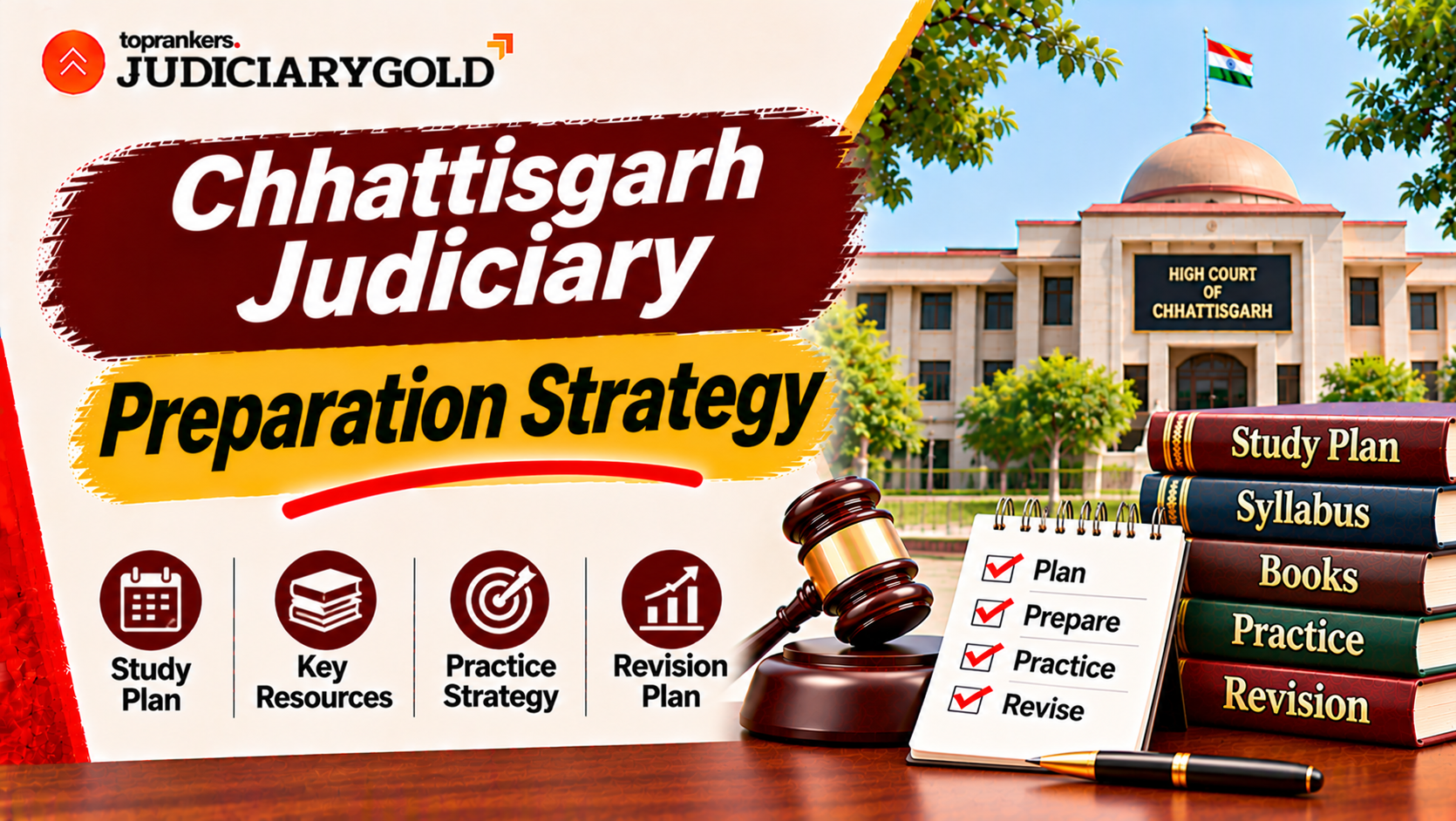
The best Chhattisgarh Judiciary preparation strategy for 2026 is to prepare for Prelims and Mains together from day one, because the Mains paper has changed.
- After the September 2026 amendment to the Chhattisgarh Lower Judicial Service Rules, the Mains has four descriptive papers worth 400 marks.
- Candidates final rank depends on Mains plus a 25-mark Interview (viva - voce). Prelims only decides who reaches the Mains.
So, learn the bare acts well enough to answer MCQs and write long answers on them. Build criminal law around BNS, BNSS and BSA, not the IPC, CrPC and Evidence Act. Start answer writing, essays and translation months before Prelims, not after the result.
Chhattisgarh Judiciary Exam 2026 Overview
The table below states how CGPSC selects Civil Judges (Junior Division) under the amended 2026 rules, from the qualifying Prelims to the 425-mark final merit.
| Particular | Details |
|---|---|
| Conducting body | Chhattisgarh Public Service Commission (CGPSC) |
| Post | Civil Judge (Junior Division), entry level |
| Stages | Prelims (screening) → Mains (written) → Viva voce |
| Prelims | 100 objective questions for 100 marks in 2 hours. Qualifying only. |
| Mains | 4 papers of 100 marks each, with 3 hours per paper (400 marks in total) |
| Viva voce | 25 marks. The minimum qualifying score is 33% for unreserved candidates and 25% for SC, ST and OBC candidates. |
| Final merit | Mains (400 marks) + viva voce (25 marks) = 425 marks |
Candidates can check for dates, vacancies and the application process, on the Chhattisgarh Judiciary 2026 notification and vacancy.
What Changed in Chhattisgarh Judiciary 2026 and Why Your Preparation Must Change
The Chhattisgarh Law and Legislative Affairs Department amended the Lower Judicial Service Rules through an extraordinary Gazette notification dated 11 September 2026.
The Chhattisgarh Judiciary exam pattern has been changed and the amendment moves the exam from a judgment-writing test to a full written examination of civil law, criminal law, language and drafting.
| Particulars | Old pattern (2024 cycle and earlier) | New pattern (from September 2026) |
|---|---|---|
| Mains papers | One paper covering civil judgment (40 marks), criminal judgment (40 marks) and translation (20 marks) | Four papers covering Civil Law, Criminal Law, Language & Translation, and Judgment Writing & Pleadings |
| Mains marks | 100 | 400 |
| Viva voce | 15 marks | 25 marks |
| Merit total | 115 | 425 |
| Substantive law in Mains | Not tested directly | 200 marks (Papers 1 and 2) |
| Essays and legal awareness | Not tested | 60 marks (Paper 3) |
Can fresh law graduates apply in 2026-27?
On 21 August 2026, the Supreme Court modified its 2025 three-year practice rule. Candidates under recruitment notifications issued up to 31 March 2027 can apply without prior practice.
If selected, they join as trainee judicial officers and complete one year of State Judicial Academy training and one year of clerkship. For notifications issued after 31 March 2027, at least one year of practice will be required.
If you graduate in 2026 or 2027, the timing of the next CGPSC advertisement matters. Candidaes can check the Chhattisgarh Judiciary eligibility criteria and the advertisement itself before you plan around one attempt.
Chhattisgarh Judiciary Preparation Strategy: Stage-wise Overview
Each stage tests a different skill, so your preparation should shift weight as the exam gets closer.
| Stage | What it tests | What to prioritise |
|---|---|---|
| Prelims | Recall of bare-act provisions, local laws and Chhattisgarh GK | Section numbers, provisos, illustrations and previous-year questions |
| Mains Papers 1–2 | Applying civil and criminal law to facts | Legal concepts, landmark cases and answers to problem questions |
| Mains Paper 3 | Hindi and English language skills, essays, legal awareness and translation | Structured article writing and daily translation practice |
| Mains Paper 4 | Drafting and judgment writing | Weekly practice in civil and criminal judgment writing and drafting pleadings |
| Viva voce | Judicial temperament, clarity and knowledge of current law | Mock interviews, local law and recent judgments |
How to Prepare for Chhattisgarh Judiciary Prelims 2026
Prelims demands precise knowledge of the bare acts. Questions mostly come from the text of the statute, its provisos and its illustrations, so the bare act should be your main source, with a reference book only for difficult portions. Candidates can refer the Chhattisgarh Judiciary syllabus for more information on prelims subjects.
Prelims subjects and where to focus
The Prelims syllabus has 16 subjects. Group them by how often they appear and how much they overlap with the Mains.
| Priority | Subjects | Why |
|---|---|---|
| Core (start here) | Code of Civil Procedure, Bharatiya Nagarik Suraksha Sanhita (BNSS), Bharatiya Nyaya Sanhita (BNS) and Constitution of India | These subjects account for most Prelims questions and all four are tested again in the Mains. |
| High | Bharatiya Sakshya Adhiniyam (BSA), Transfer of Property Act and Indian Contract Act | These subjects carry consistent weightage. The Transfer of Property Act and Indian Contract Act also appear in Mains Paper 1. |
| Chhattisgarh local laws | Chhattisgarh Land Revenue Code, 1959, Chhattisgarh Rent Control Act, 2011, and Chhattisgarh Excise Act, 1915 | These laws account for fewer questions. Studying them can give you an edge when other candidates skip them. |
| Short Acts | Limitation Act, Specific Relief Act, Negotiable Instruments Act, Court Fees Act and Registration Act | These Acts are quick to cover and offer scoring opportunities. |
| General Knowledge | Chhattisgarh history, geography, economy, culture and government schemes | A few extra marks in GK can make a difference when your score is close to the cut-off. |
Read the new criminal laws with a comparison table
Most available question banks still use IPC, CrPC and Evidence Act numbering. Make a one-page conversion table for every chapter you study (for example, BNS chapter on offences affecting the human body against the old IPC chapter).
Learn the new section numbers first, then note what actually changed in substance. Questions on new offences and new procedures are easy to set and easy to miss.
Use previous year papers to find repeat areas
The High Court and CGPSC often return to the same provisions. Repetition shows up in two ways: the same question again, or a different question on the same section, rule or doctrine. The second is far more common.
While solving Chhattisgarh Judiciary previous year question papers, tag each question by act and section. After three or four papers you will see which sections keep returning.
Don't skip Chhattisgarh GK and local laws
Candidates from outside the state often lose marks here. Read the Land Revenue Code chapters on land records, mutation and revenue courts carefully, and cover state GK from a single standard source rather than many.
Prelims cut-offs are usually close, so these marks matter; check past Chhattisgarh Judiciary cut-off marks to see the range.
For a Prelims-only plan, candidates can read how to prepare for Chhattisgarh Judiciary Prelims.
Paper-wise Strategy for Chhattisgarh Judiciary Mains 2026 (400-Mark Pattern)
In the last cycle, the Mains came about three months after Prelims. Three months is not enough to learn four descriptive papers from scratch, so begin Mains writing alongside Prelims reading.
Paper 1: Civil Law (100 marks)
Paper 1 covers the Code of Civil Procedure, Contract Act, Specific Relief Act, Limitation Act, Transfer of Property Act, Constitution of India, Hindu Succession Act and the Chhattisgarh Land Revenue Code.
- Expect problem questions: a set of facts, then "decide the suit" or "advise the party". Answer in the order issue → provision → case law → application → conclusion.
- Prepare short notes on doctrines examiners like to test, such as res judicata, part performance, lis pendens and the rule against perpetuities.
- Keep a list of two or three leading judgments per topic, with one line on what each decided.
Paper 2: Criminal Law (100 marks)
Paper 2 covers BNS, BNSS and BSA, along with the Negotiable Instruments Act, Chhattisgarh Excise Act, Juvenile Justice (Care and Protection of Children) Act, Arms Act and Information Technology Act.
- Write the ingredients of each major offence as a list you can reproduce in an answer.
- For BNSS, focus on arrest, bail, charge, trial procedure and the new timelines.
- For BSA, cover relevancy, admissions, confessions, burden of proof, presumptions and electronic evidence.
Paper 3: Language, Social and Legal Perspective, and Translation (100 marks)
Paper 3 is the one paper where bare-act knowledge alone won't carry you: marks depend on clear writing in English and Hindi, well-argued articles and awareness of recent legal changes. Here is how its 100 marks are divided.
| Section | Marks |
|---|---|
| English language (correction, synonyms, antonyms, one-word substitution and précis) | 10 |
| Hindi language (the same skills in Hindi) | 10 |
| Article on a social topic | 20 |
| Article on a legal topic | 20 |
| Legal knowledge (recent laws and judicial trends) | 20 |
| English-to-Hindi translation | 10 |
| Hindi-to-English translation | 10 |
Paper 4: Judgment Writing, Conveyancing and Pleadings (100 marks)
Paper 4 has 20 marks for drafting (plaint, written statement, bail application, petition, notice), 40 for a civil judgment and 40 for a criminal judgment.
- Civil judgment: facts in brief, issues framed, evidence discussed issue by issue, findings, relief and decree.
- Criminal judgment: charge, prosecution and defence evidence, appreciation of evidence, presumptions, finding of guilt or acquittal, and sentence.
- Write one civil and one criminal judgment every week from month three onward, and get them checked. Self-checking misses structural mistakes.
For a full paper-by-paper routine, read the Chhattisgarh Judiciary Mains preparation tips.
How to Prepare for the Chhattisgarh Judiciary Interview (Viva-Voce) 2026
The viva carries 25 marks and has its own minimum (33% for unreserved, 25% for SC/ST/OBC), so a weak interview can cost a seat even after a strong Mains. A sitting High Court judge sits on the panel.
- Revise your own Mains answers and judgments; panels often ask about them.
- Be ready on Chhattisgarh's courts, land law, tribal areas and recent High Court decisions.
- Practise answering in both Hindi and English, calmly and briefly.
- Take at least three mock interviews and ask for blunt feedback on posture and tone.
12-Month Chhattisgarh Judiciary 2026 Study Plan
This plan assumes a full-time aspirant with 7–8 hours a day. Working professionals can stretch each phase by about 50%.
| Months | Prelims focus | Mains focus |
|---|---|---|
| 1–2 | CPC, Constitution and Contract Act | Write short answers on the same subjects. |
| 3–4 | BNS, BNSS and BSA with section conversion tables | Write 1 civil judgment and 1 criminal judgment per week. |
| 5–6 | Transfer of Property Act, Specific Relief Act, Limitation Act and Negotiable Instruments Act | Practise answers to problem questions for Papers 1 and 2. |
| 7 | Local laws, Court Fees Act, Registration Act and Chhattisgarh GK | Practise drafting plaints, written statements and bail applications. |
| 8–9 | Complete your first full revision and tag previous-year questions by section. | Practise Paper 3 essays and update your legal knowledge file. |
| 10 | Complete your final revision and take mocks under timed exam conditions. | Keep up with light answer-writing practice. |
| After Prelims | Rest for 2 days. | Take full-length Mains mocks covering all four papers. |
| After Mains | — | Prepare for the viva voce and practise mock interviews. |
Best Books and Resources for Chhattisgarh Judiciary 2026
Start with the bare acts; use one reference book per subject only for difficult areas. Make sure every criminal-law book you buy is updated for BNS, BNSS and BSA.
| Particulars | Resource |
|---|---|
| All subjects | Latest bare acts with amendments, in the language you will use to write your answers |
| Civil law | One standard commentary each for the CPC, Transfer of Property Act and Indian Contract Act |
| Criminal law | Updated editions covering BNS, BNSS and BSA |
| Chhattisgarh laws | Bare acts of the Land Revenue Code, Rent Control Act and Excise Act |
| Practice | Previous-year question papers, a test series and judgment-writing workbooks |
Key Takeaways
If you remember only a few things from this Chhattisgarh Judiciary preparation strategy, make them these:
- Your rank is decided by the Mains (400 marks) and viva (25 marks); Prelims only gets you to the Mains, so plan for both from the start.
- Since the September 2026 amendment, half the Mains tests civil and criminal law in depth, and judgment writing is now only 80 of 400 marks.
- Build every criminal-law note around BNS, BNSS and BSA, and convert old IPC, CrPC and Evidence Act material before you use it.
- Treat the bare act as your main text for Prelims, and tag previous year questions by section to spot the provisions that keep returning.
- Don't leave Chhattisgarh local laws, state GK or Hindi for the end; they decide close cut-offs and carry marks in Paper 3.
- Write at least one civil and one criminal judgment every week, and get them evaluated, from the third month onwards.
- Fresh graduates can apply under notifications issued up to 31 March 2027; after that, one year of practice will be required, so check the next CGPSC advertisement carefully.
If you want a structured guidance, take a free demo online class or talk to a Judiciary Gold counsellor about the course.
Download Judiciary Study Material
Fill your details
Frequently Asked Questions
How should I start preparing for Chhattisgarh Judiciary 2026?

Are Prelims marks added to the final merit list?
Do I need three years of practice to apply?
Which criminal laws are asked in the Chhattisgarh Judiciary exam 2026?
How many months are enough to prepare for Chhattisgarh Judiciary?
Can I write the Mains in Hindi?
What is the new Chhattisgarh Judiciary exam pattern 2026?

Nancy Mahavir Sharma
Legal Writer
SHARE