


Chhattisgarh Judiciary Exam Pattern 2026: Structure And Marking Scheme
November 11, 2026
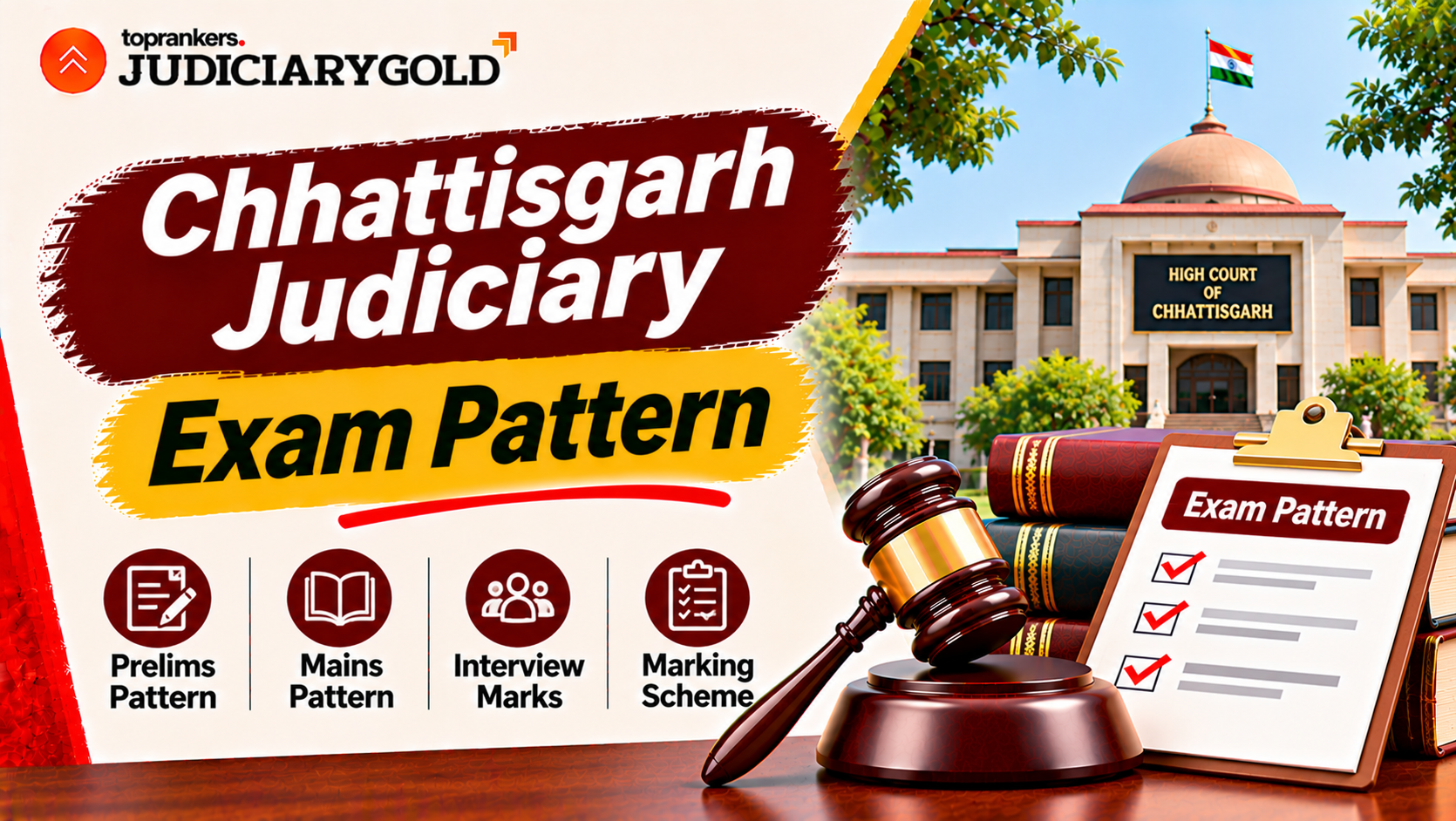
The Chhattisgarh Judiciary exam pattern has three stages - a 100-mark objective Prelims that only screens candidates, a descriptive Mains of four papers worth 400 marks, and a 25-mark Interview (Viva-voce).
The Chhattisgarh Public Service Commission (CGPSC) conducts the exam for the post of Civil Judge (Junior Division).
- Candidates final rank depends only on Mains and Interview (Viva marks) out of 425.
- The Mains and Interview marks come from the September 2026 amendment to the Chhattisgarh Lower Judicial Service (Recruitment and Conditions of Service) Rules, 2006.
- Earlier cycles used a 100-mark Mains and a 15-mark Interview, so older notes and question papers will not match the new structure.
Chhattisgarh Judiciary Exam Pattern 2026 Overview
The table below covers up the Chhattisgarh Judiciary exam pattern 2026 and states who conducts the exam, its three stages and the marks for each. Only the Mains and Viva-voce count towards your final rank, which is calculated out of 425 marks.
| Particular | Details |
|---|---|
| Conducting body | Chhattisgarh Public Service Commission (CGPSC), under the supervision of a committee of High Court judges |
| Post | Civil Judge (Junior Division) (Entry Level) |
| Stages | Prelims → Mains (written) → Viva voce |
| Prelims | 100 objective questions for 100 marks in 2 hours. This stage is qualifying only. |
| Mains | Four descriptive papers, each worth 100 marks and lasting 3 hours. Total: 400 marks. |
| Viva voce | 25 marks |
| Shortlisting | 10 times the number of vacancies for Mains and 3 times for viva voce. |
| Final merit | Mains (400 marks) + Interview (viva voce) (25 marks) = 425 marks |
Chhattisgarh Judiciary Prelims Exam Pattern 2026
The Prelims consists of a single two-hour paper with 100 multiple-choice questions. The score is used only to shortlist candidates for the Mains. Final merit is based on the Mains and viva voce marks.
| Particulars | Prelims Exam Pattern |
|---|---|
| Questions | 100 multiple-choice questions |
| Marks | 100 (1 mark per question) |
| Duration | 2 hours |
| Nature | Screening (qualifying) |
Chhattisgarh Judiciary Prelims subjects
Schedule-I of the Rules lists 16 subjects for the Prelims. Candidates can refer Chhattisgarh Judiciary syllabus for topic-wise detail and weightage details.
Three of them are the new criminal laws that replaced the IPC, CrPC and Evidence Act:
- Bharatiya Nyaya Sanhita, 2023 (BNS)
- Bharatiya Nagarik Suraksha Sanhita, 2023 (BNSS)
- Bharatiya Sakshya Adhiniyam, 2023 (BSA)
- Code of Civil Procedure
- Constitution of India
- Transfer of Property Act
- Contract Act
- Limitation Act
- Chhattisgarh Rent Control Act, 2011
- Court Fees Act
- Specific Relief Act
- Registration Act
- Chhattisgarh Land Revenue Code
- Negotiable Instruments Act, 1881
- Chhattisgarh Excise Act, 1915
- General Knowledge of Chhattisgarh
Past Prelims cut-offs give a sense of the score you need; refer Chhattisgarh Judiciary cut-off marks by category and year.
Chhattisgarh Judiciary Mains Exam Pattern 2026
The Mains now has four descriptive papers of 100 marks each, and every paper runs for three hours. Two papers test substantive and procedural law, one tests language and analytical writing, and one tests practical drafting and judgment writing.
| Paper | Subject | Marks |
|---|---|---|
| Paper 1 | Civil Law | 100 |
| Paper 2 | Criminal Law | 100 |
| Paper 3 | Language, Social and Legal Perspective, and Translation | 100 |
| Paper 4 | Judgment Writing, Conveyancing and Pleadings | 100 |
| Total | 400 | |
Paper 1: Civil Law
Paper 1 covers the main civil statutes a Civil Judge applies daily: the Code of Civil Procedure, Contract Act, Specific Relief Act, Limitation Act, Transfer of Property Act, Constitution of India, Hindu Succession Act and the Chhattisgarh Land Revenue Code. Expect problem-based questions where you apply provisions to facts, not just recall them.
Paper 2: Criminal Law
Paper 2 is built on BNS, BNSS and BSA, along with the Negotiable Instruments Act, Chhattisgarh Excise Act, Juvenile Justice (Care and Protection of Children) Act, Arms Act and Information Technology Act. Notes written for the IPC, CrPC and Evidence Act need to be re-mapped to the new section numbers.
Paper 3: Language, Social and Legal Perspective, and Translation
Paper 3 tests how well you write and reason in both English and Hindi, not just how much law you know. It combines grammar, two structured articles, recent legal developments and two-way translation in one 100-mark paper.
| Details | Marks |
|---|---|
| English language (correction, synonyms, antonyms, one-word substitution and précis) | 10 |
| Hindi language (the same skills in Hindi) | 10 |
| Article on a social topic | 20 |
| Article on a legal topic | 20 |
| Legal knowledge (recent laws and judicial trends) | 20 |
| English-to-Hindi translation | 10 |
| Hindi-to-English translation | 10 |
| Total | 100 |
Paper 4: Judgment Writing, Conveyancing and Pleadings
Paper 4 checks whether you can do the day-to-day work of a Civil Judge: draft legal documents and write reasoned judgments from a set of facts. Most of its marks go to civil and criminal judgment writing, with a smaller share for drafting pleadings.
| Particulars | Marks |
|---|---|
| Conveyancing and pleadings (plaint, written statement, bail application, petition and notice) | 20 |
| Civil judgment (framing issues, appreciating evidence, recording findings and drafting the decree) | 40 |
| Criminal judgment (framing charges, appreciating evidence, deciding on conviction or acquittal, and sentencing where applicable) | 40 |
| Total | 100 |
For a paper-by-paper study plan, candidates can read Chhattisgarh Judiciary Mains preparation tips.
Chhattisgarh Judiciary Interview (Viva-Voce) Exam Pattern 2026
The Interview (Viva-voce) now carries 25 marks. CGPSC calls candidates in a ratio of 1:3 against the vacancies, based on Mains marks, and a sitting High Court judge nominated by the Chief Justice takes part in the interview panel.
The Interview (Viva) has its own minimum: 33% for unreserved candidates and 25% for SC, ST and OBC candidates. On 25 marks, that works out to 8.25 and 6.25 marks. A candidate who scores below this is not selected, however high the Mains score.
How the Final Merit List Is Prepared
CGPSC ranks candidates on the total of Mains (400) and Interview (25) marks, out of 425. Prelims marks are not counted.
If two candidates have the same total, the older candidate is placed higher; if they are also the same age, the one with more marks in the written examination is placed higher.
Old vs New Chhattisgarh Judiciary Exam Pattern 2026
The September 2026 amendment remains the Prelims as it was but modified the Mains and raises the Interview (Viva-voce) marks, taking the merit total from 115 to 425.
The table shows each change side by side, so you can see which parts of older study material still apply.
| Particulars | Old pattern (until the 2025–26 cycle) | New pattern (September 2026 amendment) |
|---|---|---|
| Prelims | 100 MCQs, 2 hours, qualifying | No reported change |
| Mains papers | Civil judgment (40 marks), criminal judgment (40 marks) and translation (10 + 10 marks) | 4 papers of 100 marks each |
| Mains total | 100 marks | 400 marks |
| Viva voce | 15 marks | 25 marks |
| Marks for final merit | 115 marks | 425 marks |
| Substantive law in Mains | Not tested directly | Paper 1 and Paper 2 (200 marks combined) |
| Essays and legal awareness | Not tested | 60 marks in Paper 3 |
| Drafting and pleadings | Not tested | 20 marks in Paper 4 |
What the New Pattern Means for Your Preparation
The numbers change where your marks come from. Judgment writing was 80% of the old Mains; it is now 80 of 400 marks, or 20%. Half the Mains (200 marks) now tests civil and criminal law in depth, so Prelims-level knowledge of the Acts is no longer enough.
Translation falls from 20% of the Mains to 5%. The Viva rises from 15 to 25 marks, but its share of the final merit actually drops, from about 13% (15 of 115) to about 6% (25 of 425). In practice, the written Mains decides most of the final list.
- Make descriptive answer-writing on CPC, TPA, Contract, BNS and BNSS a weekly habit, not a last-month task.
- Keep a running file of Supreme Court and Chhattisgarh High Court judgments for the 20-mark legal knowledge section.
- Practise one plaint, one written statement and one bail application each fortnight for the drafting section.
- Practise both articles in the four-part structure so that each part earns its 5 marks.
Candidates can refer preparation strategy and study plan for Chhattisgarh Judiciary which turns these priorities into a month-wise plan.
Key Takeaways
Here are the essential points about the Chhattisgarh Judiciary exam pattern 2026, including the September 2026 changes.
- CGPSC conducts the Civil Judge (Junior Division) exam in three stages: Prelims, Mains (Written) and Viva-voce.
- The Prelims has 100 objective questions for 100 marks in 2 hours, and it only screens candidates; its marks are not added to the final merit.
- Candidates are shortlisted for the Mains at 10 times the vacancies and for the Viva at 3 times the vacancies.
- After the September 2026 amendment, the Mains has four 3-hour papers of 100 marks each (400 marks): Civil Law, Criminal Law, Language and Translation, and Judgment Writing and Pleadings.
- The Viva-voce now carries 25 marks instead of 15, with a minimum of 33% for unreserved and 25% for SC, ST and OBC candidates.
- Final merit is based on Mains and Viva marks out of 425; the written Mains makes up about 94% of it.
- The criminal law portions in both Prelims and Mains follow BNS, BNSS and BSA, not the IPC, CrPC and Evidence Act.
If you want a structured guidance, take a free demo online class or talk to a Judiciary Gold counsellor about the course.
Download Judiciary Study Material
Fill your details
Frequently Asked Questions
What is the Chhattisgarh Judiciary exam pattern 2026?

Are Prelims marks counted in the final merit list?
How many marks is the Chhattisgarh Judiciary interview?
Is there negative marking in the Chhattisgarh Judiciary Prelims?
Which criminal laws are tested in the Chhattisgarh Judiciary 2026 exam?

Nancy Mahavir Sharma
Legal Writer
SHARE