
1723534562.png)

UCEED Syllabus 2027: Complete Part A & B Topic List (Official)
September 2, 2026
UCEED syllabus includes 7 skill-based topics in Part-A and drawing-based topics in Part-B of the exam, instead of regular academic subjects like Physics or Maths.
Part A (200 marks, computer-based) tests Visualization & Spatial Ability, Practical & Scientific Knowledge, Observation & Design Sensitivity, Environment & Society, Analytical & Logical Reasoning, Language and Creativity. While Part B (100 marks, pen-and-paper) tests Drawing (50 marks) and Design Aptitude (50 marks).
These are not textbook subjects. IIT Bombay designed this syllabus to evaluate how you think, observe, and solve problems visually, not what you have memorized.
(These topics are listed as per the official brochure of the latest admission cycle (2026).
UCEED 2027 Syllabus at a Glance (Official)
|
Part A (Objective) |
|
| Subject | Particulars |
|
Visualization & Spatial Ability |
Shape rotation, paper folding/unfolding, surface counting, cube-dice, patterns |
|
Observation & Design Sensitivity |
Design principles, product evolution, materials, visual culture |
|
Coding-decoding, series, syllogism, puzzles, logic grids |
|
|
Practical & Scientific Knowledge |
Everyday object functioning, design of common items, technological advances |
|
Environmental & Social Awareness |
Basic sustainability concepts, design for society, reuse & recycle themes |
|
Language |
Questions that test reading and comprehension of English |
|
Creativity |
Verbal analogies, visual-verbal linking, symbols, signs |
|
Part B (Drawing / Design Aptitude) |
|
| Subject | Particulars |
|
Free-hand Drawing |
Persons, products, scenes with clarity, composition & perspective |
|
Creative Thinking & Problem Solving |
Theme-based prompts (e.g., design for environment, inclusive product) |
|
Visual Communication |
Expressive sketches, clean line-work, proportion & shading |
|
Design Concepts |
Ergonomics, usability, aesthetics, human-centered design |
NOTE:
- The Official UCEED 2027 Syllabus (IIT Bombay) is expected to release around September 2026.
- UCEED may not necessarily cover all the above topics in a given year's paper.
Key Highlights: UCEED Syllabus 2027
- Two parts in UCEED exam syllabus: Part A (objective, 200 marks) + Part B (drawing/design, 100 marks) = 300 marks in 3 hours.
- Part-A syllabus: Visualization & spatial ability, Observation and Design Sensitivity, Environmental and Social Awareness, Analytical & Logical Reasoning, Language, and Creativity. The major three with maximum weightage in the paper are reasoning, observation & visualization (~85% of Part A).
- Part B = Drawing (50) + Design Aptitude (50) - subjective, pencil-based, evaluated only if you clear the Part A cutoff.
- Part-B syllabus: Perspective drawing of products / people / scenes, design thinking and aptitude questions.
- No separate Maths subject - basic numerical ability appears only inside NAT and reasoning questions.
- Stable syllabus - IIT Bombay rarely changes topics; it varies difficulty instead, so last year's syllabus can be safely expected to continue being the same for 2027.
Table of Contents
- Official UCEED 2027 Syllabus at a Glance
- Topic-wise Weightage Distribution in Syllabus
- UCEED Syllabus 2027: Part A (Aptitude)
UCEED Syllabus Weightage: How Much of Part A Each Topic Covers
While IIT Bombay's UCEED exam brochure lists all seven Part A domains without assigning official marks to each, analysis of the last seven years of UCEED papers (2019-2025) shows a consistent pattern in how much each domain actually occupies the exam:
|
Syllabus Domain |
Avg. Questions (2019-2025) |
Avg. % of Part A |
|
Analytical & Logical Reasoning |
22.1 |
32.9% |
|
Observation & Design Sensitivity |
18.9 |
28.0% |
|
Visualization & Spatial Reasoning |
16.3 |
24.2% |
|
Practical & Scientific Knowledge |
4.0 |
5.9% |
|
Creativity |
3.7 |
5.5% |
|
Environment & Society |
2.1 |
3.2% |
|
Language |
0.1 |
0.2% |
NOTE:
- This analysis is based on a 7-year average of official UCEED question papers (2019-2025).
- Individual years vary. For example, Environment & Society has appeared with as few as 0 questions in some years and up to 7 in others, so treat this as a directional guide to the syllabus's structure, not a fixed yearly guarantee.
- Three domains - Analytical & Logical Reasoning, Observation & Design Sensitivity, and Visualization & Spatial Reasoning, together account for roughly 85% of Part A every year, making them the structural core of the syllabus.
- The remaining four domains rotate in smaller, more variable doses.
Detailed Subject-wise UCEED Syllabus 2027: Part A
Part A is conducted for 200 marks; the maximum allotted time is 2 hours. It includes Numerical Answer Type (NAT) questions, Multiple Select Questions (MSQ), and Multiple Choice Questions (MCQ).
The UCEED 2027 Syllabus for Part A consists of the following seven topics.
1. Visualization and Spatial Ability
This section of UCEED 2027 syllabus consists of pictorial and diagrammatic questions to test your understanding of the transformation and manipulation of 2D shapes and 3D objects and their spatial relationships.
|
Pattern and design of paper folding |
Optical Illusion (2D/3D objects and understanding) |
|
Mirror, water reflections |
Transformation of 2D & 3D shapes (scaling, rotation, symmetry) |
|
Isometric and perspective views |
Interpreting exploded views and mechanical drawings |
|
Object Manipulation |
Visualization is a skill that's 100% trainable. Our guide on improving visual-spatial ability for UCEED has daily exercises that'll help you practice it fast.
Sample Questions:
Q.1. A perspective view of a solid is shown below. The solid is symmetrical, and hidden surfaces such as the base are flat. What is the total number of surfaces in the solid?
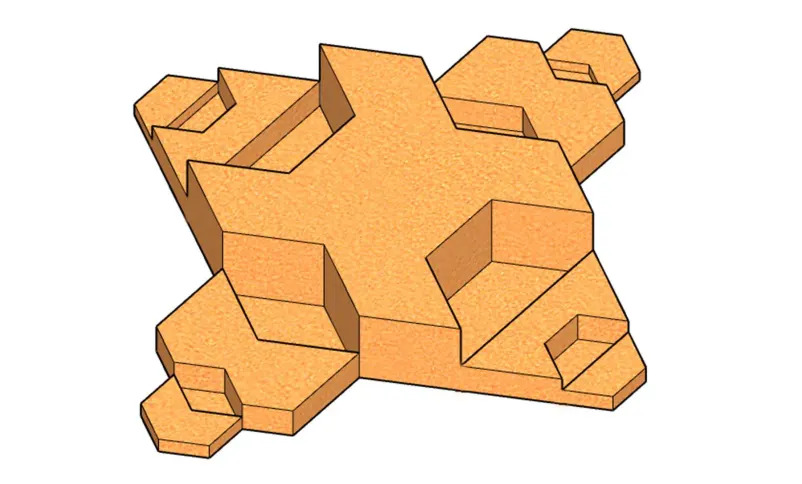
Answer: 72
Q.2. P and Q show two different views of the same solid object. Which of the options represent(s) the top view of the solid object? (MSQ)
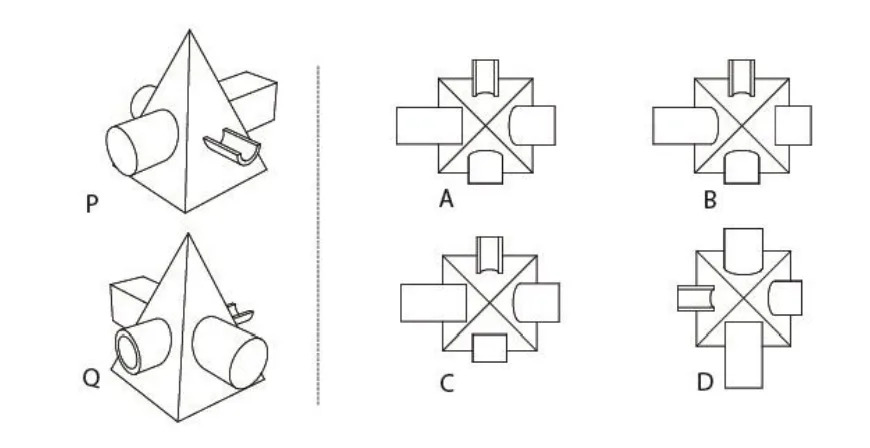
Answer: A, C
Before mapping the syllabus to a timetable, confirm you meet the UCEED eligibility criteria - the age limit and the subjects you choose for class 11 & 12 decides which of the seven participating IITs you can even apply to for admission.

2. Practical and Scientific Knowledge
This section of UCEED 2027 Syllabus evaluates your know-how of scientific principles behind everyday objects.
|
Topics |
Particulars |
|
Heat & Expansion |
Expansion of metals (railway tracks, bridges, gaps in concrete roads) and real-life design application |
|
Light & Optics |
Concave/convex mirrors and lenses in everyday objects (torch, car headlights, spectacles), reflection/refraction in water bodies, glass design, prisms. |
|
Sound & Acoustics |
Echo vs reverberation, materials used for soundproofing in auditoriums, etc. |
|
Electricity & Circuits |
Simple applications like fuses, earthing, wiring safety, appliances design (e.g., why 3-pin plugs are used). |
|
Mechanics in Daily Life |
Levers/pulleys/gears/screw jack. Or door handles/scissors/bicycles as real-life lever systems. |
|
Forces & Motion |
Example - why tyres have treads, why shoes have grip, etc. |
|
Energy & Sustainability |
Questions can be about solar panels, wind turbines, hydroelectric applications, renewable energy integration in architecture. |
|
Materials & Their Properties |
Example - Wood vs metal vs plastic: strength, durability, eco-friendliness or heat conductors and insulators (e.g., cookware design). |
|
Human Body & Biomechanics |
About vision (near/farsightedness and lenses), Ergonomics (chair/table design for posture), etc. |
|
Environmental Applications |
Water harvesting, eco-friendly innovations, Green building materials (bamboo, mud, recycled plastic) and so on. |
Sample Questions:
Q.1. The Tropic of Cancer passes through which of the states shown below?
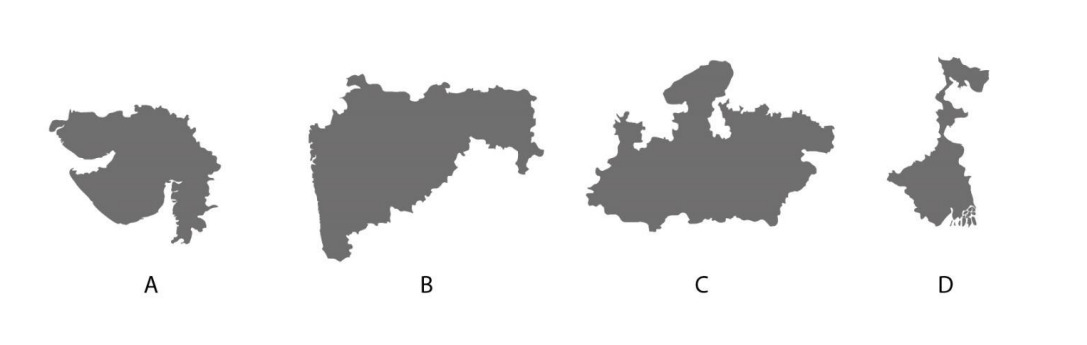
Answer: A, C, D
Q.2. In the image below, gear 1 rotates in the direction of the arrow. Which of the statements is / are CORRECT?
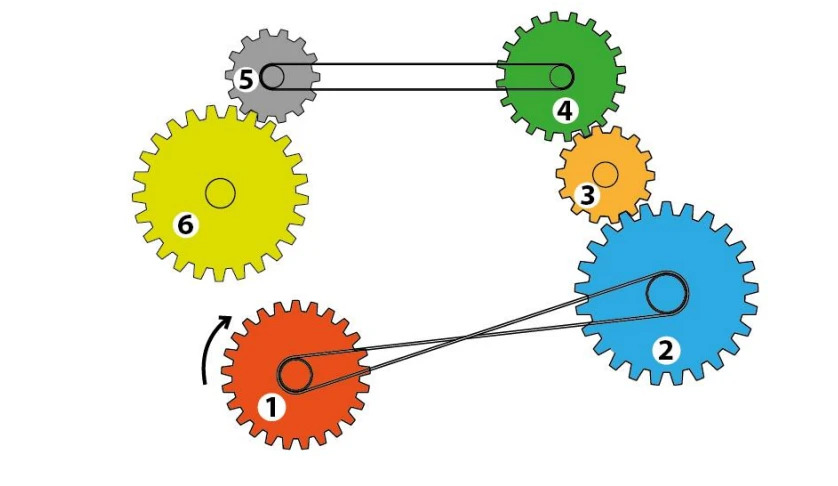
A. 1 and 6 rotate in the same direction.
B. 3 and 6 rotate in the opposite direction.
C. 1 and 4 rotate in the opposite direction.
D. 2 and 6 rotate in the same direction.
Answer: A, C
Knowing which topics make up the UCEED paper is just half work done - see how a Part A score converts to a rank in our UCEED marks vs rank breakdown and calibrate your prep accordingly.
3. Observation and Design Sensitivity Syllabus
These questions are designed to test your ability to detect concealed properties in ordinary things, people, situations, and events and to think critically about them.
|
Elements of Design, Layout & Principles of Design |
Visual logic and odd one out |
|
Colour Theory and Psychology |
Detecting errors or subtle differences in layouts/designs |
|
Visual Perception |
Matching shapes and forms |
|
Pattern recognition and completion |
Sample Questions:
Q. How many different patterns of pens are present in the given figure?
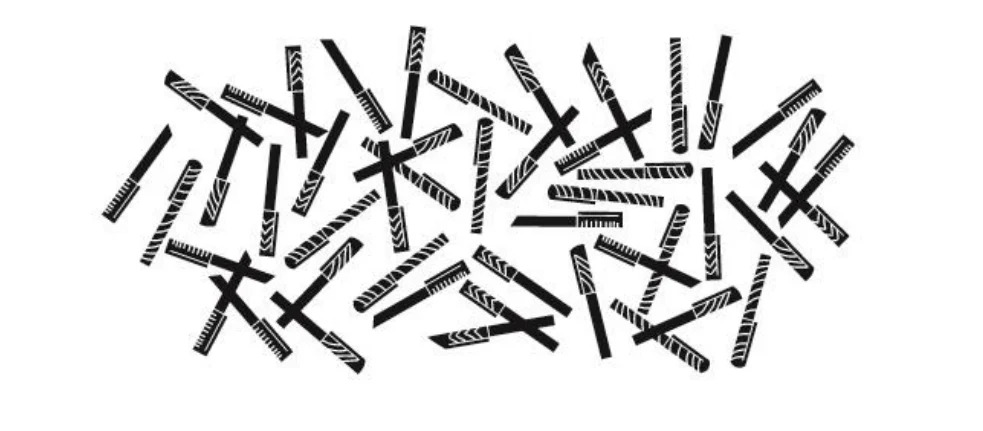
Answer: 5
Observation questions are quick to solve but only if you don't overthink them. Our UCEED time-management tips show how much maximum time you should spend per section.
4. Environment and Society
This section of UCEED syllabus includes question on general knowledge about environmental factors such as climate, population, water, vegetation, pollution, weather, natural resources, etc., and their implications on the design of products, images, infrastructure, and environment.
You should be aware of social and cultural connections with the design, the history of the designed artefact, and socially responsible and environmentally sustainable design responses.
|
History of Indian Art/Design, An overview of World Art, Art and Architecture, Social and Cultural relation with Art/Design. |
Environmental issues, design-related current affairs |
|
Environmentally Sustainable Designs |
Awareness of products, logos, media, advertising |
|
Indian cultural background and famous Structures, |
Musical instruments, Musical Maestros, Dance forms, Crafts, and Dresses. |
Sample Questions:
Q.1. Which global product is an example of user-centric design innovation?
A) Eames Lounge Chair
B) Coca-Cola Contour Bottle
C) Both A and B
D) None of the above
Answer: Both A, B
Q.2. Which material is most eco-friendly for temporary shelters?
A) Reinforced concrete
B) Bamboo
C) Aluminium sheets
D) PVC plastic
Answer: B
Reading the syllabus is only the first step, practicing questions on each topic consistently is what's going to help you crack the exam. Pressure-test every topic with a free UCEED mock test under real timing.
5. Analytical and Logical Reasoning
This section of the UCEED syllabus tests the ability to look at qualitative or quantitative information and discern patterns within the information. You should be able to weigh opinions, arguments or solutions against appropriate criteria.
Also, you should be able to check for hidden bias or assumptions and whether evidence and arguments provided support the conclusions.
Going through Data Interpretation, brainteasers, and patterns can be an advantage.
|
Arguments, Assumptions, Course of Action |
Syllogism (a process of logic in which two general statements lead to more precise information) |
|
Assertion and Reasoning |
Series, sequences, coding-decoding |
|
Causes and Effect |
Venn diagrams, statement-conclusion |
Sample Questions:
Q.1. In the cursed land of Weirdisthan, strength of animals was disproportionately distributed. Horse has half the strength of a Dog and four times the strength of an Elephant. Monkey has three times the strength of a Rhino. Elephant has half the strength of a Rhino. One Dog was becoming a danger for other animals and they decided to assign a team of animal soldiers to overpower him. Which team of soldiers managed to overpower the dog?
A) One Rhino and One Monkey
B) One Rhino, One Horse and One Elephant
C) One Horse and One Monkey
D) Two Horses
Answer: C
Q.2. Which of the options shows the word “TRANSFORM” as it would appear after it is reflected horizontally along AXIS 1 and then vertically along AXIS 2, as indicated in the figure below?
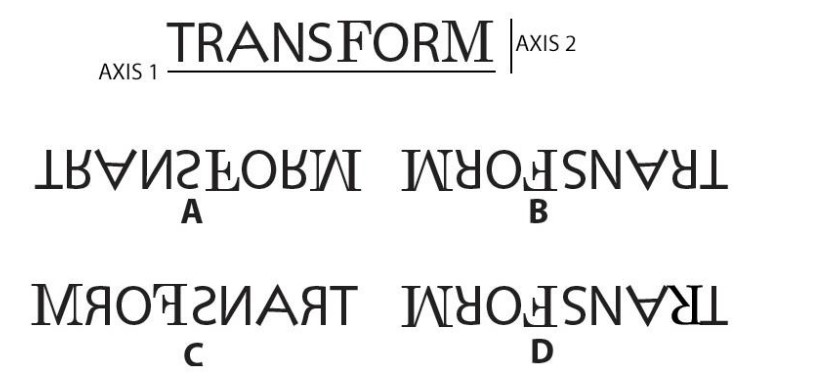
Answer: B
Reasoning has been one of the most dominant section of the paper for years- our UCEED exam analysis tracks how each section's difficulty has evolved year on year.
6. Language (English)
This section of the UCEED paper syllabus requires proficiency in reading and comprehending Standard English.
|
Questions from general English grammar. |
Standard English, Vocabulary, sentence formation, metaphors |
|
You should also be able to think creatively about alternatives, distinguish innovative options, and think outside the box. |
Story-based questions, creative writing prompts |
|
Grasp of verbal and non-verbal analogies, metaphors, signs and symbols. |
Pictorial questions that require language interpretation |
Sample Questions:
Q.1. Betty bought some butter but the butter was too bitter, so she put a little gummy to make the bitter butter yummy.” In the above sentence, if you replace every letter ‘t’ with letter ‘b’, what is the total number of instances in which the same letter appears at least twice in a word?
Q.2. Which slogan is most effective for a public bicycle-sharing campaign?
A) “Cycle today, save tomorrow.”
B) “Wheels of luxury.”
C) “Drive less, eat more.”
D) “Pedal your way to freedom.”
Note:
- Although there's no separate UCEED Maths syllabus, it can be integrated in questions from numerical ability test (NAT), spatial reasoning and analytical reasoning.
- The topics above are exhaustive and indicative of the nature of the questions. However, UCEED may or may not cover all the topics.
Language related questions often appear as fill-in-the-blanks in the exam - here's how to solve fill-in-the-blanks in design entrance exams without second-guessing.
7. Creativity
The Creativity topic from the UCEED syllabus checks how well you connect and reinterpret ideas, a must for design thinking.
As per official definition it covers - "grasp of verbal and non-verbal analogies, metaphors, signs and symbols." Practically you can expect questions that might ask you to spot the relationship between two things and apply it to a third, decode a symbol or sign, or pick the option that best completes a visual-verbal analogy.
|
Focus area |
What it means |
|
Verbal analogies |
Relationships between words/concepts (A is to B as C is to ?) |
|
Non-verbal analogies |
The same logic applied to shapes, images and patterns |
|
Metaphors |
Reading figurative meaning and visual metaphor |
|
Signs & symbols |
Interpreting icons, pictograms and symbolic cues |
Sample question:
Q. "Wheel is to car as ___ is to ship."
A) Sail B) Anchor C) Propeller D) Deck
Answer: C (the propeller drives a ship as the wheel drives a car (function analogy)).
Creativity overlaps with Part B's Design Aptitude, so practicing analogies and symbols would help in both.
For more exam-level practice questions work through our UCEED sample papers under timed conditions.
UCEED Exam Syllabus 2027: Part B
As per the UCEED Exam Pattern, Part B syllabus is about sketching and design thinking. It consists of two UCEED drawing questions for 50 marks each. It is a pen and paper-based test that lasts 60 minutes, and the question paper aims to test your drawing skills, which will require subjective evaluation.
1. Scene Creation / Perspective Drawing / Memory Drawing
Crucial Concepts:
- Perspective drawing (1-point, 2-point, 3-point)
- Product sketching (redesigning or imagining new products)
- Scene creation (from daily life, imaginative settings, futuristic environments)
- Human figure drawing in action or interaction
- Object proportion, scale, and foreshortening
- Expressing mood, context, or message visually
Sample Question:
Q. The competitive examinations are finally over and you are going on a holiday. You are at the nearest railway station with your family and relatives, waiting for the train that you can see, arriving. The platform is bustling with activity. Other travellers with luggage, vendors and porters (and whatever else you are likely to observe) are also on the platform. Imagine and draw what you see, giving prominence to your family and relatives.
Your UCEED score opens doors to institutes even beyond the seven core IITs - see the full list of UCEED colleges that accept the score.
2. Design Aptitude and Problem-Solving
This part of UCEED Syllabus 2027 requires that you should be able to use visual analogies, metaphors, signs, and symbols. Also, you must understand the complexity, identify the problem, generate alternatives, evaluate the options, and select solutions to score well in this section of the UCEED 2027 syllabus.
Crucial Concepts:
- Situational design questions
- User-centric problem scenarios
- Service design thinking
- Problem analysis and solution generation
- Scenario-based creative reasoning
Sample question:
Q. Redesign a classroom chair so that it can also hold a laptop safely. Sketch and label your design.
Proper form and proportion of human figures in perspective drawings is where most Part B scores are won or lost. Practice for them with our guide - designing sketches and human figures for UCEED.
Latest Updates on UCEED 2027 Exam Pattern
As per the UCEED 2027 Exam Pattern, the UCEED question paper consists of Parts A and B:
| Particulars | Details |
|
Conducting Body |
IIT Bombay |
|
Exam Mode for UCEED pattern |
Computer-based test (Part A) and Paper-based test (Part B) |
|
Exam Duration |
3 hours (Total) |
| Number of sections |
3 in Part A (NAT, MSQ, MCQ) and 2 in Part B (Drawing & Design Aptitude) |
|
Total UCEED marks |
300 [PART A - 200 Marks (2 Hrs) ; PART B - 100 Marks (1 Hr)] |
Part A filters candidates for Part B checking. However, both are required to score well to get top ranks.
Understanding UCEED 2027 syllabus will help you understand the skill sets required to perform well in the UCEED 2027 examination.
UCEED Marking & Shortlisting (Official)
Following is the official UCEED Marking Scheme as per the brochure of latest cycle (2026); expected to be same in 2027 as well.
Part A (200 marks, 2 hours):
|
Section |
Questions |
Marks (correct) |
Negative |
Section total |
|
NAT |
14 |
+4 |
none |
56 |
|
MSQ |
15 |
partial (up to +4) |
−1 (for wrong answer) |
60 |
|
MCQ |
28 |
+3 |
−0.71 |
84 |
|
Total |
57 |
200 |
Part B (100 marks, 1 hour): Sketching - 1 question (50 marks); Design Aptitude - 1 question (50 marks). Pencil only, no colors allowed unless specified.
How Shortlisting Works in UCEED
Only those who clear the Part A cutoff will get their Part B checked.
Part A cut-off for OPEN category is δ = μ + (σ/2), where μ and σ are the mean and standard deviation of all participants’ Part A marks. For other categories, relaxed cut-offs are 0.9δ (OBC-NCL/EWS) and 0.5δ (SC/ST/PwD).
Your Part B is evaluated only if you clear this cut-off - so a strong drawing can't save a weak Part A. Your final rank combines Part A + Part B. As for ties, first criteria is Part B marks, then MSQ, and then NAT.
Why Mastering Each Subject in UCEED 2027 Syllabus Matters
UCEED is not a 'draw-only' test. All UCEED subjects contributes to the final score in a different way:
- Some subjects are easy to score in quickly if you practice (e.g., visual reasoning, observation).
- Some require deliberate practice (e.g., drawing, design sensitivity).
- Some are low-effort, high-return (e.g., general design awareness, basic practical science).
Understanding the syllabus gives you a prioritized roadmap. Not equal time for all topics, but the right time for the right topics. Official syllabus sections (below) are the map you should follow.
UCEED Syllabus Preparation Roadmap (2027)
A successful preparation strategy for UCEED exam should focus on building fundamentals first, followed by practice, mock tests, and revision.
|
Timeline |
Focus Areas |
Goal |
|
Months 1-2 |
Visualization & Spatial Ability, Observation Skills, Design Sensitivity, English, Basic Reasoning, Sketching Fundamentals |
Build strong fundamentals in the highest-weightage UCEED topics |
|
Month 3 |
Creativity, Design Thinking, Environment & Society, Practical & Scientific Knowledge, Perspective Drawing |
Complete syllabus coverage and start solving topic-wise questions |
|
Month 4 |
Previous Year Papers, Part A Practice, Drawing & Design Aptitude Questions |
Learn actual UCEED question patterns and improve speed |
|
Month 5 |
Full-Length Mocks, Weak-Area Improvement, Timed Sketching |
Improve accuracy, time management, and exam temperament |
|
Final Month |
Revision, Mock Analysis, Error Log Review, Frequently Asked Topics |
Maximize score through revision and performance optimization |
The roadmap above is the summary - for a day-by-day version, follow our full UCEED study plan.
Topic-Wise Priority Order:
|
Priority |
UCEED Syllabus Topics |
|
Highest Priority |
Visualization & Spatial Ability, Observation & Design Sensitivity, Drawing, Design Aptitude |
|
High Priority |
Analytical & Logical Reasoning, Creativity, Design Thinking & Problem Solving |
|
Medium Priority |
Environment & Society, Practical & Scientific Knowledge |
|
Ongoing Throughout Preparation |
Language, Reading Comprehension, Sketching Practice |
Must Check: How to Improve Visual Spatial Ability for UCEED 2027?
FREE Study Resources to Cover Complete UCEED 2027 Syllabus
|
FREE UCEED Study Material Name |
Link |
|
UCEED Study Material for Drawing |
|
|
UCEED Study Material for Numerical Aptitude |
|
|
UCEED Study Material for Verbal Reasoning |
|
|
UCEED Study Material for Non-verbal Reasoning |
|
|
UCEED Study Material for Verbal Ability |
|
|
UCEED Study Material for General Awareness |
|
|
UCEED Study Material for Aptitude |
|
UCEED Preparation Books - Best Study Material to Cover UCEED 2027 Syllabus
It is essential to choose the right books that cover all topics per the latest UCEED 2027 syllabus. You may consider referring to the books listed below for your UCEED 2027 Preparation.
| List of UCEED Books PDF | Author(s)/Publisher |
| UCEED Original Previous Year Solved Papers (10 Years Solved Papers for part-A and part-B) | Creative Edge by Toprankers |
| Verbal and Non-Verbal Reasoning | RS Aggarwal |
| Quantitative Aptitude | RS Aggarwal |
The UCEED previous year papers book by Creative Edge is designed by expert mentors and alumni from India’s top design schools. It gives you complete exposure to the exam’s structure, difficulty level, and question style.
What truly sets this book apart is extensive explanation for Part-1 questions with shortcuts & tricks and exclusive QR-based Video Solutions for Part B (drawing section), a first-of-its-kind feature that lets you watch expert artists solve each creative problem step-by-step.
It's the only comprehensive UCEED book you need to practice for the highly competitive exam, decipher the question types/patterns, identify your strengths/weaknesses and crack the exam like a pro.
UCEED vs NID Syllabus 2027 - Quick Comparison Table
Many design aspirants usually prepare for both UCEED and NID, but the syllabus and focus areas differ significantly. Here's a comparison to help you understand these differences and prepare better:
|
Criteria |
UCEED |
NID |
|
Conducting Body |
IIT Bombay |
NID Admission Cell |
|
Degree Offered |
B.Des (6 IITs and 1 IIIT) |
B.Des (NIDs) |
|
Exam Parts/Phases |
Part A (NAT, MSQ, MCQ) Part B (Drawing) |
Prelims: Subjective Drawing Section and Objective Aptitude Section (MCQs; removed in 2026; might reappear) Mains: Studio Sensitivity Test (60%) + In-person Sensitivity Test (40%) |
|
Theory Section |
Part A: High focus on visualization, reasoning, and design thinking |
GAT: Emphasis on GK, math, logical reasoning and English |
|
Drawing Section |
Part B: Scene-based sketching (perspective drawing), product sketching, storytelling |
CAT: Poster making, product design / redesign, sequential art, perspective drawing, scene creation, design related problem-solving, storyboarding |
|
Design Thinking |
Tested directly through questions |
Through studio test and CAT questions |
|
Portfolio/Interview |
No |
Yes, as part of DAT Mains, after getting shortlisted in Prelims (CAT+GAT) |
NID's selection process was revised in 2026 (GAT removed, Prelims made qualifier-only round for Mains). Confirm current details in the official NID Admissions Handbook at admissions.nid.edu.
So Can You Prepare for UCEED and NID 2027 Together?
Yes. The UCEED syllabus and NID DAT syllabus have significant overlap in areas such as visualization, observation, creativity, design thinking, problem-solving, and sketching. With a well-planned strategy, aspirants can prepare for both exams simultaneously and then focus on exam-specific topics closer to the actual test dates.
Understanding syllabus and practicing questions can help you improve, but to set a target score for admission to top IITs, it's important to know what is a good score in UCEED.
Frequently Asked Questions (FAQs) About Syllabus of UCEED
1. What is the syllabus for 2027 UCEED exam?
The UCEED 2027 syllabus defines the topics and skills tested in the Undergraduate Common Entrance Examination for Design in 2027. It is prescribed by IIT Bombay and evaluates candidates on design aptitude, logical reasoning, visualization, creativity, and drawing ability through Part A (objective) and Part B (drawing) sections.
2. Has the UCEED Syllabus changed?
No, the syllabus for UCEED has not changed significantly in recent years. IIT Bombay follows a stable syllabus structure, though the difficulty level and nature of questions may vary each year. The core focus areas remain the same.
3. Is UCEED 2027 syllabus same as last year?
Yes, the UCEED 2027 syllabus is expected to be the same as the previous year’s syllabus. UCEED does not introduce frequent syllabus changes. Candidates preparing as per the latest available structure (2026) are effectively preparing for UCEED 2027.
4. What are the subjects in UCEED 2027?
UCEED does not have traditional subjects like Physics or Chemistry. Instead, the syllabus is divided into skill-based areas tested across two parts:
- Part A: Visualization & spatial reasoning, logical reasoning, numerical ability, design sensitivity, environmental & social awareness, language & creativity
- Part B: Drawing, perspective, visual storytelling, creativity, and design problem-solving
UCEED focuses on design aptitude and thinking skills, not textbook subjects.
5. Does UCEED require maths?
UCEED does not require advanced mathematics. Only basic maths is included as part of numerical ability in Part A, such as percentages, ratios, averages, speed-time, and logical calculations.
No formulas from higher-level mathematics are needed. Strong logic and accuracy matter more than maths proficiency.
6. Is UCEED difficult?
UCEED is considered moderately to highly competitive, not academically difficult.
The challenge lies in:
- Time pressure
- Conceptual and logic-based questions
- Design thinking and visualization skills
7. Is the UCEED 2027 syllabus based on Class 11 and 12?
No, the syllabus is not strictly based on Class 11 or 12 textbooks. It focuses on aptitude and thinking skills, not academic theory. School-level knowledge may be helpful, but UCEED primarily tests visualisation, observation, problem-solving, application, and reasoning.
8. Is the UCEED 2027 syllabus the same for all candidates?
Yes, the syllabus is the same for all candidates targeting the 2027 UCEED exam. There is no separate syllabus based on background (science, commerce, or arts). All aspirants are tested on the same design-aptitude framework.
Conclusion
A close look at the syllabus reveals that the UCEED exam consistently rewards three skills above everything else: visualization, observation, and design thinking.
While many aspirants spend months collecting resources, the real differentiator is how effectively they practice these skills through mock tests, sketching exercises, and previous year papers.
If you're preparing for the 2027 or 2028 attempt, treat the UCEED exam syllabus as a priority map:
- master the high-frequency topics first
- focus on application rather than theory
- seek feedback
- and regularly test yourself against actual UCEED questions.
That's the most reliable way to convert syllabus coverage into a strong UCEED rank.
Preparing for UCEED 2027? We can help you with exact strategic roadmap, study material and crucial feedback required to ace this exam.
Join the best UCEED Online Coaching by Creative Edge and get expert guidance on all UCEED 2027 subjects.


Attempt a Free UCEED Mock Test
Fill your details
Frequently Asked Questions
What is the UCEED syllabus?

Does UCEED require maths?
What is the UCEED 2027 Syllabus for Environmental and social awareness section?
What is the UCEED Part B (drawing) syllabus?
What is the UCEED marking scheme?
How are candidates shortlisted in UCEED?
What's the difference between the UCEED syllabus and UCEED important topics?
Is the UCEED syllabus based on Class 11 and 12?
Is the UCEED syllabus the same as NID and CEED?
Vineeta Agrawal
Communications Executive
SHARE