


How To Prepare for General Studies for UP Judiciary 2026: GK Study Plan UPPCS J Preparation
November 11, 2026
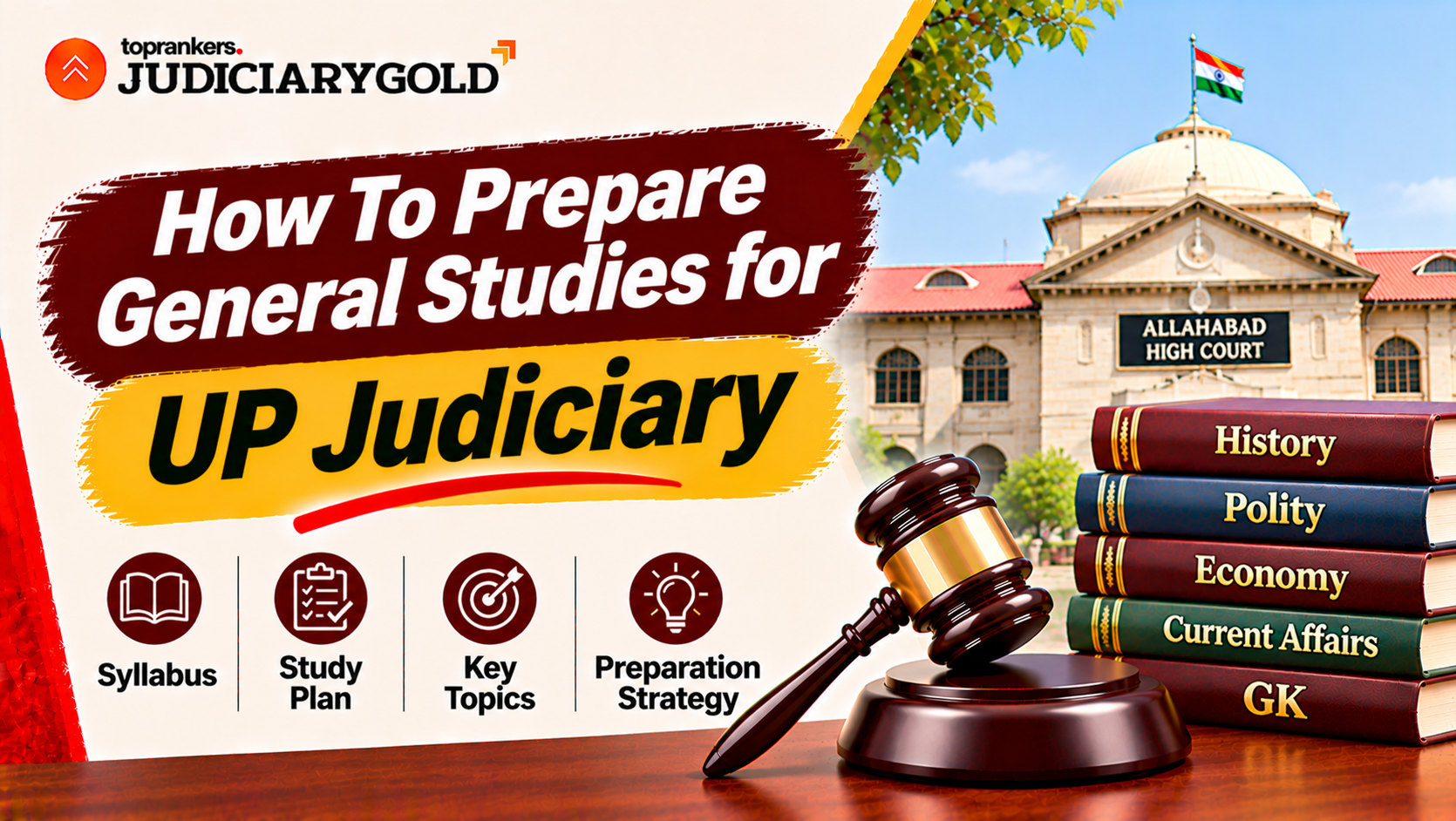
UP Judiciary General Studies preparation covers the General Knowledge part of the UP PCS J exam which carries 150 marks in Prelims (objective) and 200 marks in Mains (written).
Candidates should cover the eight areas of the official UPPSC syllabus, including nine social-welfare Acts, using NCERTs, one newspaper and past papers, in 1.5 to 2 hours a day alongside law.
UP Judiciary 2026 General Studies Paper Overview
The table below provides information about who conducts the exam, how the GK paper is set at each stage and which syllabus applies. Candidates can check this against the next UPPSC advertisement when it is released.
| Particulars | Details |
|---|---|
| Exam | U.P. Judicial Service Civil Judge (Junior Division) Examination (UP PCS J) |
| Conducted by | Uttar Pradesh Public Service Commission (UPPSC), on requisition from the Allahabad High Court |
| GK in Prelims | Paper I is an objective paper worth 150 marks and lasts 2 hours. The penalty is one-third mark per wrong answer. |
| GK in Mains | Paper 1 is a written paper worth 200 marks and counts towards final merit. |
| Syllabus source | The latest official syllabus is in the UPPSC advertisement for the 2022 examination. |
| 2026 notification | Awaited |
What does the UP Judiciary General Studies paper test?
The UP Judiciary General Studies paper tests broad awareness of India and the world, not specialist knowledge. UPPSC states that questions are set so that a well-educated person can answer them without specialised study.
The same syllabus applies to both stages. What changes is the format and how much the marks matter.
UP Judiciary GK syllabus 2026
The UP PCS J GK syllabus has eight areas, listed in the UPPSC advertisement for the 2022 examination. No newer syllabus has been issued, so treat this as current until the next advertisement.
| Syllabus area (official wording) | What to study |
|---|---|
| History of India and Indian Culture | Ancient, medieval and modern Indian history, the freedom struggle, and Indian art, architecture, religion and literature |
| Geography of India | Physical features, rivers, climate, soils, agriculture, minerals, population and transport |
| Indian Polity | Constitution, Parliament, judiciary, federalism, local government and constitutional bodies |
| Current National Issues and topics of social relevance | National news, government schemes and the nine Acts listed in the next section |
| India and the World | Foreign policy, relations with neighbouring countries, bilateral agreements and India's role in global groupings |
| Indian Economy | Budget, Economic Survey basics, banking, RBI, inflation, poverty and employment schemes |
| International Affairs and Institutions | UN bodies, WTO, IMF, World Bank, regional groupings and summits |
| Science and Technology, Communications and Space | ISRO missions, defence technology, IT, telecom, and developments in health and biotechnology |
Candidates can refer for the law papers and the complete subject list on UP Judiciary syllabus.
Nine social-welfare Acts in the GK syllabus for UP Judiciary 2026
The GK syllabus names nine Acts under "topics of social relevance", with a focus on sensitivity towards persons with disabilities, senior citizens, and offences against women and children. This is where a law graduate has an edge, because these are statutes you can read in a bare act.
| Act | What to know first |
|---|---|
| Rights of Persons with Disabilities Act, 2016 | 21 specified disabilities. Benchmark disability is 40% or more. Reservation is 4% in government posts and 5% in higher education seats. |
| Maintenance and Welfare of Parents and Senior Citizens Act, 2007 | Maintenance Tribunal, monthly maintenance cap of ₹10,000 and abandonment of a senior citizen as an offence. |
| Dowry Prohibition Act, 1961 | Giving or taking dowry carries a minimum of five years and a fine. Demanding dowry is a separate offence. Review the role of Dowry Prohibition Officers. |
| Protection of Women from Domestic Violence Act, 2005 | Covers physical, sexual, verbal, emotional and economic abuse. Review the role of Protection Officers and the protection, residence and monetary orders a Magistrate can issue. |
| Sexual Harassment of Women at Workplace (Prevention, Prohibition and Redressal) Act, 2013 | Internal Committee at workplaces with 10 or more people, Local Committee at the district level and a three-month deadline for filing a complaint. |
| Pre-Conception and Pre-Natal Diagnostic Techniques (Prohibition of Sex Selection) Act, 1994 | Prohibits sex selection and disclosure of foetal sex. Review clinic registration and the role of supervisory boards. |
| Medical Termination of Pregnancy Act, 1971 | The 2021 amendment raised the limit to 24 weeks for specified categories. Review the role of Medical Boards in cases of substantial foetal abnormalities. |
| Indecent Representation of Women (Prohibition) Act, 1986 | Prohibits indecent depiction of women in advertisements, publications, writings and paintings. |
| Protection of Children from Sexual Offences Act, 2012 | Defines a child as anyone under 18. The Act is gender-neutral and provides for Special Courts and mandatory reporting. |
How to prepare General Studies for UP Judiciary 2026: Step by step
Candidates can start with past papers, build static GK from a few fixed sources, and run current affairs as a daily habit. The order matters because past papers tell you which parts of the syllabus actually get asked.
- Go through the UP Judiciary previous year question papers for the GK paper and tag each question by syllabus area. Two papers are enough to see the pattern.
- Use NCERTs for history, geography and economy before any one-liner book. One-liners stick only when the concept behind them is clear.
- You already know Articles and Schedules from Constitutional Law. Add constitutional bodies, local government and recent amendments, and finish the nine Acts in your second week.
- Keep a rolling 12-month file, because the exam date is not yet known.
- Practise topic-wise questions, then full GK papers under a two-hour limit.
- Write two GK answers a week. Waiting until after Prelims leaves too little time for a 200-mark descriptive paper.
Subject-wise strategy for UP PCS J General Studies
Each GK area needs a different amount of depth. The pointers below is a starting point; adjust it once you have tagged the past papers.
History of India and Indian Culture
Modern India and the freedom struggle deserve the most time, followed by culture (temples, dance forms, literature, religious movements). For ancient and medieval history, focus on dynasties, rulers, administration and major texts rather than every battle. Make a timeline sheet for 1857 to 1947 and revise it weekly.
Geography of India
Study Indian physical geography with an atlas open. Rivers and their tributaries, national parks, mountain passes, and crop-producing states are frequent MCQ material. Candidates can refer geography preparation for UP Judiciary breaks the topics down further.
Indian Polity
For a law graduate this is the quickest area to finish. Cover what LLB courses often skip: constitutional and statutory bodies, the 73rd and 74th Amendments, emergency provisions in practice, and recent constitutional amendments.
Indian Economy
Keep it conceptual. Learn the terms (repo rate, fiscal deficit, GDP, inflation measures), the structure of banking and the RBI, and the main points of the latest Union Budget and Economic Survey. Avoid memorising year-old figures.
India and the World, and International Affairs and Institutions
Prepare a one-page sheet per institution: headquarters, members, India's role and any recent summit. Add India's relations with each neighbour and major bilateral agreements from the last year.
Science and Technology, Communications and Space
Follow ISRO missions, defence tests, digital public infrastructure, telecom policy and health technology in the news. Learn the basic science behind each development, just enough to answer "what is it" and "why does it matter".
Current National Issues
Track government schemes, national awards, appointments to constitutional posts, reports and indices, and landmark Supreme Court judgments. Judgments double as material for the law papers and the interview.
How to prepare current affairs for UP Judiciary 2026
Cover the 12 months before the exam, from one newspaper and one monthly compilation. More sources rarely mean more marks; they mean more revision you will not finish.
- Read one national newspaper (The Hindu or The Indian Express) for 45 to 60 minutes. Skip politics-as-gossip, sports gossip and city news.
- Note only what fits a syllabus area: schemes, Acts and amendments, judgments, appointments, summits, reports, space and defence events.
- Use the Press Information Bureau for exact scheme names and launch dates.
- Revise with daily current affairs and close each month with a 50-question quiz.
- Interlink: when an Act is amended or a scheme is launched for women, children, senior citizens or persons with disabilities, add it to your notes on the nine Acts.
How to prepare GK for UP PCS J 2026 Mains
Mains Paper 1 is a 200-mark written paper, so knowing a fact is not enough; you need to explain it clearly in limited time.
- Read the GK questions in past Mains papers to see the question style before you start writing practice answers.
- Structure each answer: a one-line definition or context, three or four points with a fact, scheme name or provision, and a one-line conclusion.
- Quote data and provisions you can stand behind: a section number, a scheme's year, an Article. Vague answers score poorly.
- Practise in the language you will write in. Many candidates write in Hindi; if you do, build your notes in Hindi from the start.
- Time yourself on full papers in the last month.
Best books and sources for UP Judiciary General Studies 2026
Candidates can add a one-liner book only for revision and MCQ practice and for law subjects, refer the best books for UP Judiciary.
| Area | Main source | For revision and MCQs |
|---|---|---|
| History and culture | NCERT History (Classes 6–12), A Brief History of Modern India (Spectrum), and India's Struggle for Independence (Bipan Chandra) | Lucent's General Knowledge |
| Art and culture | NCERT An Introduction to Indian Art (Class 11) and Indian Art and Culture (Nitin Singhania) | Lucent's General Knowledge |
| Geography | NCERT India: Physical Environment (Class 11), NCERT India: People and Economy (Class 12), and a school atlas | Ghatna Chakra |
| Polity | Indian Polity (M. Laxmikanth) | Bare text of the Constitution |
| Economy | NCERT Indian Economic Development (Class 11) and summaries of the latest Union Budget and Economic Survey | Ghatna Chakra |
| Social-welfare Acts | Bare texts of the nine Acts | Your one-page notes for each Act |
| Current affairs | PIB releases and The Hindu newspaper | A monthly current affairs compilation |
12-Week GK Study Plan for UP Judiciary
Candidates can set aside 1.5 to 2 hours a day for GK and use the rest of your study time for law. Stretch the plan to 16 weeks if you are still in college.
| Weeks | GK focus | Practice |
|---|---|---|
| 1–2 | Review the syllabus, sort past-paper questions by topic, fill gaps in polity and study the nine Acts. | Read a newspaper daily and start a current affairs file. |
| 3–4 | Modern history, the freedom struggle, and art and culture | Answer 25 MCQs a day from completed topics. |
| 5–6 | Indian geography with atlas practice | Write one Mains GK answer a week. |
| 7–8 | Indian economy, the Union Budget and the Economic Survey | Take topic-wise tests. |
| 9 | Ancient and medieval history | Write two Mains answers this week. |
| 10 | International affairs and institutions, and India and the World | Take a monthly current affairs quiz. |
| 11 | Science and technology, communications and space | Attempt two full GK mock papers. |
| 12 | Revise all topics using your own notes. | Attempt three full GK mock papers under timed conditions. |
Key takeaways
Here is the 12-week UP Judiciary GK plan in brief, so you can see what each phase asks of you at a glance.
- Give GK 1.5 to 2 hours a day and keep the rest for law. If you are still in college, stretch the plan to 16 weeks.
- Finish Polity and the nine social-welfare Acts in the first two weeks, since a law graduate covers these fastest.
- Take static GK in this order: modern history and culture, geography, economy, ancient and medieval history, international affairs, then science and technology.
- Start daily MCQs from week 3 and Mains answers from week 5, moving from one to two answers a week by week 9.
- Keep the newspaper and current affairs file running through all 12 weeks, not just at the end.
- Use weeks 11 and 12 for full GK mocks under the two-hour limit, and revise only from your own notes in the final week.
If you want a structured guidance, take a free demo online class or talk to a Judiciary Gold counsellor about the course.
Download Judiciary Study Material
Fill your details
Frequently Asked Questions
How many hours a day should I give to GK for UP Judiciary 2026?

Which is the best book for UP Judiciary General Studies?
Do Prelims GK marks count in the final UP PCS J merit list?
Should I make GK notes online or on paper?
Is there UP-specific GK in the UP PCS J 2026 syllabus?
Which newspaper is best for UP Judiciary 2026 current affairs?
Nancy Mahavir Sharma
Legal Writer
SHARE