


UP Judiciary Books 2026 — Best Books for Prelims, Mains & New Criminal Laws
October 30, 2026
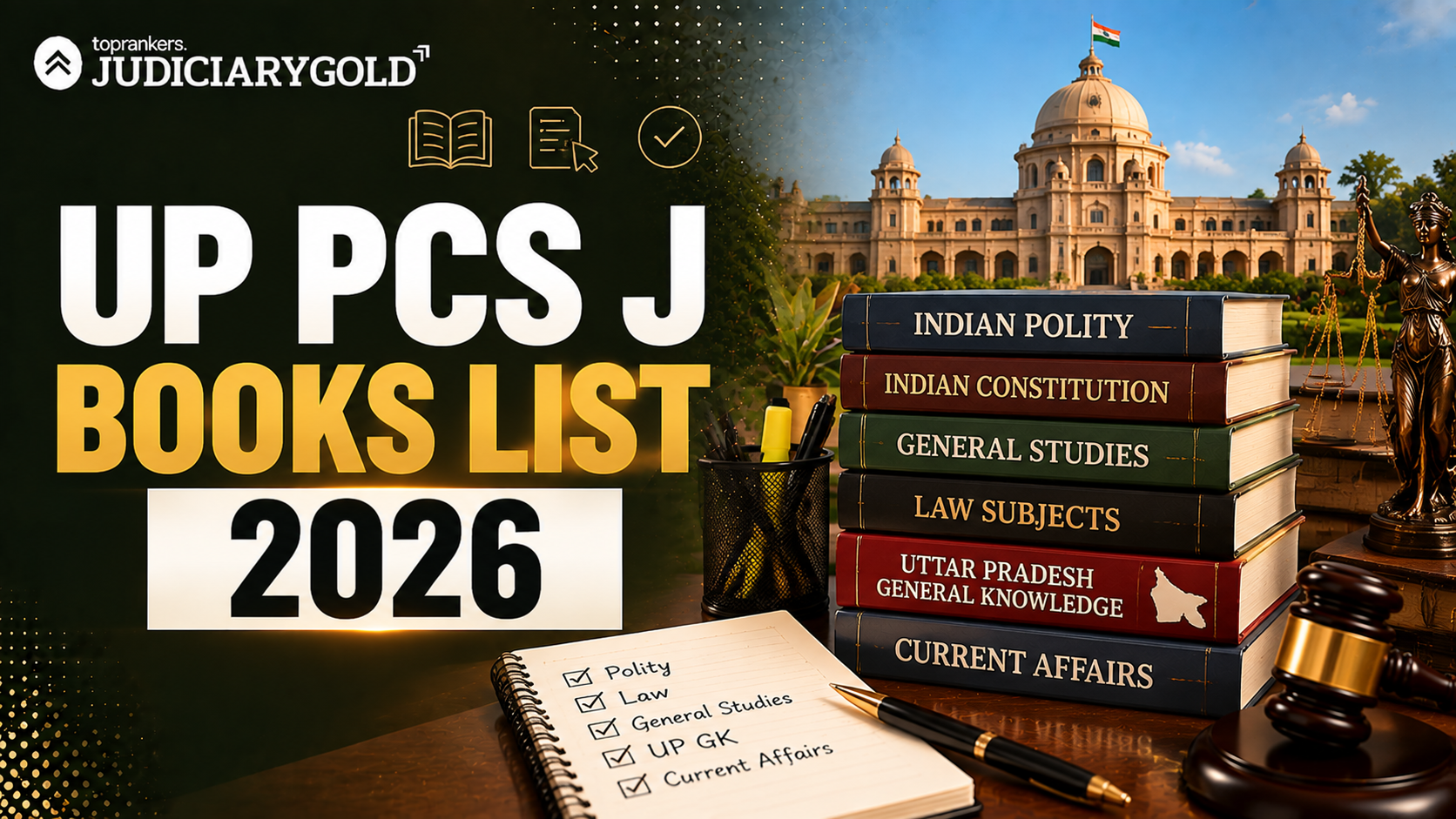
The best UP Judiciary books can save you months of reading the wrong material. This UP PCS J book list 2026 maps one trusted book to every subject in the Prelims and Mains syllabus, from the Constitution and CPC to the new criminal laws and UP revenue and local laws.
- Start with the bare act of each law, then add one standard textbook per subject.
- For criminal law, prepare from only BNS, BNSS and BSA editions, since these replaced the IPC, CrPC and Evidence Act on 1 July 2024.
UP PCS J Book List 2026 Overview
The UP Judiciary syllabus is vast, and many books are available to help you prepare. To make it easier for you, we have compiled a list of top books recommended by experts for the UP PCS J Exam 2026.
The table below lists one core book for each UP PCS J subject, mapped to the Prelims and Mains paper it serves. Read each book alongside the bare act of that law, and pick only BNS, BNSS and BSA editions for criminal law.
For UP revenue and local laws, the latest bare acts with rules are the main source.
| Subject | Book | Author | Use for |
|---|---|---|---|
| General Knowledge | Lucent's General Knowledge | Lucent | Prelims + Mains |
| Indian Polity | Indian Polity | M. Laxmikanth | Prelims + Mains |
| Constitution | Indian Constitutional Law | M.P. Jain | Prelims + Mains |
| Contract & Specific Relief | Law of Contract and Specific Relief | Avtar Singh | Prelims + Mains |
| Transfer of Property | Property Law | Poonam Pradhan Saxena | Prelims + Mains |
| Civil Procedure | Civil Procedure with Limitation Act | C.K. Takwani | Prelims + Mains |
| BNSS | The Bharatiya Nagarik Suraksha Sanhita † | Ratanlal & Dhirajlal | Prelims + Mains |
| BSA | Law of Evidence, BSA edition † | Batuk Lal | Prelims + Mains |
| BNS | Textbook on Bharatiya Nyaya Sanhita † | K.D. Gaur | Prelims + Mains |
| Jurisprudence | Studies in Jurisprudence and Legal Theory | N.V. Paranjape | Prelims |
Best Books for UP PCS J Prelims 2026
The Prelims has two objective papers: General Knowledge (150 marks) and Law (300 marks), two hours each. Every wrong answer costs one-third of a mark. Prelims marks only decide who reaches Mains, so aim for accuracy over coverage.
The marks, timing and negative marking for both papers are explained in the UP Judiciary exam pattern.
Paper I: General Knowledge
Paper I covers Indian history, geography, polity, economy, science, current affairs and social-welfare laws for women, children and senior citizens. Two static books and a daily newspaper are enough if you revise them often. For topic-wise coverage, see UP Judiciary general studies preparation.
| Area | Book | Author / Publisher |
|---|---|---|
| Static GK | Lucent's General Knowledge | Lucent |
| Static GK practice | General Knowledge | Manohar Pandey (Arihant) |
| Polity | Indian Polity | M. Laxmikanth |
| Yearly facts | Manorama Yearbook | Malayala Manorama |
| Current affairs | The Hindu or The Indian Express | — |
Paper II: Law
Paper II carries double the marks of Paper I and usually decides who clears Prelims. It tests Jurisprudence, International Organisations, the Constitution, Contract, Transfer of Property, CPC, BNS, BNSS and BSA. Check the topic list in the UP PCS J Prelims syllabus before you start.
| Subject | Book | Author |
|---|---|---|
| Constitution | Indian Constitutional Law | M.P. Jain |
| Constitution (simpler option) | Constitutional Law of India | J.N. Pandey |
| Jurisprudence | Studies in Jurisprudence and Legal Theory | N.V. Paranjape |
| International Organisations | International Law & Human Rights | S.K. Kapoor |
| Law of Contract | Law of Contract and Specific Relief | Avtar Singh |
| Transfer of Property | Property Law | Poonam Pradhan Saxena |
| Civil Procedure | Civil Procedure with Limitation Act | C.K. Takwani |
| BNS | Textbook on the Bharatiya Nyaya Sanhita | K.D. Gaur |
| BNSS | The Bharatiya Nagarik Suraksha Sanhita | Ratanlal & Dhirajlal |
| BSA | Law of Evidence (BSA 2023 edition) | M. Monir |
Best Books for UP PCS J Mains 2026
Mains is a written exam of 1,000 marks, followed by a 100-mark interview. Examiners reward answers that cite the correct section and one relevant judgment, so choose textbooks that explain leading cases.
The gap between the Prelims result and Mains has been only a few weeks in past cycles, so start Mains reading before Prelims. Use the UP Judiciary Mains preparation to plan paper-wise time.
Law I: Substantive Law
Law I is the widest paper, covering civil, property, family and constitutional law. Problem-based questions are common, so practise applying each section to a set of facts. Past questions are in our UP PCS J Mains question papers.
| Subject | Book | Author |
|---|---|---|
| Contract & Specific Relief | Law of Contract and Specific Relief | Avtar Singh |
| Partnership | Introduction to the Law of Partnership | Avtar Singh |
| Torts | The Law of Torts | Ratanlal & Dhirajlal |
| Torts (simpler option) | Law of Torts | R.K. Bangia |
| Transfer of Property & Easements | Property Law | Poonam Pradhan Saxena |
| Equity, Trusts & Specific Relief | Equity, Trusts and Specific Relief | B.M. Gandhi |
| Hindu Law | Modern Hindu Law | Paras Diwan |
| Muslim Law | Mohammedan Law | Aqil Ahmed |
| Muslim Law (reference) | Principles of Mahomedan Law | D.F. Mulla |
| Constitution | Indian Constitutional Law | M.P. Jain |
Law II: Procedure and Evidence
Law II tests how a civil or criminal case moves through court, from pleadings to judgment. Answers score well when they set out the procedure step by step with section numbers. Our judiciary Mains answer-writing tips show how to structure them.
| Subject | Book | Author |
|---|---|---|
| Civil Procedure | Civil Procedure with Limitation Act | C.K. Takwani |
| BNSS | The Bharatiya Nagarik Suraksha Sanhita | Ratanlal & Dhirajlal |
| BSA | Law of Evidence (BSA 2023 edition) | M. Monir |
| Pleading | Order VI–VIII of the CPC with your CPC textbook | C.K. Takwani |
Law III: Penal, Revenue and Local Laws
Law III carries 200 marks: about 50 for the Bharatiya Nyaya Sanhita and about 150 for UP revenue and local laws. For BNS, use K.D. Gaur's Textbook on the Bharatiya Nyaya Sanhita with the bare act.
Because local laws carry three times the weight of BNS here, plan this paper around the UP Acts. The full Act list is in the UP Judiciary Mains syllabus.
Books for UP Revenue and Local Laws
Most local-law questions come straight from the sections, so the latest bare act with rules is the main book for each Act. Add a commentary only after you know the bare act well.
| Act | What to read |
|---|---|
| U.P. Revenue Code, 2006 | Bare act with the U.P. Revenue Code Rules, 2016 |
| U.P. Urban Buildings (Regulation of Letting, Rent and Eviction) Act, 1972 | Bare act |
| U.P. Regulation of Urban Premises Tenancy Act, 2021 | Bare act |
| U.P. Municipalities Act, 1916 | Bare act |
| U.P. Panchayat Raj Act, 1947 | Bare act |
| U.P. Consolidation of Holdings Act, 1953 | Bare act |
| U.P. Urban Planning and Development Act, 1973 | Bare act |
Books for the English and Hindi Language Papers
The language papers test essay, précis and translation between Hindi and English.
These papers reward regular practice more than extra books. Daily reading for the legal current affairs section also builds the vocabulary you need for essays.
| Paper | Resource | Use it for |
|---|---|---|
| English | High School English Grammar and Composition — Wren & Martin | Grammar, précis, essay structure |
| Hindi | A standard Hindi grammar (vyakaran) book | Grammar, précis |
| Both | Past Mains language papers | Timed essay and translation practice |
| Both | Hindi–English diglot bare acts | Legal terms in both languages |
Translation is where English-medium candidates lose the most marks. Translate one passage each way every week and compare it with a model answer.
BNS, BNSS and BSA: Which Books Replace IPC, CrPC and Evidence Act Titles
The Bharatiya Nyaya Sanhita, Bharatiya Nagarik Suraksha Sanhita and Bharatiya Sakshya Adhiniyam replaced the IPC, CrPC and Indian Evidence Act on 1 July 2024. Buy editions written for the new codes. Older IPC or CrPC books still help with case law, but their section numbers no longer match.
| Old law | New law | Book to buy |
|---|---|---|
| Indian Penal Code, 1860 | Bharatiya Nyaya Sanhita, 2023 | K.D. Gaur, Textbook on the Bharatiya Nyaya Sanhita |
| Code of Criminal Procedure, 1973 | Bharatiya Nagarik Suraksha Sanhita, 2023 | Ratanlal & Dhirajlal, The Bharatiya Nagarik Suraksha Sanhita |
| Indian Evidence Act, 1872 | Bharatiya Sakshya Adhiniyam, 2023 | M. Monir, Law of Evidence (BSA 2023 edition) |
UP PCS J Books in Hindi
Hindi-medium candidates can use the same subject list with these editions.
Check the language and medium rules in the UP Judiciary exam pattern before choosing your books.
| Subject | Hindi resource |
|---|---|
| General Knowledge | Lucent's Samanya Gyan |
| Polity | Bharat ki Rajvyavastha — M. Laxmikanth |
| BNS, BNSS, BSA | Hindi–English diglot bare acts of the three codes |
| Other law subjects | Hindi bare acts of each Act in the syllabus |
How to Choose UP PCS J Books
Most aspirants buy too many books and finish none. A short list read three times beats a long list read once. Use these five checks before you buy, and see our judiciary exam study plan for how to fit them into your routine.
- Match the syllabus first. Buy a book only if it covers a subject listed for Prelims or Mains.
- Check the criminal-law edition. Any BNS, BNSS or BSA book should be printed after July 2024.
- Keep one textbook per subject. Add a second only for a subject you keep getting wrong in mocks.
- Read with the bare act open. Questions quote the section text, not the textbook.
- Prefer books that cite cases. Mains answers need a section and a leading judgment.
Preparing for another state as well? See the book list for other state judiciary exams.
How to Read These Books: Suggested Order
Reading in the right order saves time, because procedural laws make substantive laws easier to understand. This six-month order covers both Prelims and Mains. Keep an eye on upcoming judiciary exams to adjust it to the actual exam date.
- Months 1–3: Constitution, CPC and BNSS with bare acts, plus one GK subject at a time.
- Months 4–5: BNS, BSA, Contract, Transfer of Property and Jurisprudence. Start topic-wise questions from past papers.
- Month 6: Hindu and Muslim law, Torts, Trusts and the UP local Acts. Write two Mains answers a week.
- Last 60 days: Revise from your own notes, take two full mocks a week and read one local-law bare act daily.
For a week-by-week schedule, see UP Judiciary preparation tips and study plan.
If you want a structured guidance, take a free demo online class or talk to a Judiciary Gold counsellor about the course.
Download Judiciary Study Material
Fill your details
Frequently Asked Questions
Are the UP Judiciary Books available online?

Can I find UP PCS J Preparation Books in Hindi?
Which is the best UP PCS J Syllabus books for Prelims Exam?
What are the most recommended books UP PCS J Books for BSA preparation?
List some important books for the preparation of UP Judiciary Hindu Laws?
Should I make online notes or offline notes while referring to UP PCS J Books?
Nancy Mahavir Sharma
Legal Writer
SHARE