
1723534562.png)

NID Drawing Tips 2027: How to Improve Your DAT Sketching
August 25, 2026
To improve your drawing for the NID DAT, you need 4 string pillars:
- observation (sketch real objects and people daily)
- fundamentals in place (line, form, proportion, perspective and shading)
- solid idea generation (build habit to think of at least 5 unique alternatives of an initial idea)
- and speed under time (timed practice with previous-year papers)
Since the NID Prelims paper in the last cycle (2026) was fully drawing-based, daily sketching plus a weekly full-length practice paper is the best way to improve.
Play by one single rule- NID looks for sharp thinkers, not artists. A clear idea will always beat a pretty sketch with no vision.
Key Highlights- How to Improve NID Drawing Skills
- Ideas over empty art: NID has known to prefer unique concepts, storytelling and problem-solving more than neat artistic sketches.
- Daily habit: Nothing can improve proportion, observation, and form understanding like daily 20-30 minutes sketching of day-to-day objects and scenes.
- Master the fundamentals first: Start with line, shape, form, texture practice, then move to one/two/three point perspective, and light & shadow.
- Practise NID question types: memory drawing, scenario/storyboard, product sketching and visual composition.
- Train for speed: the Prelims is ~3 hours for 5-6 questions with sub parts, it can get lengthy - so timed practice is essential.
- Learn from real papers: solve at least 10+ NID previous year papers under timed conditions to best understand what, how and why behind NID drawing questions.
- Get feedback: mentor-reviewed sketches improve faster than self-assessment.
Looking for tips on how to improve NID drawing skills for the 2027 exam? Explore suggestions to improve drawing from actual mentors who've guided thousands to their dream NID colleges.
NID Drawing Question Paper Pattern- What the NID DAT Drawing Test Actually Looks Like
The NID DAT is conducted in two stages-
the Prelims (a single offline, pen-and-paper drawing test)
the Mains (a Studio Test plus interview) - only if you qualify after Prelims.
In the 2026 cycle, the Prelims was fully drawing-based, with no separate aptitude (GAT) section - the entire paper tested creativity, design thinking and problem-solving through drawing.
Typically the NID drawing paper features:
- 5-6 main questions, often with sub-parts (scenario-based drawing, product sketching, and design problem-solving)
- Roughly 15-20 marks per question, to be solved in about 3 hours
- Fully subjective, concept-driven tasks - ideas and clarity matter more than aesthetics.
NID publishes no fixed pattern or official syllabus for the drawing test, and since 2026 the Prelims acts as a qualifier while the Mains Studio Test carries the selection weight - so strong drawing skills matter at both stages. For the full structure, see the NID exam pattern.
What Has Changed?
Earlier, NID included both GAT + CAT, but now the focus has shifted to:
- 100% CAT (drawing + thinking)
- Prelims has become a qualifier only round for DAT Mains
The NID exam 2027 question paper is expected to give more emphasis on ideas, logic, and creativity over neatness.
However, considering the past year trends, no one can say if the GAT will reappear in future attempts of NID 2027 or 2028. Experts predict the following weightage distribution if GAT section does find a place again.
| Exam Part | Type of Questions | No. of Questions | Marks |
| Part I | Objective type questions | 14 to 25 questions | 20-30 |
| Part II | Subjective type questions | 4 to 5 questions | 70-80 |
| Total | 100 marks | ||
The objective questions in GAT section might include basic-level quantitative aptitude, logical reasoning, general knowledge, current events, and English.
Meanwhile, the subjective questions might include Rendering, Scene Creation or Perspective Questions, Human figures, Scale/Proportion, Design Solutions, and other Topics.
The NID drawing section carries maximum weightage in the NID marking scheme, making it of utmost importance for clearing the exam. With a few tips on how to improve your NID drawing skills, you can easily crack it.


The NID Drawing Question Types (and How to Tackle Each)
Following are the NID important topics for the subjective paper in the DAT exam:
| Question type | What it asks | How to approach it |
|---|---|---|
| Memory / observation drawing | Draw a real object, scene or person from memory | Build a mental library by sketching everyday objects daily - focus on proportion, depth and characteristic details |
| Scenario / storyboard | Draw a situation or a sequence of events | Plan your panels with thumbnails first - use clear composition, expressions and actions to tell the story |
| Product sketching / redesign | Redesign or improve an everyday product | Show the idea with simple views from different angles and annotations- focus on functionality and clarity |
| Visual composition / rendering | Compose given elements with colour, light and balance | Decide a focal point and light source first - keep composition balanced and realistic |
| Imaginative / abstract | Visualize and illustrate an unusual or abstract concept | Prioritize a strong concept - a bold idea that is cleanly presented will score well |
To see which topics recur, study the NID exam analysis before planning your practice.
What NID Evaluators Actually Look For in Drawings
Your NID sketches will not me marked like they would in an art competition. The evaluators look for a clear central idea, design thinking process, and problem-solving along with understanding of space, proportions, and perspectives. Although, line quality does matter.
That's why a candidate with average sketching but sharp ideas tend to do better in a design exam like NID DAT. Basically, you need to start with a solid concept and then support it with clean and confident execution.
NID Drawing Tips for 2027 Exam
The NID DAT exam is highly competitive and requires a blend of creativity, technique, and time management skills. Mastering your NID drawing skills can heavily impact your NID results. And it is also the section most candidates find themselves struggling with.
However, sketching for the NID exam can become effortless with the right tips and tricks. Let's take a look at some NID DAT drawing tips.
1. Understanding the Basics of Drawing
Just like building a house requires a strong foundation, good art is built upon the basic principles and elements of drawing.
Any tips to improve drawing skills for NID preparations for 2027 list will be incomplete without including the importance of line, shape, form, and texture. Let's have a look at the basic structure in drawing -
- Line: The most basic element, it defines boundaries and shapes in drawings and can vary in width, direction, and length.
- Shape: Flat, enclosed areas that are two-dimensional. Shapes are formed when lines meet.
- Form: Gives depth to shapes, making them three-dimensional (e.g., a circle becomes a sphere).
- Texture: Adds depth and interest, representing the surface quality of an object.
2. Sharpen Your Observation
NID assesses your ability to interpret situations from the users' point of view. Sharpening your observation NID drawing skills can help you become a better designer. Go beyond just looking and train your eyes to identify shapes, proportions, light and shadow.
Drawing what you see, rather than what you interpret, can sharpen your ability to capture details and likeness accurately.
It helps to carry a sketchbook and capture quick studies of your surroundings during your daily commutes or breaks. This way, you can hone your observation skills, which will help you practice.
3. Experiment with Different Mediums
Experimenting with different techniques and other mediums while drawing helps get you out of your comfort zone.
The pros and cons of various mediums like pencil, charcoal and ink are given below -
Pencil:
- Pros - Easily erasable and versatile.
- Cons - Limited to grayscale.
Charcoal:
- Pros - Rich blacks, good for shading.
- Cons - Messy, can smudge easily.
Ink:
- Pros - Bold and defining.
- Cons - Permanent, no room for error.
While this is just a comprehensive list, you can use different mediums to enhance your drawing skills. Each medium offers unique qualities, and adjusting techniques to suit the medium can produce varied and interesting results.
4. Master Perspectives
Understanding the perspective and proportions is key to creating realistic depth.
There are three types of perspective when it comes to drawing -
- One-point: All lines converge to a single point on the horizon, used for frontal views.
- Two-point: Uses two vanishing points, typically capturing corner views of objects.
- Three-point: Adds a third vanishing point either above or below, introducing height.
Use guiding lines, grid methods, or the "thumb and pencil" method to measure and compare distances.
5. Study Shadows and Lighting
Understanding light and shadow is fundamental for anyone who wants to improve their drawing.
The source of light, its direction, and its intensity can all help determine how shadows are cast and objects are illuminated. Observing these gives you an idea of how light affects shadow formation and helps you integrate them into your drawing.
Studying light and shadows also helps you understand how harsh and soft light affects objects' sharpness and shadows.
6. Sketch Diverse Subjects
Don't be afraid to imagine! While most artists take inspiration from real life, creativity also plays a crucial role in harnessing your drawing ability.
By challenging yourself to draw unfamiliar subjects from your imagination, you can develop a broader skill set and versatility. Focusing on storytelling rather than drawing for drawing's sake helps you let your imagination run wild.
Diversifying subjects helps in understanding different drawing techniques, perspectives, and concepts.
7. Balancing Skills
You should not be concerned if your sketching is poor. NID seeks a diverse set of skills.
Those with high DAT scores did not always have excellent sketching skills. They did, however, generate out-of-the-box ideas.
You do not need to focus all your energy on NID DAT drawing preparation; it is sufficient if your sketches express your thoughts.
8. Show Your Creativity
Be prepared to tackle unexpected questions that require incredible creativity.
There are questions to put your sketching abilities to the test. Make sure you've had enough practice drawing strange things. A creative solution should be found for the given situation.
Maintain a high level of creativity throughout your NID preparation.
9. Develop a Personal Style
While mastering the basics of drawing, don't be afraid to experiment and develop your own artistic style. Most previous year's candidates who qualified in NID had distinct sketching styles.
Get out of the habit of copying great designers and experiment with different types of shading using pencils instead of markers, using broad pencil strokes to make your design look dynamic. You will learn various techniques during your practice session with NID drawing questions.
10. Time Management is Key
The NID exam often has time constraints that make it harder for candidates to finish in time. Start by creating a study plan for NID preparation. Practice timed drawings to develop your speed and accuracy.
Think carefully before sketching. Remember that a straightforward answer to the question is better than an unfinished one.
Practice Previous Year's Papers
Examine all NID sample papers from the previous year. Solve at least ten papers from the previous year in the allotted time. This is an important tip for improving NID drawing skills for NID 2027.
- By reviewing past papers, you clearly understand the exam format, the types of questions asked, and the marks distribution across sections.
- Solving full-length papers within the stipulated time helps you improve your speed and manage your time efficiently during the exam.
- By attempting these papers, you can pinpoint the areas where you're consistently struggling, allowing you to focus your preparation on those sections.
- The NID exam is not just about theoretical knowledge. It tests your ability to apply concepts in various scenarios. NID Previous year's papers give you a real sense of how your learning will be tested.
- Over the years, the emphasis on certain topics might change. By practicing past papers, you can identify patterns or trends in questions.
In summary, success in the NID 2027 exam hinges on combining creative vision and practical drawing skills, including strong NID drawing skills.
Just starting out? Practise with these NID sketching questions for beginners.
How to Improve Your NID Drawing in 8 Weeks
| Weeks | Focus | What to Practise |
|---|---|---|
| Weeks 1-2 | Fundamentals | Daily 30-minute sketching of basic forms, focusing on correct proportion and perspective |
| Weeks 3-4 | Observation & Rendering | Sketch real objects and scenes- add light, shadow and texture. |
| Weeks 5-6 | NID Question Types | Practice storyboards, product sketches and composition |
| Weeks 7-8 | Timed Papers | Full-length previous year papers under exam conditions + mentor feedback. |
Anchor the plan to real questions from the NID previous-year papers and the NID sketching questions.
Sample NID Drawing Questions to Practice
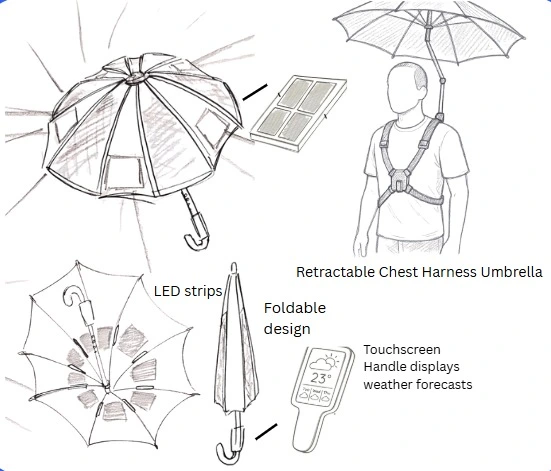
Q) Monsoon season brings the constant struggle of carrying umbrellas, especially in crowded streets and public transport. The biggest problem? The long handle makes it clumsy to store, carry, and manage when wet.
Your task: Design an umbrella without a traditional handle that solves this problem while remaining functional in heavy rain.
Solution:

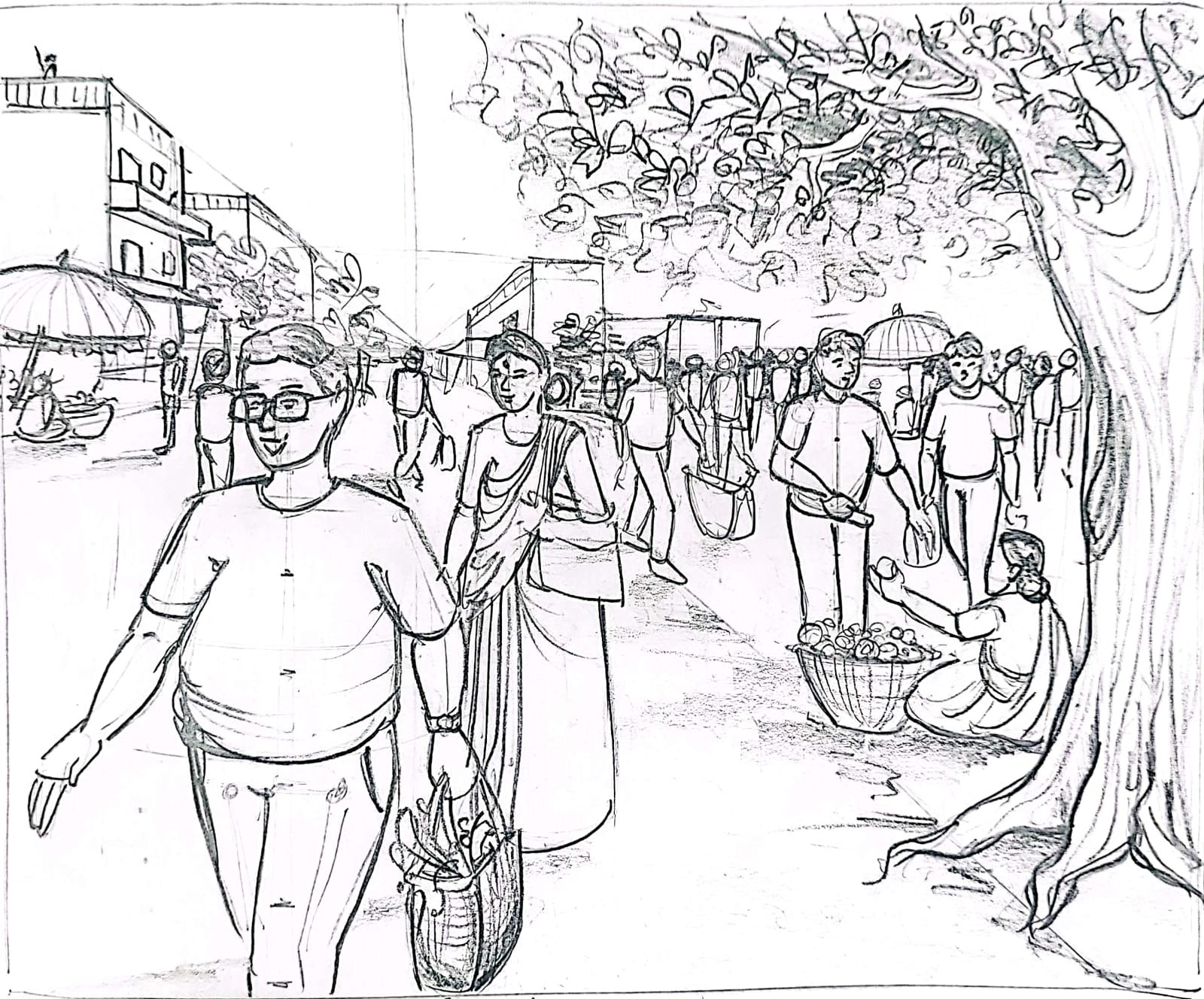
Q) Draw a busy street market scene using one-point perspective. Show people walking, vendors selling goods, and surrounding elements like trees, stalls, and buildings that give a sense of depth and daily life.
Solution:
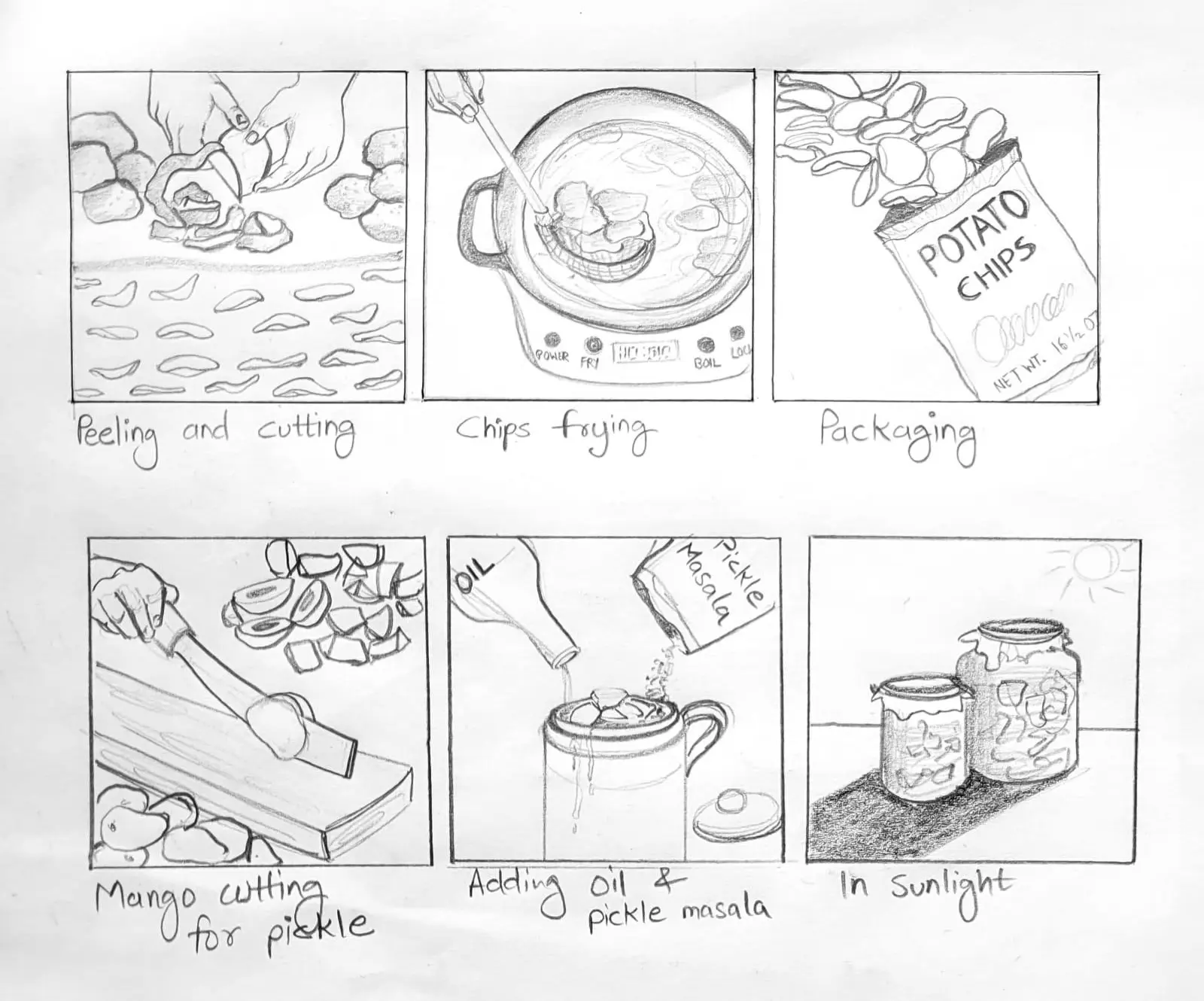
Q) Draw 3 key steps for the process. Given below:
- Potato to chips
- Mango/fruit to pickle
Solution:
5 Common NID Drawing Mistakes Students Usually Make (and How to Fix Them)
1. Chasing perfect drawing over ideation
NID wants to know if you have the traits an aspiring designer should have - thinking, observation, empathy and the ability to come up with innovative solutions.
2. Ignoring composition
Disproportionate or unbalanced layouts will leave you less space for all elements of the drawings to be included.
3. Weak proportions
Practice measuring with the thumb-and-pencil method until it comes to you naturally.
[Mentor's tip: Focus on perspective. Well drawn perspective result in more accurate proportions.]
4. No time strategy
A finished drawing that communicates it's idea clearly is better than a half-baked masterpiece. Plan time per question and stick to it.
5. Only drawing what's comfortable
Practice unfamiliar prompts or alternative ideas for each question, so that exam-day surprises don't bother you much.
Importance of Improving NID Drawing Skills 2027
1. High Competition
Thousands compete for limited seats in NID colleges. These tips help you stand out and increase your chances of getting in.
2. Solid Foundation
Drawing is the core of design. These tips help you build a strong base, making further studies in design more accessible and more fruitful.
3. Express Ideas Clearly
Good drawing skills allow you to turn your thoughts into clear visuals, which is what NID looks for.
4. Boost Confidence
With better drawing skills, you'll feel more confident tackling the NID exam and showcasing your talent.
5. Preparation Edge
These tips offer a roadmap, ensuring you're well-prepared and focused, making your preparation time more effective.
FREE Study Material to Practice and Improve NID Drawing
Preparing with tips to improve NID drawing skills for NID is not enough. You should also use study materials during your preparation.
Best Free NID Study Material PDF Free Download
|
FREE NID Study Material for Drawing |
Link |
|
NID Sample Drawing Questions Solved |
|
| NID Mock Test Series | |
| NID Sample Papers | |
Best Books for NID Drawing Preparation 2027
Since the NID DAT drawing questions have no prescribed syllabus. These books will help you immensely in NID sketching questions practice.
Past Year Paper Book for NID 2027:
- Includes 11 years of fully solved original past year papers (2015-2025).
- Step-by-step QR-based video solutions for CAT drawing questions by expert design mentors.
- Curated by Creative Edge faculty with over 29 years of experience in design entrance prep and real exam analysis.
- Comes with last 5 year papers exam trend analysis.
Sample Papers Book for NID 207:
- 15 sample papers based on the latest NID DAT Pattern.
- 5-year topic-wise weightage analysis
- 3 full-length mocks with video solutions
- Extensive practice with 400+ questions
- Learn key concepts through detailed explanations
Improving your NID drawing skills may seem daunting, but with patience, practice, and determination, you can become a better artist.
Start by understanding the fundamentals of drawing and developing a practice utilizing helpful resources, to improve your drawing skills for the upcoming NID exam. With time, you can learn to draw more accurately, expressively, and confidently.
Key Takeaways:
- Understanding fundamental drawing concepts. Practice utilizing the right resources and tips to improve your NID drawing skills for the NID 2027 exam.
- The drawing journey should emphasize creative exploration and expression.
- Remember, for NID DAT 2027, it's not just about being a great sketch artist but also about showcasing creativity, observation, and unique design thinking.
Preparing for NID 2027? We can help you with exact strategic roadmap, study material and crucial feedback required to ace this exam.
Join Creative Edge, India’s leading NID online coaching and coaching and get expert guidance on all NID 2027 subjects.


Attempt a Free NID Mock Test
Fill your details
Frequently Asked Questions
Is sketching important for NID?

How can I improve my drawing for NID?
How do I practice drawing for NID 2027?
Do I need to be a great artist to clear NID?
What is the difficulty level of the NID drawing test?

Vineeta Agrawal
Communications Executive
SHARE