
1723534562.png)

NID CAT Questions 2027: Important Questions with Answers [PDF Download]
September 7, 2026
NID CAT questions are subjective drawing tasks like story illustration, scene creation, product design/redesign, unconventional use of everyday objects, problem-solving, etc.
From 2026, the NID DAT Prelims is a CAT-only paper - the General Ability Test (GAT) was dropped. That makes the subjective section the single most important stage to clear Prelims and reach the next stage - Studio Test (Mains) which decides your final admission.
Expect each task to carry around 15-30 marks.
This guide gives you solved NID CAT questions, sample and previous-year prompts, topics that are likely to be asked in 2027 exam, and a free PDF to practice with.
(Note: NID can revise its pattern year to year, so don’t skip aptitude prep completely - but plan your prep strategy around a CAT-only Prelims for now.)
Key Highlights- Important NID CAT Questions for 2027
- CAT is the subjective, drawing-based section of NID DAT Prelims
- Since 2026, only sketching questions are asked in Prelims, aptitude is removed.
- Questions test creativity, observation, visualization, storytelling and design thinking - clarity & presentation of idea > "pretty" drawings.
- Common formats- complete-the-story, perspective drawing, story rendering, object transformation, user-centric product design or redesign.
- Each task typically carries 15-30 marks; expect a longer creative paper than the old GAT+CAT format.
- Most important factors are - concept clarity, correct proportion/perspective, composition and neat presentation.
- Best prep- timed practice on previous year questions + model solutions.
NID CAT 2027: Marks, Structure & What Changed
|
Aspect |
Detail (current CAT-only format) |
|
Section |
Creative Ability Test (CAT) - Prelims is CAT-only since 2026 |
|
Type of questions |
Subjective - drawing, sketching, storyboarding, scene creation |
|
Marks per question |
Usually 15-30 marks each |
|
Negative marking |
None |
|
Mode |
Offline (pen/pencil & paper) |
|
Role in selection |
CAT questions in Prelims will only qualify you for the Studio Test & Interview (Mains); Mains decides final admission |
What changed in 2026:
NID removed the objective GAT section, so Prelims now entirely depends on creative drawing. However, experts suggest you to still lightly prep for GAT as a backup in case NID reintroduces it.
See the full NID exam pattern for details.
How to Prepare for NID CAT Questions 2027?
Read the prompt like a designer, not an artist:
Underline who / where / why before you draw - NID marks concept clarity over decoration and technical perfection.
Practice every sketch under timed conditions
Spend not more than 15-30 mins per sketch, so you finish with thoughtful answers, not a half-shaded page.
Build a "visual vocabulary"
Observe everyday objects, human figures in action, and simple scenes carefully. This will help you draw from memory in exam under pressure.
Practice storytelling formats
4-frame comics, complete the scene, and object-transformation questions appear repeatedly.
Solve real previous-year papers and self-mark on accuracy, composition, originality, detailing and neatness.
Solved NID CAT Questions for 2027 Prep
Q.1. Each of the following drawing is incomplete. Add the needed missing lines to complete the views. Write down the names.
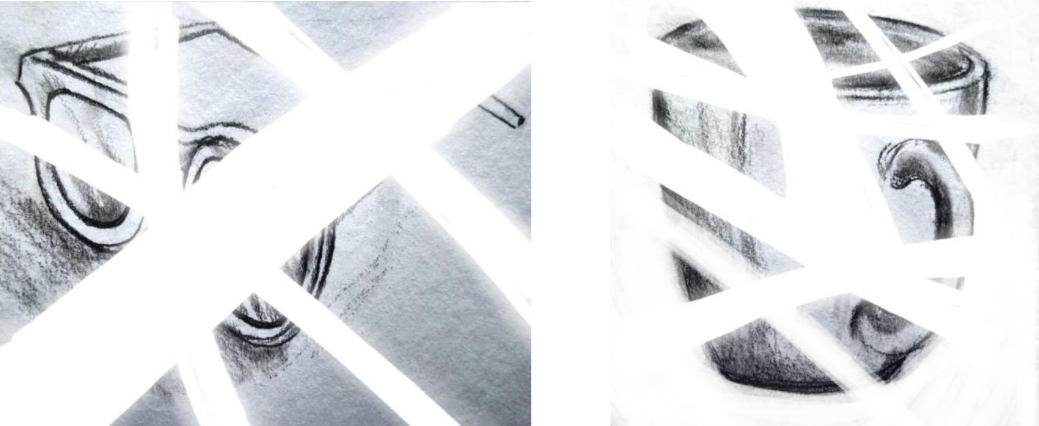
Solution:
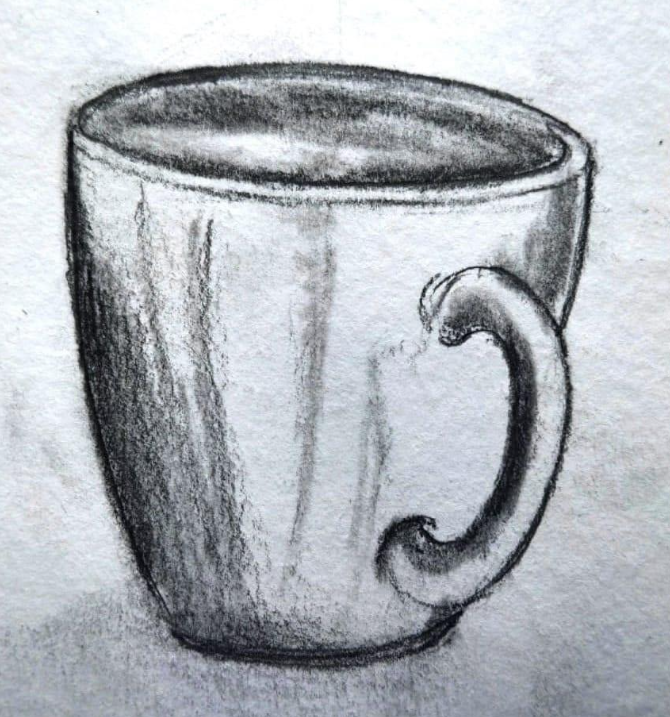
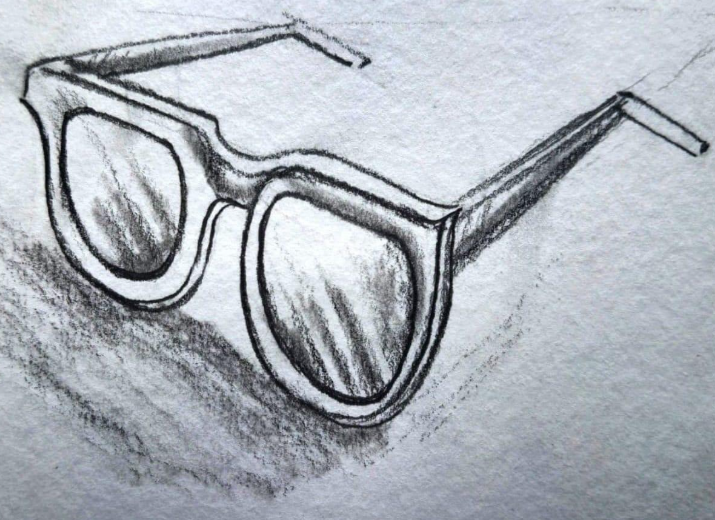
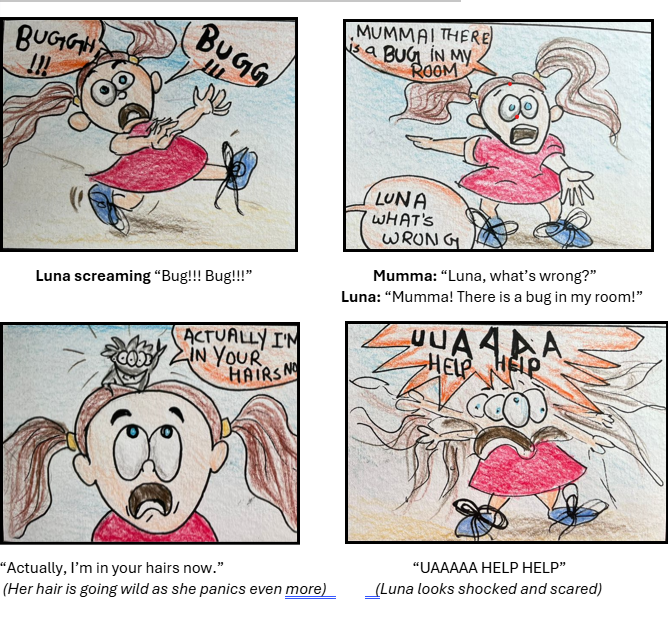
Q.2. One day Luna saw a bug in her room and screamed in panic. as she ran around shouting, the bug sneakily landed in her hair! Luna freaked out even more, calling for help. Her mom rushed in, confused, while Luna kept yelling about the creepy intruder in her hair. Frame a story in 4 frames, also mention the title and moral of the story.
Solution:
Title- Bug in My Hair
Moral- Don’t panic, stay calm and face your fears.
Q.3. Draw human figures in action showing different profiles, front view, side view and back view- performing various everyday activities like walking, running, bending, or lifting.
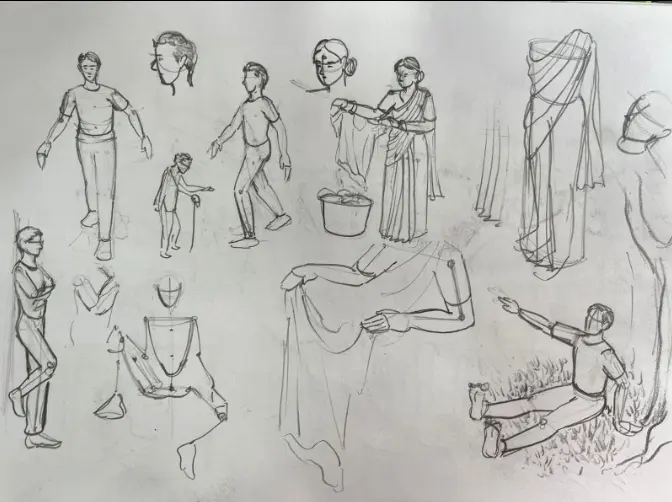


Important NID CAT Questions 2027
Wondering about the NID drawing question types and difficulty level in the upcoming NID Exam 2027? Explore these curated NID sample questions:
Q1. Add a drawing to the blank square to complete the story. Then, describe the story in under 150 words.
1762155306.webp)
Solution Approach:
First decide the narrative of the story - beginning (given frames) -> your frame -> implied ending, before drawing anything. The drawing in your frame must be the logical next step, not a random image. In the write-up, state who/where/what happens in plain language.
Q2. Observe and redraw the car including a human figure.
1762155280.webp)
Solution Approach:
Draw the car as simple blocks first (body, cabin, wheel arch) to lock proportion, then go for finishing touches. Place the human at the door or beside the bonnet in correct proportion- an adult's head would be roughly about the car's roof height. Also add a light ground shadow of both the car and the human. The human-to-object scaling should be believeable.
Q3. Create a scene incorporating the three given objects.
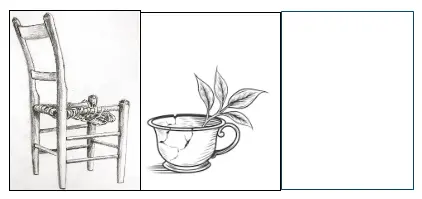
Solution Approach:
Don't just place the three objects side by side, think of a situation that connects them (e.g. a location or a small event). First put a horizon line and a focal point, then arrange the objects in foreground/midground/background for depth, and let their sizes/scale show their relationship with each other in the drawing.
Q4. Identify the logos from the image below.

Solution Approach:
Work left-to-right, name each logo you recognize, and for any logo that you're unsure of, at least mention the brand category (auto, tech, food) rather than leaving it blank.
Q5. Illustrate any three objects that contribute to global warming.
Solution Approach:
Draw three clearly recognizable, labelled objects - e.g. a car (exhaust fumes), a factory chimney (smoke), and an air-conditioner (refrigerant). Keep line-work clean, add a small emission cue (fumes/smoke) to show the why. Also give a title to your drawing. Examiners want to see your clarity and relevance of idea, not artistic drawings.
Q6. Complete the scene by drawing two adult human figures.
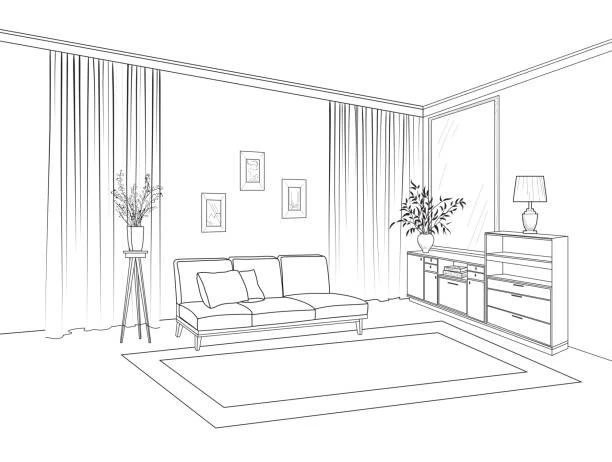
Solution Approach:
Match the figures to the given scene's context (waiting, working, walking) so the scene finally looks complete and realistic. Use the head count method for establishing scale of the figures. An adult is roughly 7-7.5 heads tall. Keep both figures on the same ground line so the scale is consistent. Show posture through the spine and shoulder line, not facial details.
Q7. Redraw the bicycle including two animals.

Solution Approach:
Draw the bicycle from two circles (wheels) on a shared baseline, then the frame triangle between them - this fixes the hardest part, proportion. Add two animals interacting with it (a dog running alongside, a cat in the basket) to create a mini-story and narrative.
Previous Year NID CAT Questions
Here are a few select NID CAT questions from past NID CAT exams to help you understand the pattern and creativity required:
Q.1. Draw an umbrella in the image to tell a story of anger or humor. Write a short narrative (max 5 sentences) and give it a title.
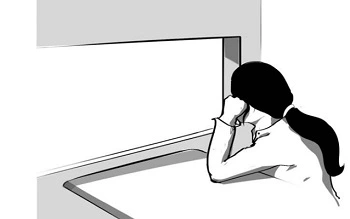
Q.2. Complete the composition by choosing one:
- Two human figures
- One human + one animal
- Two animals
Q.3. Create a 4-frame comic strip on one of the following:
- Your journey to Mars
- Me as a fish
- Your visit to a dentist
Q.4. Think of 5 creative uses of an old bulb in a humorous way. Illustrate your ideas briefly.
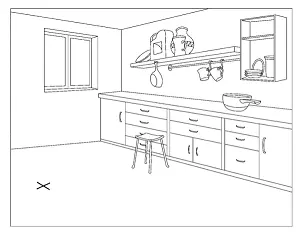
Q.5. Draw a kitchen scene as viewed from a three-year-old child’s perspective.
NID CAT Syllabus 2027
NID's purpose behind the creative ability test is to examine if the candidate can think of original and valuable ideas that can solve design problems. The NID drawing questions are subjective in nature and include questions on scene creation, perspective drawing of objects, storyboarding, object transformation etc.
In last completed cycle (2026), there were 6 questions with several sub-parts in each. The same structure is expected to be followed in 2027 as well. However, NID never specifies exact number or questions or syllabus for the exam, so expect the unexpected.
Even then, our experts have studied past year patterns and curated all the possible topics that are important from the exam perspective and from which NID CAT questions can be asked.
| NID Prelims Syllabus for CAT - BDes | ||
| Design Outline | Colour Terminology | Inspiration & Design Development |
| Elements & Principles Of Design | Design Theory | Mood, Theme & Colour Inter-relationship |
| Geometrical Form | Colour, Pattern & Texture | Innovation in Design |
| Principles of Composition Lettering | Optical Illusion | Understanding Light & Shade |
| Form & Function | Colour Psychology & Optical Illusions | Design Awareness |
| Drawing Fundamentals | Creative thinking & writing | Picture Analysis |
| Visual Logic | Good Design vs Bad Design | Theme Development |
| Use of Measurements, Scale & Proportions | Developing Themes & Colour Associations | Foreshortening & Perspective |
| 3D Visualisation | Inspiration & Creativity | Ornaments & Motifs |
| Memory Drawing | Usage of Colour in Compositions | Expression & Emotion |
| Exercises on imagination | Lateral Thinking | Story Pictures |
| Graphics & Pictograms | Imagination & Doodling | Presentation Techniques |
Read our NID DAT exam analysis to see which question types are asked the most and their difficulty levels in recent papers.
How Can Creative Edge Help You?
Looking for guided preparation for NID 2027? Creative Edge, by TopRankers, offers a comprehensive platform with expert support. Creative Edge's Alumni mentors from NID/NIFT/IIT train aspirants in both online and offline classes as per their convenience.
They can not only help you with developing creativity and design thinking from scratch, but also guide you personally with a strategic roadmap to crack one of the toughest design entrance exam like NID DAT.
- Live + Recorded Classes
- Digital/Physical Study Materials
- 1-on-1 Mentorship
- Live Doubt Clearing Sessions
- Topic Tests and Assignments
- Mock Tests with Video Solutions
- Expert Academic Faculty
- Career Counseling Assistance
Conclusion
With GAT removed from Prelims since 2026, the CAT is everything in NID Prelims. And to score higher in these questions, you’ll need clear thinking more than polished drawing. Work through the solved questions above, practice previous-year questions under a timer, and get feedback on concept clarity, composition, proportion and neatness.
When you want a mentor to critique your sketches and show you exactly where you might be losing marks, start with NID 2027 online coaching by Creative Edge.

Attempt a Free NID Mock Test
Fill your details
Frequently Asked Questions
How long does it take for NID Exam Preparation?

Can I crack NID 2027 Exam in 3 months?
What's the difference between NID sample papers and previous-year papers?
Should I still practice GAT for 2027?
What is the difficulty level of NID CAT exam 2027?
How to prepare for NID CAT 2027?

Vineeta Agrawal
Communications Executive
SHARE