


NATA GK Questions 2027: Sample Questions with Answers [PDF Download Here]
October 8, 2026
NATA GK questions are the architecture and general awareness MCQs in Part B (Aptitude) of the NATA exam. They test how well you know famous buildings, architects, architectural styles, design and urban planning concepts, awards, and recent events in architecture.
GK carries roughly 15-20 marks, and architectural awareness adds another 25-30, which makes the GK questions in NATA some of the easiest marks to score with regular revision.
- Where they appear: Part B (Aptitude), out of 120 marks and about 50 questions
- Question format: direct MCQs and image-based identification of buildings and monuments
- How to prepare: learn 3 facts a day with visual notes, then practice NATA GK questions from PYPs
Key Highlights: NATA 2027 GK Questions
- NATA GK questions typically include 15-16 questions in the exam, making GK a useful scoring section in the NATA aptitude section.
- Most questions are based on famous architects, design & architecture terminology, architectural styles (Gothic, Mughal, Modern), Indian monuments, world landmarks, UNESCO sites, the Pritzker Prize, sustainable architecture and building materials.
- Candidates should revise current affairs related to architecture, global events, and cultural developments to perform well in GK.
- Practicing NATA GK questions from previous year papers helps understand the exam pattern and frequently asked topics.
- Regular practice of NATA GK questions with answers PDF and mock tests improves accuracy and quick recall during the exam.
Are you aiming for a top score in the NATA 2027 exam? While your drawing and observation skills are crucial, don't overlook the General Knowledge section, which can be a game-changer in your overall performance.
It's the most easy to score section if you prepare well. You can expect 15 -16 NATA important questions from the GK section in the NATA 2027 entrance test. We have curated the most important NATA GK questions with answers pdf from the previous year's exams and sample papers. Practicing these NATA important questions will help you score well in the upcoming exam.
Table of Contents
Important NATA GK Questions 2027
Most of the questions in the GK for NATA section will be based on national/ international architects and famous architectural creations.
The following are some important NATA general knowledge questions from the previous year's question papers for the NATA exam.
Q.1.) Nandalal Bose was a famous
- a) Sculptor
- b) Painter
- c) Scientist
- d) Architect
Ans: b
Q.2.) In which state of India the famous Sun temple of Modhera is situated?
- a) Maharashtra
- b) Gujarat
- c) Uttar Pradesh
- d) Madhya Pradesh
Ans: b
Q.3.) In which year the Sir J.J. School of Art, Mumbai was established?
- a) 1857
- b) 1935
- c) 1960
- d) 1980
Ans: a
Check: How to download NATA Admit Card
Q.4.) One MB of computer memory is equal to
- a) 1000 KB
- b) 100 KB
- c) 1024 KB
- d) 512 KB
Ans: c
Q.5.) Stonehenge structure is an example of
- a) Dome architecture
- b) Post and Lintel
- c) Arch
- d) Concrete
Ans: b
Q.6.) Manneken piss is a
- a) Painting of a lady
- b) Monument
- c) Tomb
- d) Sculpture of a young boy
Ans: d
Q.7.) The famous painting ‘The starry night’ was painted by
- a) Vincent Vangogh
- b) Pablo Picasso
- c) Leonardo da Vinci
- d) None of these
Ans: a
Q.8.) The famous monument ‘Bird’s Nest’ is a
- a) Temple
- b) Olympic Stadium
- c) Tower
- d) Hospital
Ans: b (Beijing National Stadium)
Make revision stick - here's how to prepare NATA notes that get reused.
Q.9.) The famous painting ‘The starry night’ was painted by
- a) Vincent Vangogh
- b) Pablo Picasso
- c) Leonardo da Vinci
- d) None of these
Ans: a
Q.10.) ‘Mickey Mouse was created by
- a) Walt Disney
- b) Warner brothers
- c) Charlie Chaplin
- d) Cartoon network
Ans: a
Q.11.) ‘Pakhwaz’ is a
- a) musical instrument
- b) monument
- c) fort
- d) painting
Ans: a
Q.12.) Salim Chisti was a
- a) Scientist
- b) Sufi Saint
- c) Musician
- d) artist
Ans: b
Q.13.) Pandit D.V. Paluskar is known for his contribution in
- a) painting
- b) dance
- c) music
- d) sports
Ans: c
Round out Part B with verbal reasoning questions for NATA.
Q.14.) Sitara Devi is the master of
- a) Instrumental music
- b) Singing
- c) Kathak
- d) Bharatnatyam
Ans: c
Q.15.) ‘Lust for Life’ is a biography of
- a) M.F. Hussein
- b) Vincent Van Gogh
- c) Pablo Picasso
- d) Rabindranath Tagore
Ans: b
Q.16.) Mahatma Gandhi was born in the year
- a) 1849
- b) 1869
- c) 1889
- d) 1899
Ans: b
Q.17.) Which of the following is the opaque medium of colouring?
- a) watercolours
- b) oil pastels
- c) crayons
- d) pencils
Ans: b
Check: How to Improve Your NATA Score
Q.18.) Mesopotamia is the ancient name of today’s
- a) Afghanistan
- b) America
- c) Egypt
- d) Iraq
Ans: d
Q.19.) The Petronas towers are situated in
- a) the U.S.A.
- b) China
- c) France
- d) Malaysia
Ans: d
Q.20.) Edward Munch is famous for
- a) ‘The scream.’
- b) chocolates
- c) his music
- d) None of these
Ans: a
Not sure about timing? Here's when to start NATA preparation.
Important GK Topics for NATA Exam
If you’re preparing using NATA GK questions, focusing on the right topics is more important than just solving random questions. The NATA exam tests architecture awareness, general knowledge, and current affairs, so your preparation should be targeted and strategic.
Below are the most important GK topics for NATA based on previous year trends and exam patterns:
NATA 2027 Important Topics - Architecture Awareness & GK
| Topic | Importance | Focus On |
|---|---|---|
| Famous Architects | High | Indian & international architects, their projects, style, awards (if any) |
| National awards in architecture | ||
| Design & innovation awards | ||
| Architectural Styles | High | Gothic |
| Baroque | ||
| Modernism | ||
| Indo-islamic etc. | ||
| Indian Monuments | High | Historical & modern monuments with their architectural styles |
| Global iconic structures | ||
| Location + Architect + SignificanceTemple architecture / Mughal architecture | ||
| Cultural landmarks | ||
| UNESCO world heritage sites | ||
| Building Materials & Basic Architecture Terminology | Moderate | Important terms like elevation, facade, vernacular architecture |
| Sustainable Architecture | Moderate | Green buildings, energy efficient design, sustainable materials etc. |
| Historical Timeline | Moderate | History related to art & culture |
| Current Affairs | Moderate | Recent architectural projects, Environmental & urban development news |
| Major global events |
Keep your goal in sight - see the best architecture colleges through NATA.
Topic Wise Important NATA Architecture GK Questions
Architecture GK
Q) What is the name of the tower associated with mosques?
- a) minaret
- b) minbar
- c) mizpah
- d) muezzin
Ans: Minaret
Explanation: It's the slender tower from which the call to prayer is given.
Q) A group of ancient temples built between 950–1050 CE in the Nagara architectural style, located in Chhatarpur district of Madhya Pradesh, refers to which site?
- (a) Sun Temple, Konark
- (b) Khajuraho Group of Monuments
- (c) Shore Temple, Mahabalipuram
- (d) Dilwara Temples, Mount Abu
Ans: Khajuraho Group of Monuments
Explanation: Khajuraho is a UNESCO site from Chandela dynasty.
Q) Identify the type of staircase shown in the given image.

- (a) Helical staircase
- (b) C Shaped staircase
- (c) Spiral staircase
- (d) Cylindrical staircase
Ans: Helical Staircase
Explanation: You might get confused between spiral staircase and helical staircase. While spiral stairs winds tightly around a central pole or column, a helical staircase curves in an open arc without a central column (leaving an open void in the middle).
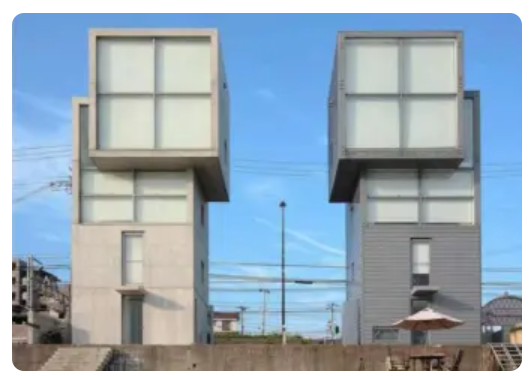
Q) The 4 x 4 (2003) house (on the left) designed by Tadao Ando in Hyogo, Japan; has a twin (on the right) designed by the same architect but constructed with different materials. What are they?
- (a) Concrete and Steel
- (b) Stone and Concrete
- (c) Concrete and Wood
- (d) Concrete and Aluminum panels
Ans: Concrete and Wood
Explanation: The first house (Left) is made of heavy reinforced concrete with a continuous internal flight of steps. While the second house (Right) is made of timber / wood structure and features an elevator instead of a staircase.
Q) This type of artwork belongs to a particular style. Identify

- (a) Renaissance
- (b) Medieval
- (c) Tudor
- (d) Roman
Ans: Renaissance
Explanation: This artwork is The School of Athens by Raphael, which belongs to the Renaissance (specifically, High Renaissance) style. Characteristics include linear perspective, humanism, harmonious composition.
Drawing is 80 marks, so keep it in your routine - start with our NATA drawing preparation tips.
Famous Buildings
Q) What is the old city usually built around North African citadels called?
- a) Favela
- b) Inner City
- c) Old Quarter
- d) Casbah
Ans: d) Casbah
Explanation: The old city built around a North African citadel is called a casbah (or qasba), which refers to the fortified quarter, fortress, or old walled town.
Q) Which iconic building in New York City did Andy Warhol feature in a single-shot documentary with an eight-hour run time?
- a) Trump Tower
- b) the Chrysler Building
- c) the Guggenheim
- d) the Empire State Building
Ans: the Empire State Building
Explanation: Andy Warhol featured the Empire State Building in his 1964 silent experimental film titled Empire.
Q) The Giza Pyramid Complex is from which era?
- a) Ancient Egyptian
- b) Pre-historic times
- c) Stone Age
- d) Bronze Age
Ans: Ancient Egyptian
Explanation: The Giza Pyramid Complex belongs to the Old Kingdom era of ancient Egypt, specifically during the 4th Dynasty (circa 2575–2465 BCE).
Q) Stonehenge structure is an example of
- a) Dome architecture
- b) Post and Lintel
- c) Arch
- d) Concrete
Ans: Post and Lintel
Explanation: Vertical stone pillars (posts) hold up horizontal stone beams (lintels) across the top, forming the classic trilithons seen at the site.
Q) ‘Pieta’ is the name of a famous
- a) City
- b) country
- c) Painter
- d) sculpture
Ans: sculpture
Explanation: The Pieta is a world-famous Renaissance sculpture created by the Italian artist Michelangelo Buonarroti. Housed in St. Peter's Basilica in Vatican City, it depicts the body of Jesus on the lap of his mother Mary after the Crucifixion.
Balance GK with the scoring maths section using the NATA maths syllabus and sample questions.
Indian Monuments
Q) How old are the famous Indus Valley civilization ruins at Mohen jo Daro?
- a) around 500 years
- b) around 1000 years
- c) around 5000 years
- d) around 20000 years
Ans: around 5000 years
Explanation: Mohenjo-daro was built around 2500 BCE (approximately 4,500 to 5,000 years ago) and was one of the largest settlements of the ancient Indus Valley Civilization.
Q) The Mount Mary church is in
- a) Mumbai
- b) Delhi
- c) Kolkata
- d) Chennai
Ans: Mumbai
Explanation: The Basilica of Our Lady of the Mount, commonly known as Mount Mary Church, is a famous Roman Catholic basilica located in Bandra, Mumbai.
Q) The Mughal emperor built the red fort at Delhi
- a) Akbar
- b) Jahangir
- c) Shahjahan
- d) None of these
Ans: Shahjahan
Explanation: The Red Fort (Lal Qila) in Delhi was commissioned by the Mughal Emperor Shah Jahan in 1638 when he decided to shift his capital from Agra to his new city of Shahjahanabad. Construction finished in 1648.
Q) Which of the following is a rock-cut temple?
- a) Lingaraj Mandir
- b) Birla Mandir
- c) Kailas Mandir
- d) Konark Sun Temple
Ans: Kailas Mandir
Explanation: This famous 8th-century Hindu temple is one of the most remarkable rock-cut structures in the world. Builders carved the entire temple vertically downward out of a single, massive basalt cliff face.
Q) Charminar at Hyderabad is a
- a) victory memorial
- b) tomb
- c) fort
- d) mosque
Ans: mosque
Explanation: The Charminar, built in 1591 by Sultan Muhammad Quli Qutb Shah, is an iconic historical monument that houses a functional mosque on its top/second floor.
Q) The given image shows a grand royal palace known for its Indo-Saracenic architecture and famous illumination during festivals. Identify the monument.

- (a) City Palace, Jaipur
- (b) Mysore Palace
- (c) Falaknuma Palace, Hyderabad
- (d) Umaid Bhawan Palace, Jodhpur
Ans: Mysore Palace
Explanation: A brilliant example of the Indo-Saracenic style, located in the city of Mysuru, Karnataka. Famously lit with nearly 100,000 light bulbs during the Dasara festival.
Turn this practice into marks with our guide on how to improve your NATA score.
Current Affairs / Static GK
Q) Name the country from this flag

Ans: Ukraine
Explanation: The national Flag of Ukraine is a bicolour consisting of two equal horizontal bands of blue on top and yellow on the bottom, with an aspect ratio of 2:3.
Q) Image shown below is part of a logo. Identify

- (a) Archeological Survey of India
- (b) State Archeology Department
- (c) National Museum
- (d) Indian Institute of Architects
Ans: Indian Institute of Architects
Explanation: The image depicts the central emblem of the official logo of the Indian Institute of Architects (IIA). The design features a traditional Indian gateway (torana) inspired by the architecture of the Sanchi Stupa, flanked by elephants, with a multi-pointed star at the base.
Q) Which among the following is known as India's first fully solar powered village?
- (a) Chitrakoot, Uttar Pradesh
- (b) Damoh, Madhya Pradesh
- (c) Modhera, Gujarat
- (d) Agasthiyamalai, TN
Ans: Modhera, Gujarat
Explanation: Modhera was officially declared by the Prime Minister as India’s first round-the-clock (24x7), 100% solar-powered village.
GK pairs well with reasoning - practice logical reasoning questions for NATA next.
Famous Architects
Q) Who designed Hearst Castle
- a) Julia Morgan
- b) Marian Davies
- c) William Randolph Hearst
- d) Orson Welles
Ans: Julia Morgan
Explanation: Julia Morgan, the pioneering American architect hired by William Randolph Hearst in 1919 to design the estate.
Q) A team of architects designed the Seagram Building. Who were they?
- a) Mies van der Rohe and Philip Johnson
- b) Rem Koolhaas and Zaha Hadid
- c) Louis Sullivan and Frank Lloyd Wright
- d) Charles Correa and I.M. Pei
Ans: Mies van der Rohe and Philip Johnson
Explanation: Ludwig Mies van der Rohe designed the overall functionalist structure of the Seagram Building in New York City, while Philip Johnson designed the interior spaces, including the famous Four Seasons Restaurant.
Q) Who designed the Hagia Sophia?
- a) Anthemius of Tralles and Isidore of Miletus
- b) Justinian I
- c) Saladin
- d) Theodora
Ans: Anthemius of Tralles and Isidore of Miletus
Explanation: Anthemius of Tralles and Isidore of Miletus were the Greek geometrician and mathematician appointed by Emperor Justinian I (choice b) to design and build the famous basilica in Constantinople (now Istanbul) between 532 and 537 AD.
Q) Which architect wrote I Quattro Libri dell Architettura (1570; The Four Books of Architecture)?
- a) Benedetto Antelami
- b) Michelangelo
- c) Sinan
- d) Andrea Palladio
Ans: Andrea Palladio
Explanation: Andrea Palladio published this highly influential treatise on architecture in Venice in 1570, which heavily shaped Western architecture for centuries, inspiring the Palladian style.
Q) What great Ottoman architect designed the Mosque of Süleyman I the Magnificent?
- a) Nūbār Pasha
- b) Saladin
- c) Sinan
- d) Omar Khayyam
Ans: Sinan
Explanation: Mimar Sinan (often known simply as Sinan) was the chief Ottoman architect who designed the magnificent Süleymaniye Mosque in Istanbul, which was completed in 1557 for Sultan Süleyman the Magnificent. He is widely considered the greatest architect of the classical period of Ottoman architecture.
Q) Whose Turning Torso (1999–2005), a unique apartment tower in Malmö, Sweden, is based on a twisting spinal column?
- a) Santiago Calatrava
- b) Jean Nouvel
- c) Zaha Hadid
- d) Frank Gehry
Ans: Santiago Calatrava
Explanation: The Turning Torso in Malmö, Sweden, was designed by the Spanish architect Santiago Calatrava. The building's striking design is based on a white marble sculpture he created called the Twisting Torso, which mimics the natural curves and rotation of a human spine.
Along with these questions, practicing NATA Mock Tests regularly will help test your preparation levels and overcome mistakes.
Q) What prolific female architect merged Modernism and populism in works she built largely in Brazil?
- a) Lota de Macedo Soares
- b) Tarsila do Amaral
- c) Clarice Lispector
- d) Lina Bo Bardi
Ans: Lina Bo Bardi
Explanation: Lina Bo Bardi was a prolific Italian-born Brazilian architect who famously merged Modernism and populism in her work. She designed iconic, socially engaging Brazilian landmarks such as the São Paulo Museum of Art (MASP) and the SESC Pompéia.
Q) Who was an up-and-coming Mexican architect in the early 21st century?
- a) Carlos Slim
- b) David Alfaro Siqueiros
- c) Tatiana Bilbao
- d) Luis Barragan
Ans: Tatiana Bilbao
Explanation: Tatiana Bilbao is a renowned Mexican architect who gained international recognition in the early 21st century after founding her firm, Tatiana Bilbao Estudio, in 2004. Her work focuses on sustainable design, social housing, and integrating geometry with nature.
Q) The sculptures of Henry Moore are
- a) abstract
- b) realistic
- c) relief
- d) grotesque
Ans: abstract
Explanation: Henry Moore is world-renowned for his semi-abstract bronze sculptures, which typically depict stylized human figures - most notably reclining figures and mother-and-child compositions.
Short on time? Fold this GK plan into a one-month NATA preparation plan.
How to Prepare GK for NATA - Full Study Plan for 2027 Exam
To score well in nata gk questions, you need a consistent and structured preparation strategy. Follow the plan below to cover both static GK and current architecture awareness effectively:
NATA GK Preparation Strategy:
| Task | What to Do | Time Required | Frequency |
|---|---|---|---|
| Current Affairs | Read architecture + general news (focus on buildings, awards, projects) | 30 mins | Daily |
| Static GK Revision | Revise architects, monuments, architectural styles, timeline | 20-30 mins | Weekly |
| Solve GK Questions | Practice topic-wise nata gk questions with answers | 30-60 mins | Daily |
| Previous Year Questions (PYQs) | Solve and analyze repeated GK questions | 20-30 mins | 2-3 times/week |
| GK Notes Making | Maintain short notes for quick revision (facts, architects, awards) | Everytime you read something new | Daily |
| Weekly Revision | Revise all topics + notes + important facts | 1-2 hours | Weekly |
Pro Tip:
Instead of studying GK randomly, align your preparation with important NATA GK topics like:
- Architecture & monuments
- Architectural styles & timeline
- Sustainable architecture
- Current architectural events
This ensures you’re practicing relevant nata gk questions, not wasting time on low-impact topics.
How can Creative Edge Benefit You in Your NATA 2027 Preparation?
Creative Edge, a TopRankers initiative, is one of the top online NATA coaching centres.
Here, we make your NATA preparation more fun and easier to process. We help you to shape your skills and nourish your qualities to excel in the exam.
- Get to communicate with our top faculty.
- Live classes with separate doubt-clearing sessions.
- Online Mock Tests are available for self-assessment.
- Get access to valuable study materials through PDF formats.
- Stay focused on the subject with interactive visuals and sample papers.
Use Creative Edge Free Resources 2027 Strategically
| Resource | Link |
| NATA Mock Test | |
| NATA Preparation Video 2027 | |
| NATA Syllabus 2027 | |
| NATA PYQs |
If you're still weighing your path, see whether NATA is necessary for architecture.

Conclusion
In conclusion, preparation for the Important NATA GK Questions is essential to score well in the exam.
Your prep plan should include a thorough understanding of the NATA exam pattern and syllabus, regular practice and revision of topics, and regular mock tests. Additionally, keeping track of your strengths and weaknesses will help you stay focused and organized.
With the right guidance and plenty of practice, you can ace the NATA GK exam 2027 and achieve your goals.
Preparing for NATA 2027? We can help you with exact strategic roadmap, study material and crucial feedback required to ace this exam.
Join Creative Edge NATA Online Course and get expert guidance on all NATA 2027 subjects.
You can enroll in offline NATA batches at your nearest centres also!


Attempt a Free NATA Mock Test
Fill your details
Frequently Asked Questions
How to prepare for NATA GK Questions in one month?

Where can I find Important NATA GK Questions with Answers?
Who prescribes Syllabus for NATA exam?
What type of NATA GK Questions are asked in the exam?
How many questions are asked under GK section in NATA exam?

Vineeta Agrawal
Communications Executive
SHARE