


JIPMAT Syllabus 2027: Complete Topic-Wise Guide with PDF Download
October 30, 2026
Preparing for JIPMAT 2027 and wondering what you actually need to study?
The JIPMAT Syllabus 2027 covers three major areas: Quantitative Aptitude, Data Interpretation & Logical Reasoning, and Verbal Ability & Reading Comprehension. The latest available NTA exam structure has 100 questions for 400 marks, to be attempted within 150 minutes. With +4 marks for every correct answer and -1 mark for every incorrect answer, knowing the syllabus is only the first step. You also need a smart approach to question selection and time management.
The good news is that JIPMAT does not demand advanced mathematics or highly specialised subjects. The Quantitative Aptitude section is based on mathematical concepts up to the Class 10 level, while DILR tests your ability to interpret information and solve logical problems. VARC checks your command of English, vocabulary and reading comprehension.
This guide gives you a complete JIPMAT syllabus 2027 topic-wise, along with the latest available exam pattern, section-wise weightage, important topics, recommended books and a practical preparation strategy.
JIPMAT 2027 Update: NTA has not yet released the official JIPMAT 2027 information bulletin. Therefore, the 2027 syllabus and pattern given below are based on the latest available NTA information and recent JIPMAT papers. Any change announced by NTA will be updated here.
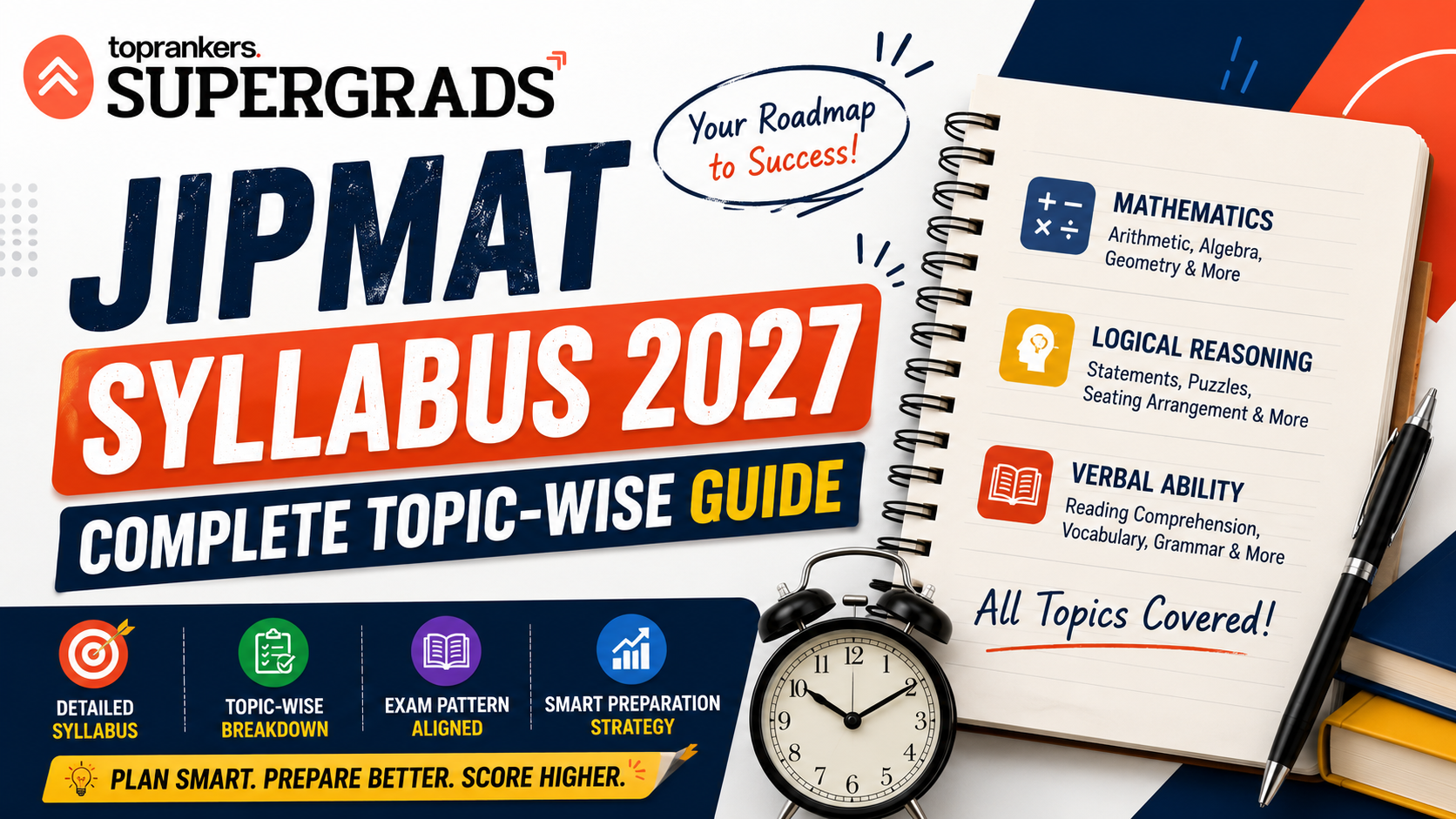
What Is the JIPMAT Syllabus 2027?
JIPMAT, or the Joint Integrated Programme in Management Admission Test, is conducted for admission to the five-year Integrated Programme in Management at IIM Jammu and IIM Bodh Gaya. NTA is responsible for conducting the entrance examination and declaring the result.
The JIPMAT paper is divided into three sections:
- Quantitative Aptitude (QA)
- Data Interpretation & Logical Reasoning (DILR)
- Verbal Ability & Reading Comprehension (VARC)
The latest NTA syllabus specifically states that Quantitative Aptitude tests the understanding and application of mathematical concepts up to Class 10 Mathematics.
NTA does not always provide students with a separate, chapter-by-chapter syllabus document. Therefore, the most useful way to prepare is to combine the official section descriptions with recent question papers and recurring topics.
JIPMAT Syllabus 2027: Section-Wise Overview
The nearly equal distribution across sections means that preparing only one or two areas can leave a major part of your score untouched.
| Section | Question Type | Max Marks | Main Skills |
|---|---|---|---|
| Quantitative Aptitude | 33 | 132 | Mathematical concepts, calculation and application |
| Data Interpretation & Logical Reasoning | 33 | 132 | Data analysis, logic and problem-solving |
| Verbal Ability & Reading Comprehension | 34 | 136 | English usage, vocabulary and comprehension |
| Total | 100 | 400 | — |
Mentor tip: DILR is where JIPMAT rank is won or lost. QA and VARC are scoring sections most serious candidates clear; the DILR sets puzzles, seating arrangements, and caselets separate the top percentiles.
That's also clear from the JIPMAT exam analysis of recent papers.
| Subject | Download PDF |
|---|---|
| Quantitative Aptitude | |
| Data Interpretation & Logical Reasoning (DILR) | |
| Verbal Ability & Reading Comprehension (VARC) |
JIPMAT 2027 Syllabus for Quantitative Aptitude
The Quantitative Aptitude section of JIPMAT focuses on basic mathematical concepts and their application. According to the latest NTA bulletin, questions test concepts up to the Class 10 Mathematics level.
You do not need to study advanced calculus for this section. Instead, focus on building strong fundamentals, improving calculation speed and learning how to apply concepts to unfamiliar questions.
| Topic | Key Areas |
|---|---|
| Number System | Integers, Rational numbers, LCM, HCF, Fractions, Decimals, Surds |
| Arithmetic | Percentages, Profit & Loss, SI & CI, Ratio & Proportion, Averages, Time-Speed-Distance, Time & Work |
| Algebra | Linear & Quadratic Equations, Polynomials, Inequalities |
| Geometry & Mensuration | Lines, Angles, Triangles, Circles, Areas, Volumes |
| Probability & Statistics | Basic Probability, Mean, Median, Mode, Variance, SD |
| Set Theory | Union, Intersection, Venn Diagrams |
| Trigonometry | Basic Ratios, Heights & Distances |
| Data Sufficiency | Solving with the data provided |
Which Quant Topics Should You Study First?
If you are starting JIPMAT preparation from scratch, do not try to complete every topic at the same time.
Start with:
- Percentages
- Ratio and Proportion
- Profit and Loss
- Averages
- Time, Speed and Distance
- Time and Work
- Number System
- Algebra
- Geometry and Mensuration
- Data Sufficiency
Arithmetic deserves special attention because many questions can be solved quickly once your concepts and calculation techniques are strong.
Recent JIPMAT preparation resources also continue to highlight areas such as percentages, profit and loss, time and work, time and distance, averages, HCF-LCM and algebra.
Fix your Arithmetic first. For targeted practice, work through our algebra questions for IPM/JIPMAT, number theory questions, and multiplication and division short tricks to build speed.
How to Prepare for JIPMAT Quantitative Aptitude?
Do not spend weeks only reading formulas. A better approach is:
Learn the concept → solve basic questions → practise mixed questions → attempt timed sets → analyse mistakes.
For example, after completing percentages, solve questions involving profit and loss, discounts, ratios and data interpretation. This helps you understand how the same concept can appear in different forms.
| JIPMAT Selection Process | JIPMAT Important Questions |
JIPMAT 2027 Syllabus for Data Interpretation & Logical Reasoning
The Data Interpretation & Logical Reasoning (DILR) section checks how quickly you can understand information, identify patterns and reach logical conclusions.
This section can look different from one paper to another, so practising only one type of puzzle is not enough.
| Data Interpretation & Logical Reasoning Topics | |||
|---|---|---|---|
| Blood Relations | Clocks & Calendars | Syllogism | |
| Series | Statements | Venn Diagram | |
| Proposition | Data Arrangement | Data Structures | |
| Direction Sense | Family Tree | Tables | |
| Coding–Decoding | Binary Logic | Pie Charts | |
| Assumptions | Seating Arrangement | Data Sufficiency | |
| Puzzles | Sets & Caselets | Bar & Line Graphs | |
The exact mix of questions can vary, which is why previous-year papers are important when preparing for JIPMAT.
How to Improve Your DILR Score
DILR is not only about knowing the correct method. It is also about deciding which question or set deserves your time.
While practising for the DILR section, ask yourself:
- Can I understand the information quickly?
- How many steps will this question take?
- Is there an easier question I can attempt first?
- Am I spending too much time on one puzzle?
Start with untimed practice to understand the concepts. Once you become comfortable, introduce a timer.
Sharpen individual skills with our JIPMAT logical reasoning questions, DI questions for IPMAT/JIPMAT, and a dedicated walkthrough on how to solve syllogism questions.
JIPMAT 2027 Syllabus for Verbal Ability & Reading Comprehension
The Verbal Ability & Reading Comprehension (VARC) section contains 34 questions in the latest available JIPMAT pattern, making it the largest section by question count and marks.
This section checks your understanding of English rather than simply testing whether you have memorised grammar rules.
| Topic Category | Topics Covered |
|---|---|
| Reading Comprehension | Passages with inference, tone, and summary questions |
| Vocabulary | Synonyms, Antonyms, One-word Substitution, Idioms, Phrases |
| Grammar | Sentence Correction, Spotting Errors, Fill in the Blanks |
| Sentence Structuring | Para-jumbles, Cloze Test |
| Critical Reasoning | Inference-based Questions, Logical Consistency, Arguments |
How to Prepare for JIPMAT VARC in 2027?
The simplest way to improve VARC is to make English part of your daily routine.
Read for 20–30 minutes every day. You can use newspapers, magazines, quality articles or non-fiction books.
While reading, do not focus only on finishing the article. Try to identify:
- The central idea
- The author’s purpose
- The tone of the passage
- Important arguments
- Unfamiliar words
- How different ideas are connected
Maintain a small vocabulary notebook and revise the words regularly.
Strengthen this section with our guide on how to solve verbal ability questions, practice sets of JIPMAT verbal ability questions, and tips to build vocabulary for IPMAT & NPAT.
Has the Syllabus Changed for JIPMAT 2027?
Short answer: no structural change is expected. The three-section format, the 100-question / 400-mark pattern, the +4 / −1 marking, and the Class 10–12 scope have all been consistent for multiple cycles.
Until NTA publishes the official 2027 information brochure, treat the JIPMAT syllabus 2027 above, grounded in the latest papers, as your working map. We'll update this page the moment the 2027 notification is live.
What may shift in 2027 (and is not yet confirmed): exam date, registration window, application fee, and the eligibility birth/passing years.
These will be verified against the official NTA notification, expected around Feb–April 2027. To understand how these feed into admission, see the JIPMAT selection process.
JIPMAT 2027 Exam Pattern & Marking Scheme
Understanding the JIPMAT exam pattern is just as important as knowing the syllabus.
The latest available NTA bulletin specifies 100 questions carrying 400 marks, with 150 minutes available to complete the test. Each correct answer carries 4 marks, while an incorrect answer results in a 1-mark deduction.
| JIPMAT Section | No. of Questions | Marks/Question | Total Marks |
|---|---|---|---|
| Quantitative Aptitude | 33 | 4 | 132 |
| Data Interpretation & Logical Reasoning | 33 | 4 | 132 |
| Verbal Ability & Reading Comprehension | 34 | 4 | 136 |
| Total | 100 | — | 400 |
JIPMAT 2027 Marking scheme:
| Aspect | Detail |
|---|---|
| Correct answer | +4 marks |
| Incorrect answer | −1 mark |
| Unattempted | 0 (no penalty) |
| Mode | Computer-Based Test (CBT), English only |
| Duration | 2 hours 30 minutes |
Because there's negative marking, accuracy beats volume. A student who attempts 80 questions at high accuracy usually outscores one who rushes all 100.
Leave a question blank when you genuinely can't narrow it to two options. To see how raw marks translate into a rank, check the JIPMAT marks vs percentile analysis.
JIPMAT Syllabus 2027: Section-Wise Weightage
The distribution is almost balanced across all three sections.
| Section | Question Type | Max Marks | Approx. Share |
|---|---|---|---|
| Quantitative Aptitude | 33 | 132 | 33% |
| DILR | 33 | 132 | 33% |
| VARC | 34 | 136 | 34% |
| Total | 100 | 400 | 100% |
This makes one point very clear: do not build your preparation around a single section.
A strong preparation plan should give every section regular practice, while allowing more time for the areas where your accuracy or speed is lower.
Has the JIPMAT Syllabus Changed for 2027?
Well, the official JIPMAT 2027 information bulletin has not been released.
The latest available NTA information confirms the three-section structure and the 100-question, 400-mark format described above.
Therefore, candidates preparing for JIPMAT 2027 can use the latest available pattern as their working preparation framework.
However, details such as:
- JIPMAT 2027 exam date
- Registration dates
- Application fee
- Eligibility cut-off dates
- Other application-related requirements
should be treated as pending until NTA releases the 2027 notification.
Do not rely on social media posts or unofficial websites for these details. Check the official NTA JIPMAT portal when the 2027 notification is released.
JIPMAT 2027 Preparation Strategy
Knowing the syllabus is useful, but knowing how to use it is what turns the syllabus into a preparation plan.
Step 1: Complete Your Basics
Start with school-level concepts. For Quant, revise your Class 8–10 mathematics concepts before moving to advanced question practice.
For VARC, begin with grammar and vocabulary basics.
For DILR, start with individual reasoning concepts before moving to lengthy puzzles.
Step 2: Create a Topic-Wise Practice Plan
You can also divide the JIPMAT syllabus into small achievable targets.
For example:
Monday: Percentages + Vocabulary
Tuesday: Ratio + Coding-Decoding
Wednesday: Profit & Loss + Reading Comprehension
Thursday: Algebra + Syllogism
Friday: Time & Work + Para Jumbles
Saturday: Mixed practice
Sunday: Mock test + analysis
The exact schedule can change, but the idea is simple: study, practise and review every week.
If you’d rather follow a week-by-week plan with classes and faculty support, SuperGrads’ online JIPMAT preparation course maps the full syllabus into a structured schedule across QA, DILR and VARC
Step 3: Start Solving Previous-Year Papers
JIPMAT Previous-year papers are one of the most useful resources for understanding how the syllabus is converted into actual questions.
They help you identify:
- Frequently tested concepts
- Question difficulty
- Common question formats
- Your weak areas
- Time-consuming topics
- Repeated mistakes
Do not simply check your score after completing a paper.
Spend time analysing every incorrect question.
Step 4: Add Timed Practice
Once your basics are clear, start working on time management.
For example, take a 20-question Quant set and give yourself a fixed amount of time.
Gradually reduce the time while maintaining accuracy.
This is particularly useful because JIPMAT gives you 150 minutes for 100 questions, which means you need to make efficient decisions throughout the paper.
Step 5: Take Full-Length Mocks
Start with one mock every week.
As the examination gets closer, increase the frequency based on your preparation level.
After every mock, record:
| What to Analyse | Questions to Ask |
| Accuracy | Which questions did I get wrong? |
| Speed | Which section consumed most of my time? |
| Concepts | Which topics need revision? |
| Selection | Which questions should I have skipped? |
| Mistakes | Was the error conceptual or due to calculation? |
Your mock score matters, but the analysis after the mock tells you what to improve.
Best Books for JIPMAT 2027 Preparation
You do not need a large collection of books to complete the JIPMAT syllabus.
Choose a few reliable resources and use them consistently.
Books for Quantitative Aptitude
- Quantitative Aptitude by R.S. Aggarwal
- Quantitative Aptitude by Arihant
- NCERT Mathematics, Classes 9–10
Books for Logical Reasoning & DILR
- A New Approach to Reasoning by B.S. Sijwali and S. Sijwali
- 501 Challenging Logical Reasoning
- Verbal & Non-Verbal Reasoning by R.S. Aggarwal
Books for Verbal Ability
- High School English Grammar & Composition by Wren & Martin
- Objective General English by S.P. Bakshi
- Word Power Made Easy by Norman Lewis
- From Plinth to Paramount by Neetu Singh
Along with books, use JIPMAT previous-year papers, mock tests and section-wise practice questions to understand the actual exam style.
JIPMAT 2027 Preparation: Common Mistakes to Avoid
The fact that the syllabus is large doesn't mean that you have to study every day.
What matters is the consistency with which you use your study time.
Avoid these common mistakes:
1. Starting With Random Questions
Start by developing your concepts; otherwise, carrying out random practice without an understanding of the basics will result in confusion.
2. Ignoring DILR
Although DILR may seem unpredictable, regular practice does make it easier to recognise different question types.
3. Memorising Vocabulary Without Revision
It is more useful to learn 10 to 15 words and go over them regularly than it is to learn 50 words all at once.
4. Taking Mocks Without Analysis
You can't consider a mock test to be complete just because you've submitted it—the genuine learning occurs when you analyse it.
5. Spending Too Long on One Question
The risk involved in guessing at random is that negative marking will have an effect, and the time taken to answer one hard question can influence the rest of the paper.
Conclusion
The JIPMAT Syllabus 2027 is broad, but it is manageable when you divide it into smaller targets.
Remember these five points:
- QA: Build strong Class 10-level mathematical fundamentals.
- DILR: Practise different types of arrangements, puzzles and data sets.
- VARC: Read regularly and improve vocabulary, grammar and comprehension.
- Mocks: Use them to improve speed, accuracy and question selection.
- Updates: Check NTA for the official JIPMAT 2027 notification before relying on dates, fees or eligibility details.
The latest available JIPMAT pattern gives you 100 questions, 400 marks and 150 minutes. That means preparation is not simply about knowing more topics. It is about knowing the topics well enough to recognise the right approach quickly.
So, start with the syllabus, build your fundamentals, practise consistently and keep measuring your progress through previous-year papers and mocks. You do not need to finish everything in one week. One topic, one practice set and one improvement at a time can take you a long way toward your JIPMAT 2027 goal.
| JIPMAT Cut Off | JIPMAT Marks vs Percentile | JIPMAT Exam Analysis — All Years |
Download Your Free JIPMAT Study Material
Fill your details
Frequently Asked Questions
How many sections are included in JIPMAT 2027 Exam?

What are the important topics in JIPMAT Syllabus 2027?
What is the marking scheme of JIPMAT Exam 2027?
How can I effectively prepare for the JIPMAT syllabus 2027?
What are the important topics that I need to be prepared from JIPMAT Quantitative Syllabus?
Can I complete the JIPMAT Syllabus 2027 in two months months?

Lalita Vishwakarma
Content Writer
SHARE