


AIBE 22 Syllabus 2026: Download Official PDF, Subjects & Weightage
October 15, 2026
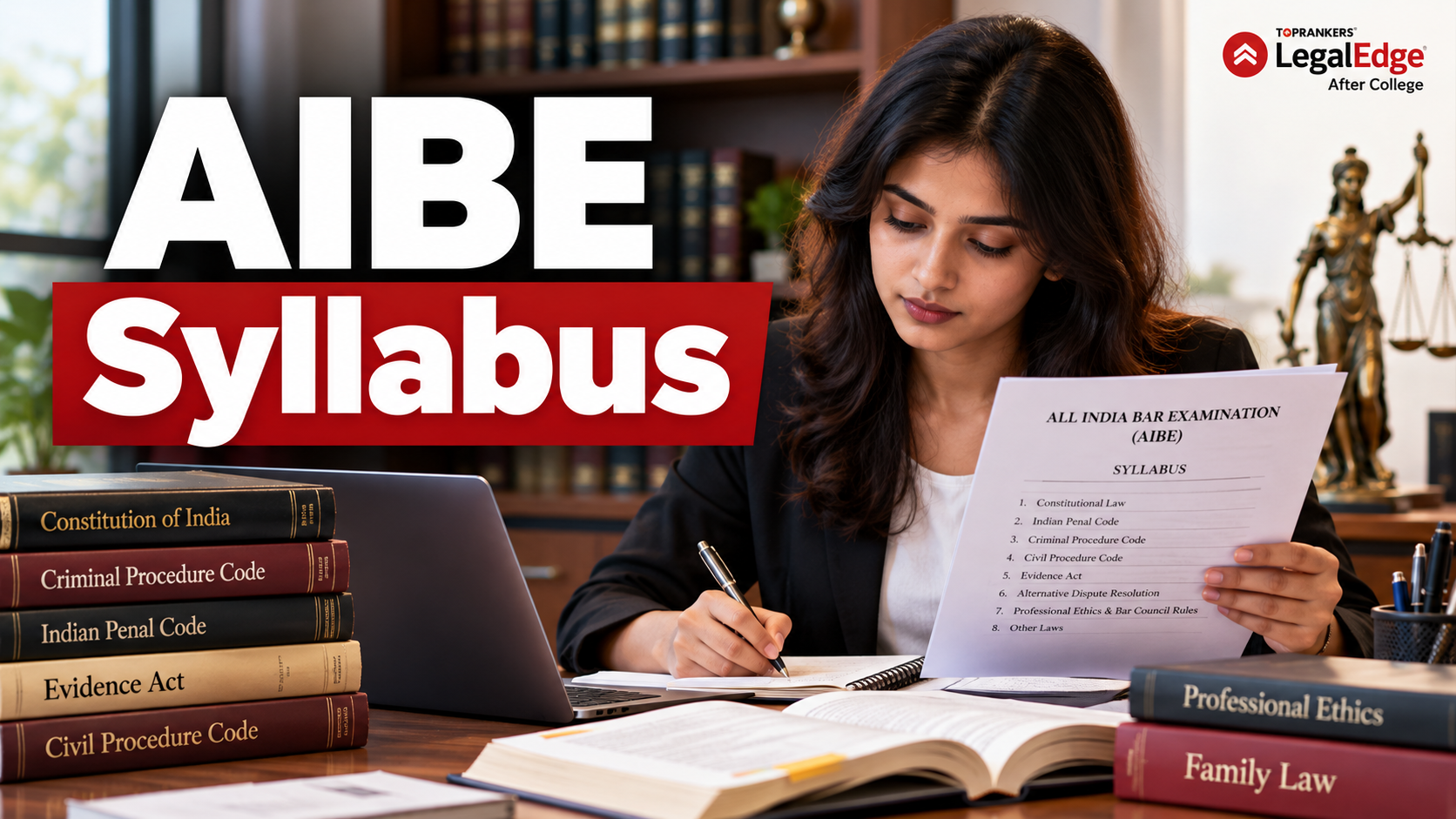
The AIBE Syllabus 2026 consists of 19 subjects and 100 MCQs. The subjects are: Constitutional Law, Civil Procedure Code (CPC), Criminal Procedure (CrPC/BNSS), Criminal Law (IPC/BNS), Evidence Law (BSA) and Professional Ethics. Knowing the subject-wise syllabus and the marks distribution will go a long way in helping you determine the key areas to focus on and plan your preparation accordingly.
As per the published AIBE syllabus, Constitutional Law, CPC and CrPC/BNSS carry the highest weightage, with 10 questions each. Candidates should also prepare the new criminal laws, including BNS, BNSS and BSA.
In this article, you can check the subject-wise weightage, explore important topics and follow a practical preparation strategy for the All India Bar Examination.
What Is New in the AIBE 22 Syllabus 2026?
The AIBE 22 Syllabus 2026 covers 19 law subjects and 100 multiple-choice questions. One of the most important areas for candidates is the inclusion of India's three new criminal laws alongside their earlier counterparts: the Bharatiya Nyaya Sanhita (BNS), Bharatiya Nagarik Suraksha Sanhita (BNSS) and Bharatiya Sakshya Adhiniyam (BSA).
Students preparing for the All India Bar Examination should understand these laws and their relationship with the Indian Penal Code (IPC), Criminal Procedure Code (CrPC) and Indian Evidence Act.
AIBE XXII Syllabus PDF Download
You can download the AIBE XXII Syllabus in PDF form to get a clear idea of the subjects and the key topics you'll need to cover for the All India Bar Examination. The syllabus will tell you what the subjects are and what the important topics are so that you can plan your preparation accordingly.
It's essential that you go through the AIBE 22 Syllabus before you start studying, as it will give you an idea of the subject-wise coverage and will allow you to plan your study schedule. The official syllabus PDF can be used as a checklist to monitor your progress and ensure that you're not missing out on any of the important topics.
AIBE Syllabus 2026 (Detailed)
The AIBE is an examination designed to test your knowledge and ability in a range of areas of law. It is absolutely essential that you have a good grasp of the AIBE syllabus if you are to be in any chance of success. The syllabus is broad and covers a wide variety of subjects in law to ensure that you are being tested on your knowledge of the full breadth of the subject. The following are the subjects which are included in the AIBE syllabus:
- Constitutional Law
- Indian Penal Code (IPC)/ (New) Bharatiya Nyaya Sanhita
- Criminal Procedure Code (CrPC)/ (New) Bharatiya
Nagarik Suraksha Sanhita - Code of Civil Procedure (CPC)
- Evidence Act/ (New) Bharatiya Sakshya Adhiniyam
- Alternative Dispute Redressal, including Arbitration Act
- Family Law
- Public Interest Litigation
- Administrative Law
- Professional Ethics & Cases of Professional Misconduct under BCI rules
- Company Law
- Environmental Law
- Cyber Law
- Labour & Industrial Laws
- Law of Tort, including Motor Vehicle Act and Consumer Protection Law
- Law related to Taxation
- Land Acquisition Act
- Intellectual Property Laws
- Law of Contract, Specific Relief, Property Laws, Negotiable Instruments Act
AIBE 2026 Syllabus: Topic-wise Weightage
In the AIBE exam, questions are asked from 19 different topics. The weightage of each topic varies according to the AIBE syllabus. With a subject-wise weightage for the AIBE exam, you can focus on more important areas.
Here's a breakdown of the number of questions you can expect from each topic:
- x-axis -> explains the topics
- y-axis -> explains the number of questions asked in respective topics
The same AIBE 22 Syllabus is presented in the form of a table below to help you better understand the number of questions asked for each topic.
| Topic | Number of Questions |
|---|---|
| Constitutional Law | 10 |
| IPC (Indian Penal Code)/ Bharitiya Nyaya Sanhita | 8 |
| Cr.PC (Criminal Procedure Code)/ Bhartiya Surakhsha Sanhita | 10 |
| CPC (Code of Civil Procedure) | 10 |
| Evidence Act/ Bhartiya Sakshya Adhiniyam | 8 |
| Alternative Dispute Redressal, including the Arbitration Act | 4 |
| Family Law | 8 |
| Public Interest Litigation | 4 |
| Administrative Law | 3 |
| Professional Ethics and Cases of Professional Misconduct under BCI rules | 4 |
| Company Law | 2 |
| Environmental Law | 2 |
| Cyber Law | 2 |
| Labour and Industrial Laws | 4 |
| Law of Tort, including the Motor Vehicle Act and Consumer Protection Law | 5 |
| Law related to Taxation | 4 |
| Law of Contract, Specific Relief, Property Laws, Negotiable Instrument Act | 8 |
| Land Acquisition Act | 2 |
| Intellectual Property Laws | 2 |
Read Detailed Guide: How to Prepare for AIBE?
AIBE Syllabus 2026: Important Topics
To help you prepare for the AIBE exam, we have detailed the AIBE syllabus 2026 below. You will be tested on 19 topics in the All India Bar Examination.
1. Constitutional Law
- Salient Features of the Indian Constitution
- Fundamental Rights
- Legislative Process
- Directive Principle of State Policy
- Emergency Powers
- Federalism
2. Indian Penal Code (IPC)/ Bhartiya Nyaya Sanhita
- General Principles of Crime
- Principles of Criminal Liability
- Criminal Act by Several Persons or Groups
- Offences Affecting Human Life
- Criminal Trespass
3. Criminal Procedure Code (CrPC)/ Bhartiya Suraksha Sanhita
- Introductory and Pre-Trial Process
- Salient Features of Juvenile Justice
- Salient Features of the Probation of Offenders Act
- Criminal Rules and Practice
4. Code of Civil Procedure (CPC)
- Difference Between Procedural Law and Substantive Law
- Suits in Particular Cases
- Appearance and Examination of Parties
- Discovery, Inspection, and Production of Documents
5. Evidence Act/ Bhartiya Sakshya Adhiniyam
- Difference Between Substantive Law and Procedural Law
- Central Conceptions in the Law of Evidence
- Relevancy & Admissibility of Confessions
- Character Evidence
6. Alternative Dispute Redressal, including the Arbitration Act
- Dispute Resolution Methods: Inquisitorial and Adversarial
- Arbitration, Conciliation, Negotiation, Mediation
7. Family Law
- Hindu Law
- Hindu Undivided Family
- Inheritance & Succession
- Law Relating to Hindu Minority & Guardianship
Read Detailed Guide: Family Law Prep for AIBE 2026
8. Public Interest Litigation
- Concept of Public Interest Litigation in India
- Procedural Law in Public Interest Litigation
- Judicial Activism
- Role of Judiciary in Enforcement of Rights
9. Administrative Law
- Nature & Scope of Administrative Law
- Judicial Power of Administration
- Corporations and Public Undertakings
10. Professional Ethics & Cases of Professional Misconduct under BCI Rules
- Legal Profession and Responsibilities
- Duty to the Court
- Major Supreme Court Judgments
- Opinions of the Bar Council of India
11. Company Law
- Companies Act of 1956
- AOA
- Issue of Shares
- SEBI Act, 1992
- FEMA Act, 1999
12. Environmental Law
- Environmental Policy & Law
- Prevention and Control of Pollution
- Biological Diversity & Legal Order
- Environment Protection Act of 1986
13. Cyber Law
- Fundamentals of Cyberspace
- Intellectual Property Issues
- Indian Penal Law & Cybercrimes
- Obscenity & Pornography
- Digital Evidence
14. Labour & Industrial Laws
- Industrial Disputes Act of 1947
- Trade Unions Act of 1926
- Labour Welfare Legislation
- Minimum Wages Act of 1948
Read More: Important Questions for AIBE 2026 Exam
15. Law of Tort, including the Motor Vehicle Act and Consumer Protection Law
- General Condition of Liability in Tort
- Justification of Tort
- Remedies and Damages
- Personal Capacity
- Consumer Protection Act, 1986
16. Law Related to Taxation
- Direct Taxes
- Indirect Taxes
- Customs and Duties
17. Land Acquisition Act
- Preliminary Investigation
- Publication of Preliminary Notification
- Payment of Damages
- Declaration of Intended Acquisition
- Award by the Collector
- Temporary Occupation of Land
- Acquisition of Land for Companies
18. Intellectual Property Laws
- Introductory Aspects
- Patents
- Trademarks
- Geographical Indications
- Indian Copyright Law
19. Law of Contract, Specific Relief, Property Laws, Negotiable Instrument Act
- Validity, Discharge, and Performance of Contract Law
- Remedies and Quasi-Contracts
- Specific Contract
- Bailment and Pledge
- Doctrine of Election
By thoroughly reviewing these topics in the AIBE syllabus, you can enhance your preparation for the AIBE 2026 exam. Practising previous years' AIBE Question Papers and focusing on key areas will improve your chances of success.
Bare Acts to Study for AIBE 2026?
For the AIBE Syllabus 2026, candidates should prioritise Bare Acts covering Constitutional Law, Criminal Law, Criminal Procedure, Civil Procedure, Evidence, Family Law and Contract Law.
Bare Acts provide the statutory language of a law, including important definitions, sections, exceptions and legal procedures. Understanding these provisions helps candidates answer direct legal questions and apply statutory principles to factual situations.
List of Important Bare Acts for AIBE Preparation
| Bare Acts | Areas to Prepare |
| Constitution of India | Fundamental Rights, DPSPs, writs, judiciary and constitutional powers |
| Bharatiya Nyaya Sanhita, 2023 | General exceptions, offences and punishments |
| Bharatiya Nagarik Suraksha Sanhita, 2023 | FIR, arrest, investigation, bail and trial procedures |
| Bharatiya Sakshya Adhiniyam, 2023 | Relevancy, admissibility, documentary and electronic evidence |
| Code of Civil Procedure, 1908 | Jurisdiction, institution of suits, orders, decrees and appeals |
| Indian Contract Act, 1872 | Valid contracts, breach, remedies, indemnity and guarantee |
| Specific Relief Act, 1963 | Specific performance, injunctions and other reliefs |
| Transfer of Property Act, 1882 | Sale, mortgage, lease and transfer of property |
| Negotiable Instruments Act, 1881 | Promissory notes, cheques and cheque dishonour |
| Advocates Act, 1961 | Legal profession, enrolment and professional regulation |
| Arbitration and Conciliation Act, 1996 | Arbitration agreements, proceedings and awards |
Overview of the AIBE Exam Pattern
Understanding the AIBE exam pattern is important to make sure you put effort in the right direction and clear the exam with a maximum score.
- Number of Questions: The AIBE exam consists of 100 questions, with each question carrying one mark.
- Negative Marking: Currently, there is no negative marking in the exam, though discussions are ongoing about its potential introduction.
- Time Allotted: You have 3 hours and 30 minutes to complete the exam.
Exam Language Options
You can take the AIBE exam in any of the following 25 languages:
- Hindi, English, Gujarati, Konkani, Nepali, Urdu, Dogri, Telugu, Tamil, Panjabi, Kashmiri, Oriya, Bodo, Assamese, Kannada, Odia, Malayalam, Sanskrit, Santhali, Bengali, Marathi, Kannada, Manipuri, Sindhi, and Maithili.
Best Books for AIBE Exam 2026
If you have access to the appropriate collection of books for direction, you will find it much simpler to obtain good scores in the exam.
Here are some of the best books for AIBE 2026 exam to help you prepare well:
| Book Title | Author/Publication |
|---|---|
| Criminal Manual | Universal's |
| Other Bare Acts | Universal Law Publishing Co Pvt Ltd |
| Constitution of India | Durga Das Basu |
| Company Law and Practice | AK Majumdar/Dr. GK Kapoor |
| Civil Procedure with Limitation Act | CK Takwani |
| Law of Torts | R.K. Bangia |
| Indian Evidence Act | Batuk Lal |
| Family Law | Paras Diwan |
| Public Interest Litigation | Mamta Rao |
| Professional Ethics | Ram Jethmalani |
| Environmental Law | S.C. Shastri |
| Cyber Law | Pavan Duggal |
| Labour and Industrial Laws | S.N. Mishra |
| Law of Contract | Avatar Singh |
By studying these books and knowing how to read Bare Acts, you can effectively cover all topics outlined in the AIBE syllabus 2026 and enhance your chances of success in the exam.
How to Complete the AIBE Syllabus in 30 Days?
You can plan to complete the AIBE Syllabus 2026 in 30 days by dividing the 19 subjects into weekly study targets, prioritising high-weightage laws and reserving the final week for revision and mock tests.
The following study plan is suitable for candidates who have already studied the core subjects during their LL.B. course and need a structured revision schedule.
AIBE 30-Day Study Plan
| Day | Topic | Preparation Tasks |
| Day 1–3 | Constitutional Law | Important articles, Fundamental Rights, writs and constitutional bodies |
| Day 4–6 | CrPC/BNSS | Arrest, bail, FIR, investigation and trials |
| Day 7–9 | Civil Procedure Code | Jurisdiction, suits, orders, decrees and appeals |
| Day 10–11 | IPC/BNS | Criminal liability, offences and exceptions |
| Day 12–13 | Evidence Act/BSA | Evidence, confessions, burden of proof and electronic evidence |
| Day 14–15 | Family Law | Marriage, divorce, inheritance and succession |
| Day 16–18 | Contract, Specific Relief, Property and Negotiable Instruments Laws | Contracts, remedies, property transfers and cheques |
| Day 19–21 | Torts, ADR, PIL and Professional Ethics | Important principles, procedures and professional duties |
| Day 22–24 | Labour, Taxation, Administrative, Company, Environmental, Cyber, Land Acquisition and IP Laws | Revise key statutory concepts and practise MCQs |
| Day 25–26 | Previous Year Question Papers | Solve papers and identify weak areas |
| Day 27–28 | Full-Length Mock Tests | Practise 100-question tests under timed conditions |
| Day 29 | Revision of Weak Subjects | Review errors, important provisions and confusing concepts |
| Day 30 | Final Revision | Revise important laws and review examination instructions |
Common Mistakes Students Make While Preparing for the AIBE Syllabus
Some candidates struggle with AIBE preparation because they focus on reading many books instead of systematically completing the prescribed subjects and practising questions.
Avoiding the following mistakes can make your AIBE 2026 preparation more effective.
Preparing Only High-Weightage Subjects
Constitutional Law, CPC and Criminal Procedure are important, but focusing exclusively on these subjects leaves several potential questions uncovered.
What to do: Complete at least one revision of all 19 subject groups before the examination.
Ignoring the New Criminal Laws
Studying only the IPC, CrPC and Indian Evidence Act without reviewing BNS, BNSS and BSA can leave gaps in your preparation.
What to do: Compare important provisions of the older and newer criminal legislation and use updated study materials.
Using Outdated Bare Acts and Study Materials
Old editions may not reflect legislative changes and updated statutory terminology.
What to do: Check the applicable legislation, amendments and official syllabus before using books or notes.
Not Practising Previous Year Question Papers
Reading legal concepts without solving questions can make it difficult to assess examination readiness.
What to do: Practise AIBE previous year papers and analyse why each incorrect option is wrong.
Leaving Professional Ethics Until the Last Day
Professional Ethics is sometimes overlooked because students concentrate heavily on substantive law.
What to do: Revise professional conduct, duties towards clients and courts, and misconduct-related principles separately.
Depending Entirely on Bare Acts During the Examination
Candidates may assume that permitted reference materials will eliminate the need for preparation. However, searching for every answer during a timed examination can be inefficient.
What to do: Build conceptual clarity before the exam and practise answering questions within the prescribed time.
A balanced approach combining statutory understanding, question practice and revision will help candidates prepare more confidently.
Here are your key takeaways from the blog:
- Comprehensive Syllabus: The AIBE 2026 will cover 20 key areas of law.
- Exam pattern: 100 questions, no negative marking. 3 hours 30 minutes to complete.
- Language options: The AIBE exam can be taken in 25 languages.
- Study materials: use the recommended books and the practice papers.
- Preparation Tips: Focus on key topics, practice previous year papers, and take mock tests to improve your chances of success.
Frequently Asked Questions
What is the AIBE 2026 Syllabus?

How many subjects are included in AIBE Exam Syllabus 2026?
How many questions are asked from Constitutional law in AIBE 2026 Exam?
Which is the best book for preparing AIBE 2026 syllabus?
Which subjects hold the maximum weightage in the AIBE exam Syllabus 2026?
Can I complete AIBE 2026 Syllabus in 2 months?

Souvik Podder
Content Writer
SHARE