
1723534562.png)

How to Prepare for Quantitative Aptitude for CAT 2026 (Topic Priority + 12-Week Plan)
July 6, 2026
Overview: How to prepare for Quantitative Aptitude for CAT 2026? Quantitative Aptitude can be your biggest score booster in CAT if you follow a topic-first roadmap, track mistakes, and build speed with timed practice. In this guide, you’ll get a step-by-step plan, a 12-week timetable, and a mock-analysis checklist for CAT 2026.
Preparing for CAT Quant isn’t about solving thousands of questions it’s about mastering high-yield topics (especially Arithmetic), revising formulas, and improving selection in mocks. Use this guide to plan your week-by-week coverage and daily practice targets.
The Quantitative Ability section is one of the most challenging to prepare for the CAT exam. The QA section carries a good weightage of the total 66 questions. It would help if you had the right plan and strategy to get the solution for how to prepare for Quantitative Aptitude for CAT 2026.
- The CAT exam 2026 is all set to be conducted on 29 November 2026.
- The QA section asks questions about Arithmetic topics, Number Systems and Modern Math, Geometry and Allied Topics, Algebra and Miscellaneous.
- With less time remaining, it's important to grab the opportunity and prepare for the QA section with us.
This article will help you prepare for the Quantitative Aptitude section or to get the solution on how to prepare for the Quantitative Aptitude for CAT exam 2026.
What is Quantitative Aptitude in CAT 2026?
Quantitative Aptitude (QA) refers to the ability to work with numbers, analyze data, and solve mathematical problems efficiently. It typically includes questions from the following major topics:
- Arithmetic (Percentages, Profit and Loss, Time-Speed-Distance)
- Algebra (Linear and Quadratic Equations)
- Geometry and Mensuration
- Number System
- Modern Math (Set Theory, Permutation & Combination, Probability)
- Data Interpretation (in exams like CAT and XAT)
Mastering QA requires both conceptual clarity and the ability to solve questions efficiently under time constraints.
Read more: Important CAT Quant Topics
Understanding the Role of Quantitative Aptitude in CAT 2026
The Quantitative Aptitude section in CAT typically comprises 22 questions and is one of the three main sections, along with VARC (Verbal Ability & Reading Comprehension) and DILR (Data Interpretation & Logical Reasoning).
Key highlights:
- Duration: 40 minutes (for non-PwD candidates)
- Question Type: MCQs and Non-MCQs (TITA — Type in the Answer)
- Marks: +3 for correct answers, -1 for incorrect MCQs, no negative marking for TITA
- Focus Areas: Arithmetic, Algebra, Geometry, Number System, and Modern Maths
Check: Important Formulas for CAT
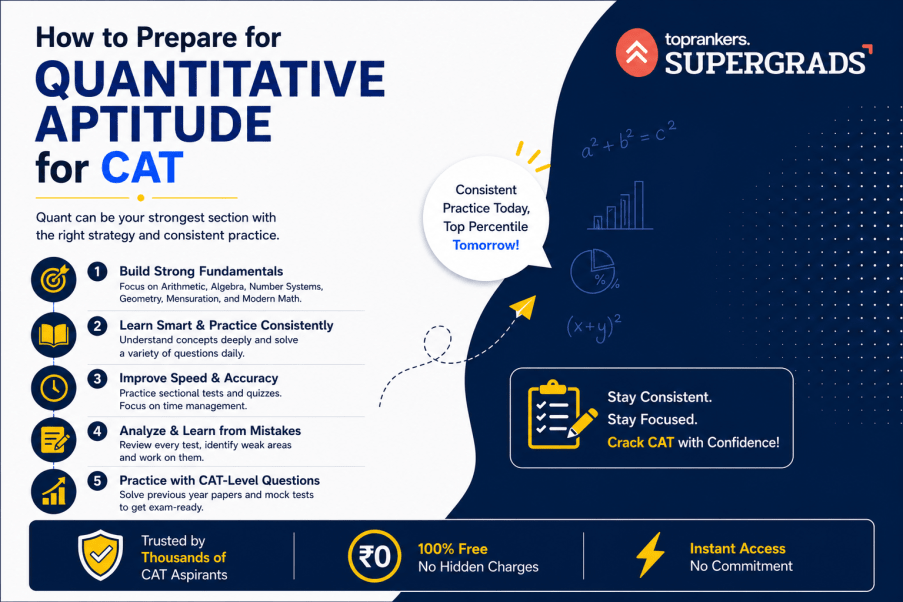
How to Prepare for Quantitative Aptitude for CAT 2026? Step-by-Step QA Preparation Plan
| Step | Action | Details & Tips |
|---|---|---|
| 1 | Know the Syllabus & Prioritize Topics | Break QA into 5 areas: Arithmetic, Algebra, Geometry, Number Systems, Modern Math. Prioritize Arithmetic first. |
| 2 | Build Concepts | Study theory from books like Quantum CAT or Arun Sharma. Focus on formulas and understanding. |
| 3 | Create a Formula Sheet | Maintain a handwritten formula book as suggested by Toprankers. Revise it weekly. |
| 4 | Practice Topic-Wise | Start with basic problems → moderate → difficult. Solve a variety of question types. |
| 5 | Practice Mental Math | Memorise squares (1–30), cubes (1–20), percentage-fraction conversions, tables (up to 20). |
| 6 | Take Topic-Wise Tests | Use platforms like Cracku, 2IIM, or TIME to test yourself on each topic after learning it. |
| 7 | Maintain an Error Log | Note down your errors, type of mistake (conceptual, silly, calculation), and correct method. |
| 8 | Mix Topics for Practice Sets | Solve mixed-topic tests (10–15 questions) to improve switching speed between topics. |
| 9 | Start Taking Mocks | Begin with 1–2 mocks per week under real CAT conditions. Increase frequency closer to exam. |
| 10 | Analyse Each Mock Deeply | Track accuracy, question selection, timing, and redo every mistake. Use analytics from IMS/CL. |
| 11 | Revise Regularly | Use your formula sheet + error log for weekly revisions. Revise old topics every 2 weeks. |
| 12 | Fine-tune Strategy | In the last 4–6 weeks, focus on mocks, stamina, accuracy, question selection, and revision. |
How to Prepare for Quantitative Aptitude for CAT 2026: 12-Week CAT QA Preparation Plan
This table outlines a structured 12-week plan designed to systematically cover all key Quantitative Aptitude topics for CAT.
| Week | Focus Area | Topics to Cover | Tests & Practice |
|---|---|---|---|
| Week 1–2 | Concept Building – Arithmetic I | Percentages, Ratio & Proportion, Averages, Profit & Loss | Basic problem sets, create a formula sheet |
| Week 3–4 | Arithmetic II + Start Algebra | Time & Work, Time-Speed-Distance, Linear & Quadratic Equations | Topic-wise quizzes, mental math drills |
| Week 5–6 | Number Systems + Algebra II | Divisibility, Remainders, Factors, Inequalities, Logarithms | Practice mixed topic sets, start error log |
| Week 7 | Geometry I | Triangles, Circles, Polygons (basics + visualisation) | Geometry-only timed sets |
| Week 8 | Geometry II + Coordinate Geometry | Coordinate geometry, Mensuration 2D/3D | Mixed topic tests, revise formula sheet |
| Week 9 | Modern Math | Permutation, Combination, Probability, Set Theory | Start taking sectional QA mocks |
| Week 10 | Advanced Practice | Functions, Progressions, Tough problems from all topics | Mixed problem sets, 1 full mock |
| Week 11 | Mock Practice | 2–3 full-length mocks + review | Analyse QA section deeply |
| Week 12 | Final Revision | Weak areas, shortcuts, high-yield topics | Formula revision + 3 mocks + error log review |
Quantitative Aptitude for CAT 2026: Important topics
The Quantitative Aptitude in CAT exam syllabus includes.
How to Prepare for Quantitative Aptitude for CAT 2026: 12-Week CAT QA Preparation Plan
Here are the preparation tips for different sections of the quantitative section of the CAT exam:
Tips to Improve the Geometry Section
- Clear your Basic Concepts: Focus on understanding fundamental geometric concepts, as it will make solving complex geometry problems easier.
- Visualise Geometric Figures: Develop the ability to visualise geometric figures and their properties to gain insight into geometric relationships.
- Solve a Variety of Problems: Solve a diverse range of CAT Maths questions to improve your calculation speed and accuracy.
- Review Solutions: After solving geometry problems, review the solutions carefully to understand the underlying concepts and problem-solving techniques.
Also check | CAT Exam Maths Syllabus
Tips to Improve the Arithmetic Section
- Build the Fundamentals: Ensure you have a strong command of topics such as ratios and Proportions, Percentages, Profit and Loss, Time and Work, and Time and Distance.
- Memorise Important Formulas: Familiarise yourself with common arithmetic shortcuts and tricks to solve problems efficiently.
- Practice Word Problems: Practice translating word problems into mathematical equations and solving them systematically.
- Work on Speed and Accuracy: Improve your Quantitative Ability by focusing on your speed and accuracy in solving arithmetic problems. Practice solving timed arithmetic drills and track your progress over time.
Check: CAT Slot Timings
Tips to Improve Algebra Section
- Master Algebraic Concepts: Practice simplifying algebraic expressions and solving equations using different methods.
- Practice Equation Solving: Solve a variety of algebraic equations, including linear equations, quadratic equations, and simultaneous equations.
- Solve Application Problems: Algebra topics in CAT exam preparation often involve real-world applications, such as time-speed-distance, Time and work, and mixtures.
- Review Algebraic Identities and Formulas: Memorise important identities such as the quadratic formula, binomial theorem, and properties of exponents to simplify algebraic expressions and solve problems efficiently.
Learn more | How to fill CAT Application form 2026?
Use SuperGrads Free Resources 2026 Strategically
| CAT VARC Mock Test 2026 | |
| CAT DILR Mock test 2026 | |
| CAT QA Mock Test 2026 | |
| CAT VARC Prep Videos 2026 | |
| CAT DILR Prep Videos 2026 | |
| CAT QA Prep Videos 2026 | |
| CAT Syllabus 2026 | |
| CAT PYQs | |
| CAT VARC Questions |
Best Books for Quantitative Aptitude for CAT 2026 by Arun Sharma
You can refer to the best CAT exam books for quantitative aptitude to ace your quantitative aptitude test for CAT.
- Quantitative Aptitude Quantum CAT by Sarvesh Sharma
- Quantitative Aptitude for Competitive Examinations by Abhijit Guha
- Quantitative Aptitude by R.S. Aggarwal
- Quantitative Aptitude for CAT by Nishit Sinha
- NCERT Mathematics Books (Class 6 to 10)
- How to Prepare for Quantitative Aptitude for CAT pdf by Arun Sharma
- Additionally, consider accessing resources like the "How to Prepare for Quantitative Aptitude for CAT PDF Download" to support your preparation further.
Check | Geometry Questions for CAT 2026
How to Improve Quantitative Aptitude for CAT Exam 2026?
You can try the following things to improve your quantitative aptitude for the CAT exam:
Learn the Basics of Quantitative Aptitude
- Quantitative Aptitude basics in CAT are essential because they form the foundation of the quantitative aptitude section of the exam.
- They are essential for understanding the various CAT maths questions in sections such as Data Interpretation, Arithmetic Reasoning, and Algebra.
- Knowing the basics helps candidates develop the ability to solve questions faster and increase accuracy.
Practice: Quadratic Equations for CAT 2026


Shortcut Techniques for Quantitative Aptitude for CAT 2026
- Below are some essential techniques for preparing for quantitative aptitude for the CAT 2026 exam.
- Quantitative Aptitude shortcut techniques are essential because they allow test-takers to quickly complete complex calculations and solve difficult problems in a shorter time.
- This is important for competitive exams, such as the GMAT, where time is a factor in scoring.
- CAT exam shortcut techniques also allow test-takers to understand the material better and quickly recall it when needed.
- This can significantly improve a test-taker's performance and increase their chances of success.
Also Read: Supergrads CAT Toppers List
Solve CAT Previous Years' Papers and Mocks
- You understand the type of questions that can be asked in this section. Practising QA questions from CAT's previous years' papers can help you gain accuracy and speed to solve the answers.
- Also, ensure you learn tables to 30, squares up to 25, percentage equivalent of fractions to 20, and cubes up to 20, as this will save a lot of time solving the questions.
- Lastly, dedicate 3 hours per day to the quant section.
- Maintain a Formula book with all the important formulae for this section.
Check | CAT Exam Quantitative Aptitude Questions With Solution
Conclusion
How to prepare for Quantitative Aptitude for CAT 2026? Preparing for quantitative aptitude for CAT PDF can be challenging. However, with the right approach and resources, you can maximize your preparation for this section. Review and practice your weak areas regularly, and use the resources available in this article.
Lastly, stay organized and consistent in your preparation and always maintain a positive attitude. With the right approach, you will be well prepared to tackle the quantitative aptitude section in the CAT.
Read More: Supergrads CAT Topper Interviews

Smart Prep for CAT: Join Our Free Demo Class
Fill your details
Frequently Asked Questions
How to prepare for quantitative aptitude for CAT?

What are the basics that constitute QA in the CAT exam?
What resources can I use to prepare for quantitative aptitude for CAT?
How many questions do I need to answer in the QA section?

Zubeen Siddiqui
Content Writer | MBA & CAT Preparation
SHARE