


NATA Exam Pattern 2027: Marking scheme, Topic-Wise Weightage, Marks, Number of Questions
October 6, 2026
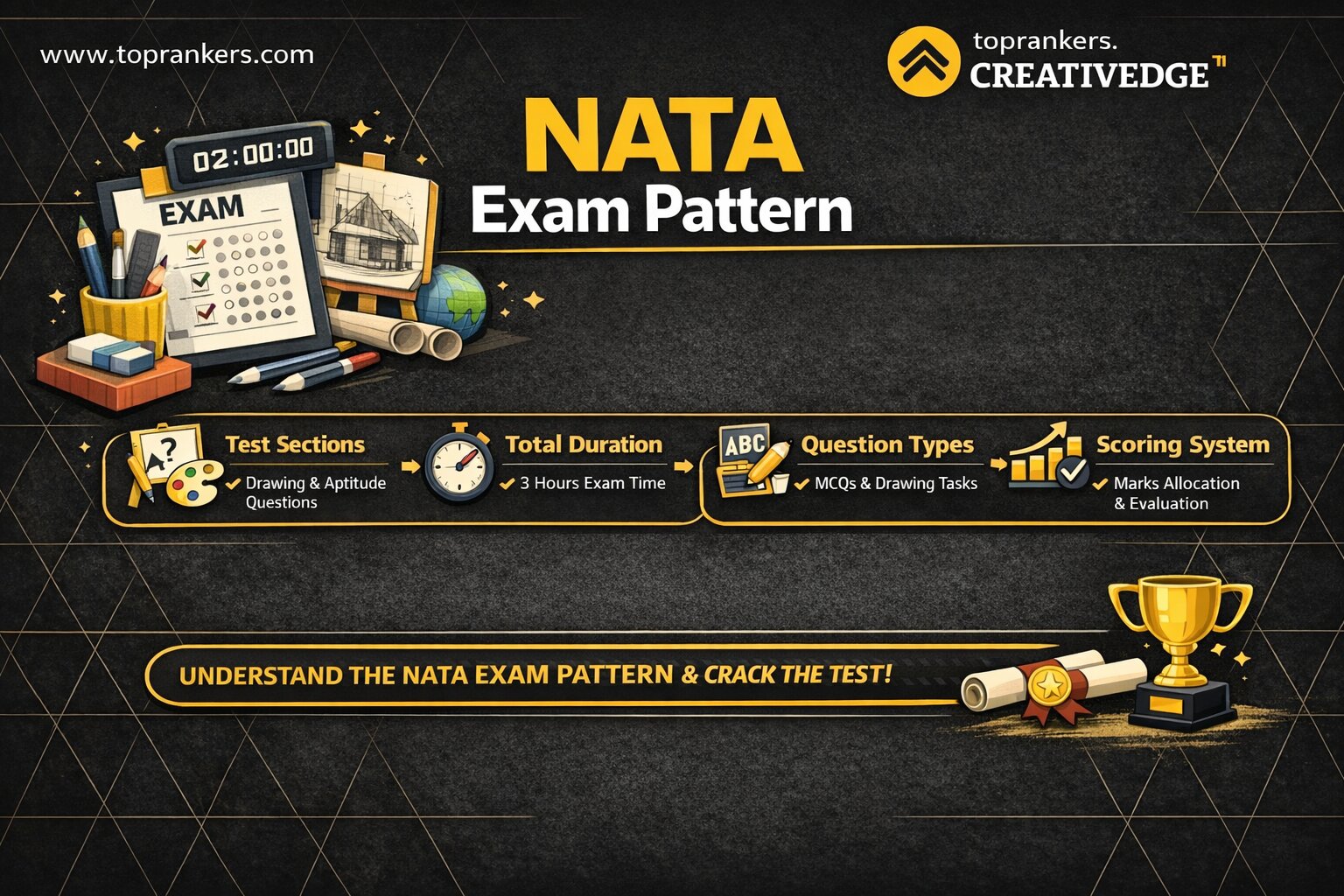
The NATA 2027 exam pattern has two parts for 200 marks over 3 hours. Part A - Drawing & Composition (offline, 3 questions, 80 marks) and Part B - Aptitude (computer-based, 50 questions = 42 MCQ + 8 NCQ, 120 marks).
The medium is English and Hindi, Part B is time-bound (~108 seconds per question), and there is no negative marking. Set by the Council of Architecture (nata.in). The Council of Architecture is expected to publish the NATA 2027 exam pattern in the official notification on the official website by around February 2027.
Key Highlights: NATA Exam Pattern 2027
| Particular | Details (2027) |
|---|---|
| Conducting body | Council of Architecture (CoA) |
| Total marks | 200 |
| Duration | 180 minutes (Part A 90 + Part B 90) |
| Part A | Drawing & Composition - offline, 3 questions, 80 marks |
| Part B | Aptitude (MCQ + NCQ) - computer-based adaptive, 50 questions, 120 marks |
| Total questions | 53 |
| Medium | English and Hindi |
| Negative marking | None |
| Part B timing | ~108 seconds per question |
| Scoring | Percentile-based (Phase 1); raw score (Phase 2) |
| Qualifying | No fixed minimum raw score - a non-zero percentile is a valid qualifying score |
| Score validity | Academic session 2027-2028 |
| Official source | nata.in |
The 2027 pattern is expected to match 2026; confirm on the official brochure. Last verified: 6 October 2026.
In 2025, the NATA paper pattern was revised, and the NATA entrance exam was conducted in both computer-based and offline mode and a timer was introduced in the aptitude section. Let's dive into the post to know the detailed NATA Exam pattern for the NATA Entrance Exam 2027.
Latest Update on NATA 2027:
- Application Form Release - February-March 2027 (Expected)
- Schedule of NATA 2027 Exam - April to June (Expected)
Table of Contents
What is NATA Exam Pattern 2027? - Overview
According to the latest official exam structure, the NATA 2027 exam carries a total of 200 marks and is conducted in a hybrid format that includes both offline drawing tasks and a computer-based aptitude test.
The NATA exam pattern is officially designed and regulated by the Council of Architecture (COA), which is the governing authority responsible for architecture education and entrance testing in India.
The NATA 2027 exam pattern described on this page follows the latest structure outlined in the official NATA brochure published on the official portal, nata.in. Candidates are always advised to refer to the official notification and brochure released by COA for the most accurate and updated exam pattern details.
| Feature | Details |
|---|---|
| Total Marks | 200 Marks |
| Total Duration | 180 Minutes (3 Hours) |
| Exam Mode | Hybrid - Offline Drawing + Computer-Based Test |
| Sections | Drawing and Composition Test + Aptitude Test (MCQ+NCQ) |
| Negative Marking | No |
How many questions are in NATA?
Part A is the offline Drawing & Composition test (3 questions, 80 marks). Part B is the computer-based aptitude test (50 questions, 120 marks) covering logical reasoning, visual reasoning, language interpretation, numerical ability and architectural awareness.
If your attempt is close, our one-month NATA preparation plan shows how to cover both parts (drawing & aptitude) in time.
What is the Marking Scheme in NATA 2027 Exam Pattern?
Marks are fixed per section.
| Section | Question | No. of Qs | Marks | Mode | Duration |
|---|---|---|---|---|---|
| Part A (Drawing) |
A1 - Composition & Colour | 1 | 25 | Offline | 90 min |
| A2 - Sketching & Composition (B&W) | 1 | 25 | |||
| A3 - 3D Composition | 1 | 30 | |||
| Total Part A | 3 | 80 | |||
| Part B (Aptitude) |
B1 - MCQ | 42 | 120 | Computer-based (adaptive) | 90 min (~108 sec/Q) |
| B2 - NCQ | 8 | ||||
| Total Part B | 50 | 120 |
Source: Council of Architecture (nata.in)
"The question paper will have a total of 53 questions for 200 marks. As per the NATA Exam Pattern, no marks will be deducted for wrongly answered questions."
How Your NATA Score Is Calculated?
Because there's no negative marking, your Part B score is simply the marks for every correct answer - wrong answers cost nothing, so leave nothing blank. Part A is subjective, so two strong drawings can swing your total significantly.
Since Part A is 40% of the paper, a candidate who is strong in aptitude but weak in drawing can still fall short - balance both. Your final NATA score is reported out of 200, and the best score across your permitted attempts is what admission authorities use.
The best way to internalise this pattern is to solve real papers - work through our NATA previous year question papers.
NATA 2027 Section Wise Weightage Distribution
| Section | What it covers | Weightage | Evaluation |
|---|---|---|---|
| Part A - Drawing & Composition | Sketching, composition, colour, 3D composition | 80 / 200 (40%) | Subjective |
| Part B - Aptitude (MCQ + NCQ) | Logical & visual reasoning, language interpretation, numerical ability, architectural awareness | 120 / 200 (60%) | Objective (computer-based) |
Note: NCQ (No-Choice Questions) are part of Part B's 120 marks, not a separate section.
Types of Questions Asked in NATA Exam Pattern
| Question Type | What It Tests | Preparation Focus |
|---|---|---|
| Drawing and Composition Tasks | Creativity, visualization, design sensitivity | Practice perspective, composition, shading |
| MCQ Questions | Analytical reasoning and observation | Improve accuracy and speed |
| NCQ Adaptive Questions | Cognitive ability and spatial logic | Practice visual analysis and problem-solving |
Once you know the question types, turn them into a method with our NATA preparation tips for cracking the exam on the first attempt.
What the NATA Syllabus Covers (In Brief)
The NATA exam pattern maps to three major areas- Part A tests Drawing & Composition (composition and colour, black-and-white sketching, 3D composition), while Part B tests General Aptitude - visual and logical reasoning, language interpretation, numerical ability, and architectural & design awareness.
For the full topic-by-topic breakdown of each section, see our complete NATA 2027 syllabus guide.


NATA 2027 Exam Pattern - Final Score Validity
If you have a valid, qualifying NATA 2026 score and have not yet taken admission during 2026-2027 (as per Council records), and you do not appear for NATA 2027, you are still expected to be assigned a Percentile Score for admission during the CAP round - your NATA 2026 scorecard is expected to remain valid for the 2027-2028 academic session.
For admission against vacant seats, the best score on your NATA 2026 scorecard would be treated as your Raw Score.
If you hold a valid NATA 2026 score, you may also appear for NATA 2027. However, if you take two attempts in NATA 2027, your NATA 2026 score becomes invalid. In that case, your NATA 2027 score and percentile are determined by the number of attempts you take in Phase 1 or Phase 2, as below:
| Status in NATA 2026 | Attempts in NATA 2027 | Final Raw Score considered in NATA 2027 |
|---|---|---|
| Obtained a valid 2026 score | 1st Attempt (Phase-1) | Best of two scores of NATA 2027 (NATA 2026 score shall be rendered invalid) |
| 1st & 2nd Attempt (Phase-1) | Best of two scores of NATA 2027 (NATA 2026 score shall be rendered invalid) | |
| 1st Attempt (Phase-2) (if not appeared during Phase-1) | NATA 2027 score (NATA 2026 score shall be rendered invalid) |
Note: A NATA 2026 score is invalid for candidates who have already secured admission to an architectural institution based on NATA 2026. Candidates who did not qualify in NATA 2026 must appear in NATA 2027 afresh.
This reflects the rule from the 2026 cycle, shifted to 2027 - the Council of Architecture restates it each year, so confirm against the official NATA 2027 brochure on release. Last verified: 6 October 2026.
Join Creative Edges NATA Coaching Institutes in India
| NATA Coaching in Indore | NATA Coaching in Andheri | NATA Coaching in Mumbai |
| NATA Coaching in Agra | NATA Coaching in Lucknow | NATA Coaching in Kolkata |
NATA 2027 Qualifying Criteria (Expected)
NATA does not set a fixed passing mark. As per the Council of Architecture's latest criteria, no minimum raw score is prescribed to qualify NATA.
Instead, NATA uses a percentile-based scoring system - you are considered qualified if your Final Scorecard shows a valid best raw score with a corresponding non-zero percentile score.
In practical terms:
- There is no "pass mark" or fixed cut-off in NATA itself - any non-zero percentile on your Final Scorecard counts as a valid qualifying score.
- If you take two attempts in a phase, your best raw score is used to compute your percentile.
- Phase-1 scorecards carry both a best raw score and a percentile score (used for Centralised Admission Counselling). Phase-2 scorecards carry a raw score only (used for vacant seats).
- Qualifying NATA does not guarantee admission - actual B.Arch admission depends on the cut-offs and eligibility set by individual states, institutions and counselling authorities.
Your NATA 2027 score will be valid for the 2027–2028 academic session.
This reflects the official NATA 2026 criteria, carried forward to 2027 (expected). The Council of Architecture restates the qualifying criteria each year, so confirm against the official NATA 2027 brochure on release. Last verified: 6 October 2026.
Qualifying is one bar and competitive scores are another - see the expected NATA 2027 cut-off to set your target.
NATA Exam Pattern 2027 - Tie-breaking Procedure
If two candidates score the same total, admission authorities break the tie in this order (as set by the Council of Architecture):
1. Higher marks in the numerical/mathematics questions of Part B
2. Fewer incorrect answers in those questions
3. Higher marks in the overall Part B aptitude test
4. Fewer incorrect answers in Part B
5. Older candidate (earlier date of birth) is preferred
[Tentative: confirm the exact tie-break sequence in the official NATA 2027 brochure.]
NATA Current Exam Pattern vs Previous Years - Official Pattern Comparison
NATA is a computer-based adaptive test, and its structure has evolved every year over the last three cycles. However, based on recent stabilization, experts predict that the NATA 2027 exam pattern is expected to remain similar to 2026, maintaining 3 drawing questions (80 marks) and 50 aptitude questions (120 marks).
One of the most important updates introduced in the recent structure is the inclusion of a 3D modelling and composition component within the Part A drawing section, which evaluates spatial visualization and practical creativity.
Comparing the latest NATA exam pattern of 2026 cycle (also expected for 2027) with the official 2025 and 2024 structures helps aspirants understand how drawing weightage, question types, and evaluation methods have evolved.
NATA Exam Pattern Comparison (2026 vs 2025 vs 2024)
| Feature | NATA 2027 (Expected) | NATA 2026 | NATA 2025 | NATA 2024 |
|---|---|---|---|---|
| Total Marks | 200 Marks | 200 Marks | 200 Marks | 200 Marks |
| Total Duration | 180 Minutes (3 Hours) | 180 Minutes: 90 min Drawing; 90 min Aptitude (108 sec/question) | 180 Minutes: 90 min Drawing; 90 min Aptitude (108 sec/question) | 180 Minutes: 90 min Drawing; 90 min Aptitude |
| Part A – Drawing Section | Drawing, composition, 3D composition and visualization tasks | Drawing & composition with 3D composition component | NATA Drawing and Composition Test with 3D composition component introduced | Drawing-focused evaluation with composition and visualization |
| Part A Number of Questions | 3 (25, 25, 30 marks) | 3 (25, 25, 30 marks) | 3 (25, 25, 30 marks) | 3 (25, 25, 30 marks) |
| Part A Weightage | 80 Marks | 80 Marks | 80 Marks | 80 Marks |
| Part B – Aptitude Section | MCQ + NCQ adaptive aptitude test | MCQ + NCQ adaptive test | MCQ + NCQ adaptive test (NCQ introduced) | MCQ-only aptitude format |
| Part B Number of Questions | 50 questions (42 MCQ, 8 NCQ) | 50 questions (42 MCQ, 8 NCQ) | 50 questions (42 MCQ, 8 NCQ) | 45 questions (30 × 2 marks & 15 × 4 marks) |
| Part B Weightage | 120 Marks | 120 Marks | 120 Marks | 120 Marks |
| Exam Mode | Hybrid (Offline Drawing + CBT Aptitude) | Hybrid Mode | Hybrid Mode | Hybrid Mode |
| Scoring / Evaluation | Percentile-based; no fixed minimum qualifying marks | Percentile-based; no fixed minimum qualifying marks | Percentile-based scoring introduced | Fixed cut-off- min 20 in Part A, min 30 in Part B |
From the NATA 2025 adaptive cycle onward, scoring is percentile-based with no fixed minimum qualifying marks (the earlier fixed cut-offs applied up to 2024). The 2027 column is expected, based on the 2026 pattern; confirm on the official brochure. Last verified: 6 October 2026.
Check: How to prepare for NATA in 1 Month
Evolution of Part A Drawing Section (Key Change)
| Year | Major Drawing Component Focus | Preparation Impact |
|---|---|---|
| NATA 2024 | Composition, perspective, visualization | Focus on sketching clarity and spatial imagination |
| NATA 2025 | Addition of 3D modelling and practical design evaluation | Increased emphasis on spatial construction and real-world architectural thinking |
| NATA 2026 & 2027 (Expected) | Continuation of 3D modelling with composition tasks | Candidates should practice object construction, depth, and structural visualization |
The addition of the 3D modelling component reflects a shift toward assessing practical architectural skills instead of only observational drawing.
Read more: Best Architecture Colleges in India
Question Format Evolution in NATA
| Change Area | What Has Changed | Preparation Implication |
|---|---|---|
| Adaptive NCQ Questions | Introduced to test cognitive ability | Focus on analytical thinking |
| Hybrid Exam Mode | Offline drawing + CBT aptitude | Practice both digital and manual skills |
| Balanced Evaluation | Creativity + reasoning combined | Maintain equal preparation for both sections |
Key NATA Exam Pattern Trends Leading into NATA 2027
- The exam continues to maintain a balanced evaluation between creative drawing and aptitude reasoning.
- Adaptive NCQ questions remain a major shift, testing analytical thinking rather than rote memorization.
- Drawing weightage is stable at 80 marks, confirming its continued importance for architecture aspirants.
- The hybrid mode reinforces the need for both manual sketching practice and digital aptitude preparation.
Turn these trends into a routine with the best NATA study timetable.
Is NATA Exam Easy to Crack on the First Attempt?
NATA is regarded as one of India's tougher architecture entrance exams, but "hard" doesn't mean "unpredictable" - and that's good news for a first attempt.
The pattern is fixed and well-documented, so most of the difficulty comes from breadth (you're tested on drawing, aptitude, reasoning and general awareness together) rather than hidden surprises. Knowing the structure well is half the battle.
A few things the exam pattern itself tells you about cracking it first time:
1. Both parts matter - don't lean on one
Part A (drawing) is 40% of your marks and is judged manually, while Part B (aptitude) is 60% and scored objectively. Strong sketching alone won't carry you, and neither will strong aptitude - the students who clear it comfortably prepare for both.
2. There's no negative marking, so attempt everything
In Part B (MCQ + NCQ), a wrong answer costs nothing, so leaving questions blank only throws away marks. Answer all 50.
3. Speed is part of the test
Part B gives you about 108 seconds per question, so practice under a timer, not just untimed - accuracy without speed won't finish the paper.
4. Practice real question types, not just theory
The reasoning and visual questions reward pattern recognition that builds with repetition, so working through plenty of NATA aptitude questions and previous papers is the most reliable way to raise your score.
So is it easy? Not exactly - but it's very crack-able on the first try if you respect both halves of the paper, practice against the clock, and use the no-negative-marking rule to your advantage. Consistent daily sketching plus timed aptitude practice beats last-minute cramming every time.
Use Creative Edge Free NATA Study Material Resources for 2027 Strategically
| NATA Material | Link |
| NATA Mock Test | |
| NATA Preparation Video 2027 | |
| NATA Syllabus 2027 | |
| NATA PYQs |
Pair those resources with the best books for NATA preparation.
Conclusion
The NATA 2027 pattern is deliberately two-sided- 40% rewards what you can draw and compose by hand, 60% rewards how you reason under a timer. That split is the whole strategy - you can't out-sketch a weak aptitude score or out-reason a weak drawing one, and the minimum Part A requirement makes drawing non-negotiable.
Treat the pattern as a plan. Bank the no-negative-marking Part B questions, protect your 3D composition time in Part A, and rehearse against the ~108-second clock.
Respect both halves equally and NATA becomes very crackable - even on the first attempt.
Preparing for NATA 2027? We can help you with exact strategic roadmap, study material and crucial feedback required to ace this exam.
Join Creative Edge, India’s leading NATA online coaching and get expert guidance on all NATA subjects.


Frequently Asked Questions
What are the new changes made in NATA Exam Pattern?

What number of questions will come from each of the sections?
What is the total marks allotted to each section?
What is the Mode of Exam for each of the section?
Is there negative marking in NATA 2027?
How many questions will be asked in NATA 2027 drawing test?
Can I use measuring instruments in drawing test of NATA 2027?
Is the pattern the same for NATA Phase 1 and Phase 2?
Is a calculator allowed in NATA 2027?

Vineeta Agrawal
Communications Executive
SHARE