
1723534562.png)

CMAT Subjects 2026 PDF Download Section Wise Important Topics [Official]
August 19, 2026
Overview: CMAT Subjects 2026 include five sections: Quantitative Techniques & Data Interpretation (QTDI), Logical Reasoning, Language Comprehension, General Awareness, and Innovation & Entrepreneurship. If you know what each CMAT subject tests and prioritise the high-ROI topics, you can improve speed, accuracy, and your overall score.
Quick snapshot: CMAT Exam is a 3-hour CBT exam with 100 questions for 400 marks and a standard marking scheme of +4/-1 (as per official pattern). Use the subject-wise topic list below to plan your preparation and revision.
CMAT Subjects vs CMAT Syllabus vs CMAT Exam Pattern
CMAT Subjects tell you the 5 sections asked in the exam (what to study). CMAT Syllabus breaks each subject into topic lists (topic-wise plan). CMAT Exam Pattern tells you the number of questions, marks, duration, and marking scheme (how the paper works).
What are Subjects in CMAT?
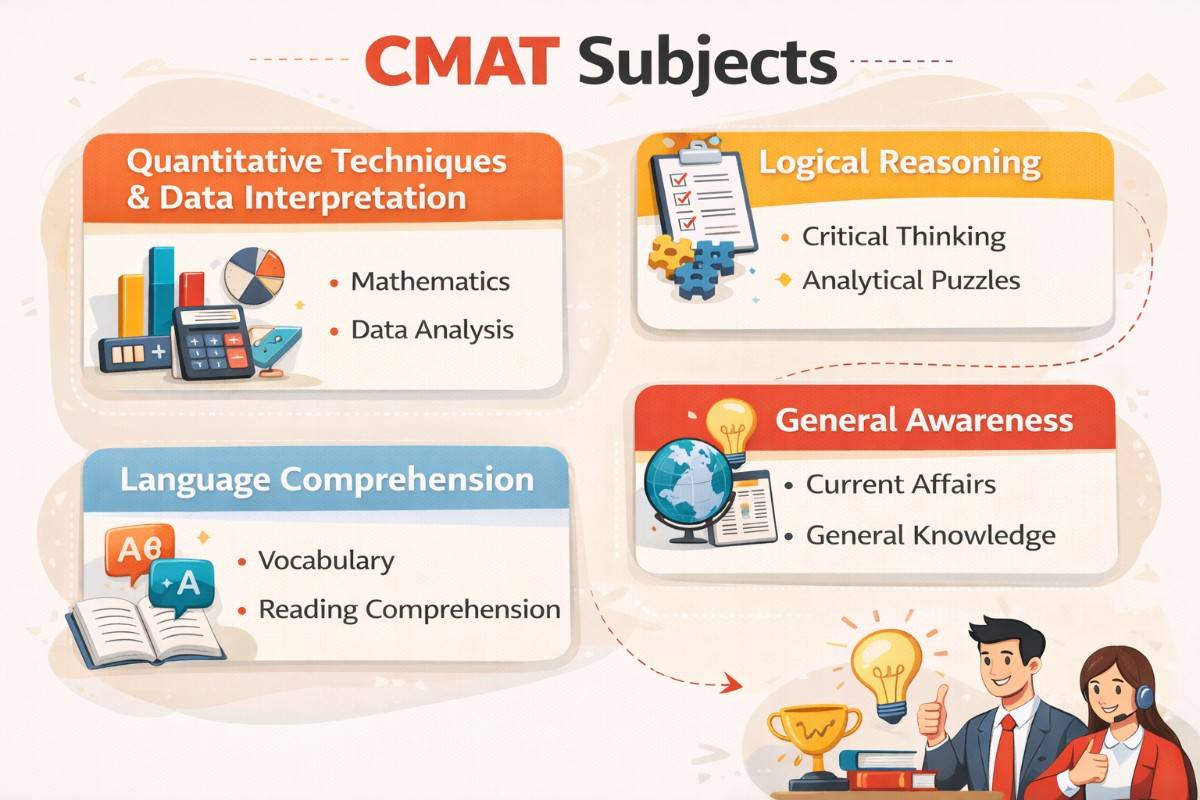
CMAT subjects refer to the five sections you need to prepare for in the CMAT exam: Quantitative Techniques & Data Interpretation, Logical Reasoning, Language Comprehension, General Awareness, and Innovation & Entrepreneurship.
These subjects together test your aptitude, reasoning ability, language skills, awareness of current and static CMAT GK Questions, and basic understanding of business/startups. Knowing the CMAT subjects helps you plan section-wise CMAT preparation, prioritise high-scoring topics, and build a smarter mock-test strategy.
CMAT Subjects 2026: Section-wise overview (at a glance)
| CMAT Subject (Section) | What it tests | High-ROI focus |
|---|---|---|
| QTDI | Arithmetic + Algebra + Modern Maths + Geometry + Data Interpretation | Arithmetic basics, Algebra core, DI sets (tables/graphs), speed maths |
| Logical Reasoning | Analytical + verbal + non-verbal reasoning, decision-making | Arrangements, series, coding, syllogism, statement-based questions |
| Language Comprehension | RC, grammar, vocabulary, verbal ability | RC + vocab (syn/antonyms, idioms) + error spotting |
| General Awareness | Static GK + current affairs across sectors | Business/economy, national updates, awards, sports, basic polity |
| Innovation & Entrepreneurship | Startup ecosystem, business basics, innovation frameworks | Business models, funding, marketing growth, govt support, IPR basics |
Detailed Break Down of CMAT Subjects 2026
1) Quantitative Techniques & Data Interpretation (QTDI)
What to expect: QTDI checks calculation comfort, concept clarity, and data reading ability. Your score improves fastest when you lock Arithmetic + core Algebra and practise DI sets regularly.
High-ROI priority list: Percentages, Ratio–Proportion, Profit–Loss, SI–CI, Time–Work, TSD, Averages, Mixtures, Linear/Quadratic equations, Indices/Surds, Logarithms, Permutation–Combination, Probability, Basic Geometry, Mensuration, Tables/Bar/Line/Pie charts.
| Cluster | Topics to cover | Priority |
|---|---|---|
| Arithmetic | Percentages, Ratio–Proportion, Averages, Profit–Loss, SI–CI, TSD, Time–Work, Mixtures, Pipes & Cisterns, Partnership, Unitary Method | Very High |
| Algebra | Linear/Quadratic equations, Inequalities, Progressions, Indices & Surds, Logarithms | High |
| Modern Maths | Permutation–Combination, Probability, Set Theory, Binomial (basics) | Medium |
| Geometry & Mensuration | Lines & angles, Triangles, Circles, Polygons, Coordinate geometry basics, 2D/3D Mensuration, Trigonometry basics | Medium |
| Data Interpretation | Tabulation, Pie chart, Bar graph, Line graph, Mixed graphs | Very High |
Preparation tip: Keep a QTDI error log (formula slip, concept slip, silly mistake). Re-solve those 2–3 times before your next mock.
2) Logical Reasoning (LR)
What to expect: CMAT LR includes analytical reasoning (arrangements, puzzles), verbal reasoning (statement-based), and non-verbal reasoning (patterns). The fastest improvement comes from practising arrangements + statement questions with strict timing.
High-ROI priority list: Linear/Circular/Matrix arrangements, Syllogism, Coding–Decoding, Series, Blood relations, Direction–Distance, Order–Ranking, Analogy, Inference, Statement–Assumption/Conclusion/Argument, Cause–Effect, Course of Action, Visual reasoning.
| Cluster | Topics to cover | Priority |
|---|---|---|
| Arrangements & Puzzles | Linear, Circular, Matrix arrangements, Sequencing, Ranking | Very High |
| Verbal Reasoning | Syllogism, Statement–Assumption, Statement–Conclusion, Arguments, Inference, Course of Action | High |
| Basics Set | Coding–Decoding, Series (number/alphabet), Blood relations, Direction–Distance | High |
| Non-verbal | Visual reasoning, figure series, pattern completion | Medium |
Preparation tip: In mocks, don’t “fight” one puzzle for too long. Keep a hard cut-off time per set and move on.
3) Language Comprehension
What to expect: The CMAT section tests RC, vocabulary, grammar, and verbal ability. The most reliable score gain comes from CMAT subjects daily reading + RC practice + error spotting.
- Reading Comprehension (passage-based questions)
- Vocabulary: One-word substitution, synonyms/antonyms, idioms & phrases, foreign words used in English
- Grammar & Usage: Error spotting, sentence correction, fill in the blanks, common usage errors
- Verbal Ability: Para jumbles, paragraph completion, basic verbal reasoning
Preparation tip: Build a “50-word list” for recurring vocab + revise it every 3rd day. It pays off quickly.
4) General Awareness (GA)
What to expect: GA covers both static GK and current affairs. You don’t need to read everything—use smart sources and revise repeatedly.
| Area | What to cover | Priority |
|---|---|---|
| Current Affairs | National & international events, business/economy updates, appointments, awards, sports, reports & indices (basics) | High |
| Static GK | Indian polity basics, constitution basics, geography, history, culture, science in everyday life, important personalities | Medium |
| Trade & Business Awareness | Business terms, budgeting basics, entrepreneurship vocabulary, marketing terms | High |
Preparation tip: GA is revision-driven. Revise the same monthly notes 3–4 times instead of chasing 10 sources.
5) Innovation & Entrepreneurship
What to expect: This section checks your understanding of how startups and businesses work, how innovation is created/scaled, and the ecosystem around entrepreneurship. You don’t need an MBA-level deep dive—just clear basics + common frameworks + applied examples.
High-ROI priority list: Entrepreneur & types, startup lifecycle, business models, marketing & growth, funding basics, government support, legal structure & IPR basics, challenges/risk, innovation concepts & frameworks, role of entrepreneurship in economic development.
| Cluster | Topics to cover | Priority |
|---|---|---|
| Entrepreneurship Basics | Entrepreneur definition, types of entrepreneurs, traits/skills, theories/models of entrepreneurship, entrepreneurship challenges | Very High |
| Startup & Business Models | Value proposition, customer segments, revenue models, unit economics (basics), B2B vs B2C, go-to-market basics | High |
| Funding & Finance (Basics) | Bootstrapping, angel/VC, pitch basics, funding stages (seed to growth), valuation basics (conceptual), burn & runway (conceptual) | High |
| Marketing & Growth Strategy | Brand basics, growth levers, product-market fit concept, customer acquisition basics, retention basics | High |
| Innovation Concepts & Frameworks | Concepts of innovation, innovation framework, incremental vs disruptive (basics), idea-to-launch steps | High |
| Legal Structure & Govt Support | Legal structure of startups (basic forms), IPR basics (trademark/patent/copyright), role of government in promoting entrepreneurship, incubators/accelerators (conceptual) | Medium |
| Social/Rural/Women Entrepreneurship | Rural entrepreneurship, women entrepreneurship, entrepreneurship in economic development (high-level) | Medium |
Preparation tip: Treat this section like “smart GK for startups.” Make 2-page notes: keywords + frameworks + examples + common funding terms.
Weightage for CMAT Subjects 2026 (Section-wise questions & marks)
The CMAT total marks depends on the sections, number of questions and maximum marks given below:
| Section | No. of Questions | Maximum Marks |
|---|---|---|
| Quantitative Techniques & Data Interpretation | 20 | 80 |
| Logical Reasoning | 20 | 80 |
| Language Comprehension | 20 | 80 |
| General Awareness | 20 | 80 |
| Innovation & Entrepreneurship | 20 | 80 |
| Total | 100 | 400 |
Recommended books for CMAT Subjects 2026 (cleaned + non-repetitive)
QTDI
- How to Prepare for Quantitative Aptitude – Arun Sharma
- Quantitative Aptitude for Competitive Examinations – R.S. Aggarwal
- Quantitative Aptitude for CAT – Nishit K. Sinha
Logical Reasoning
- A Modern Approach to Logical Reasoning – R.S. Aggarwal
- How to Prepare for Logical Reasoning for the CAT – Arun Sharma
- Logical Reasoning & Data Interpretation for CAT – Nishit K. Sinha
Language Comprehension
- Word Power Made Easy – Norman Lewis
- High School English Grammar & Composition – Wren & Martin
- Verbal Ability & Reading Comprehension for CAT – Arun Sharma & Meenakshi Upadhyay
General Awareness
- Manorama Year Book (for static)
- 1 reliable daily newspaper + monthly current affairs revision notes
Innovation & Entrepreneurship
- The Innovator’s Dilemma – Clayton M. Christensen
- National Policy on Skill Development and Entrepreneurship – Govt. of India (overview)
- Incubation/Startup ecosystem reading (basic terminology + frameworks)
Last 30 days strategy (quick plan)
- Week 1–2: 1 full mock every 2–3 days + error-log revision
- Week 3: 3 full mocks + sectional focus (QTDI DI sets + LR arrangements + RC)
- Week 4: Formula revision + GK rapid notes + 5 mixed mini-tests + 2 final mocks
Conclusion
Understanding the CMAT Subjects 2026 is the fastest way to build a practical preparation plan. Once your high-ROI topics are clear, your CMAT mocks become more focused, your revision becomes sharper, and your score moves up consistently.
Pro tip: Keep one notebook for formulas + one notebook for error-log + one notebook for GK/I&E keywords. Revise them in cycles.
Smart Prep for CAT: Join Our Free Demo Class
Fill your details
Frequently Asked Questions
What are the subjects in CMAT?

What are the subjects in CMAT 2026?
What is the weightage of each CMAT subject?
Is CMAT syllabus the same as CMAT subjects?
Which CMAT subject is the most scoring?
Does CMAT have sectional cutoff?
What is the weightage of the CMAT subjects?
Is CMAT objective or subjective?
Does CMAT have sectional cutoff?

Zubeen Siddiqui
Content Writer | MBA & CAT Preparation
SHARE