
1723534562.png)

NIFT Entrance Exam Syllabus 2027: CAT & GAT Topics, Weightage, PDF Download
July 31, 2026
Quick Answer: The NIFT 2027 syllabus is built around two written papers: the Creative Ability Test (CAT), a drawing-based test for B.Des and M.Des aspirants, and the General Ability Test (GAT), an aptitude test taken by every program.
B.Des candidates then face a Situation Test, while M.Des, M.FTech and MFM candidates go through a Group Discussion and Personal Interview (GD/PI). Only the GAT carries negative marking - 0.25 marks off per wrong answer.
Key Highlights: NIFT 2027 Syllabus
- Two-stage exam: Stage 1 is the written test (CAT + GAT); Stage 2 is the Situation Test (B.Des) or GD/PI (M.Des, M.FTech, MFM). B.FTech is selected on GAT alone.
- CAT (Creative Ability Test): Paper-based (offline) drawing test for B.Des and M.Des - evaluates creativity, observation, visualization and design thinking. No negative marking.
- GAT (General Ability Test): Computer-based (online) test for all program - covers quantitative ability, communication and English, analytical/logical ability, GK & current affairs, plus a case study for technology and management courses.
- Negative marking: Applies only in GAT (-0.25 per wrong answer); CAT and the Situation Test carry none.
- Situation Test: A hands-on round where B.Des candidates build a 3D model from given materials, judged on space visualization, material use, composition and a written concept note.
- Conducted by NTA on behalf of NIFT, across 20 campuses pan-India; the official 2027 notification is expected around December 2026, so dates and pattern below are based on the NIFT 2026 cycle.
NOTE: NIFT 2027 notification is expected around December 2026. The structure below reflects the latest pattern (2026) and will be updated, in case of any changes, once NTA releases the 2027 bulletin.
What is NIFT Syllabus 2027?
The NIFT syllabus 2027 includes topics from the Creative Ability Test (CAT) and the General Ability Test (GAT). CAT covers drawing, creativity, visualization, and design thinking. GAT includes quantitative ability, logical reasoning, English comprehension, general knowledge, and case studies, depending on the program.
Although the NIFT 2027 syllabus varies slightly by program. Design programs like B.Des and M.Des emphasize CAT along with GAT, focusing more on creativity and visualization skills.
Technology and management program such as B.FTech, M.FTech, and MFM rely primarily on GAT and include a case study component that tests analytical thinking, decision-making, and real-world problem-solving ability.
Which paper matters most depends on your course. If you're aiming for B.Des or M.Des, your CAT drawing sheet decides the seat - GAT only supports it. If you're going for B.FTech, M.FTech or MFM, GAT is the whole game, so aptitude and the case study are where your hours should go.
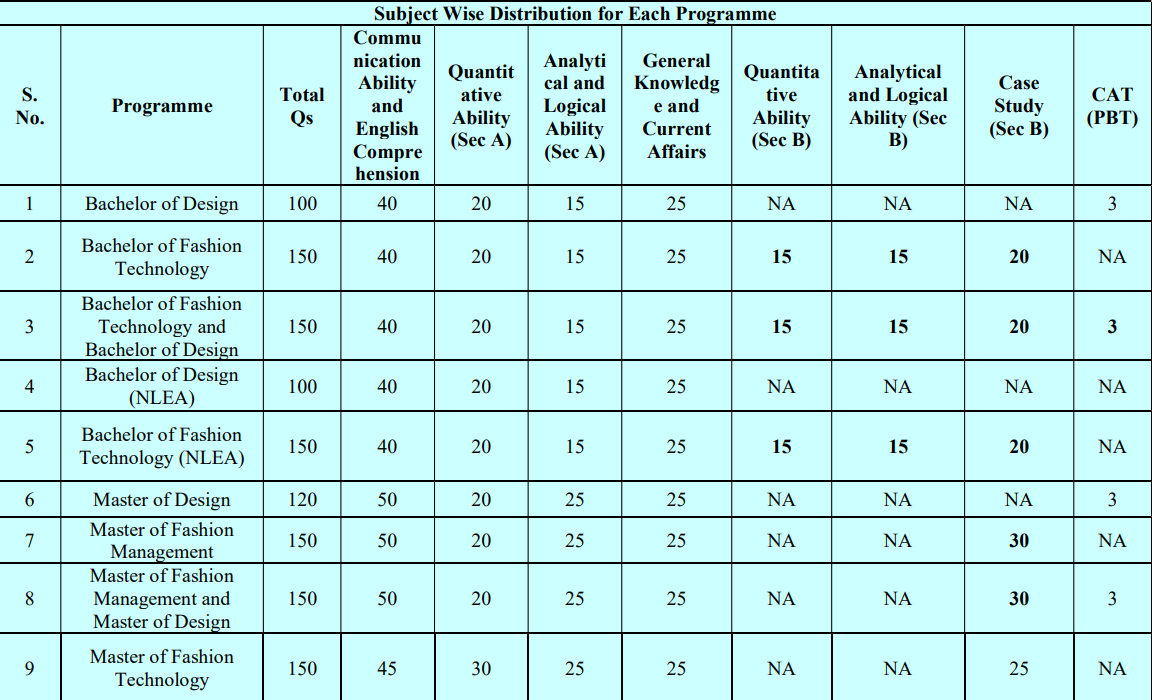
NIFT Entrance Exam 2027 Highlights
The NIFT 2027 entrance exam will be divided into two parts:
Step 1: Written exams
- General Ability Test
- Creative Ability Test (only B.Des and M.Des candidates need to take CAT)
Short listed candidates from the written entrance examination are required to take the Situation test/Group Discussion (GD) / Interview as applicable (except B.FTech).
Step 2: Situation Test (B.Des only) or Group Discussion / Personal Interview (M.Des, M.FTech, MFM). B.FTech is selected on GAT alone.
Let's take a look at the NIFT 2027 highlights in the table below:
| Exam Name | NIFT 2027 |
| Full-Form | National Institute of Fashion Technology |
| Courses Offered | Bachelor of Design (B.Des) |
| Bachelor of Fashion Technology (B.FTech) | |
| Master of Design (M.Des) | |
| Master of Fashion Technology (M.FTech) | |
| Master of Fashion Management (M.F.M) | |
| Exam Type | Undergraduate & Postgraduate |
| Exam Level | National Level |
| Conducting Body | Conducting Body: National Testing Agency (NTA), on behalf of NIFT |
| Total seats | 5076 |
| Participating Institutes | 20 campuses |
| Mode of the exam | Offline (Pen and Paper) for CAT, Online Computer-based for GAT, and Offline Hands-on for Situation Test |
| Application Mode | Online mode |
NIFT Syllabus 2027 For CAT
NIFT CAT is administered for both UG and PG Design Program to evaluate a candidate's:
- Creativity
- Observation Power
- Intuitive Ability
- Imagination & Conceptualization
- Innovation and Development of Concept
- Innovative Use of Colours
- Illustration Skill
- Storyboarding & Sequential Drawing
- Product Redesign & Innovative Thinking
- Poster Making & Visual Messaging
- Design Problem Solving (with constraints)
Check: NIFT Previous Year Drawing Questions
NIFT Syllabus for CAT section (Only for B.Des & M.Des): Sample Questions
- Draw an imaginary creature using parts of 3 different animals.
- Redesign a toothbrush for elderly users.
- Create a poster on the theme “Save Water” using only visuals.
- Create a story in 4 frames based on the scene: “You miss your train.”
You must note that the National Institute of Fashion Technology has not released any official NIFT entrance exam syllabus for the CAT exam, however our in-house experts at Toprankers who've led several toppers to their dream NIFT colleges, have prepared detailed NIFT syllabus with essential topic-wise list of various sections for your reference.
These topics are in-line with the NIFT question papers from the previous year, which are listed below.
NIFT Syllabus 2027 - Key Differences Between B.Des and M.Des CAT
|
Aspect |
B.Des CAT |
M.Des CAT |
|
Level of thinking |
Basic to intermediate |
Advanced and analytical |
|
Drawing complexity |
Simple to moderate |
Concept-driven, not necessarily detailed |
|
Idea depth |
Imaginative |
Strategic and contextual |
|
Evaluation style |
Creativity and presentation |
Design logic and intent |
Important Notes for Aspirants
- CAT is a scoring section, especially important for design-oriented courses
- Quality of ideas matters more than artistic perfection
- Clean drawings, clear concepts, and relevance to the question are critical
- Overcrowding, unnecessary detailing, or off-topic visuals can reduce scores

NIFT General Ability Test (GAT) Syllabus 2027: Section-by-Section
The NIFT Syllabus 2027 for GAT to pursue the NIFT Fashion Designing Course includes the following components:
- Quantitative Ability
- Communication Ability & English Comprehension
- Analytical & Logical ability
- General Knowledge & Current Affairs
- Case Study
The section-wise details of the NIFT syllabus GAT section are as follows:
|
Section |
Objective | Topics Covered in NIFT GAT Syllabus |
| Quantitative Ability | This section tests your quantitative ability skills | Addition, Multiplication, Division, Fractions, Percentage, Rate of Interest, Work and Task, Ratio and Proportion, and Distance. |
| Communication Ability | You will be tested on language skills and their use in day-to-day communication in English. | Synonyms, Antonyms, Words with corresponding meanings, Singular, Plural, One-word Substitutes, Idioms and Phrases, Spelling correction. |
| English Comprehension | Your reading and comprehension abilities of a given situation in the unseen passage are tested in this section. | English language skills through the questions based on the course |
| Analytical Ability | The questions are designed to test your capacity to infer and use logic from the given information. | Questions from the areas of logical reasoning where you are supposed to draw logical conclusions from the analytical reasoning questions |
| General Knowledge and Current Affairs | Questions are designed to test your general awareness and current affairs. | Current affairs and general knowledge. |
| Case Study |
These questions present a real-world business, management, or design scenario and test your ability to analyze information, identify problems, and choose the most logical solution. They evaluate decision-making, analytical thinking, comprehension, and problem-solving skills. |
|
NIFT Syllabus 2027 - Key Differences Between B.Des and M.Des GAT
The General Ability Test (GAT) in the National Institute of Fashion Technology (NIFT) entrance exam evaluates aptitude-related skills for both B.Des and M.Des candidates. While the core areas remain similar, the depth, complexity, and expectation level differ significantly between UG and PG aspirants.
B.Des vs M.Des – NIFT GAT Section Comparison
|
Parameter |
B.Des GAT |
M.Des GAT |
|
Level of difficulty |
Moderate |
Moderate to High |
|
Focus of questions |
Fundamentals and basic application |
Conceptual understanding and analytical application |
|
Basic reasoning, pattern recognition |
Advanced reasoning, multi-step logic |
|
|
Quantitative ability |
Simple arithmetic, percentages, ratios, speed–time |
Data interpretation, applied numeracy |
|
English comprehension |
Vocabulary, grammar, basic reading comprehension |
Critical reading, inference-based questions |
|
GK & current affairs |
Basic awareness (design, fashion, culture) |
Design-centric awareness with deeper context |
|
Analytical ability |
Straightforward problem solving |
Scenario-based and decision-oriented questions |
|
Question framing |
Direct and simpler |
Complex, layered, and interpretation-driven |
|
Expected approach |
Speed + accuracy |
Accuracy + reasoning depth |
|
Evaluation intent |
Assess readiness for undergraduate design learning |
Assess design maturity and postgraduate aptitude |
NIFT Entrance Exam Syllabus 2027 for Situation Test (B.Des Only)
This evaluation is for admissions into all the NIFT participating colleges.
The test helps determine the creative dimension of your mind, and you are asked to prepare a prototype or 3D model from the materials received. In this test, as a part of the NIFT 2027 syllabus, you are largely evaluated based on the below-mentioned parameters:
- Space visualization
- 3D model creation based on a given theme, functional product design, or story-based scenarios
- Innovative and creative use of allotted materials
- Functional Product Design
- Composition of elements
- Colour scheme
- Overall presentation
These parameters will be evaluated in the write-up you will have to write along with the model/prototype making, explaining the concept behind the model constructed.
Prepare well for this test because once you clear this, the life at NIFT that awaits you is exciting!
Sample questions for Situation Test
1. Design a headgear/ mask inspired by:
- Alien
- Underwater Creatures
- Mythological Character
2. Create a scene based on:
- Folk tales like Ramayana
- Fairy tales
- A tale from the Panchtantra
3. Design a character depicting the city/culture you belong to.
4. Create a futuristic office area of:
- Author
- Social Media Influencer
- Veterinary
5. Create models on any of the following themes:
- Digital India
- Make in India
- Save Girl Child
NIFT Syllabus 2027 for Group Discussion (GD) & Evaluation Parameters
The panel of experts will assess your leadership qualities, conceptual clarity, problem-solving skills, etc., in the group discussion.
| Conceptual clarity | Knowledge of the topic assigned |
| Contribution to the case | Interpersonal skills |
| Ability to generate new ideas | Problem-solving approach |
| Leadership qualities | Effective communication |
Overall, learn effective ways to attempt CAT questions in NIFT or short tricks to score more marks on the GAT paper to boost your score.
NIFT Syllabus 2027 for Personal Interview (PI)
You will be tested on the following parameters during the personal interview for the exam:
There's no defined NIFT 2027 syllabus for this round, it just has to be your confidence and clarity that makes you stand out!
| Career orientation | Aptness for the field |
| Good Communication Skills | General awareness and aptitude |
| Overall personal achievements in academics and co-curricular activities | Creative and lateral thinking |

NIFT Exam Syllabus - Subject-wise Sample Questions (Solved)
| FREE NIFT Sample Papers PDF Download | Question Papers Link | Answer Key Link (with detailed explanations) |
| NIFT Study Material - Sample Paper 1 | ||
| NIFT Study Material - Sample Paper 2 | ||
| NIFT Study Material - Sample Paper 3 |
NIFT Exam Pattern 2027
NIFT entrance exam paper pattern and the NIFT syllabus vary for each course. CAT & GAT exam for NIFT Phase 1 are written tests. For some courses both the exams are required while for other only GAT is required. This is followed by Phase 2 of NIFTEE which is Situation Test for some courses and GD/PI for others.
Exam rounds to attend for each course are as follows:
- For B.Des, you must appear for CAT, GAT, and Situation Test.
- For M.Des, you must appear for CAT, GAT, and GD/ PI.
- For B.FTech, you must appear for GAT.
- For M.FTech and MFM applicants, the selection process will be through GAT and GD/ PI.
Note:
- General Ability Test (GAT) will be a Computer Based Test (CBT).
- Creative Ability Test (CAT) will be a Paper Based Test (PBT).
NIFT GAT Exam Pattern 2027: B.Des & M.Des
| Program | B.Des | M.Des |
| Paper Name | GAT | GAT |
| Language Of Written Test | English/Hindi | English/Hindi |
| Test Duration (Min) | 120 | 120 |
| Communication Ability | 25 | 30 |
| English Comprehension | 25 | 30 |
| Quantitative Ability | 20 | 20 |
| Analytical Ability | 15 | 25 |
| General Knowledge and Current Affairs | 15 | 15 |
| Total No. of Questions | 100 | 120 |
Negative marking applies only in GAT - 0.25 marks are deducted for each incorrect answer. CAT and the Situation Test carry no negative marking.
NIFT GAT Exam Pattern 2027: B.FTech, M.FTech & MFM
|
Program |
B.FTech |
M.FTech |
M.F.M |
|
Paper Name |
GAT |
GAT |
GAT |
|
Language Of Written Test |
English/Hindi |
English/Hindi |
English/Hindi |
|
Test Duration (Min) |
180 |
180 |
180 |
|
Sections |
No. of Questions |
No. of Questions |
No. of Questions |
|
Communication Ability & English Comprehension |
45 |
45 |
50 |
|
Case Study |
25 |
25 |
40 |
|
Quantitative Ability |
30 |
30 |
10 |
|
Analytical & Logical Ability |
25 |
25 |
25 |
|
General Knowledge and Current Affairs |
25 |
25 |
25 |
|
Total No. of Questions |
150 |
150 |
150 |
Note: M.FTech will also have some questions from the engineering field. The number of questions may vary in each section and for each course year to year. The level of difficulty in questions for all courses may vary.
NIFT CAT Exam Pattern 2027: B.Des & M.Des
The Creative Ability Test (CAT) is a core component of the National Institute of Fashion Technology (NIFT) entrance exam. CAT evaluates a candidate’s creativity, visualization skills, problem-solving ability, and design thinking through drawing-based questions.
While the intent of CAT remains the same for both UG and PG aspirants, the complexity, depth, and expectations differ for B.Des and M.Des candidates.
NIFT CAT Exam Pattern - B.Des (Undergraduate) vs M.Des (Postgraduate)
|
Parameter |
B.Des |
M.Des |
| Total Marks | 100 | 100 |
| Time Duration | 3 Hours | 3 Hours |
| Mode | Offline, Pen & Paper | Offline, Pen & Paper |
|
Purpose of CAT |
Assess basic creativity, imagination, and visual expression |
Assess advanced design thinking and conceptual maturity |
| No. of Questions | 3 - 6 Subjective/Drawing-based questions | 3 - 6 Subjective/Drawing-based questions |
|
Question type |
Drawing and visualisation based (subjective) |
Drawing-based and concept-driven (subjective) |
|
Skills tested |
Creativity, observation, composition, colour sense, concept visualisation |
Problem identification, ideation depth, visual reasoning, design sensitivity |
|
Difficulty level |
Moderate |
Moderate to High |
|
Nature of tasks |
Situation-based drawing, theme illustration, simple design problems |
Conceptual design problems, abstract themes, context-based scenarios |
|
Focus |
Idea generation and visual clarity rather than technical perfection |
Depth of concept, logic behind ideas, and relevance to real-world design |
|
Evaluation emphasis |
Originality, relevance to the theme, neat presentation |
Thought process, innovation, justification of design choices |
Check: NIFT Exam Detailed Analysis
Best Books & Study Material for NIFT 2027
Choose the right books that cover all topics per the nift entrance exam syllabus to score good marks on the exam.
You may consider referring to the following NIFT Preparation Books listed in the table below:
| Name of the Book | Publication | Availability |
| NIFT Previous Year Papers Book | Creative Edge by Toprankers | Amazon & Flipkart |
| NIFT Sample Papers Book | Creative Edge by Toprankers | Amazon & Flipkart |
Creative Edge NIFT Prep Books - built by mentors and NIFT alumni
Two focused resources round out your preparation:
- The NIFT Past Year Papers book compiles 11 years of fully solved GAT + CAT papers (2015–2026, including the latest 2026 paper), with QR-linked video solutions for CAT drawing questions and a 5-year trend analysis to target high-weightage topics.
- The NIFT Sample Papers book offers 400+ questions, 3 full-length mocks with video solutions, and a 5-year topic-wise weightage breakdown - all mapped to the latest NIFT exam pattern.
_(1)1754636837.webp)
1756536783.webp)
Conclusion
The NIFT Syllabus 2027 provides a comprehensive overview of the subjects and skills required to excel in the National Institute of Fashion Technology entrance exams.
NIFT offers undergraduate and postgraduate programs in fashion design, and understanding the NIFT 2027 syllabus is crucial, as around 50,000-60,000 students appear for the entrance exams each year.
The exams consist of a Creative Ability Test (CAT), General Ability Test (GAT), Situational Analysis, Group Discussion (GD), and Personal Interview (PI) segments, each assessing specific skills and knowledge areas.
Key takeaways:
- The Creative Ability Test (CAT) evaluates candidates' creativity, design skills, and artistic abilities, covering design theory, colour terminology, and visual logic.
- The General Ability Test (GAT) assesses quantitative ability, communication skills, English comprehension, analytical ability, general knowledge, and current affairs.
- The Situation Test evaluates candidates' material handling, innovation, creativity, and prototype development abilities.
- Group Discussion (GD) and Personal Interview (PI) measure leadership qualities, problem-solving skills, communication skills, and overall aptitude for the fashion industry.
- Thorough preparation and practice, especially in areas covered by the NIFT 2027 syllabus, are essential for success in these competitive exams.
Enrol here to boost your NIFT 2027 Exam Preparation: NIFT 2027 Online Coaching by CreativeEdge
Table of contents
or reload the browser
1764684691.webp)
Attempt a Free NIFT Mock Test
Fill your details
Frequently Asked Questions
Which subjects are required for NIFT?

Is NIFT very difficult?
Which stream is best for NIFT?
What is the NIFT Entrance Exam Syllabus 2027 for GAT?
What is the NIFT Syllabus for situation test for 2027?
What is the syllabus for NIFT Entrance Exam for PI?
What is the syllabus for B.Des at NIFT?
What is the syllabus of the NIFT B.Des fashion design course in the 2nd year?

Vineeta Agrawal
Communications Executive


SHARE