
1723534562.png)

CLAT Time Management Tips 2027: Section-Wise Strategy to Attempt 120 Questions
June 2, 2026
Reader's Digest - If you consistently score well in sectionals but struggle to complete full-length mocks, time management may be your biggest challenge.
The right CLAT Time Management Tips can help you attempt more questions accurately, avoid panic during the exam, and maximize your final score.
In this guide, you'll learn section-wise timing, topper strategies, mock test techniques, and exam-day tips.
Key Takeaways
- Plan your time smartly: Allocate fixed time to each section and avoid overspending time on any one area.
- Practice with a timer: Regular mock tests and previous papers help improve speed and accuracy.
- Master comprehension strategy: Skim, read questions first, and focus only on relevant parts of passages.
- Skip & return approach: Don’t get stuck—move ahead and revisit tough questions later.
- Stay calm and consistent: A balanced routine, proper revision, and stress control are key to success.
Table of Contents
- How Much Time Should You Allocate to Each CLAT Section?
- What is the Best Attempt Order for CLAT?
- Section-Wise CLAT Time Management Tips 2027
- What Should be Your Approach to CLAT Exam 2027?
- What are CLAT Time Management Tips to Manage Stress?
- What is the Smart Way of Solving Comprehension-Based Questions in CLAT 2027?
- How to Improve Speed and Accuracy for CLAT?
- CLAT Mock Test Time Management Tips
- Common Time Management Mistakes in CLAT
- Self-Evaluation Check
As the competition for the CLAT exam is increasing exponentially, you must put your maximum effort into the exam to deal with the competition and come out with flying colours.
Effective time management is vital to securing a good entrance exam rank. Also, it will help you boost your confidence, set priorities, and reduce stress levels.
This post will provide the best CLAT time management tips, smart ways to solve lengthy passage-based questions, and more.
So, why late? Let's dive into the post for simple tips and tricks that will help enhance your time management skills.
How Much Time Should You Allocate to Each CLAT Section?
One of the most important CLAT Time Management Tips 2027 is knowing exactly how much time to spend in each section.
| Section | Ideal Time Allocation |
|---|---|
| English Language | 20-25 Minutes |
| Current Affairs & GK | 8-10 Minutes |
| Legal Reasoning | 30-35 Minutes |
| Logical Reasoning | 20-25 Minutes |
| Quantitative Techniques | 10-15 Minutes |
Total: 120 Minutes
Remember, this is not a rigid formula. You can adjust based on your strengths and weaknesses.
Read More: CLAT Exam Pattern 2027
What is the Best Attempt Order for CLAT?
There is no universal attempt order that works for everyone.
However, most high-scoring candidates follow one of these strategies.
Strategy 1: The Safe Scorer Approach
Current Affairs → English → Logical Reasoning → Legal Reasoning → Quantitative Techniques
Best for students who:
- Have strong GK preparation
- Want quick confidence-building marks
- Prefer finishing shorter sections first
Strategy 2: The Comprehension Master Approach
English → Legal Reasoning → Logical Reasoning → Current Affairs → Quantitative Techniques
Best for students who:
- Read quickly
- Have strong comprehension skills
- Perform well in passage-based questions
Try both strategies in mocks and finalize the one that feels natural.
Section-Wise CLAT Time Management Tips 2027
English Language
Recommended Time: 20–25 Minutes
Many students make the mistake of reading every passage slowly.
Instead:
Follow This Process
Step 1: Read the passage actively.
Step 2: Understand the author's argument.
Step 3: Attempt direct questions first.
Step 4: Leave inference-based questions for later if needed.
Pro Tip
Do not memorize vocabulary lists endlessly.
Focus on reading editorials, opinion pieces, and legal articles regularly.
The better your reading speed, the faster you'll complete this section.
Read more: CLAT Reading Comprehension Tips 2027 Tips
Current Affairs and General Knowledge
Recommended Time: 8–10 Minutes
This should be your fastest section.
Since the answers depend largely on prior knowledge, avoid overthinking.
Smart Strategy
- Attempt questions you know immediately.
- Skip doubtful questions.
- Return only if time permits.
Many toppers complete this section within 8 minutes.
Legal Reasoning
Recommended Time: 30–35 Minutes
Legal Reasoning often consumes the maximum time.
The challenge isn't legal knowledge.
The challenge is reading and analyzing lengthy passages.
Time-Saving Approach
- Read the principle carefully.
- Understand the facts.
- Eliminate incorrect options quickly.
- Avoid rereading the entire passage repeatedly.
Common Mistake
Students often spend 4–5 minutes on a single difficult question.
Never do this.
Move ahead and return later.
Read more: Most important legal reasoning questions for CLAT
Logical Reasoning
Recommended Time: 20–25 Minutes
Logical Reasoning rewards concentration.
Improve Efficiency By
- Identifying the main argument first.
- Eliminating extreme options.
- Avoiding emotional interpretation.
- Reading questions before revisiting the passage.
The goal is smart analysis, not speed reading.
Quantitative Techniques
Recommended Time: 10–15 Minutes
Many students fear this section.
However, it can become a scoring area with practice.
Best Approach
- Attempt DI questions systematically.
- Use approximation wherever possible.
- Skip lengthy calculations.
- Solve easy questions first.
Remember, every question carries equal marks.
Do not waste 4 minutes on one calculation-heavy problem.
Read more: Important time and work questions for CLAT exam
What Should be Your Approach to CLAT Exam 2027?
Many of you may perform well in sectional tests, but you cannot reach the expectation when attempting a complete CLAT Question Paper. This is due to consuming more time for any section and having no time for other areas.
Time management, both within and outside the exam, is necessary to ensure greater chances of success. Time management on the part of an aspirant ensures that enough appropriate time has been allocated to each concept and, in the paper, to each section.
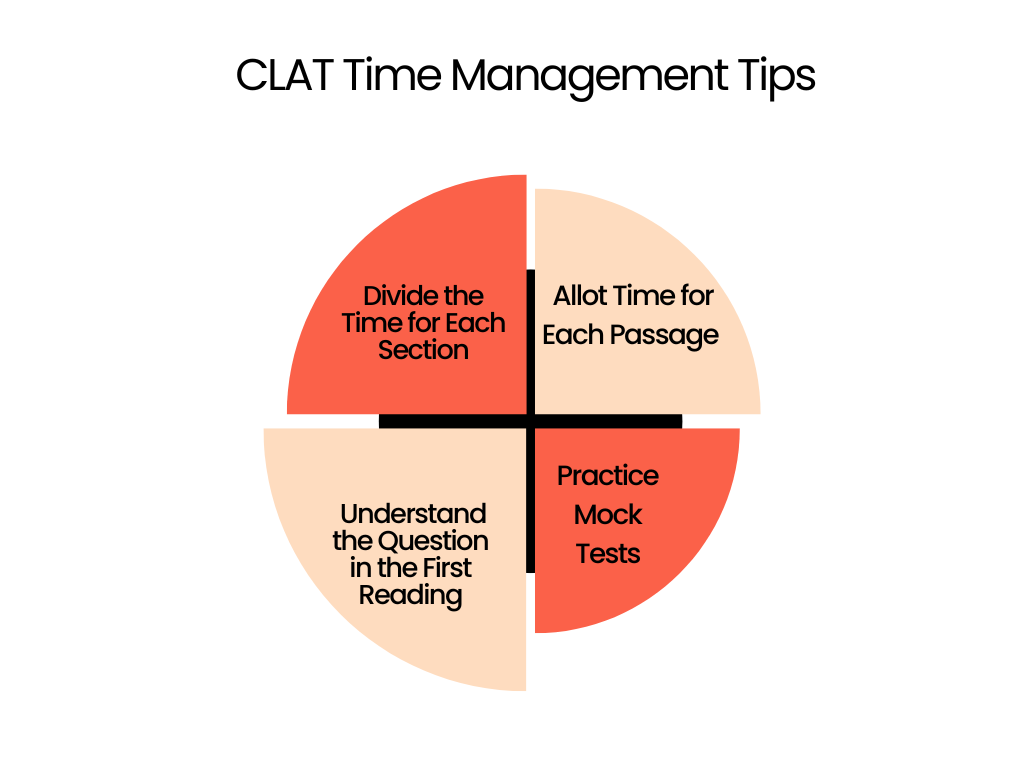
The CLAT time management tips below will help you better understand how to manage time to succeed in the Common Law Admission Test 2027:
- Note weak and strong sections separately. This can help you proceed with the easier and more confident section first.
- Have a rough plan on how much time to spend on each section.
- Since the question paper includes comprehension-based questions, read and understand the passage in one go.
- The best way to improve your time management skills is to practice CLAT Mock Tests and previous years' papers. Set a timer while you do so.
- Improve reading and comprehension skills by regularly reading newspapers or magazines.
- You know your speed, improve your reading skills, and solve questions of different difficulty levels.
- Before starting, quickly read the instructions to avoid misunderstanding the questions or marking scheme.
- Keeping calm during the exam is vital. If you feel stressed, take a few deep breaths to relax. Panicking can waste time and impair your ability to think clearly.
What are CLAT Time Management Tips to Manage Stress?
Feeling stressed or overwhelmed during the CLAT entrance exam is the most common in most of you. But remember, feeling stressed sometimes is also good for our brains.
Create a realistic and well-structured CLAT study plan that includes breaks and leisure activities. A balanced schedule prevents burnout and keeps stress levels low.
Regular physical exercise, adequate sleep, and healthy eating can significantly impact your stress levels and overall mental health. These should be integral parts of your preparation.
Incorporate mindfulness practices such as meditation, deep breathing exercises, or yoga into your daily routine. These practices can reduce stress and improve concentration.
Simulate exam conditions at home to get accustomed to the pressure of the CLAT. This practice helps reduce anxiety as you become more familiar with the exam format and time constraints.
Aim for progress, not perfection. Setting achievable goals for each study session can reduce feelings of overwhelm and increase your confidence.


What is the Smart Way of Solving Comprehension-Based Questions in CLAT 2027?
Solving comprehension-based questions in the Common Law Admission Test (CLAT) efficiently is crucial since these questions test your reading, understanding, and analytical skills. The CLAT examination has shifted its focus towards evaluating candidates' abilities to comprehend and analyze passages across various sections, including English, Current Affairs, Legal Reasoning, and Logical Reasoning. Here's a smart approach to tackle comprehension-based questions in the CLAT:
- Skim the Passage First: Initially skim through the passage to get a general idea of its theme, tone, and structure without focusing too much on the details. This will help you save time and understand the context.
- Read the Questions Carefully: Before diving deep into the passage, read the questions to know what you're looking for. This can help you to be more focused when you read the passage in detail.
- Note Keywords and Phrases in Questions: Highlight keywords and phrases in the questions. When you go through the passage again, these keywords can guide you to the relevant parts of the text.
- Detailed Reading Based on Questions: Now, read the passage more carefully, paying special attention to the parts likely to contain the answers to the questions you've read. This focused approach saves time and improves accuracy.
- Answer Questions by sticking with passage information: Base your answers on the information provided in the passage. Avoid relying on prior knowledge or assumptions not supported by the text.
- Eliminate Wrong Answers: Use the process of elimination to narrow down your choices. Discard options that are clearly incorrect, irrelevant, or contradictory to the information provided in the passage.
- Manage Your Time: Allocate your time wisely. Don't spend too much time on one question. If you're stuck, move on to the next question and return later if time permits.
- Practice Regularly: Regular practice with comprehension passages from previous years' papers and mock tests can significantly improve your speed and accuracy.
- Learn from mistakes: After practising, review your answers, especially the incorrect ones. Understand why you got a question wrong and how you can avoid similar mistakes in the future.
Stay Calm and Confident: Approach each passage with confidence. Staying calm can help you read and comprehend faster, as stress can impede your ability to understand and analyze the text effectively.
How to Improve Speed and Accuracy for CLAT?
Speed without accuracy is dangerous.
Accuracy without speed is insufficient.
You need both.
1. Read Daily
Spend at least 45 minutes reading:
- Newspapers
- Editorials
- Legal articles
- Opinion pieces
This improves comprehension speed naturally.
2. Solve Timed Sectionals
Use a timer while solving individual sections.
Train your brain to perform under pressure.
3. Analyze Every Mock
Do not simply attempt mocks.
Study them.
Ask yourself:
- Which section consumed the most time?
- Which questions were unnecessary mistakes?
- Which passages slowed me down?
Improvement happens during analysis, not during the mock itself.
Read More: best tips to crack the CLAT exam on the first attempt
CLAT Mock Test Time Management Tips
Mock tests are where real preparation happens.
After every mock, maintain a tracking sheet.
Record:
- Number of attempts
- Accuracy percentage
- Time spent per section
- Questions skipped
- Questions guessed
Within a few weeks, patterns start emerging.
You'll discover exactly where you're losing time.
This self-analysis can improve your score more than solving another mock.
Common Time Management Mistakes in CLAT
Avoid these mistakes at all costs.
Spending Too Much Time on One Question
Move on if you're stuck.
Reading Passages Twice
Train yourself to read actively the first time.
Attempting Questions Randomly
Follow a predetermined strategy.
Ignoring Mock Analysis
Mocks without analysis are incomplete preparation.
Chasing 100% Attempts
Accuracy matters more than blind attempts.
Self-Evaluation Check
Answer honestly:
Can you complete a full CLAT mock within 120 minutes?
Do you spend more than 35 minutes on Legal Reasoning?
Is your Current Affairs section completed within 10 minutes?
Are you analyzing every mock properly?
Do you have a fixed attempt order?
If your answer is "No" to most of these questions, your time management strategy needs improvement.
Conclusion
In conclusion, effective time management is crucial when preparing for the CLAT 2027 examination. By following these CLAT time management tips, you can enhance your study routine and maximize your chances of success.
Key takeaways:
- Prioritize study material based on importance and difficulty.
- Create a well-structured study schedule with allocated time slots for each subject.
- Utilize effective study techniques such as breaking down complex topics and practising with mock tests.
- Seek guidance from mentors or teachers when needed.
- Maintain a healthy work-life balance and take regular breaks to avoid burnout.
- Stay disciplined, consistent, and positive throughout your CLAT preparation journey.
- Allotting time for each section is the first step toward optimizing your time in CLAT.
- You should adhere to the time specified for each section above and move on to the next section once the time has lapsed.
- Also, it will help you understand the questions you can answer first and quickly.
- Try to finish the easier passages first and then move to trickier ones.
- Develop a habit of understanding the depth of problems and drawing their solutions.
- Do not hurry when it comes to attempting problems. No matter if it is during practice or the actual exam.
- Revisiting the passage or question is an unnecessary usage of time that could be better allocated to understand and solve other portions. Use your alert meta while reading the passage so you comprehend it in one go.
- The seriousness and mindset during the preparation directly impact the actual exam.
- Cramming never works, especially when it is an essential exam like CLAT Entrance Exam.
- Deep knowledge of the basic concepts is a positive pathway to cracking the exam.
- One does not have much time to spend reading questions again and again. So, ensure you read it, focusing on it the first time.
- Concentration is an essential aspect of CLAT time management tips. Soak the questions in the first reading.
- Do not revise anything new at the end of the hours.
- In the exam hall, try to be calm and silent.
- Do not indulge in any talks at the exam hall.
- Talking about the exam, especially, can build the pressure of attempting it. So, avoid conversation anyway.
- Before the exam, do not get into negative thoughts, talks, quotes, etc.
- Do not guess in the exam. Take the problem, understand it and then answer it. If it does not get into the mind, leave it. Do not play a guessing game.
- Do not jump on sections. Attempt one section, then move on to the other one. Otherwise, it will create confusion.
- Do not stick to questions. Move on. Keep solving. Mark the time-consuming questions. Solve them later
- Be positive. Things will work out.

NLU Dream, Zero Cost Start: Free CLAT Demo
Fill your details
Frequently Asked Questions
How many hours should I study for CLAT Exam?

Is 1 month enough for CLAT Preparation?
Do really solving mock tests will help improve my time management skills in the CLAT exam?
How many times can I appear for CLAT?
Is the CLAT exam easy?
How can I overcome CLAT exam stress?
What are the best CLAT Time Managements Tips?

Samriddhi Pandey
Content Writer


SHARE