
1723534562.png)

CLAT Subjects List 2027 [Official] Check Topics & Sub Topics
September 24, 2026
The Consortium of NLUs released the CLAT subjects list on its official website. The subject list includes English Language, Current Affairs including General Knowledge, Legal Reasoning, Logical Reasoning, and Quantitative Techniques.
- In English Language, you will get passages of about 450 words each from contemporary or historically significant fiction and non-fiction writing.
- In the Current Affairs section, you will be provided with passages of 450 words each from news, journals, and non-fiction writing.
- The Legal Reasoning section will include legal matters, public policy questions, or moral philosophical enquiries.
- The Logical Reasoning section will include statements and arguments, analogies, etc.
- You will get short sets of facts or propositions, or textual representations of numerical information.
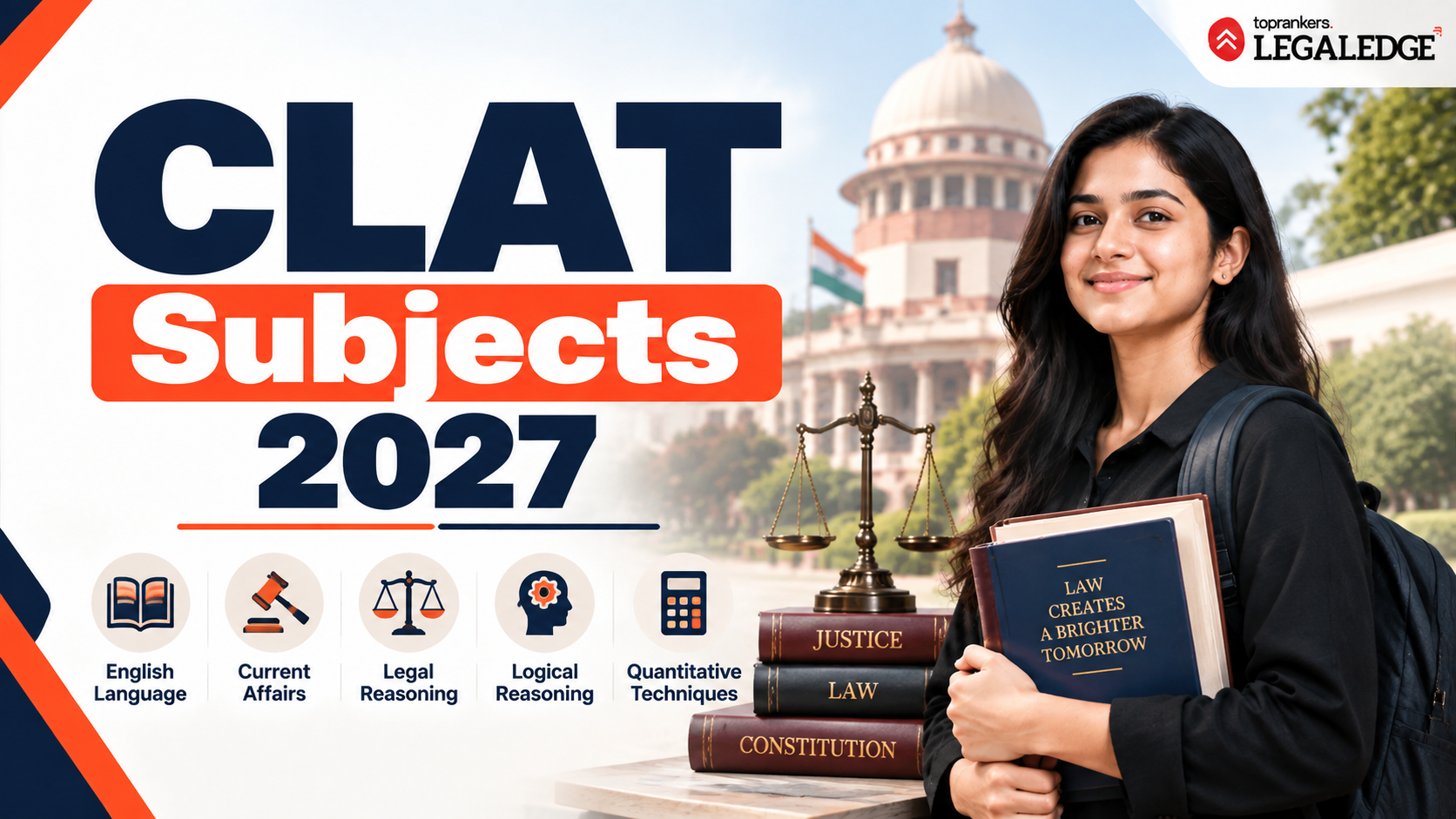
CLAT Subjects List 2027
CLAT 2027 exam includes a total of 5 subjects. You can check the names of the subjects below.
Here are the five subjects included in the CLAT Syllabus:
- English Language
- Current Affairs, including General Knowledge
- Legal Reasoning
- Logical Reasoning
- Quantitative Techniques
According to the most recent pattern, these subjects are necessary for the CLAT 2027 exam. The CLAT does not assess memorisation, in contrast to conventional board exams. This implies that you have to grasp the fundamental idea and then put it into practice, frequently under time constraints.
CLAT Subjects Weightage 2027: Section-Wise Details
You can check the section-wise weightage for the CLAT subjects list in the table below. You should prepare for the exam according to the weightage.
| Subject | Expected Questions | Approx. Weightage |
|---|---|---|
| English Language | 22–26 | 20% |
| Current Affairs + GK | 28–32 | 25% |
| Legal Reasoning | 28–32 | 25% |
| Logical Reasoning | 22–26 | 20% |
| Quantitative Techniques | 10–14 | 10% |
CLAT 2027 English Language - 20%
English is the foundation of the paper, not just a section. Understanding of the topics is required to prepare for this section. You can check the topics covered in the CLAT English Syllabus below.
- Correcting incorrect grammar sentences
- Spotting grammatical errors
- Tenses
- Synonyms & antonyms
- Fill in the Blanks
- Idioms and phrases
- Active & passive voice
- Vocabulary
Current Affairs including General Knowledge - 25%
This section may feel unpredictable, but it's actually one of the easiest to master if you stay consistent. The topics covered in the CLAT Current Affairs syllabus are
- Important National & International Events
- Awards, Sports, Summits
- Legal updates & Supreme Court Judgments
- Government Schemes & Policies
- Global Rankings and Indices
Legal Reasoning - 25%
This is the most "CLAT-specific" section. You do not need prior legal knowledge, but you do need to think like a law student. Check the topics included in the CLAT Legal Reasoning syllabus.
- Legal Principles and Application
- Law of Torts, Contract, and Criminal Law (Basics)
- Important Constitutional Concepts (Preamble, FRs, DPSPs)
- Legal Maxims
- Reading-based legal case passages
Logical Reasoning - 20%
This section trains your mind to analyse, infer, and argue, skills you will use every day in law school. You can check the topics included in the CLAT Logical Reasoning Syllabus.
- Argument-based comprehension
- Assumptions, Strengthen/Weaken, Inference
- Cause & Effect relationships
- Logical flow and conclusion derivation
Quantitative Techniques - 10%
This section is also known as the Maths section. This section includes class 10-level arithmetic, presented via tables, charts, and graphs. Check the topics included in the CLAT Math syllabus below.
- Ratio, Percentage, Profit & Loss
- Averages, Simple Interest & Compound Interest
- Time-Speed-Distance
- Data Interpretation (Pie chart, Bar Graphs, Tables)
CLAT LLM Subjects List 2027
The CLAT PG exam has only one section that tests your legal knowledge. You can check the topics included in the CLAT PG Syllabus below.
-
Constitutional Law
-
Law of Torts
-
Administrative law
-
Criminal Law
-
Family law
-
Labour and industrial law
-
Property law
-
Public international law
-
Jurisprudence
-
Company law
-
Intellectual Property Law
-
International Law
-
Tax law
-
Law of Contracts
Has Subject-Wise Weightage Changed for CLAT Exam?
No, the subject-wise weightage for the CLAT exam has remained the same since 2020. The only change is that the number of questions was reduced from 150 to 120 starting with CLAT 2024.
| Section | CLAT 2020–2023 (150 Qs) | CLAT 2024–2027 (120 Qs) | Approx Weightage |
|---|---|---|---|
| Legal Reasoning | 35–39 questions | 28–32 questions | 25% |
| Current Affairs & GK | 35–39 questions | 28–32 questions | 25% |
| English Language | 28–32 questions | 22–26 questions | 20% |
| Logical Reasoning | 28–32 questions | 22–26 questions | 20% |
| Quantitative Techniques | 13–17 questions | 10–14 questions | 10% |
What are the Skills Tested through CLAT Subjects 2027?
Let’s quickly glance at the CLAT subjects and their skill requirements:
| Subject | Key Skills Tested |
| English Language | Comprehension, Vocabulary, Inference |
| GK & Current Affairs | Awareness, Recall, Contextual Link |
| Legal Reasoning | Logical Thinking, Legal Application |
| Logical Reasoning | Argument Analysis, Deduction |
| Quantitative Techniques | Basic Math, Data Interpretation |
This bird's-eye view helps you identify which areas to focus on depending on your strengths and weaknesses.
CLAT Exam Pattern 2027
Before preparing for the exam, you must understand the CLAT exam pattern. Check the table below for the UG and PG exam patterns for the CLAT exam.
|
Particulars |
Details |
|
Duration |
2 hours |
|
Mode |
Pen-and-paper-based mode) |
|
Number of questions |
120 questions for both CLAT UG and CLAT PG |
|
Total marks |
120 marks for both CLAT UG and CLAT PG |
|
Language |
English |
Conclusion
The answer is simple if you're still unsure about the topics covered in the CLAT exam: understanding and reasoning, not memorisation, are used to evaluate the five subjects—English, GK, Legal, Logical, and Quant.
You don't have to study everything in order to pass this test. To prepare for the CLAT, you must become an expert in the subjects and practice them in the format of the test.
- Therefore, quit stuffing yourself with unneeded information.
- Adhere to the 2027 official CLAT subjects list.
- Be wise in your practice.
- Read every day.
- Make weekly revisions.
- Every week, take a mock test.
By focusing on the real subjects for the CLAT exam, you build the kind of prep that gets results, not just good attempts.
NLU Dream, Zero Cost Start: Free CLAT Demo
Fill your details
Frequently Asked Questions
What are the subjects for the CLAT exam as per 2026 guidelines?

Which are the most scoring subjects in CLAT?
Are the subjects required for CLAT exam similar to CBSE syllabus?
How to balance all CLAT subjects effectively?
Can I skip any section among the CLAT subjects if I’m weak in it?
Which subject is hardest in CLAT?

Souvik Podder
Content Writer
SHARE