
1723534562.png)

Legal Reasoning Syllabus for CLAT 2027: Complete Breakdown, Topics, Strategy & Prep Guide
February 5, 2026
Overview: If there is one section that can single-handedly change your CLAT rank, it is Legal Reasoning. Year after year, toppers agree on one thing, understanding the legal reasoning syllabus for CLAT 2027 properly gives you a massive edge over the competition.
Yet, this is also the section most students misunderstand. Many assume it requires mugging up laws, sections, or judgments. Others feel intimidated because they don’t come from a law background. The truth is much simpler, and far more manageable.
In this blog, we will break down the legal reasoning syllabus for CLAT 2027 in a clear, student-friendly way. You’ll understand what the section actually tests, which topics matter, how questions are framed, and how to prepare smartly without wasting time on unnecessary theory.
Whether you are targeting CLAT 2027 or starting early for CLAT 2028, this guide will help you build clarity, confidence, and consistency.
What Is Legal Reasoning in CLAT?
Legal Reasoning in CLAT is a skill-based section, not a knowledge-heavy one. The exam does not test how many laws you remember. Instead, it checks whether you can read, understand, and apply legal principles to given fact situations.
Each passage is around 450 words and revolves around:
- Legal issues
- Public policy questions
- Moral or philosophical dilemmas
You do not need prior legal knowledge. Every answer is contained within the passage itself. That’s why the legal reasoning syllabus for CLAT 2027 focuses on application, not memorisation.
Students who understand this early often turn Legal Reasoning into their highest-scoring section.
Why the Legal Reasoning Syllabus for CLAT Matters So Much
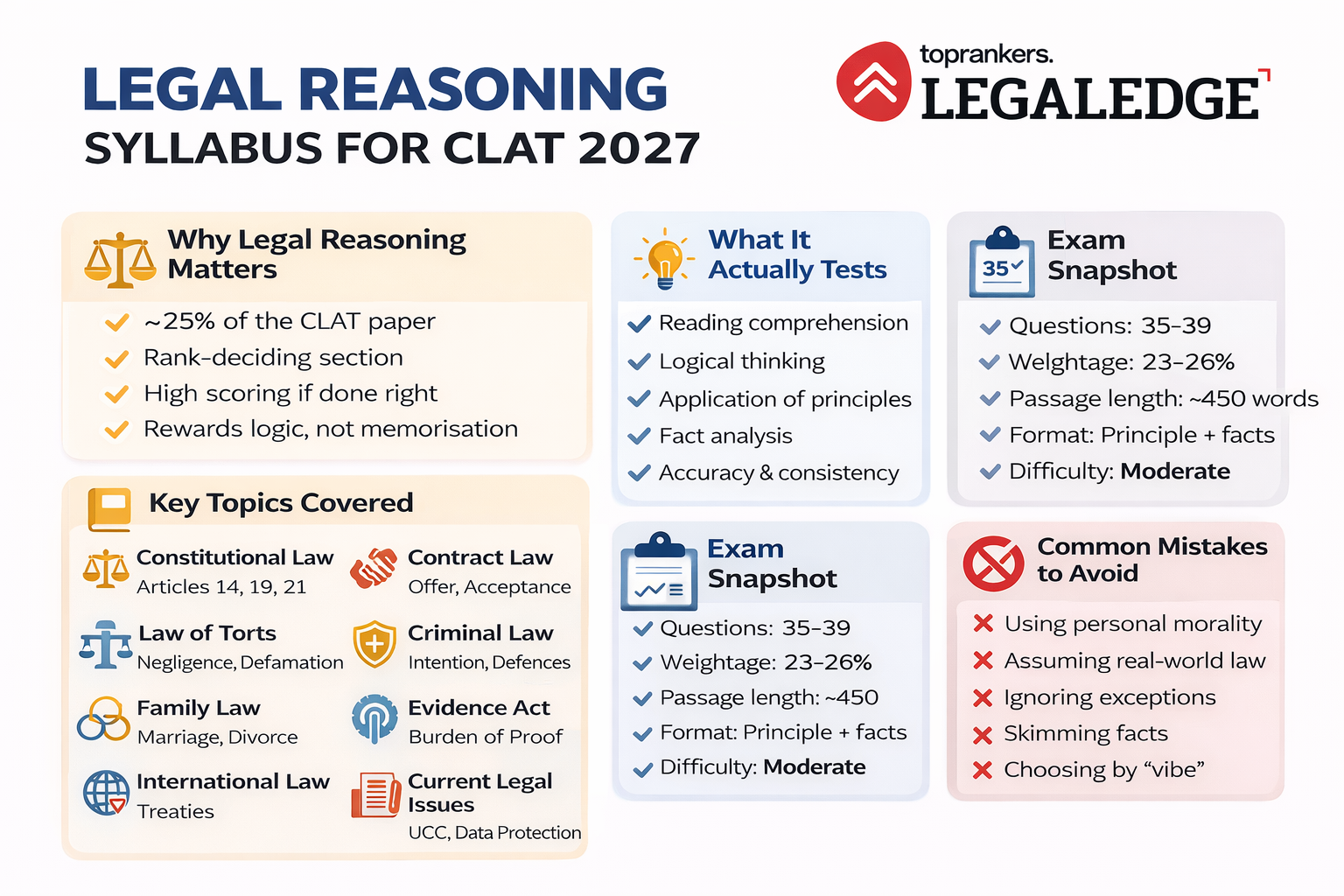
The legal reasoning syllabus for CLAT 2027 carries nearly 25% of the total paper. This means:
- Strong performance here can drastically improve your rank
- Weak conceptual clarity can pull your score down even if other sections are good
Unlike Maths or GK, Legal Reasoning rewards logic, discipline, and consistency. Once you understand how principles behave, your accuracy improves steadily.
This is why serious aspirants study the legal reasoning syllabus for CLAT in depth instead of treating it like just another reading section.
Read more: How to prepare for CLAT Legal Reasoning Section 2027?
CLAT Legal Reasoning: Quick Overview
Before diving deeper into the legal reasoning syllabus for CLAT 2027, here’s how the section looks in the exam:
- Weightage: 23–26%
- Questions: Around 35–39
- Passage length: ~450 words
- Nature: Principle + fact-based
- Law background: Not required
- Difficulty: Moderate (depends on accuracy)
This structure has remained consistent in recent years, making the CLAT legal reasoning syllabus fairly predictable if you prepare correctly.
Read more: CLAT Legal Reasoning Syllabus 2027
Core Skills Tested in the Legal Reasoning Syllabus for CLAT
Understanding the legal reasoning syllabus for CLAT 2027 is not about listing laws. It’s about mastering four core skills:
- Identifying Legal Principles: Every passage contains a rule or principle. Your job is to identify it accurately, including any conditions or exceptions.
- Separating Relevant Facts: Not all facts matter equally. The section tests whether you can spot which facts actually affect the application of the principle.
- Applying Law to Facts: This is the heart of the legal reasoning syllabus for CLAT 2027. You must apply the rule exactly as stated, even if it clashes with your personal morality.
- Understanding Variations: Some questions tweak facts or principles slightly. You are expected to understand how small changes affect outcomes.
Explore: CLAT Most Important Legal Reasoning Question Answers
Complete Legal Reasoning Syllabus for CLAT
Let’s now look at the actual legal reasoning syllabus for CLAT 2027, as reflected in exam patterns and official guidelines.
Constitutional Law
- Fundamental Rights
- Directive Principles of State Policy
- Emergency provisions
- Constitutional doctrines
- Articles 14, 19, and 21
This is a high-yield area within the legal reasoning syllabus for CLAT.
Contract Law
- Offer and acceptance
- Consideration
- Capacity to contract
- Breach and remedies
Very logic-driven and easy to score once understood.
Law of Torts
- Negligence
- Vicarious liability
- Defamation
- Nuisance
- Trespass
Torts appear frequently in legal reasoning topics for CLAT because they fit application-based questions perfectly.
Read more: Most important Legal Maxims for CLAT 2027
Criminal Law
- Murder vs culpable homicide
- Theft and intention
- Defences
Questions here test intention, consent, and liability.
Family Law
- Marriage
- Divorce
- Adoption
- Maintenance
Concepts are simple and passage-friendly.
Evidence Act
- Confessions
- Admissions
- Burden of proof
- Dying declarations
Appears occasionally in the legal reasoning syllabus for CLAT.
International Law
- Recognition of states
- Treaties
- Refugee law
- Monism vs dualism
Increasingly important in CLAT recent papers.
Current Legal Issues
- Uniform Civil Code
- Electoral bonds
- Data protection
- New criminal laws
These form a dynamic part of legal reasoning topics for CLAT.
Understanding the CLAT Legal Reasoning Syllabus in Practice
One mistake students make is treating the CLAT legal reasoning syllabus like a law school syllabus. That’s not how CLAT works.
The exam:
- Does not ask sections or case laws
- Does not expect technical language
- Does expect clean logic and discipline
That’s why many toppers rely on structured notes or a CLAT legal reasoning syllabus PDF that focuses on application instead of theory.
Read more: Best Books for CLAT 2027 Legal Reasoning
Structure of Legal Reasoning Questions
The legal reasoning syllabus for CLAT 2027 is tested entirely through passages. Questions typically fall into four types:
- Principle identification questions
- Application-based questions
- Inference questions
- Variation questions
Understanding this structure helps you align your prep directly with the legal reasoning syllabus for CLAT 2027.
Read more: How to score 25+ in Legal Reasoning 2027?
Most Important Legal Reasoning Topics for CLAT
Based on recent trends, these are the most important legal reasoning topics for CLAT:
- Constitutional doctrines
- Articles 14, 19, 21
- Torts (especially negligence)
- Contract basics
- Criminal intention and defences
- Writs
- Legal current affairs
Mastering these alone covers a large portion of the legal reasoning syllabus for CLAT.
How to Read a Legal Reasoning Passage (Step-by-Step)
A major part of scoring well in the legal reasoning syllabus for CLAT 2027 is learning how to read passages correctly.
Step 1: Read once for the main idea
Step 2: Identify the rule or principle
Step 3: Break facts into simple points
Step 4: Apply principle line-by-line
Step 5: Eliminate options logically
Step 6: Recheck exceptions and fact changes
This approach works consistently across all legal reasoning topics for CLAT.
What are the common Mistakes Students Make
Even students who know the legal reasoning syllabus for CLAT 2027 lose marks due to avoidable errors:
- Using personal morality
- Ignoring exceptions
- Assuming real-world law
- Skimming facts
- Falling for extreme options
- Choosing answers by “vibe”
Avoiding these mistakes alone can boost your score significantly.
How to Prepare the Legal Reasoning Syllabus for CLAT Effectively
Here’s how toppers approach the legal reasoning syllabus for CLAT 2027:
- Build concept clarity first
- Convert principles into if–then rules
- Practice passage-based questions daily
- Maintain a mistake notebook
- Revise through examples, not theory
- Pair notes with regular mocks
Using a reliable CLAT legal reasoning syllabus PDF helps keep revision focused and exam-aligned.
Notes vs Practice: What Matters More?
This is where many aspirants get confused. For the legal reasoning syllabus for CLAT 2027, both are essential.
- Notes build understanding
- Practice builds performance
The winning strategy is simple:
Study → Practice → Mock → Analyse → Revise
This loop keeps your preparation aligned with the CLAT legal reasoning syllabus at all times.
Who Should Focus Deeply on the Legal Reasoning Syllabus for CLAT?
The legal reasoning syllabus for CLAT 2027 is especially crucial for:
- Students with no law background
- Class 11 early starters
- Class 12 aspirants chasing accuracy
- Droppers struggling with close options
- Students targeting top NLUs
If your goal is rank improvement, this section cannot be ignored.
Conclusion
The legal reasoning syllabus for CLAT is not difficult, it is misunderstood. Once you stop treating it like a law subject and start treating it like a logic-and-application skill, everything changes.
With the right understanding of the legal reasoning syllabus for CLAT, smart notes, consistent practice, and honest mock analysis, this section can become your biggest strength.
Strong ranks don’t come from memorising laws.
They come from applying principles clearly, calmly, and consistently, exactly what CLAT rewards.
NLU Dream, Zero Cost Start: Free CLAT Demo
Fill your details
Frequently Asked Questions
Do I need prior law knowledge to prepare the legal reasoning syllabus for CLAT?

How many questions are asked from the legal reasoning syllabus for CLAT?
What are the most important legal reasoning topics for CLAT?
Is it useful to study from a CLAT legal reasoning syllabus PDF?
How should I combine mocks with the legal reasoning syllabus for CLAT?

Samriddhi Pandey
Content Writer
SHARE