
1723534562.png)

How to Score 25+ in CLAT Legal Reasoning? Preparation Tips for CLAT 2027
October 15, 2026
To score 25+ in CLAT Legal Reasoning, focus on passage comprehension, identifying legal principles, and applying them accurately to the given facts. Practise passage-based questions, solve previous-year papers, and take regular mock tests. Analyse mistakes, avoid unsupported assumptions, and improve reading speed to increase accuracy.
How to Score 25+ in CLAT Legal Reasoning highlights
- Reading is the foundation: Strong comprehension and fast reading are essential for scoring well in Legal Reasoning.
- Follow the “Principle + Facts” rule: Stick strictly to the passage and avoid using outside knowledge.
- Practice consistently: Solve previous year papers and daily mock tests to improve speed and accuracy.
- Revision is crucial: Regularly revise concepts and analyse mistakes to avoid repeating them.
- Discipline & strategy matter: A well-planned study schedule and time management can significantly boost your score.
The legal reasoning section is important in the Common Law Admission Test (CLAT). It is more significant and weighted than any other section in the paper.
It is also the deciding factor in a tie of marks between two candidates when the score is the same for both, who gets the rank above and who gets the rank below.
The legal reasoning section will include comprehension questions based on passages designed to test your critical thinking and analytical skills.
Table of Contents
- What Does Scoring 25+ Marks in CLAT Legal Reasoning Actually Mean?
- How Many Questions Should You Attempt to Score 25+?
- Why Do Many Students Get Stuck at 18–20 Marks?
- Tips to Score 25+ Marks in CLAT 2027 Exam
- A 30-Day Plan to Reach 25+ Marks in Legal Reasoning
- How Should You Approach a Legal Reasoning Passage During the Exam?
- How to Answer CLAT Legal Reasoning Questions 2027?
- What Should Be Your Weekly Legal Reasoning Improvement Framework?
- Conclusion
How do you get a good score in the CLAT Legal Reasoning section? Well, this post will give you complete insight into how to score 25+.
So, why late? Try to follow all the tips given in the post below and perform well in the upcoming exam.
The following video by Legal Edge is extremely helpful for aspirants who wish to improve their scores in the Legal section.
What Does Scoring 25+ Marks in CLAT Legal Reasoning Actually Mean?
Before you start looking for strategies on how to Score 25+ in CLAT Legal Reasoning 2027, it is important to understand why this target matters so much.
The Legal Reasoning section is usually one of the highest-weightage sections in the CLAT paper. A strong performance here can significantly improve your overall score and rank. In recent years, many top-performing candidates have consistently treated Legal Reasoning as a scoring section because it rewards logical thinking, careful reading, and smart practice.
A score of 25+ marks in Legal Reasoning often indicates that you have:
- Strong reading comprehension skills
- Good accuracy under time pressure
- The ability to identify legal principles correctly
- Consistent mock test performance
- Effective passage-solving techniques
The good news? You do not need a law background to achieve this score. The CLAT Consortium clearly states that prior legal knowledge is not required. What matters is how well you can understand the passage and apply the principle provided.
How Many Questions Should You Attempt to Score 25+?
One of the biggest mistakes students make is focusing only on attempts. The real game is accuracy.
Take a look at this simple calculation:
| Accuracy Rate | Questions Attempted | Expected Score |
|---|---|---|
| 90% | 28 | Around 25+ |
| 85% | 30 | Around 25+ |
| 80% | 32 | Around 25+ |
| 75% | 35 | May fall below 25 |
The takeaway is simple:
Focus on getting questions right.
Don't chase unnecessary attempts.
Many aspirants who score 25+ in mocks actually attempt fewer questions than others but maintain significantly higher accuracy.
If you are wondering how to Score 25+ in CLAT Legal Reasoning 2027, improving accuracy from 70% to 85% can make a bigger difference than attempting five extra questions.
Why Do Many Students Get Stuck at 18–20 Marks?
This is where most CLAT aspirants struggle.
They work hard.
They solve mocks.
They read newspapers.
Yet their score refuses to move beyond 18–20 marks.
If that sounds familiar, check whether you're making any of these mistakes:
1. Using Outside Legal Knowledge
CLAT Legal Reasoning is not a law school examination.
Many students try to answer based on what they know instead of what the passage says.
Always trust the passage.
Even if you think the law works differently in reality.
2. Ignoring the Principle
The principle hidden inside the passage is the key to solving the question.
Students often rush to the facts and miss the principle completely.
Read carefully before attempting any question.
3. Reading Too Fast
Speed matters.
But reckless speed is dangerous.
Legal passages often contain exceptions, conditions, and qualifications that can completely change the answer.
4. Skipping Mock Analysis
Taking mocks is useful.
Analysing mocks is what improves your score.
After every mock, identify:
- Questions you guessed
- Questions you misread
- Questions where accuracy dropped
This process can easily add 3–5 marks over time.
5. Over-Attempting
Many students attempt every question hoping for a miracle.
The result?
Negative marking pulls down their score.
Smart attempts always beat blind attempts.
Tips to Score 25+ Marks in CLAT 2027 Exam
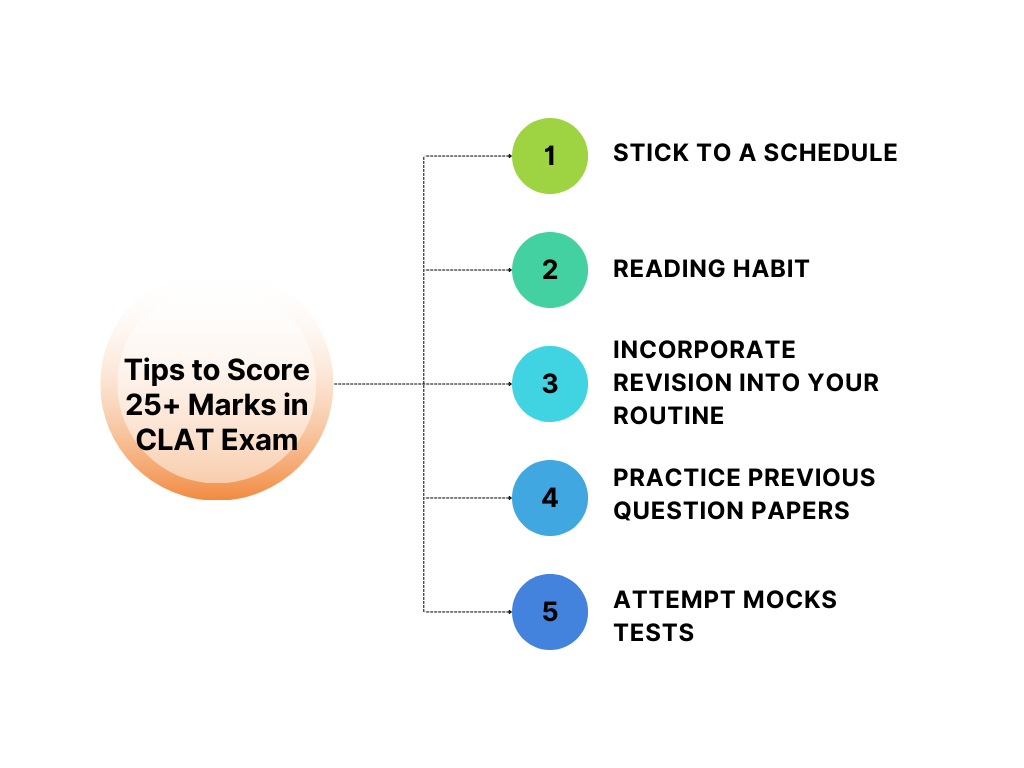
Reading is the key to scoring 25+ marks in the CLAT since the question paper consists of comprehension-based questions.
Also, you have to be a speedy reader to analyse the meaning of comprehension and derive answers. The primary focus of the CLAT exam will be English, Legal Reasoning, and GK. However, you must improve your legal and logical Reasoning skills to get a good rank.
Solve as many Question Papers for CLAT as possible to improve your time management and problem-solving skills.
You must make sure to manage time and dictate yourself in improving your English vocabulary to the best of your capability.
Stick to a Schedule
Remember, most of the time, some topics may look very complex and go over your head at first glance, but if you put your head together and start with the basics of the topic first, you can eventually dismantle even the most difficult of topics.
No war could be won without discipline. The first thing you need to do is to create the best CLAT Study Plan and work accordingly.
Draw up a schedule wherein you will refer to your theory and understanding of legal terminologies and when you will solve and analyse sectional tests. This routine will ensure consistent practice.
Also, note that we all have different reading habits, which must be accounted for. For example, some of us are night owls, but others may be comfortable reading during the day and evening hours.
So, you must create the study plan accordingly.
Reading Habit
If you are interested in making your career in Law, you should develop a reading habit, which helps to be updated with the latest news related to the legal and judgemental.
Read the daily newspaper, magazines, legal journals, and books pertaining to the laws (like- polity, constitution, etc.), etc.
Try reading articles related to the law or commentary editorial on legislation, which helps familiarise you with legal vocabulary.
While Reading a Newspaper for CLAT, you should try to understand the fundamental theme, arguments, counter-arguments, and legal appearances given in the section.
Incorporate Revision into Your Routine
The continuous revision could not only help you keep the acquired Information fresh but will also help in rectifying the information in case you haven't accessed the correct source previously.
You must allocate at least 1 hour in your timetable to revise all the topics you have prepared for the particular day.
Apart from the revision of topics, you must revise the various errors you have logged after analysis of your legal section in mocks and timed sectionals.
Practice Previous Question Papers
Questions from last year can give you the best practice ground. These questions serve as a guide and provide you with a clear outlook of what you can expect in your examination.
Also, it will help improve your time management and problem-solving skills in the final exam.
Try to solve as many legal reasoning questions as possible to enhance both these skills. Also, it will help improve your speed and accuracy in the final exam.
Read More: Short tricks to crack the CLAT exam on the first attempt
Attempt Mocks Tests
Most of the questions are asked in the passage form. So, it is important to have the speed to read and understand, which helps solve the problems within the time limit.
So, solving CLAT Mock Tests daily will help you get an idea about how much time you are taking to solve each question.
Also, it will help analyze your preparation levels and help you improve in weaker areas.
A 30-Day Plan to Reach 25+ Marks in Legal Reasoning
If you're seriously searching for How to Score 25+ in CLAT Legal Reasoning 2027, follow this structured plan.
Week 1: Build Reading Discipline
- Read editorials daily
- Solve 2 passages per day
- Focus only on understanding
Week 2: Improve Accuracy
- Solve 3–4 passages daily
- Analyse every incorrect answer
- Identify recurring mistakes
Week 3: Increase Speed
- Practice under timed conditions
- Attempt sectional tests
- Learn passage prioritisation
Week 4: Simulate Exam Conditions
- Solve full-length mocks
- Review Legal Reasoning performance
- Focus on weak areas
By the end of these 30 days, most students notice visible improvement in both confidence and score.
How Should You Approach a Legal Reasoning Passage During the Exam?
A structured approach can save valuable time.
Follow this sequence:
Step 1: Read the Passage Carefully
Identify:
- Principle
- Rule
- Exception
- Key facts
Step 2: Understand the Author's Logic
Ask yourself:
"What is the passage trying to establish?"
This helps avoid confusion later.
Step 3: Read the Question
Only after understanding the passage should you move to the questions.
Step 4: Eliminate Wrong Options
Usually, two options can be removed quickly.
Focus on choosing the best answer among the remaining choices.
Step 5: Avoid Assumptions
The answer must come from the passage.
Not from your personal opinion.
Not from current affairs.
Not from outside legal knowledge.
How to Answer CLAT Legal Reasoning Questions 2027?
Stick to the Principle" is the Golden Rule. Take the Principle as law. Read the facts carefully. Apply the facts to the Principles and draw out your best answer. This will apply to 80% of the questions.
Only some questions would be where you have to leave the principle. The following are some of the best CLAT Legal Reasoning Preparation Tips you can inculcate while solving the questions in the exam.
While answering any question, match that option's language with the principal's language. If it is matchable, then there is a high chance your answer is correct.
And if it is not matchable, then it is not correct. Apply this cheat code while attempting all the questions of Legal Reasoning.
You must ensure that even if you know a part of the principle that exists but is not a part of the passage, you don’t factor it in while answering a question. Outside knowledge should be left outside when you are giving CLAT.
While answering assertion reason questions, read the question carefully. If the Assertion itself is wrong, then your answer would be A is False and R is true.
Then, read the reason; if the reason is wrong, the answer would be A is True, and R is False. If both the Assertion and the Reason are correct, then the answer would still be from A or B. Do a little trick here.
Also, you have to work on your time management skills for CLAT, which makes a huge difference in the final exam.
What Should Be Your Weekly Legal Reasoning Improvement Framework?
Every Sunday, evaluate yourself using these five parameters:
Reading Speed
Can you comfortably finish passages without rushing?
Accuracy
Are you maintaining 80–85% accuracy?
Mock Performance
Has your score improved compared to last week?
Error Analysis
Have you fixed recurring mistakes?
Confidence Level
Do Legal Reasoning passages feel easier than they did a month ago?
This weekly review process helps students stay on track and steadily move toward the 25+ mark target.
Conclusion
- To score 25+ in CLAT Legal Reasoning 2027, it is crucial to keep a few things in mind while preparing.
- Focus on improving your reading skills and speed to analyze comprehension passages effectively. Brush up on your legal and logical reasoning skills to excel in this section.
- Solve previous question papers and attempt mock tests to enhance your time management and problem-solving abilities.
- Stick to the principles while answering legal reasoning questions and avoid incorporating outside knowledge.
- Lastly, work on your time management skills to make a significant difference in the final exam.
- With dedication and consistent practice, you can achieve your desired score in the CLAT Legal Reasoning section.

NLU Dream, Zero Cost Start: Free CLAT Demo
Fill your details
Frequently Asked Questions
What is the purpose of the Legal Reasoning section in the CLAT exam?

What topics are covered in the passages of the Official CLAT Legal Reasoning Sample Paper?
How can a general awareness of contemporary legal and moral issues benefit me in the Legal Reasoning section?
How to increase marks in CLAT Legal Reasoning section?
What is a good score in CLAT Legal Reasoning Sample Paper (official)?
Does Consortium release the Legal Reasoning Sample Paper every year?

Samriddhi Pandey
Content Writer
SHARE