
1723534562.png)

CLAT GK Syllabus 2027: Complete Guide to Current Affairs & Static GK for CLAT Aspirants
August 24, 2026
Quick Answer: The CLAT GK syllabus covers Current Affairs, including General Knowledge, and accounts for about 25% of the paper — 28 to 32 of 120 questions. It is tested through roughly 450-word passages from news and non-fiction sources, with −0.25 negative marking per wrong answer.
CLAT GK Syllabus 2027
- The CLAT GK syllabus defines the scope of the Current Affairs, including General Knowledge section in the UG CLAT exam.
- It is prescribed by the Consortium of NLUs.
The syllabus covers:- Current Affairs from the last 10–12 months.
- Static GK topics such as History, Polity, Geography, Economics, and Art & Culture, especially when linked to current events.
Why Does the CLAT GK Syllabus Matter?
- The GK section carries around 25% weightage in the CLAT exam.
- Along with Legal Reasoning, it accounts for nearly half of the total paper.
- Since CLAT GK questions are generally quicker to solve, a strong performance helps you save time for more time-consuming sections like Legal Reasoning and Logical Reasoning.
CLAT GK: Why This Section Matters So Much
The GK section carries almost 25% weightage in the CLAT exam. That’s nearly one-fourth of your total score. Unlike Quant or Legal Reasoning, this section doesn’t require complex calculations or lengthy legal principles.
With the right approach, the CLAT GK Syllabus 2027 can become one of the most scoring areas in your paper.
The section evaluates:
- Your awareness of current national and global events
- Your understanding of history, polity, economics, and culture
- Your ability to read, comprehend, and analyse factual passages
This makes the GK syllabus for CLAT both knowledge-based and comprehension-driven.
Read More: Best Books for CLAT 2027 Current Affairs
CLAT GK & Current Affairs Exam Pattern 2027: Quick Overview
| Particular | Detail |
|---|---|
| Section name (official) | Current Affairs, including General Knowledge |
| Number of questions | 28–32 |
| Total marks | 28–32 (1 mark per question) |
| Weightage in paper | ~25% of 120 questions |
| Negative marking | −0.25 for every wrong answer |
| Question type | Passage-based MCQs |
| Number of passages | 4–6 passages, each followed by 4–6 questions |
| Passage length | About 450 words |
| Passage sources | News articles, journalistic sources, other non-fiction writing |
| Sectional time limit | None — 2 hours for the full paper |
| Prior knowledge needed | Not mandatory, but the Consortium notes it can occasionally help in this section specifically |
Read more: CLAT 2027 Current Affairs Syllabus
CLAT GK Syllabus 2027: Broad Structure Explained
The CLAT GK Syllabus 2027 is divided into two major components:
- Current Affairs
- Static General Knowledge
Let’s understand both in detail.
1. Current Affairs in CLAT GK Syllabus
Current Affairs form the backbone of the GK syllabus for CLAT. Questions are not random; they revolve around events that have legal, political, economic, or social relevance.
Key Areas Covered
Contemporary Events of Significance
- Major national developments
- International political events
- Government schemes and policies
International Affairs
- Global summits and conferences
- International organisations (UN, WHO, IMF, WTO, etc.)
- Diplomatic relations and treaties
Legal Current Affairs
- Landmark Supreme Court and High Court judgments
- Important bills, acts, and amendments
- Legal issues discussed in news articles
Economy and Finance
- Overview of the Indian economy
- Highlights of the budget
- Indexes and economic reforms
Science & Technology
- Current developments
- Missions in space
- Technological and digital projects
Environment & Ecology
- Climate change conferences
- Environmental policies
- Biodiversity and conservation
Awards, Sports, and Personalities
- National and international awards
- Major sports events
- Important achievements
All these topics together shape the CLAT GK and current affairs syllabus, making daily newspaper reading non-negotiable.
Read more: CLAT 2027 GK Preparation Tips
2. Static GK in CLAT: What You Must Study
While current affairs dominate, static topics continue to play an important role. The CLAT static GK syllabus includes concepts that don’t change with time but often appear linked to current events.
Important Static GK Topics
History
- Ancient, Medieval, and Modern Indian History
- World history and important revolutions
- Historical events of continuing significance
Indian Polity & Constitution
- Constitutional framework
- Fundamental rights and duties
- Key constitutional bodies
Geography
- Physical geography of India and the world
- Important rivers, mountains, and resources
Economics
- Indian economy basics
- Five-Year Plans
- National income and taxation
Art & Culture
- Indian heritage
- Classical dances, music, and architecture
The CLAT static GK syllabus is often tested indirectly, so understanding concepts is more useful than memorising dates.
Read More: How to read a newspaper for CLAT?
| Daily Current Affairs | |
| Weekly Current Affairs | |
| Monthly Current Affairs |
Static vs Current Affairs Comparison Table
Let's understand both in detail.
| Current Affairs | Static GK | |
|---|---|---|
| Share of the section | Majority of questions | Minority, usually embedded in current context |
| What's tested | Awareness of events + ability to read and infer | Background needed to understand the passage |
| How to study | Daily newspaper + monthly compilation | Reactively, triggered by news |
| Revision cycle | Weekly and monthly | Once per quarter, then need-based |
| Typical mistake | Reading headlines, not the issue | Studying it as an isolated subject |
| Highest-yield areas | Legal and policy developments, government schemes, international affairs | Polity and Constitution, modern Indian history, economy basics |
Detailed Topic-Wise CLAT GK Syllabus
Here’s a consolidated view of important topics you must cover as part of the CLAT GK Syllabus 2027:
- Awards & Honours
- Books and Authors
- Indian & World History
- Geography and Environment
- Business and Economy
- Government and Politics
- Legal Facts and Terminology
- Science and Technology
- Arts, Literature, and Culture
- Sports and Movies
- Social Issues
- International Organisations
- Summits and Conferences
Covering these ensures your preparation aligns perfectly with the GK syllabus for CLAT.
Read more: How to memorise Current Affairs for CLAT?
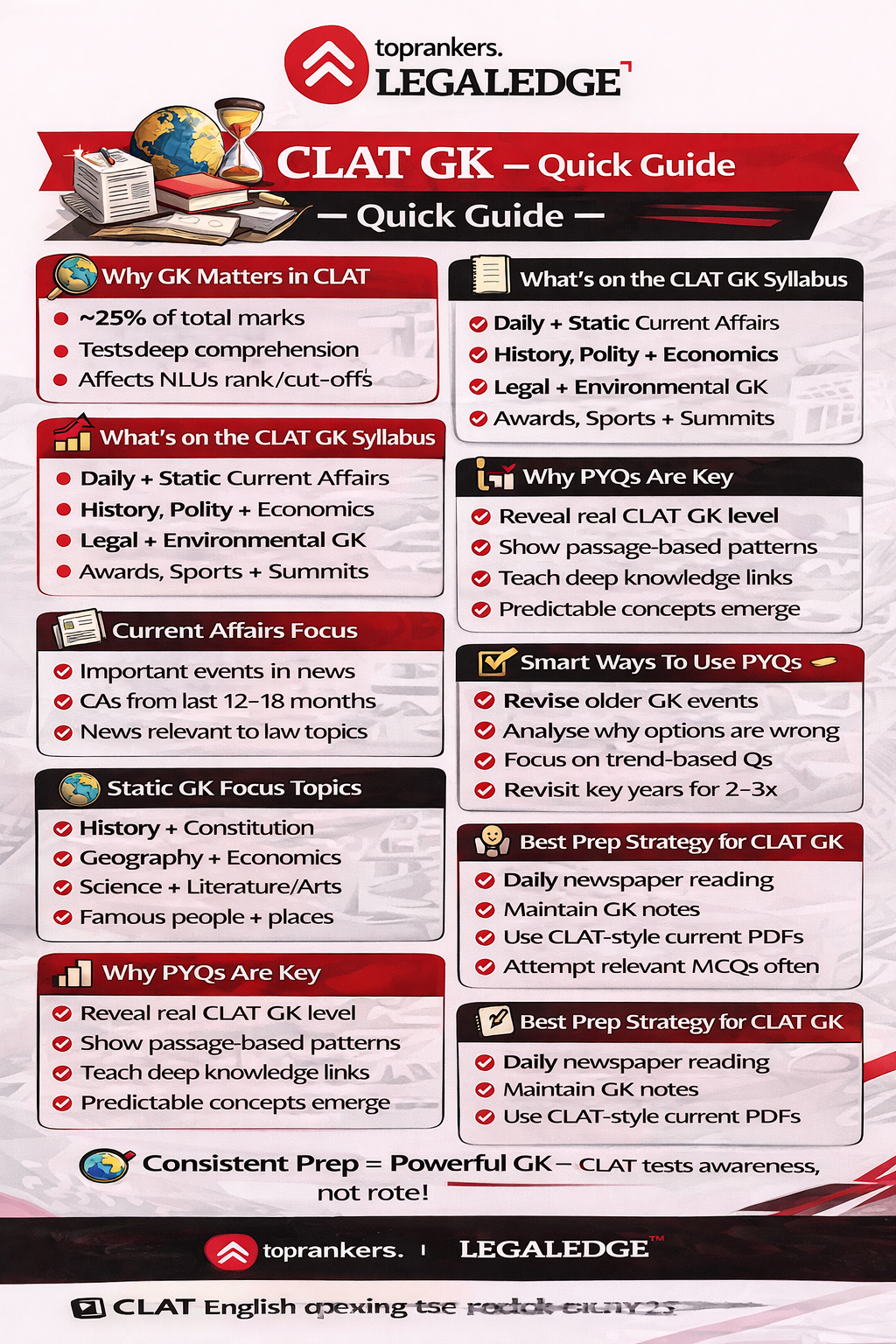
Which months of current affairs should you cover for CLAT 2027?
CLAT 2027 is expected in December 2026. The Consortium does not publish an official current affairs cut-off date, so use this working window, which is what our faculty plan the LegalEdge current affairs calendar around:
| Period | Priority | How to treat it |
|---|---|---|
| Jan – Mar 2026 | Medium | Revise from monthly compilations only. Retain the big-ticket items: Union Budget, major judgments, major summits. |
| Apr – Sep 2026 | High | Core window. Daily newspaper + monthly compilation, both. This is where most passages come from. |
| Oct – Nov 2026 | High | Read daily and note aggressively. Too recent for most compilations to have caught up. |
| Final 3–4 weeks | Revision only | Stop adding new material. Consolidate notes. |
The CLAT sections are taken from journalistic writing on topics that are still being debated, which is why the window is approximately 10 to 12 months rather than 24. A totally closed story rarely makes an effective comprehension passage. Thin coverage of two years is inferior to depth during a ten-month period.
How Questions Are Framed in CLAT GK
The Consortium no longer uses direct, one-line queries. Rather, texts demand that you:
- Determine important details Recognize the backdrop context
- Respond to inquiries based just on the paragraph.
The CLAT GK and current events course is more analytical and reading-intensive because of this design.
How Many Months of Current Affairs Are Required for CLAT 2027?
One of the most common questions among aspirants is how much current affairs coverage is sufficient for CLAT.
Ideally, candidates should prepare current affairs from the last 10-12 months before the examination. However, the most important focus should be on the last 6 months, as recent developments often receive greater attention.
Recommended Coverage Timeline
| Time Period | Importance |
| Last 3 Months | Very High |
| Last 6 Months | Extremely High |
| Last 9 Months | High |
| Last 12 Months | Moderate to High |
Aspirants should revise monthly current affairs compilations regularly to retain information effectively.
Topic-Wise Weightage Analysis for CLAT GK
Based on recent trends, some topics appear more frequently than others.
| Topic | Expected Weightage |
| Current Affairs | Very High |
| Legal Current Affairs | Very High |
| International Relations | High |
| Government Schemes | High |
| Economy | High |
| Environment | Moderate |
| Science & Technology | Moderate |
| Sports | Moderate |
| Static History | Low to Moderate |
| Geography | Low |
Candidates should prioritise current affairs and legal developments while using static GK to strengthen contextual understanding.
Previous Year Trends in CLAT GK Syllabus 2027
Analyzing previous papers reveals a clear shift from factual memorization to comprehension-based current affairs questions.
| Area | Frequency |
| Current Affairs Passages | Very High |
| Legal Developments | Very High |
| Government Policies | High |
| International Affairs | High |
| Economy | Moderate |
| Sports | Moderate |
| Static Facts | Low |
This trend indicates that aspirants should focus on understanding events rather than rote learning.
How to Prepare for the CLAT GK Syllabus 2027 Effectively
1. Read Newspapers Daily
Focus on editorials and legal news from The Hindu/English Express newspapers. Articles related to bills, judgments, and policies are especially important for the CLAT GK Syllabus 2027.
2. Make Short Notes
Maintain a dedicated GK notebook. Summarise important events, dates, and facts. This helps in quick revision of the GK syllabus for CLAT.
3. Use Monthly Current Affairs Compilations
Monthly PDFs aid in methodical revision. For structured preparation, a lot of candidates rely on CLAT GK syllabus PDF download resources
4. Practice Previous Year Papers
Clarity on how static and current affairs are combined in the CLAT current affairs syllabus can be obtained by solving CLAT PYQs
5. Attempt Mock Tests Regularly
Mocks improve speed, accuracy, and familiarity with passage-based questions.
What is the importance of the CLAT GK Syllabus PDF Download?
Many candidates prefer structured CLAT study materials. A trustworthy PDF download of the CLAT GK curriculum is helpful:
- Keep track of the subjects discussed
- Modifications to the plan
- Don't overlook crucial places
A CLAT GK curriculum PDF download makes preparation easier, along with reading the news every day.
Which Newspaper Should You Read for CLAT GK?
Newspapers remain the most reliable source for current affairs preparation.
| Newspaper | Why Read It? |
| The Hindu | Editorials and National Issues |
| Indian Express | Legal and Constitutional Developments |
| Business Standard | Economy and Business News |
| LiveMint | Financial Awareness |
| PIB Releases | Government Policies and Schemes |
Reading one quality newspaper daily and maintaining short notes is usually sufficient.
Common Mistakes Aspirants Make in CLAT GK 2027
- Ignoring static GK
- Relying only on memorisation
- Skipping legal current affairs
- Not revising regularly
Avoiding these mistakes ensures better command over the CLAT GK Syllabus 2027.
Conclusion
The goal of the CLAT GK section is to understand what counts, not to know everything. The CLAT current Syllabus 2027 can become your strongest part with frequent practice, careful note-taking, and constant reading.
Instead of treating the GK syllabus for CLAT as a last-minute assignment, make it a daily habit. Stay curious, strike a balance between current happenings and static concepts, and concentrate on comprehending the "why" underlying them.
The CLAT GK and current events syllabus won't seem daunting with the correct approach; instead, it will seem doable, sensible, and even engaging.
NLU Dream, Zero Cost Start: Free CLAT Demo
Fill your details
Frequently Asked Questions
What does the CLAT GK Syllabus include?

How much weightage does the GK section carry in CLAT?
Is static GK important for CLAT or only current affairs?
How many months of current affairs should I prepare for CLAT GK?
What is the best way to prepare for the CLAT GK section?

Samriddhi Pandey
Content Writer
SHARE