
1723534562.png)

CLAT 2028 Exam Date, Notification, Syllabus, Pattern, Eligibility & Preparation
March 31, 2026
Reader's Digest: CLAT 2028 will be the gateway for thousands of law aspirants aiming to secure a seat in India’s top National Law Universities (NLUs). Even though the official notification for CLAT 2028 has not yet been released by the Consortium of NLUs, serious aspirants have already started their preparation journey in advance. This page brings you a complete, easy-to-understand guide on the CLAT 2028 exam date, eligibility, syllabus, pattern, registration process, preparation strategy, and more.
Bookmark this page now. As soon as the official CLAT 2028 notification is released, all dates and details here will be updated instantly.
CLAT 2028 Exam – At a Glance
Before diving into the details, here is a quick snapshot of the CLAT 2028 exam for both UG and PG aspirants:
| Particular | CLAT 2028 Details (Expected) |
|---|---|
| Exam Name | Common Law Admission Test (CLAT) 2028 |
| Conducting Body | Consortium of National Law Universities (NLUs) |
| Level of Exam | Undergraduate (UG) & Postgraduate (PG) |
| Mode of Exam | Offline, pen-and-paper-based |
| Question Type | Objective, passage-based MCQs |
| Total Questions (UG) | 120 (expected, as per recent pattern) |
| Exam Duration | 2 hours (120 minutes) |
| Expected Exam Month | December 2027 (Sunday, as per usual trend) |
| Programs Covered | 5-year Integrated LL.B (UG) & LL.M (PG) |
| Official Website | consortiumofnlus.ac.in |
Note: All dates and numbers mentioned above for CLAT 2028 are expected based on the recent exam trends. The final details will be confirmed only when the Consortium publishes the official notification.
CLAT 2028 Exam Date & Schedule (Expected)
In the last few years, CLAT has typically been conducted in the first half of December. It is safe to expect that CLAT 2028 will also be held in December 2027, preferably on a Sunday morning. However, the exact date will be announced in the official notification.
Here is the tentative CLAT 2028 schedule to help you plan your CLAT 2028 preparation and application timeline:
| Event | Tentative Timeline for CLAT 2028 | What You Should Do |
|---|---|---|
| Release of CLAT 2028 Notification | July 2027 (expected) | Read the eligibility, syllabus and keep documents ready |
| CLAT 2028 Registration Starts | August 2027 (expected) | Create your account on the Consortium website and start filling out the form |
| Last Date to Submit Application | October 2027 (expected) | Complete the form, upload documents and pay fees well before the deadline |
| Admit Card Release | November 2027 (expected) | Download the admit card, verify the details and visit your exam centre in advance if possible. |
| CLAT 2028 Exam Date | December 2027 (expected) | Reach the centre on time, carry all required documents and stay calm |
| Provisional Answer Key | Same day or next day after exam (expected) | Check your responses and calculate your tentative score |
| Objection Window | Within a few days of the provisional key | Raise objections if you find any genuine discrepancy |
| Final Answer Key | Within 1–2 weeks after objections | Use the final key to estimate your final score more accurately |
| CLAT 2028 Result Declaration | Late December 2027 / January 2028 (expected) | Download the scorecard and check your All India Rank (AIR) |
| CLAT 2028 Counselling & Seat Allotment | January–February 2028 (expected) | Participate in counselling, lock choices and complete admission formalities. |
Once the official CLAT 2028 notification is released, this schedule will be updated with final dates.
What is CLAT 2028 [UG & PG Overview]
CLAT 2028 UG Exam
CLAT 2028 UG is a national-level entrance exam for admission to 5-year integrated law programmes such as BA LL.B (Hons.), BBA LL.B (Hons.), B.Com LL.B (Hons.) and similar courses offered by participating NLUs and several leading private universities across India.
The UG paper focuses on testing a student’s reading ability, reasoning skills and aptitude for legal studies through passage-based questions from English, Current Affairs, Legal Reasoning, Logical Reasoning and Quantitative Techniques.
CLAT 2028 PG Exam
CLAT 2028 PG is conducted for admission to LL.M programmes offered by select NLUs and other institutions. The PG paper tests core legal knowledge through questions on important subjects such as Constitutional Law, Jurisprudence, and other major areas of law.
If you are pursuing or have completed your LL.B. and want to specialise further with a reputed LL.M. degree, CLAT PG 2028 will be one of the most important exams for you.
CLAT 2028 Eligibility Criteria
Before filling out the CLAT 2028 application form, every candidate must ensure that they meet the eligibility criteria. The conditions for UG and PG are different.
CLAT 2028 UG Eligibility
| Criteria | Details (Expected) |
|---|---|
| Educational Qualification | Class 12 or equivalent exam from a recognised board |
| Minimum Marks (General/OBC) | At least 45% aggregate in Class 12 |
| Minimum Marks (SC/ST) | At least 40% aggregate in Class 12 |
| Age Limit | No upper age limit is expected for CLAT 2028 UG |
| Appearing Candidates | Students appearing in Class 12 in 2028 are also eligible, subject to securing the required marks at the time of admission |
| Nationality | Indian nationals, NRIs, NRI-sponsored candidates and foreign nationals as per NLU-specific rules |
CLAT 2028 PG Eligibility
| Criteria | Details (Expected) |
|---|---|
| Educational Qualification | LL.B (3-year or 5-year) or equivalent degree from a recognised university |
| Minimum Marks (General/OBC) | At least 50% aggregate marks in LL.B |
| Minimum Marks (SC/ST) | At least 45% aggregate marks in LL.B |
| Age Limit | No upper age limit is expected for CLAT 2028 PG |
| Appearing Candidates | Final-year LL.B. students are eligible, subject to fulfilling the criteria at the time of admission |
Important: Eligibility conditions mentioned above are based on the existing pattern. Candidates must refer to the official CLAT 2028 notification when released for the finally applicable rules.
CLAT 2028 Exam Pattern
The CLAT exam pattern has stabilised over the recent cycles. CLAT 2028 is also expected to follow the same structure with minor or no changes. Here is the expected exam pattern for UG and PG:
CLAT 2028 UG Exam Pattern (Expected)
- Mode of Exam: Offline (OMR-based)
- Duration: 2 hours
- Question Type: Multiple-choice questions based on passages
- Total Questions: 120
- Marking Scheme: +1 for each correct answer, –0.25 for each wrong answer
| Section | Expected No. of Questions | Approximate Weightage |
|---|---|---|
| English Language | 22–26 | ~20% |
| Current Affairs including General Knowledge | 28–32 | ~25% |
| Legal Reasoning | 28–32 | ~25% |
| Logical Reasoning | 22–26 | ~20% |
| Quantitative Techniques | 10–14 | ~10% |
| Total | 120 | 100% |
CLAT 2028 PG Exam Pattern (Expected)
- Mode of Exam: Offline
- Duration: 2 hours
- Total Questions: 120 MCQs
- Marking Scheme: +1 for correct answer, 0.25 for incorrect answer
The CLAT PG paper includes questions from:
- Constitutional Law
- Jurisprudence
- Other core areas: Contract, Torts, Criminal Law, Administrative Law, Company Law, Public International Law, Family Law and others as notified.
CLAT 2028 Syllabus (UG) – Section-wise Overview
The CLAT 2028 UG syllabus is expected to remain broadly aligned with previous years. Instead of rote learning, the focus is on comprehension and application of concepts through lengthy passages. Here is a section-wise overview:
English Language
- Reading comprehension passages from contemporary and classic sources
- Vocabulary in context (synonyms, antonyms, word usage)
- Inference, tone, main idea and conclusion-based questions
- Basic grammar and sentence usage are tested indirectly through passages
Current Affairs including General Knowledge
- Recent national and international events
- Government schemes, economy and budgets
- Important conferences, summits and organisations
- Sports, awards, science and technology developments
- Legal and constitutional developments, landmark judgments and important bills
Legal Reasoning
- Passage-based questions involving legal principles and factual situations
- Understanding legal concepts like rights, duties, liabilities and remedies
- Basics of Constitutional Law, Contract, Torts and Criminal Law from an application point of view
- No prior detailed legal knowledge required, but familiarity helps
Logical Reasoning
- Short and medium-length passages with arguments and reasoning
- Assumptions, conclusions, strengthening and weakening arguments
- Cause–and–effect relationships
- Logical consistency and structure of arguments
Quantitative Techniques
- Class 10 level mathematics
- Percentage, Profit & Loss, Simple & Compound Interest
- Ratio & Proportion, Averages, Time & Work, Time, Speed & Distance
- Data Interpretation (tables, graphs, charts)
For detailed topic-wise coverage, you can refer to a dedicated CLAT syllabus page and link it internally from this section.
CLAT 2028 Registration & Application Process
The CLAT 2028 application form will be available online only on the official Consortium website. A candidate can apply for UG or PG (or both) from the same portal by paying the respective fees.
How to Fill CLAT 2028 Application Form (Step-by-step)
- Visit the official website: consortiumofnlus.ac.in.
- Click on the CLAT 2028 registration link and create a new account using your name, mobile number and email ID.
- Log in and fill in personal details, academic details and communication address correctly.
- Select the CLAT programme (UG or PG) and choose your test city preferences.
- Upload scanned copies of your recent passport-size photograph, signature and relevant certificates (category, PwD, domicile, etc.).
- Review all details entered in the form carefully.
- Pay the CLAT 2028 application fee online using debit/credit card, UPI or net banking.
- Submit the form and download the confirmation page for future reference.
CLAT 2028 Application Fee (Expected)
The application fee for CLAT 2028 is expected to remain similar to recent exam cycles, with relaxation for reserved categories.
| Category | Expected CLAT 2028 Application Fee |
|---|---|
| General / OBC / NRI / PIO / OCI | To be notified (likely around the current fee level) |
| SC / ST / PwD | Concession on the base fee (exact amount to be notified) |
The final fee structure will be mentioned clearly in the official notification and on the application portal.
Documents Required for CLAT 2028 Form
- Valid email ID and mobile number
- Recent passport-size photograph and signature (as per size specifications)
- Class 10 and Class 12 mark sheets (for UG) / LL.B mark sheets (for PG)
- Category certificate (SC/ST/OBC) if applicable
- PwD certificate, if applicable
- Domicile certificates for state quota seats, wherever required
CLAT 2028 Preparation Strategy
Most CLAT 2028 aspirants will have the advantage of time. If you are in Class 10 or 11 right now, you can structure a long-term plan that builds your reading speed, reasoning ability and accuracy gradually.
When Should You Start Preparing for CLAT 2028?
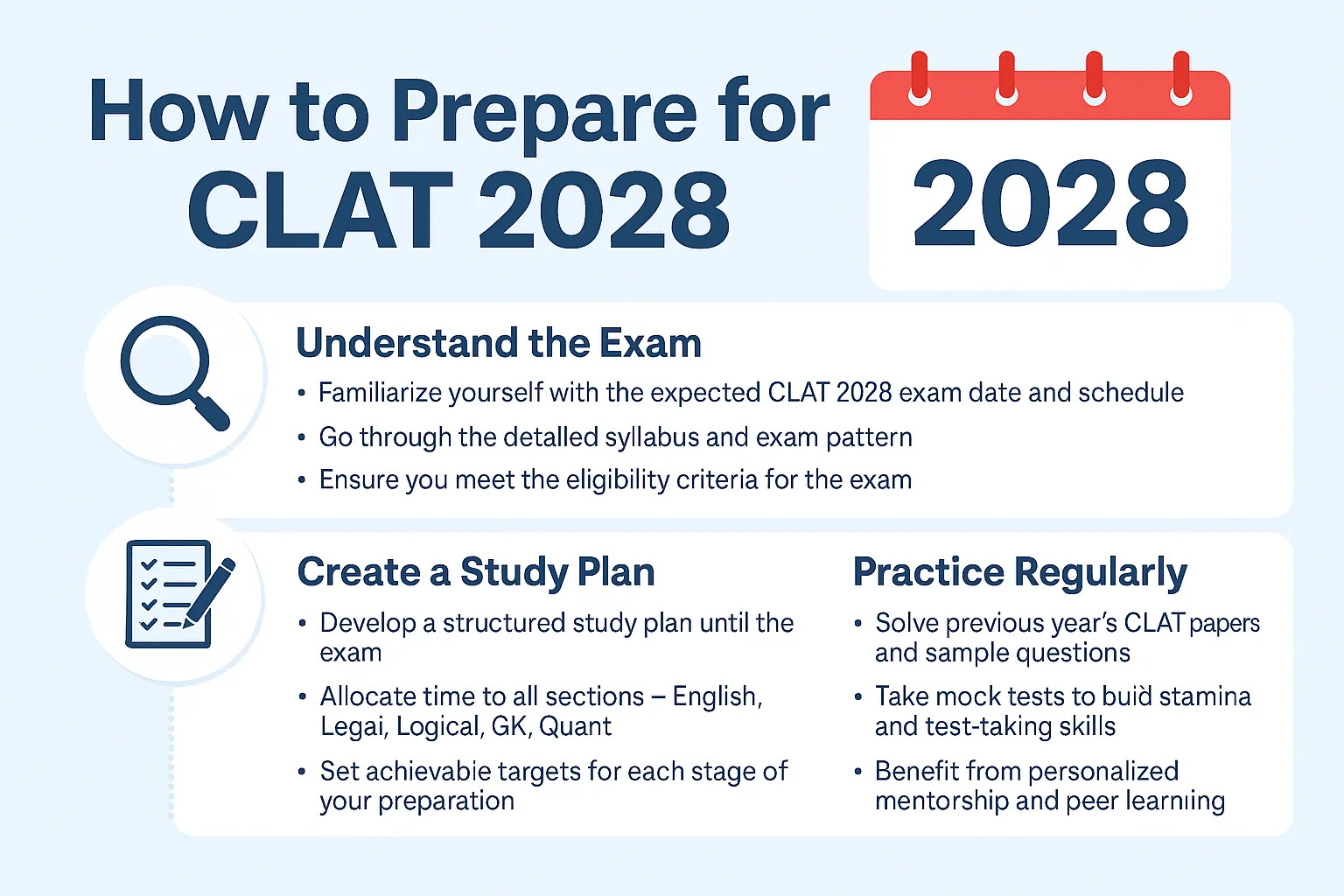
- Class 10 end / Class 11 students: This is the ideal stage to begin. You can focus on reading habits, conceptual clarity and basic reasoning skills without pressure.
- Class 12 students (appearing in 2027–28): You will have a tighter schedule, but you can crack CLAT with a focused 12–18-month plan.
- Droppers: A drop year fully dedicated to CLAT 2028, backed by a structured plan and regular mock tests, can significantly improve your chances of getting into a top NLU.
Section-wise CLAT 2028 Preparation Tips (UG)
English Language:
- Read quality newspapers, editorials and long-form articles daily.
- Practice at least 1–2 reading comprehension passages every day.
- Maintain a vocabulary notebook for new words, idioms and phrases.
Current Affairs & GK:
- Follow a reliable newspaper and a monthly current affairs magazine.
- Revise monthly compendiums regularly instead of cramming at the last moment.
- Keep a special focus on legal and constitutional developments.
Legal Reasoning:
- Practice previous CLAT legal passages to understand the question style.
- Learn to identify the legal principle and apply it calmly to the given facts.
- Do not overthink with external legal knowledge; answer strictly based on the passage.
Logical Reasoning:
- Work on critical reasoning (assumptions, conclusions, inference) regularly.
- Attempt timed sets to improve speed and accuracy.
- Analyse each solved question: why is an option wrong as much as why another is right.
Quantitative Techniques:
- Revise Class 10 maths concepts thoroughly.
- Prepare a formula sheet and revise it multiple times.
- Practise data-based DI sets and short calculation tricks regularly.
2-Year Study Plan Snapshot for CLAT 2028 (For Early Starters)
| Phase | Duration | Key Focus Areas |
|---|---|---|
| Phase 1 – Foundation | First 8–10 months | Reading habit, basic vocabulary, core maths concepts, understanding passage-based questions |
| Phase 2 – Strengthening | Next 8–10 months | Section-wise practice, topic tests, speed-building, starting full-length mocks |
| Phase 3 – Test & Revision Mode | Last 4–6 months | Full-length mocks, analysis, revision of notes, and fine-tuning exam strategy |
You can always customise this plan depending on whether you start in Class 11, 12 or as a dropper.
| Maths Preparation Tips | Maths Questions | Number System Questions |
| DI Questions | Easy Calculation Techniques | Quant Study Plan |
CLAT 2028 Previous Year Papers & Mock Tests
Why Previous Year Papers are Crucial
Previous year CLAT question papers help you understand the actual difficulty level, question framing style and time pressure of the exam. Solving them under timed conditions is one of the best ways to build exam temperament.
You should ideally:
- Solve at least the last 3–4 years’ CLAT papers in exam-like conditions.
- Analyse each paper thoroughly after attempting it.
- Identify patterns in topics, question types and common mistakes.
CLAT 2028 Mock Tests
- Start with topic-wise and sectional tests in the beginning.
- Gradually move to full-length CLAT pattern mocks.
- Aim for at least 40–60 full-length mocks before CLAT 2028, with detailed analysis.
A good mock test series with detailed solutions, performance analytics and expert guidance can help you benchmark yourself against serious aspirants across India.
CLAT 2028 Result, Cut-off & Counselling (Expected)
CLAT 2028 Result & Scorecard
Once the final answer key is released, the Consortium will declare the CLAT 2028 result in the form of a scorecard showing your total marks and All India Rank (AIR). You will have to log in using your mobile number and password to download the scorecard.
CLAT 2028 Expected Cut-off Trend
Cut-offs for CLAT vary every year based on factors like exam difficulty, number of applicants, and seats available. Generally, higher scores are required for the top NLUs and the General category, while the reserved categories have slightly lower cut-offs.
Instead of chasing a fixed cut-off number, focus on:
- Maximising your accuracy in the actual exam
- Consistently scoring above safe-score bands in mocks
- Improving rank with every 3–4 tests through proper analysis
CLAT 2028 Counselling & NLU Allotment
After the declaration of CLAT 2028 results, the Consortium will conduct a centralised counselling process. Candidates will have to register separately for counselling, pay the counselling fee and provide their NLU preferences.
Based on your rank, category, preferences and seat availability, you will be allotted a seat in one of the participating NLUs. Multiple rounds of allotment may take place. Candidates can accept, upgrade or exit based on the rules applicable in that year.
Top NLUs You Can Target Through CLAT 2028
Some of the premier National Law Universities you can aim for through a strong performance in CLAT 2028 include:
- National Law School of India University (NLSIU), Bengaluru
- National Academy of Legal Studies and Research (NALSAR), Hyderabad
- The West Bengal National University of Juridical Sciences (WBNUJS), Kolkata
- National Law University, Jodhpur
- Gujarat National Law University (GNLU), Gandhinagar
- National Law Institute University (NLIU), Bhopal
- Dr Ram Manohar Lohiya National Law University (RMLNLU), Lucknow
- National University of Advanced Legal Studies (NUALS), Kochi
- Rajiv Gandhi National University of Law (RGNUL), Patiala
- And other participating NLUs as per the latest list
Your CLAT 2028 rank will determine which NLU and which programme you can ultimately secure.
Why Prepare for CLAT 2028 with LegalEdge by Toprankers?
CLAT 2028 will be highly competitive, and a structured, guided approach can make the difference between “just appearing” and actually securing a seat in a top NLU. This is where LegalEdge by Toprankers comes in with its proven CLAT 2028 preparation ecosystem.
Proven Track Record in CLAT & Other Law Entrances
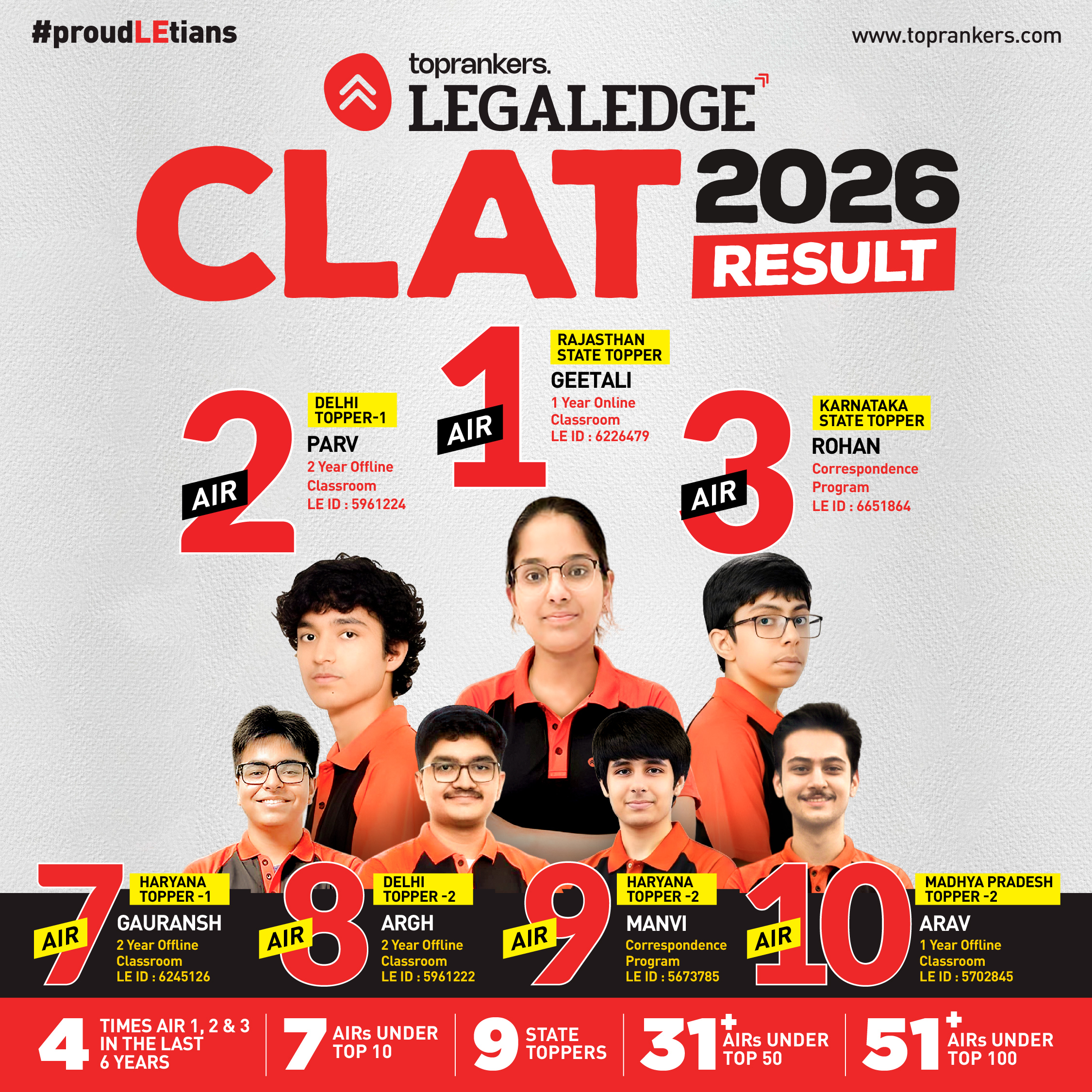
- Consistent selection of students in top NLUs across recent CLAT cycles.
- Strong presence in both online and offline modes, giving aspirants flexibility based on their location and schedule.
- Result-oriented classroom pedagogy focusing on conceptual clarity and exam temperament.
Structured Courses for CLAT 2028 Aspirants
- 2-year & 1-year CLAT 2028 Programs: Separate course designs for early starters (Class 11) and late starters (Class 12 and droppers).
- Live + Recorded Classes: Daily concept-building sessions with recordings available for revision and catch-up.
- Comprehensive Study Material: Curated books, practice sheets and handouts covering the entire CLAT 2028 syllabus with regular updates.
- Dedicated Mock Test Series: CLAT pattern-based full-length tests with detailed solutions and performance analysis.
Personalised Guidance & Smart Analytics
- Doubt-Solving Support: Regular doubt-clearing sessions so that no concept remains unclear.
- Performance Analytics: In-depth analysis of mock tests to highlight strengths, weaknesses and areas needing immediate attention.
- Mentorship & Strategy Sessions: One-on-one or small-group mentoring on exam strategy, time management and question selection.
How LegalEdge Supports Different Types of CLAT 2028 Aspirants
- Class 11 Students: Long-term foundation programs focusing on reading skills, reasoning ability and gradual syllabus completion.
- Class 12 Students: Intense, time-efficient courses that balance boards and CLAT preparation without burning out the student.
- Droppers: High-rigour programs with frequent mocks, tight feedback loops and advanced practice for rank improvement.
If you are serious about a top NLU in CLAT 2028, joining a structured program can save you months of trial and error.
Explore LegalEdge’s CLAT 2028 Courses and choose the program that best fits your profile and preparation stage.
For more details, visit the official website: https://consortiumofnlus.ac.in/
Frequently Asked Questions
What is CLAT Exam 2028?

When will CLAT 2028 be conducted?
Who can apply for CLAT 2028 UG?
Is there any age limit for CLAT 2028?
What subjects are included in the CLAT 2028 UG syllabus?
Is Maths compulsory for CLAT 2028?
Can I prepare for CLAT 2028 along with my Class 11–12 boards?
Which colleges accept CLAT 2028 scores?

Admin
Subject Matter Expert


SHARE