
1723534562.png)

NATA Study Plan 2026: Month Wise Preparation Strategies
March 12, 2026
Quick Answer: A well-structured NATA study plan helps aspirants systematically prepare across all key areas of the exam including Drawing, Mathematics, Logical & Analytical Reasoning, Visual & Spatial Ability, Architectural Awareness, and Design principles. It outlines daily, weekly, or month-wise steps that balance concept learning with regular practice to maximize performance.
Key Highlights - NATA Study Plan
- A comprehensive NATA study plan focuses on mastering the official syllabus through topic-wise learning and consistent practice.
- Prioritizes drawing and visualization exercises, which are critical for scoring high in the NATA exam.
- Includes a balanced schedule for Mathematics, Logical Reasoning, and Visual Reasoning based on NATA patterns. Including the ideal time to devote for each subject, it’s practice questions & revision.
- Encourages regular revision, mock tests, and analysis of previous NATA question papers.
- Designed to build speed, accuracy, creative confidence, and strategic time management ahead of NATA exam day.
Preparing for the architecture entrance exams like the NATA entrance exam is not challenging if you follow a well-structured study schedule and preparation strategy.
This post shall guide you through the best NATA Study Plan 2026 provided by our experts at Creative Edge (a pioneer in providing the best online guidance for architecture entrance exams) to ease your preparation.
So, what are you waiting for? Dig into the post to learn smart tips to create the best preparation plan that helps to perform well in the upcoming exam.
Table of Contents
- Study Plan and Preparation Strategy for NATA 2026
- How to Make the Best Study Time Table for NATA 2026?
- NATA 2026 Syllabus (For Your NATA Study Plan)
- What Should be the NATA Study Plan for 6 Months?
- NATA 2026 Study Plan for 30 Days (Repeatable)
- Download NATA Study Material 2026 PDF by CreativEdge
- NATA Study Plan 2026: Subject-wise Preparation Tips
Study Plan and Preparation Strategy for NATA 2026
For cracking the National Aptitude Test in Architecture, the first and foremost important thing is to have a "well-planned study schedule".
Create a NATA preparation strategy and focus on your strengths and weaknesses and allocate time accordingly.
As per the Paper Pattern for the NATA, the question paper comprises two parts: Part A comprises Maths and Aptitude, while Part B comprises drawing.
- Divide the topics from most important to least important as per the weightage of each subject.
- Make sure to distribute all the subjects in your daily plan.
- Try to review your weak areas and allocate more time to topics that you feel are difficult.
- Ensure to devote at least 1.5-2 hours to each subject daily to score good marks in the exam.
- If you are studying for 8 hours a day, allot 1-1.5 hours to solve the previous year's question papers for NATA.
- Also, make sure to allot enough time for revision in your NATA study plan for 2026.
How to Make the Best Study Time Table for NATA 2026?
As there are only a few months left for the exam, most of you might be worried about covering all the topics as per the syllabus.
We have curated the best study plan for NATA 2026 and timetable to help you know how much time you need to give for the essential topics for the NATA exam.
|
Subject Area |
Hours/Week |
Focus Areas |
|
Drawing & Visual Composition |
1.5-2 hrs |
Sketching, perspectives, human figures, scene drawing, 2D/3D compositions |
|
Numerical & Logical Aptitude |
1.5-2 hr |
Math basics (Class 10 level), series, ratios, directions, puzzles |
|
Cognitive Skills |
1 hr |
Analytical reasoning, memory exercises, pattern recognition, spatial logic |
|
Architecture Awareness |
0.5 hr |
Famous buildings, architects, materials, styles, trends |
|
General Knowledge & Awareness |
0.5 hr |
Current events, design trends, art, and architecture-related GK |
|
Revision |
1 hr |
Till the Exam |
|
Mock Tests / Practice Papers |
1–2 hrs |
One timed paper every week (Till the Exam) |
Total: 6-7 hours/day
Toprankers Tip:
- Break it down to 2–2.5 hours study sessions over followed by short breaks to get the best out of your NATA study plan for 2026
- Sundays can be reserved for focused sketching practice + 1 mock test every week + Review
Check: Best books for NATA Preparation


NATA 2026 Syllabus (For Your NATA Study Plan)
Understanding the NATA 2026 syllabus is the first and most important step while building a smart nata study plan. The exam evaluates both creative and analytical abilities required for architecture programs. Below is a structured syllabus breakdown you can directly integrate into your NATA 2026 preparation strategy.
NATA 2026 Syllabus Overview
|
Section |
Core Areas Covered |
Skills Tested |
|
Part A – Drawing & Composition |
2D composition, 3D composition, perspective drawing, sketching from imagination, visual storytelling |
Creativity, proportion, spatial understanding, shading, perspective |
|
Algebra, Trigonometry, Geometry, Mensuration, Coordinate Geometry, Calculus basics (Class 11–12 level) |
Numerical accuracy, problem-solving |
|
|
Logical & Analytical Reasoning |
Series, coding-decoding, direction sense, seating arrangement, logical puzzles |
Analytical thinking, pattern recognition |
|
Visual & Spatial Ability |
3D cube unfolding, surface counting, top/front views, rotation & reflection |
Mental visualization, spatial reasoning |
|
Architectural Awareness |
Famous architects, monuments, building materials, construction terminology |
Awareness of architecture & design |
|
Design Principles & Aesthetic Sensitivity |
Balance, contrast, rhythm, proportion, harmony, color theory |
Design sense & visual judgment |
Weightage Insight for NATA Study Plan
|
Section |
Approx. Marks |
Preparation Priority |
|
Drawing (Part A) |
80 |
Very High |
|
Part B (MCQ/NCQ) |
120 |
High |
|
Mathematics |
~30–40 |
Moderate |
|
Logical + Spatial Reasoning |
~40–50 |
High |
|
Architecture & Design Awareness |
~30 |
Moderate |
Read more: How to improve your NATA score?
FAQs on NATA 2026 Syllabus and Study Plan
What is the syllabus for NATA 2026 exam?
The NATA 2026 syllabus includes Mathematics (Class 11-12 level), Logical & Analytical Reasoning, Visual & Spatial Ability, Architectural Awareness, Design Principles, and Drawing skills. The exam tests numerical ability, 3D visualization, creativity, and aesthetic sensitivity required for B.Arch admissions.
Does the NATA syllabus overlap with JEE Main Paper 2 (B.Arch) syllabus?
Yes, there is partial overlap. Both exams include Mathematics, Aptitude, and Drawing/Design skills. However, NATA places stronger emphasis on visual perception, GK / architectural awareness, and creative composition, while JEE Main Paper 2 focuses more on Mathematics and aptitude-based reasoning.
Can you prepare for NATA and JEE Main Paper 2 together?
Yes, candidates can prepare for both simultaneously because core areas like Mathematics, Aptitude, and Drawing overlap. A combined study strategy focusing on Class 11–12 Maths, 3D visualization, and regular sketching practice works effectively for both exams.
Is the NATA syllabus based on NCERT?
The Mathematics portion of the NATA syllabus is based on Class 11 and 12 NCERT concepts. However, sections like Architectural Awareness, Visual Reasoning, and Drawing require additional preparation beyond NCERT textbooks.
Does NATA have negative marking?
Yes, NATA includes negative marking in certain MCQ sections. Candidates must answer carefully to avoid score deductions, especially in Mathematics and reasoning-based questions.
What Should be the NATA Study Plan for 6 Months?
You may have queries on what topics should be covered on which day, must-focus topics to prepare a solid NATA study plan. You can break the syllabus down month-wise to make it more manageable and focus on strengthening weak areas first.
Check out the 6-month Study Plan for NATA provided below and enhance your preparation for the upcoming NATA 2026 exam.
1st & 2nd Month
- Be thorough with the NATA 2026 pattern and syllabus before you start your preparation.
- Prepare a NATA study plan that includes all topics for all the subjects and stick to it.
- Make sure to study at least for 8 hours (2 hours for each subject).
- Revise basic maths formulas from profit and loss, area and proportion, probability, speed and distance, interest, etc.
- Try to complete all the topics as per the schedule.
3rd & 4th Month
- Continue towards completing the basic syllabus as soon as possible.
- Get acquainted with famous logos and their history and Practice human figures daily.
- Solve as many NATA Aptitude Questions as possible from NATA previous year papers.
- Take mock tests to analyse your preparation levels and overcome mistakes.
5th & 6th Month
- Try to complete anything remaining from the NATA syllabus 2026
- After that, begin your revision.
- Remember not to read any new topics as it may lead to confusion.
- Practice as many questions as possible from the previous year's papers.
- Include taking up at least 1-2 Mock Tests a day in your NATA study plan for analysing your performance.
NATA 2026 Study Plan for 30 Days (Repeatable)
As there is only one month left for the NATA Entrance Exam, most of you might be worried about completing all the topics in such a short period.
You can check out the 30 days NATA study plan from the table below and plan your preparation accordingly.
| Day | Drawing | General Aptitude | Mathematics |
| Day 1 | Understanding the Scale and Proportion of Objects | Objects, Texture Related to Architecture and Environment | Algebra |
| Day 2 | Practice perspective drawing questions | Interpretation of pictorial compositions | Logarithms |
| Day 3 | Shape, Building Forms and Elements | Visualizing three-dimensional objects from a two-dimensional drawing | Matrices |
| Day 4 | Aesthetics, colour texture, harmony, and contrast | Visualizing different sides of 3D objects | Trigonometry |
| Day 5 | Conceptualization and Visualization through structuring objects in memory | Analytical Reasoning | Coordinate Geometry |
| Day 6 | Drawing of patterns - both geometrical and abstract | Mental ability (visual, numerical, and verbal), | Coordinate geometry |
| Day 7 | Form transformations in 2D and 3D like union, subtraction, rotation, surfaces, and volumes | General awareness of national/ international architects and famous architectural creations | 3-Dimensional Co-ordinate geometry |
| Day 8 | Generating plan, elevation, and 3D views of objects | Mathematical reasoning | Theory of Calculus |
| Day 9 | Perspective drawing | Mathematical reasoning | Application of Calculus |
| Day 10 | NATA Perspective drawing | Sets and Relations | Permutation and combination |
| Day 11 | Sketching of urbanscape and landscape | Sets and Relations | Statistics and Probability |
| Day 12 | Common day-to-day life objects like furniture, equipment, etc., from memory. | Practice NATA Mock Tests | Practice Mock Test |
| Day 13 | Understanding the Scale and Proportion of Objects | Practice Sample Papers | Practice Mock Test |
| Day 14 | Geometric Composition | Practice NATA Sample Papers | Practice Sample Papers |
| Day 15 | Perspective drawing | Practice Mock Test | Practice NATA Mock Test |
| Day 16 | Aesthetics, colour texture, harmony, and contrast | Practice Sample Papers | Practice Sample Papers |
| Day 17 | Conceptualization and Visualization through structuring objects in memory | Practice previous year's papers | Practice previous year's papers |
| Day 18 | Drawing of patterns - both geometrical and abstract | Practice previous year's papers | Practice previous year's papers |
| Day 19 | Form transformations in 2D and 3D like union, subtraction, rotation, surfaces, and volumes | Practice previous year's papers | Practice previous year's papers |
| Day 20 | Generating plan, elevation, and 3D views of objects | Practice sample papers & mock test | Practice sample papers & mock test |
| Day 21 | Perspective drawing | Practice sample papers & mock test | Practice sample papers & mock test |
| Day 22 | Perspective drawing | Revision | Revision |
| Day 23 | Sketching of urbanscape and landscape | Practice sample papers | Practice sample papers |
| Day 24 | Common day-to-day life objects like furniture, equipment, etc., from memory. | Practice NATA Mock Test | Practice Mock Test |
| Day 25 | Practice Previous Years’ NATA Drawing Questions | Practice previous year's papers | Practice previous year's papers |
| Day 26 | Practice Previous Years’ NATA Drawing Questions | Practice NATA previous year question papers | Practice previous year's papers |
| Day 27 | Practice Previous Years’ NATA Drawing Questions | Practice sample papers & mock test | Practice sample papers & mock test |
| Day 28 | Practice Previous Years’ NATA Drawing Questions | Re-Revision | Re-Revision |
| Day 29 | Rest | Re-Revision | Re-Revision |
| Day 30 | Rest | Rest | Rest |
Check: How To Prepare For NATA In One Month?
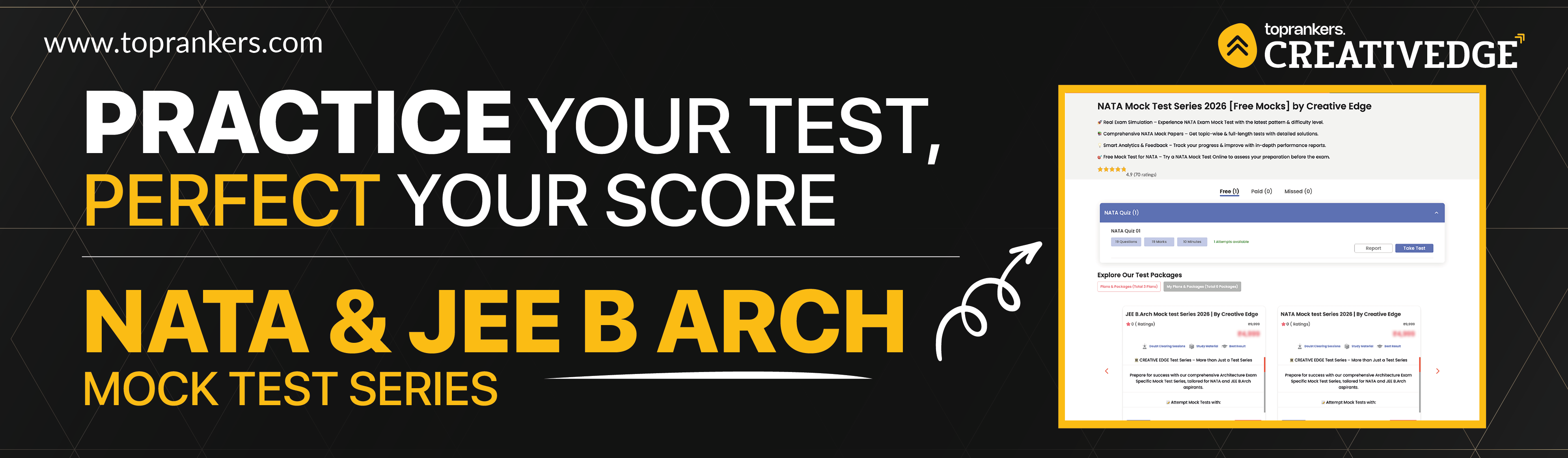
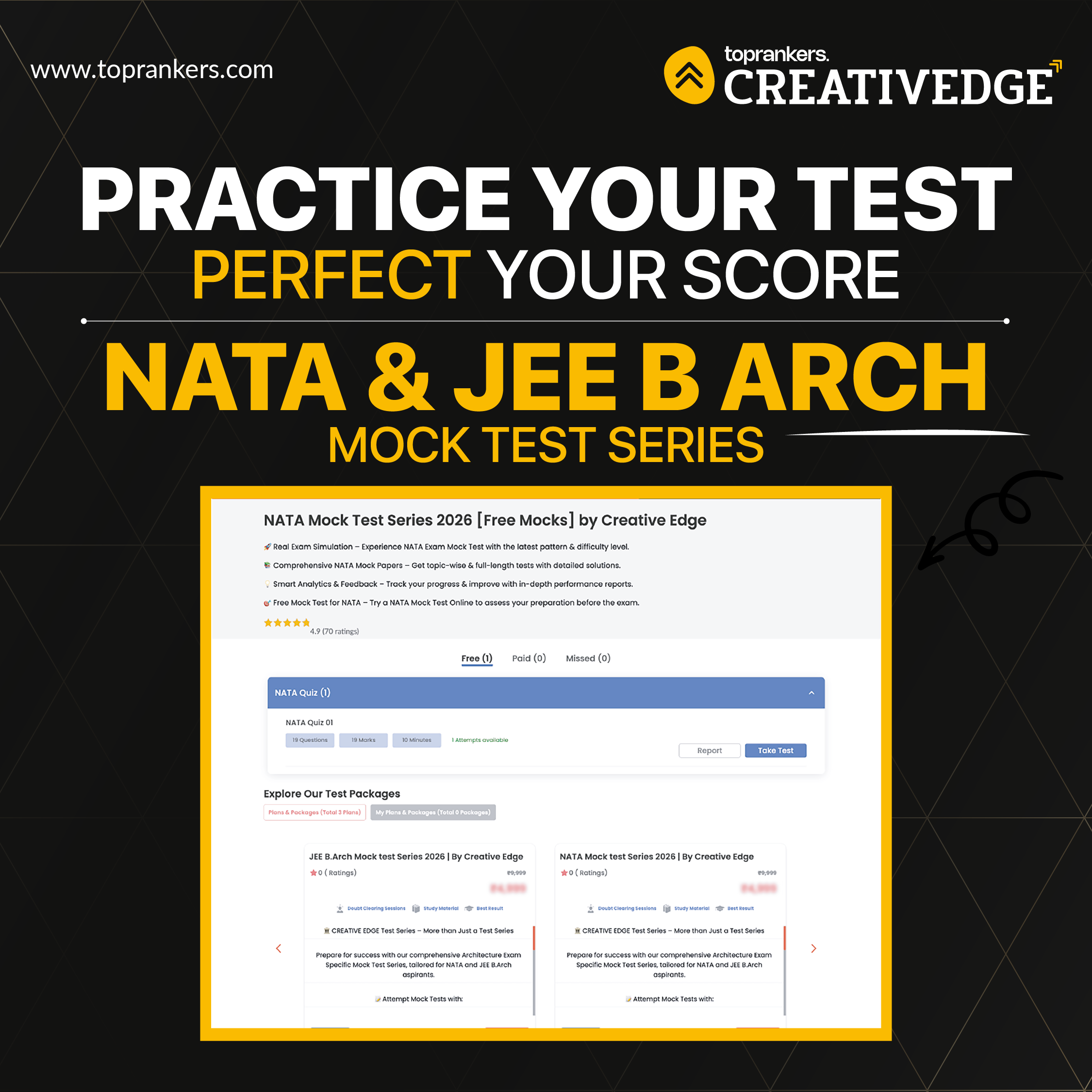
Use CreativEdge NATA Study Material & Free Resources Strategically for 2026 Prep
| NATA Mock Test | |
| NATA Preparation Video 2026 | |
| NATA Books 2026 | |
| NATA PYQs |
Check: NATA Exam and Difficulty-level Analysis
NATA Study Plan 2026- Ideal Timeframe to Prepare for NATA
How much time does it take to prepare for NATA?
Around 6-7 months of focused preparation is usually considered enough to crack an exam like NATA from scratch. You should start by familiarizing yourself with the exam pattern and the type + difficulty level of questions usually asked in the exam followed by preparing a NATA study plan.
Note that NATA comprises two main sections- Drawing and Aptitude. The aptitude section has a weightage of 120 marks, and the drawing is of 80 marks.
Performing well in aptitude can help with the overall result, but drawing is also a significant portion of the exam. And you will require time to develop core skills in sketching, perspectives, 3D composition, etc. It’s always a wise idea to start early.
If you are in class 11th or 12th, we suggest you start preparing for it along with your regular studies. Dedicating just a few hours per week will help avoid the last-minute chaos right before the exam.
Join CreativEdges NATA Coaching Institutes in India
| NATA Coaching in Indore | NATA Coaching in Andheri | NATA Coaching in Mumbai |
| NATA Coaching in Agra | NATA Coaching in Lucknow | NATA Coaching in Kolkata |
NATA Study Plan 2026: Subject-wise Preparation Tips
The following are some of the best preparation tips for NATA you can follow while preparing for the exam.
Aptitude: For the aptitude section, you should keep your general knowledge updated. Dedicate some time daily in your NATA study plan to read about buildings/structures in India and the World and Important Architects/Designers/Artists of India and the world. For rest of the aptitude, keep practicing problems on speed, distance and time, Logical and Reasoning Ability questions, General Maths questions like area, etc.
Maths: To score good marks in the mathematics section, revise basic maths formulas from topics like profit and loss, area and proportion, probability, speed and distance, interest, etc. Solve more and more questions from the previous year's papers regularly.
Drawing: For the drawing section, practice making freehand straight lines regularly without using the scale in a minimum of 5-7 sheets. Also, you are advised to solve at least 2-3 perspective drawing questions from the previous year's papers daily.

How to Improve your Scores in NATA 2026?
The NATA Study Plan 2026 is a valuable resource that outlines crucial topics and provides a well-structured timetable. By following this study plan, you can effectively prepare for the NATA exam and increase your chances of achieving good scores. Utilizing this plan to your advantage will greatly benefit your performance in the upcoming NATA exam 2026. Best of luck with your preparations!
Did You Know?: Solving previous year NATA question papers is not only a great way to familiarize yourself with the NATA exam pattern but also an interesting aspect of NATA preparations. By attempting these papers, you can gain insights into the types of questions asked, improve your time management skills, and build confidence for the actual exam.

Attempt a Free NATA Mock Test
Fill your details
Frequently Asked Questions
Is it easy to follow the NATA study plan and Time Table provided in this post for 2026 exam preparation?

How much time should I keep aside for revision in the NATA Exam Preparation plan?
How much time does it take to prepare for NATA Exam?
Can I prepare for NATA drawing syllabus in two months?
How can I improve my creative skills for NATA 2026 drawing?

Vineeta Agrawal
Communications Executive


SHARE