
1723534562.png)

NATA Syllabus 2026: Check Subject wise Syllabus, Preparation Tips
March 12, 2026
Quick Answer: The NATA syllabus 2026 includes topics from Mathematics (Class 11–12 level), Logical & Analytical Reasoning, Visual & Spatial Ability, Architectural Awareness, and Drawing skills. It tests numerical ability, 3D visualization, design sensitivity, and creative composition required for admission into B.Arch programs.
Key Highlights
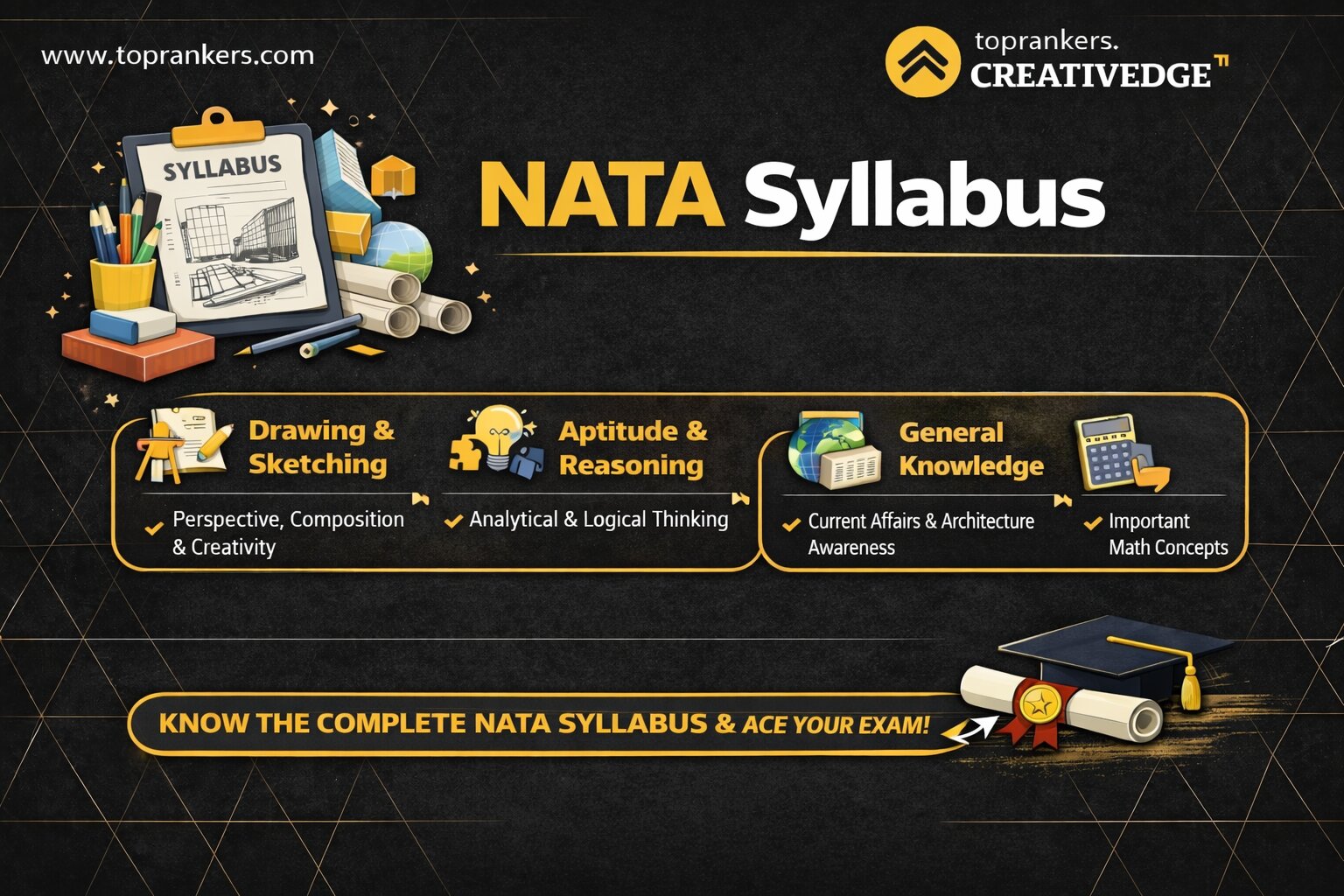
- The NATA entrance exam syllabus includes Mathematics, Logical & Analytical Reasoning, Visual & Spatial Ability, Architectural Awareness, and Drawing.
- Mathematics components are based on Class 11–12 level, including algebra, geometry, and mensuration.
- Visual Reasoning tests 3D perception, pattern recognition, and perspective understanding.
- The Drawing section evaluates composition, proportion, shading, and creative sketching skills.
- Familiarity with design principles, color theory, and architectural terminology is essential for high scores. These contribute easy and direct marks thereby improving your overall NATA result.
The Council of Architecture (CoA) releases the NATA 2026 syllabus for NATA 2026 exam in its official brochure. NATA exam has 2 sections - The Part A (Drawing & Composition Test) and Part B (MCQs & NCQs based on Maths, Aptitude & GK).
Part A will be conducted in offline mode and will consist 3 questions on drawing + composition for 80 marks. While, the Part B of the NATA exam syllabus 2026 will be conducted in CBT mode and is expected to have questions from basic mathematics, logical reasoning, visual reasoning, GK or architectural awareness (total 120 marks).
With the understanding of NATA Syllabus 2026, you can also save time by not studying topics that are unimportant for the exam. Read through the post that will give you a complete insight into the subject-wise NATA Syllabus 2026 and the best preparation books.
Table of Contents
NATA 2026 Syllabus as per Council of Architecture (COA) - Official NATA Website
The NATA Information Brochure released by the Council of Architecture outlines:
-
Section-wise NATA exam pattern & syllabus + topic coverage (Mathematics, Aptitude, Drawing)
-
Skills evaluated in the examination
-
Exam pattern, marking scheme and question structure
-
Assessment criteria for drawing and aptitude sections
-
Eligibility criteria and admission guidelines
Candidates can download the official NATA brochure and syllabus documents from the official NATA website to verify the most updated syllabus for the 2026 exam cycle.
NATA 2026 Exam Structure Explained - Part A vs Part B (Official COA Format)
As per the official Council of Architecture NATA syllabus, the exam is divided into two main components to evaluate both creative ability and analytical aptitude. Understanding the NATA exam pattern helps aspirants plan preparation more strategically instead of studying all topics together.
NATA 2026 Exam Sections Overview
|
Exam Part |
Section Name |
Mode of Test |
Duration |
Marks |
What It Evaluates |
|
Part A |
Drawing and Composition Test |
Offline drawing-based |
90 Minutes |
80 Marks |
Creativity, visualization, composition skills |
|
Part B |
MCQ and NCQ Aptitude Test |
Computer-based adaptive test |
90 Minutes |
120 Marks |
Logical reasoning, visual reasoning, design sensitivity |
Total Marks: 200
The drawing section focuses on creative thinking and architectural visualization, while the aptitude section measures analytical reasoning and observation skills.
NATA 2026 Syllabus Part A - Drawing and Composition Section (Creative Evaluation)
Part A evaluates a candidate’s artistic and spatial abilities through structured drawing tasks. The official syllabus mentions that candidates attempt questions such as composition, sketching, and 3D visualization exercises designed to test imagination and visual clarity.
|
Question Type |
What Students May Be Asked To Do |
|
Composition and Color |
Create visually balanced compositions using given themes |
|
Sketching Tasks |
Draw environments or scenarios with proportion and detailing |
|
3D Composition |
Build and illustrate forms using spatial imagination |
Preparation focus for Part A should be daily drawing practice, perspective understanding, and visualization exercises.
Check: NATA Preparation in one month
NATA Syllabus 2026 Part B – MCQ and NCQ Aptitude Section (Analytical Evaluation)
Part B is conducted in a computer-based adaptive format and evaluates logical reasoning, visual analysis, and architectural awareness. The official syllabus highlights areas such as visual reasoning, logical derivation, language interpretation, and design sensitivity.
|
Question Category |
Description |
|
Visual Reasoning |
Understanding forms, patterns, and spatial relationships |
|
Logical Derivation |
Analytical reasoning and decision-making |
|
Design Sensitivity |
Observation of environment, product, and space |
|
Numerical Ability |
Geometry-based mathematics used in architecture |
Preparation for Part B should include reasoning practice, visual analysis exercises, and basic geometry concepts rather than rote learning.
Check: NATA Basic Preparation Strategies
Section Wise NATA Syllabus 2026 - General Aptitude
The aptitude test measures your knowledge in:
- Observational skills
- Visual perception
- Aesthetic sensitivity tests
- Logical reasoning
- Critical thinking ability
The NATA aptitude test will comprise 125 questions that could be of the following:
- Multiple-Choice Questions (MCQ)
- No Choice Questions (NCQ)
You are advised to solve the previous year's question papers for NATA to know the difficulty level and the type of questions asked in the exam.
Let us look at the table below to know the important topics that must be prepared under the general aptitude section of the NATA syllabus.
NATA 2026 Syllabus - Aptitude Core Topics
|
NATA Syllabus Topics |
Detailed Subtopics |
Importance Level | Weightage in Part A |
Skills Tested |
|
Logical Reasoning |
Series completion, analogies, classification, coding-decoding |
High | 10-12% |
Analytical thinking, problem solving |
|
Visual Reasoning |
2D-3D transformation, mental rotation, pattern recognition |
High | 15-20% |
Spatial visualization |
|
Numerical & Analytical Ability |
Data interpretation, logical deduction, situation analysis |
Medium - High | 15-17% |
Decision-making and reasoning |
|
Architectural Awareness |
Famous architects, buildings, architectural terminology |
Medium | 17-20% |
Design awareness |
|
General Awareness |
Environment, urban spaces, cultural landmarks |
Medium | 8-10% |
Contextual understanding |
|
Design Sensitivity & Thinking |
Observing, recording and analyzing, people, space, product, environment + Visual comparisons & pattern spotting |
High | 7-10% |
Attention to detail |
| Language Interpretation |
Reading comprehension, vocabulary, synonyms, antonyms |
Medium | 20-22% | Ability to correctly generate meaning of words, sentences, understanding about English grammar. |
The aptitude section often combines logic with visual interpretation, so balanced preparation across reasoning and observation is important.
Other Topics from NATA Syllabus 2026 (Aptitude)
You can also expect questions from the following topics in the National Aptitude Test in Architecture 2026. Enhance your preparation levels by following expert preparation tips for NATA.
- Elements and principles of design
- Aesthetic sensitivity
- Colour theory
- Visual perception and cognition
- Graphics and imagery
- Building anatomy and architectural vocabulary
- Basic techniques of building construction and knowledge of material
- General knowledge and current affairs
Sample Questions from NATA 2026 Syllabus Aptitude Section
Q.1. Find the appropriate figure from the alternatives given below which best fits into the blank space of the symmetrical problem figure indicated by a (?)
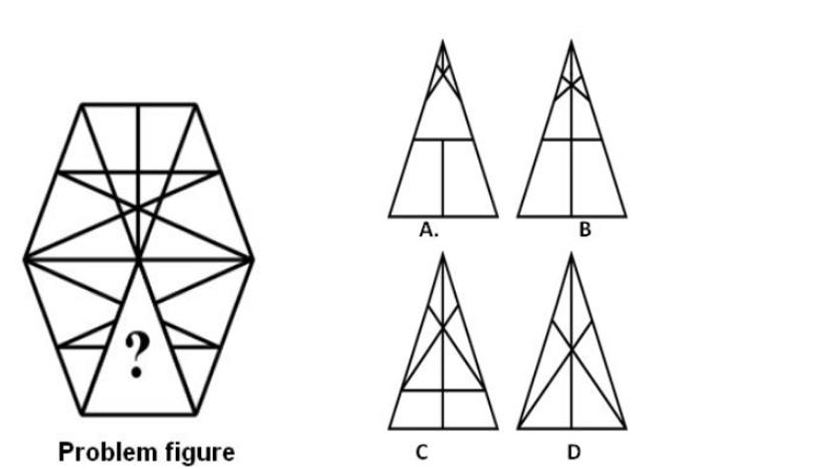
(a) (A)
(b) (B)
(c) (C)
(d) (D)
Ans: b
Q.2. Universal time is based on:
(a) Rotation of the earth on its axis
(b) Earth's orbital motion around the earth
(c) Vibrations of caesium atom
(d) Oscillation of quartz crystal
Ans: (a) Rotation of the earth on its axis.
Q.3. In a row of 40 girls, when Komal was shifted to her left by 4 places her number from the left end of the row became 10. What was the number of Swati from the right end of the row if Swati was three places to the right of Komal's original position?
(a) 25 (b) 24 (c) 23 (d) 22
Ans: b, 24
Q.4. What is the antonym of 'augment'?
(a) Diminishes
(b) Amplifies
(c) Increases
(d) Boosts
Ans: c
Check: Logical Reasoning Questions from NATA Entrance Exam Syllabus


NATA 2026 Syllabus - Mathematics
You should focus more on topics like Coordinate Geometry, Algebra, Permutation and Combination, Statistics and Probability, Matrices, and logarithms from the NATA 2026 syllabus to score good marks in mathematics.
NATA 2026 Syllabus - Maths Core Topics
Students can refer to the NATA maths syllabus in the table provided below. This helps aspirants identify exact maths topics to prepare.
|
Topic Area |
Subtopics |
|
Algebra |
Linear equations, quadratic equations, AP & GP basics, nth term, sum of series, AM-GM relation, infinite GP concepts |
|
Trigonometry |
Trigonometric functions, identities, heights and distances, equations, properties of triangles, inverse trig basics |
| Logarithms | Log formulas, properties, change of base, simplification techniques |
| Matrices | Matrix operations, transpose, determinants, inverse, solving linear equations |
|
Coordinate Geometry |
Straight lines, circles, distance formula, section formula, slope, straight lines, locus, intersections |
|
3D Coordinate Geometry |
Direction ratios/cosines, distance between points, line & plane equations |
|
Mensuration |
Area, surface area, volume |
|
Arithmetic |
Percentages, ratios, averages |
|
Calculus (Basics) |
Limits and differentiation (elementary level), continuity, chain rule, implicit & parametric functions, basic integration |
|
Application of Calculus |
Tangents & normals, maxima/minima, motion concepts, area under curves |
|
Permutation & Combination |
Basic counting principles, arrangements (nPr, nCr concepts) |
|
Statistics & Probability |
Mean, variance, standard deviation, probability rules, Bayes theorem, binomial distribution |
A well-structured study plan for NATA is essential to score good marks in the mathematics section.
NATA 2026 Syllabus - Sample Questions for Maths
Q.1. A hollow iron pipe is 20 cm long and its external diameter is 10 cm . If the thickness of the pipe is 1 cm and iron weighs 8 g/cm3, then what is the weight of the pipe? (Answer to be provided in kg to the third decimal).
Q.2. 40 men took a dip in a water tank 50 m long and 20 m broad on a religious day. If the average displacement of water by a man is 5 m3, what will the rise in the water level in the tank be. (Answer to be provided in cm)
Q.3. The product of two numbers is 120 and the sum of their squares is 289 . The sum of the number is:
(a) 23
(b) 27
(c) 32
(d) 64
NATA 2026 Syllabus - Miscellaneous Topics to Study for Part A
NATA 2026 Chemistry Topics
You are advised to solve NATA Mock Tests to know the type of questions asked from the chemistry section.
- Some Basic Concepts of Chemistry; Structure of Atom; Classification of Elements and Periodicity in Properties
- Organic Chemistry: Some Basic Principles and Techniques; Hydrocarbons; Environmental Chemistry
Sample Questions for Chemistry:
1. The speed of sound waves is maximum in .
(a) Liquids
(b) Gases
(c) Solids
(d) All of these
2. Which of the following is a physical change?
(a) Oxidation
(b) Decomposition
(c) Sublimation
(d) Reduction
Check: Last Minute Preparation Tips for NATA 2026
NATA Syllabus 2026 for Physics
Here are the important topics you must prepare for under the NATA architecture syllabus for Physics:
- Electrostatics- Electric charges and Fields; Electrostatic Potential and Clearance
- Current Electricity; Magnetic Effects of Current and Magnetism; Moving Charges and magnetism; Magnetism and Matter Electromagnetic Induction and Alternating currents- Electromagnetic Induction; Alternating Current
- Optics- Ray optics and optical instruments, Wave Optics, Dual nature of radiation and Matter
- Atoms and Nuclei- Atoms, Nuclei
- Electronic devices- Semiconductor Electronics, Materials, Devices, and Simple circuits.
Sample Questions for Physics:
Which of the men from 𝑋, 𝑌, 𝑍 will fall faster to the ground when they are jumping from an airplane, ignoring the air resistance.
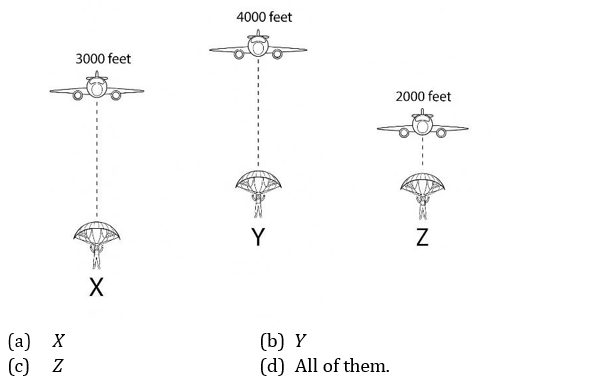
Check: Numerical reasoning questions for NATA
NATA 2026 Syllabus - Drawing
As per last year NATA 2026 syllabus, the NATA exam did not had a drawing test. Though it is essential to understand the NATA drawing syllabus for NATA 2026, we have summarized the important aspects of the NATA Drawing Syllabus 2026.
- Conceptualization and Visualization through structuring objects in memory.
- Understanding of scale and proportion of objects, geometric composition, shape, building forms and elements, aesthetics, colour texture, harmony, and contrary. Drawing of patterns - both geometrical and abstract.
- Form transformations in 2D and 3D like union, subtraction, rotation, surfaces, and volumes.
- Generating plan, elevation, and 3D views of objects. Creating 2D and 3D compositions using given shapes and forms. Perspective drawing, Sketching of urbanscape and landscape, Common day-to-day life objects like furniture, equipment, etc., from memory.
Join CreativEdges NATA Coaching Institutes in India
| NATA Coaching in Indore | NATA Coaching in Andheri | NATA Coaching in Mumbai |
| NATA Coaching in Agra | NATA Coaching in Lucknow | NATA Coaching in Kolkata |
NATA 2026 Drawing Syllabus - Core Topics
|
Skill Area |
Focus Areas |
|
Perspective Drawing |
One-point and two-point perspective |
|
Composition |
Balance, proportion, spatial planning |
|
Sketching |
Freehand drawing, line quality |
|
Visual Imagination |
Creative scene generation |
|
Memory Drawing |
Observation-based drawing |
This is critical for students preparing the drawing section.
NATA 2026 Syllabus - Sample Questions for Drawing
Q.1. Imagine you are riding a cruiser bike, the scene that you see.
Q.2. You are given five bricks, four circular wooden logs, and six balls. Make an interesting stable composition using these elements and show light and shadow in the design.
Q.3. You have been provided with a piece of coloured paper in the shape of red triangles, blue circles, and yellow squares. Make a composition in the given space using a maximum of five pieces.
Check: NATA Exam Analysis
NATA Drawing vs Aptitude – Syllabus Comparison
|
Parameter |
Drawing Section |
Aptitude + Maths Section |
|
Nature of Questions |
Subjective drawing tasks |
Objective aptitude questions |
|
Skills Required |
Creativity, imagination |
Logic, calculation |
|
Preparation Style |
Daily sketching practice |
Problem-solving drills |
|
Evaluation |
Visual and conceptual |
Accuracy-based |
Check: List of NATA Government colleges in india
Best Books for NATA 2026 Preparation
According to the expert, referring to the right books and thoroughly studying the NATA architecture syllabus will help you understand the concepts in-depth and perform well in the upcoming exam.
See the table below for the best preparation books for NATA 2026.
| Book Name | Author Name |
| A Complete Self-Study Guide for B.Arch Entrance Examination 2024/25 | PK Mishra |
| NATA (B.Arch) Guide to Bachelor of Architecture Entrance Examination B.Arch Entrance Examination Guide | Surendra Kavimandan |
| NATA & B.Arch Question Bank | AR. Shadan Usmani |
| NATA & B.Arch complete self-study material: entrance examination | AR. Shadan Usmani |
NATA Exam Syllabus - Use CreativEdge Free Resources 2026 Strategically to Prepare
| NATA Mock Test | |
| NATA Preparation Video 2026 | |
| NATA Books 2026 | |
| NATA PYQs |
Conclusion
In conclusion, NATA 2026 syllabus preparation requires hard work and dedication. Knowing the NATA syllabus, its components, and the important topics and chapters are important. Setting a timeline and allocating enough time to each topic are also important.
Additionally, practising as much as possible and using the right resources is important. With proper preparation and dedication, one can easily ace the NATA exam.
Preparing for NATA 2026? We can help you with exact strategic roadmap, study material and crucial feedback required to ace this exam.
Join CreativEdge, India’s leading NATA online coaching and get expert guidance on all NATA 2026 subjects.


Attempt a Free NATA Mock Test
Fill your details
Frequently Asked Questions
Who prescribes NATA Syllabus 2026?

What are the important topics that need to be prepared under NATA Exam Syllabus for physics?
What are the best books for preparation of NATA 2026 Exam Syllabus?
Is chemistry included in NATA Syllabus 2026?
What are the important topics that need to be prepared under General aptitude section of NATA Syllabus?
What is nata exam syllabus?

Vineeta Agrawal
Communications Executive


SHARE