
1723534562.png)

NATA Exam Pattern 2026: Marking scheme, Topic-Wise Weightage, Marks, Number of Questions
March 27, 2026
What is NATA Exam Pattern 2026?
Quick Answer: The NATA exam pattern 2026 consists of two parts - a Drawing and Composition Test and a computer-based aptitude test. The exam carries a total of 200 marks and is conducted in a hybrid format with offline drawing tasks and online MCQ and NCQ adaptive questions designed to assess creativity, spatial visualization, and architectural aptitude.
The Council of Architecture will publish the NATA 2026 exam pattern for NATA 2026 in the official notification on the official website by around February 2026. The NATA exam paper pattern depicts the structure of the question paper, number of questions, total marks, marking scheme, etc., and forms an important part of the NATA 2026 exam analysis, helping aspirants understand the exam format and prepare effectively.
NATA Exam Pattern 2026 - Key Highlights
- Hybrid exam format: Offline Drawing and Composition Test + Computer-based Aptitude Test.
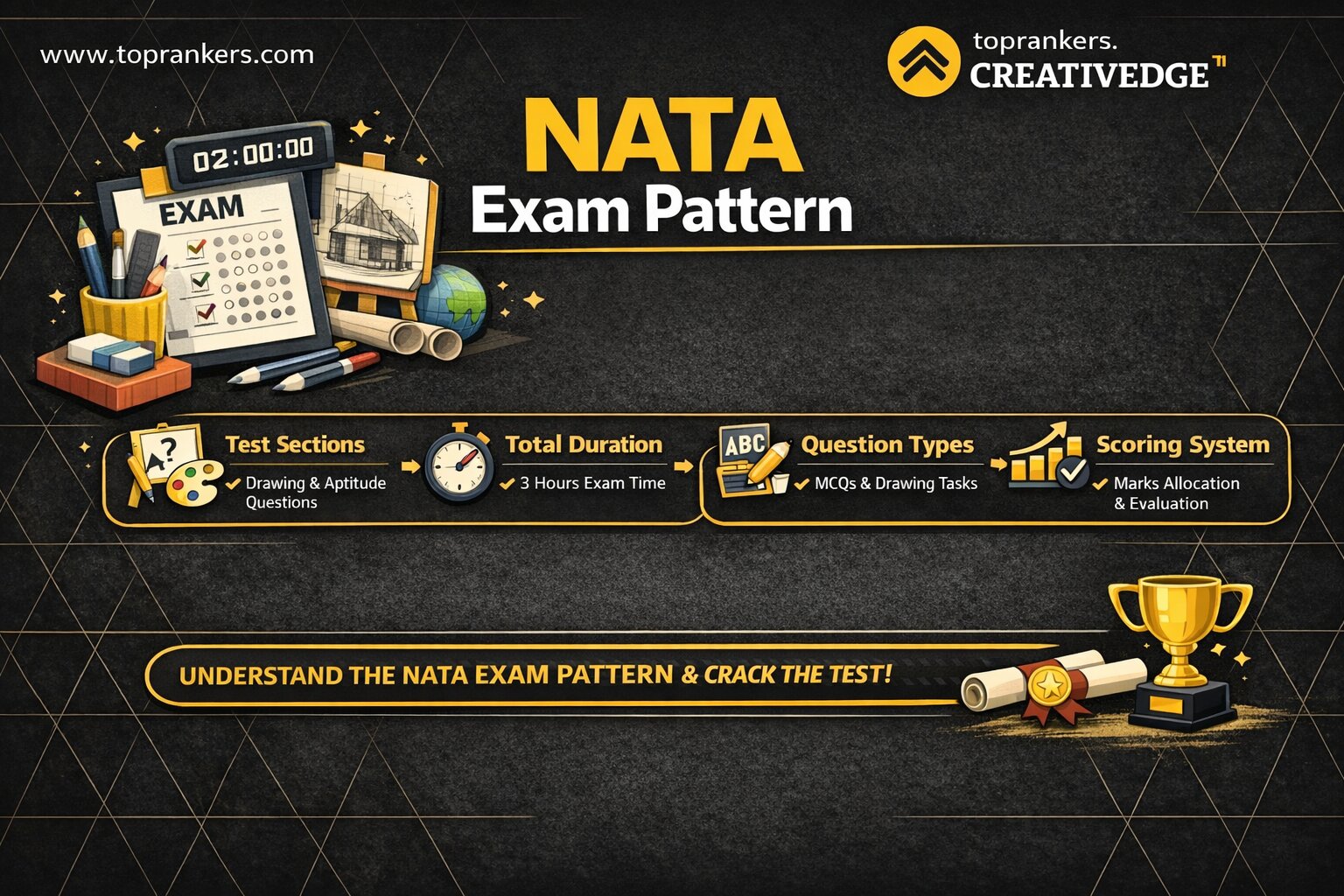
- Total marks: 200 marks (Part A Drawing - 80 marks, Part B Aptitude - 120 marks).
- Total duration: 180 minutes, with 90 minutes for each part.
- The computer based section will have a timer. Candidates will get a maximum 108 seconds to solve each Part B question (introduced first time in 2025).
- Drawing section tests creativity, spatial visualization, composition skills.
- One 3D modelling question in Part A (introduced in 2025).
- NATA Aptitude section includes logical reasoning, visual reasoning, language interpretation, numerical ability, and architectural awareness.
- Conducted by the Council of Architecture (COA) as per official structure on nata.in
- No negative marking expected in the NATA exam pattern.
- Understanding the NATA 2026 exam pattern helps candidates plan time allocation and focus on high-weightage scoring areas.
In 2025, the NATA paper pattern was revised, and the NATA entrance exam was conducted in both computer-based and offline mode and a timer was introduced in the aptitude section. Let's dive into the post to know the detailed NATA Exam pattern for the NATA Entrance Exam 2026.
Latest Update on NATA 2026:
- Registrations OFFICIALLY Began - March 9, 2026
- Schedule of NATA 2026 Exam - April 4 to June 13, 2026 (Every Friday & Saturday, except national holidays)
Table of Contents
NATA 2026 Exam Pattern Overview
According to the latest official exam structure, the NATA 2026 exam carries a total of 200 marks and is conducted in a hybrid format that includes both offline drawing tasks and a computer-based aptitude test.
The NATA exam pattern is officially designed and regulated by the Council of Architecture (COA), which is the governing authority responsible for architecture education and entrance testing in India.
The NATA 2026 exam pattern described on this page follows the latest structure outlined in the official NATA brochure published on the official portal, nata.in. Candidates are always advised to refer to the official notification and brochure released by COA for the most accurate and updated exam pattern details.
|
Feature |
Details |
|
Exam Name |
National Aptitude Test in Architecture (NATA) |
|
Total Marks |
200 Marks |
|
Total Duration |
180 Minutes (3 Hours) |
|
Exam Mode |
Hybrid – Offline Drawing + Computer-Based Test |
|
Sections |
Drawing and Composition Test, Aptitude Test (MCQ+NCQ) |
|
Conducting Body |
|
|
Negative Marking |
No negative marking expected |
How many questions are in NATA?
As per NATA paper pattern, the exam includes a combination of drawing tasks and aptitude-based objective questions. Part A contains drawing and composition tasks, while Part B includes multiple-choice and adaptive NCQ questions covering logical reasoning, visual analysis, language interpretation, and numerical ability. The exact number of objective questions may vary due to the adaptive test format.
Is NATA online or offline?
NATA follows a hybrid exam pattern. The drawing and composition section is conducted offline using pen-and-paper format, while the aptitude section is conducted as a computer-based test with MCQ and NCQ questions.
What is the Marking Scheme in NATA 2026 Exam Pattern?
The test duration is expected to be three hours, carrying a total of 200 marks. Questions will vary in marks depending on their complexity. This structure ensures a holistic assessment of creativity, critical thinking, and problem-solving skills essential for pursuing architecture.
Check the table explaining the National Aptitude Test in Architecture 2026.
|
Section |
Type of Questions |
Number of Questions |
Marks |
Mode |
Duration |
|
Part-A |
A1 – Composition & Color |
1 |
25 |
Offline |
90 Minutes |
|
A2 – Sketching & Composition (Black & White) |
1 |
25 |
|||
|
A3 – 3D Composition |
1 |
30 |
|||
|
Total Part-A |
3 Questions |
80 Marks |
|||
|
Part-B |
B1 – MCQ |
42 |
120 |
Computer-based Adaptive Test |
90 Minutes (108 Seconds for each question) |
|
B2 – NCQ |
08 |
||||
|
Total Part-B |
50 Questions |
120 marks |
Which Means:
"The question paper will have a total of 53 questions for 200 marks. As per the NATA Exam Pattern, no marks will be deducted for wrongly answered questions."
- The question paper will have multiple-choice questions (MCQs) and numerical answer type questions (NAQs).
- There will be a total of 53 questions for 200 marks.
- There will be no negative marking in NATA 2026.
- The exam is conducted in both Hindi & English language.
NATA 2026 Section Wise Weightage Distribution
|
Section |
Question Format |
Weightage in Total Marks |
Evaluation Method |
|
Drawing and Composition |
Sketching, composition, spatial visualization |
40% |
Subjective evaluation |
|
Aptitude MCQ |
Logical reasoning, visual reasoning, architecture awareness |
Part of 60% |
Objective scoring |
|
Adaptive NCQ |
Cognitive skills, visual analysis |
Part of 60% |
Computer-based evaluation |
Types of Questions Asked in NATA Exam Pattern
|
Question Type |
What It Tests |
Preparation Focus |
|
Drawing and Composition Tasks |
Creativity, visualization, design sensitivity |
Practice perspective, composition, shading |
|
MCQ Questions |
Analytical reasoning and observation |
Improve accuracy and speed |
|
NCQ Adaptive Questions |
Cognitive ability and spatial logic |
Practice visual analysis and problem-solving |
Check: Short tricks to crack the NATA exam on the first attempt


NATA 2026 Exam Pattern - Final Score Validity
Those candidates who have already appeared for NATA 2025, gave one, two, or three attempts and obtained a valid NATA scorecard, may also apply for NATA 2026. However, if they wish to avail their scores in the three attempts of NATA 2025, their 2026 scores will be frozen.
Their NATA 2026 score shall be calculated/determined as under, depending upon number of attempts:
|
Appeared in NATA 2025 |
Attempts in NATA 2026 |
Final Score |
|
Obtained a valid 2025 score |
1st Attempt |
Better of both scores of NATA 2025 & 2026 |
|
1st & 2nd Attempt |
Best of three scores of NATA 2025 & 2026 |
|
|
1st, 2nd & 3rd Attempt |
Best of three scores of NATA 2026 (NATA 2025 score shall be rendered invalid) |
Join CreativEdges NATA Coaching Institutes in India
| NATA Coaching in Indore | NATA Coaching in Andheri | NATA Coaching in Mumbai |
| NATA Coaching in Agra | NATA Coaching in Lucknow | NATA Coaching in Kolkata |
NATA 2026 Exam Pattern 2026 - Complete Syllabus Breakdown
In the NATA aptitude test, you will be assessed on your general knowledge, mathematics, and drawing. As per the NATA exam pattern and syllabus, you will be tested on the following topics. As per the previous year NATA question paper, Syllabus for NATA 2026 is provided below:
NATA Part- A Syllabus: Drawing and Composition Test
|
Part-A sections |
Content |
|
A1 - Composition and Color |
Creating suitable compositions for various situations and coloring them. Re-arranging various shapes in a visually appealing manner and coloring it suitably. |
|
A2 - Sketching and Composition (Black & White) |
Ability to draw, visualize, depict a situation, involving buildings/its components, people, environment, products with an understanding of scale, properties, textures, shades, shadows, etc. |
|
A3 - 3D Composition |
Creating interesting 3D compositions for the given situation using the provided kit. |
Check: Expected NATA 2026 Cut Off
NATA PART B Syllabus: General Aptitude
|
Part-B sections |
Content |
|
Visual Reasoning |
Ability to understand and reconstruct 2D and 3D composition, knowledge about its composition and technical concepts |
|
Logical Derivation |
Ability to decode a situation, composition, context, and generate meaning. Understanding the minute information hidden in a particular situation and drawing conclusions. |
|
G.K., Architecture & Design |
General awareness of architecture and design, current trends, and recent issues. Knowledge about important buildings, historical progressions, and innovation in materials and construction technology. |
|
Language Interpretation |
Ability to correctly and logically generate the meaning of words and sentences, understanding of English grammar. |
|
Design Sensitivity and Thinking |
Ability to observe, record, and analyze people, space, products, and the environment. Critical thinking, reasoning, and the ability to identify the subtle communications. Ability to understand semantics, metaphors, problem identification and definition, and analysis of a given situation. |
|
Numerical Ability |
Basic Mathematics and its association with creative thinking. To unfold a space with use of geometry. |
Check: NATA Previous Year Question Papers
NATA Exam Pattern 2026 - Tie-breaking Procedure
If you and other students have scored the same marks in NATA Entrance Exam 2026, then the board will decide on whom to consider for admission based on the below-mentioned criteria:
- Authorities will consider the highest marks in mathematics.
- The exam conducting body will consider the one with fewer wrong answers in the mathematics section.
- If the tie still exists, the highest marks in the Aptitude Test will be considered.
- The one with fewer wrong answers in the Aptitude Test will be considered.
- Those who have an earlier date of birth will be given first preference.
NATA 2026 Exam Pattern vs Previous Years - Official Pattern Comparison
NATA is a computer-based adaptive test, and its structure has evolved every year over the last three cycles. However, based on recent stabilization, experts predict that the NATA 2026 exam pattern is expected to remain similar to 2025, maintaining 3 drawing questions (80 marks) and 50 aptitude questions (120 marks).
One of the most important updates introduced in the recent structure is the inclusion of a 3D modelling and composition component within the Part A drawing section, which evaluates spatial visualization and practical creativity.
Comparing the NATA 2026 exam pattern with the official 2025 and 2024 structures helps aspirants understand how drawing weightage, question types, and evaluation methods have evolved.
NATA Exam Pattern Comparison (2026 vs 2025 vs 2024)
|
Feature |
NATA 2026 Exam Pattern (Expected) |
NATA 2025 Exam Pattern |
NATA 2024 Exam Pattern |
2023 Pattern |
|
Total Marks |
200 Marks |
200 Marks |
200 Marks |
200 marks |
|
Total Duration |
180 Minutes (3 Hours) |
180 Minutes: 90 minutes - Drawing 90 minutes - Aptitude (108 seconds/question) |
180 Minutes: 90 minutes - Drawing 90 minutes - Aptitude |
180 Minutes - Aptitude Only |
|
Part A - Drawing Section |
Drawing, composition, 3D modelling and visualization tasks |
NATA Drawing and Composition Test with 3D modelling component introduced |
Drawing-focused evaluation with composition and visualization |
- |
| Part A Number of Questions | 3 (25 marks, 25 marks, 30 marks) | 3 (25 marks, 25 marks, 30 marks) | 3 (25 marks, 25 marks, 30 marks) | - |
|
Part A Weightage |
80 Marks |
80 Marks |
80 Marks |
- |
|
Part B - Aptitude Section |
MCQ + NCQ adaptive aptitude test |
MCQ + NCQ adaptive test |
MCQ ONLY aptitude format |
|
| Part B Number of Questions | 50 questions (42 MCQ, 8 NCQ) | 50 questions (42 MCQ, 8 NCQ) | 45 questions (30 questions of 2 marks & 15 questions of 4 marks) | 125 (1 mark, 2 marks or 3 marks questions) |
|
Part B Weightage |
120 Marks |
120 Marks |
120 Marks [B1 – 30 Questions of 2 Marks and B2 – 15 Questions of 4 Marks] |
200 marks |
|
Exam Mode |
Hybrid (Offline Drawing + CBT Aptitude) |
Hybrid Mode |
Hybrid Mode |
Computer Based Test |
|
Evaluation Style |
Subjective drawing + adaptive objective scoring |
Same evaluation method continued |
Minimum marks in Part A - 20 Min. marks in |
Number of tests 2 - best of 2 Number of tests 3 - Average of 2 best scores |
Check: How to prepare for NATA in 1 Month
Evolution of Part A Drawing Section (Key Change)
|
Year |
Major Drawing Component Focus |
Preparation Impact |
|
NATA 2024 |
Composition, perspective, visualization |
Focus on sketching clarity and spatial imagination |
|
NATA 2025 |
Addition of 3D modelling and practical design evaluation |
Increased emphasis on spatial construction and real-world architectural thinking |
|
NATA 2026 (Expected) |
Continuation of 3D modelling with composition tasks |
Candidates should practice object construction, depth, and structural visualization |
The addition of the 3D modelling component reflects a shift toward assessing practical architectural skills instead of only observational drawing.
Read more: Best Architecture Colleges in India
Question Format Evolution in NATA
|
Change Area |
What Has Changed |
Preparation Implication |
|
Adaptive NCQ Questions |
Introduced to test cognitive ability |
Focus on analytical thinking |
|
Hybrid Exam Mode |
Offline drawing + CBT aptitude |
Practice both digital and manual skills |
|
Balanced Evaluation |
Creativity + reasoning combined |
Maintain equal preparation for both sections |
Key NATA Exam Pattern Trends Leading into NATA 2026
- The exam continues to maintain a balanced evaluation between creative drawing and aptitude reasoning.
- Adaptive NCQ questions remain a major shift, testing analytical thinking rather than rote memorisation.
- Drawing weightage is stable at 80 marks, confirming its continued importance for architecture aspirants.
- The hybrid mode reinforces the need for both manual sketching practice and digital aptitude preparation.
Check: Best study timetable for the NATA exam
Is NATA Exam Easy to Crack on the First Attempt?
Since NATA is considered one of India's toughest architecture entrance exams, most of you might wonder how to crack the exam on the first attempt. If you are proficient in free-hand sketching and aptitude testing, you can easily get accepted into one of the best institutions.
Understanding the NATA exam pattern, which includes sections on mathematics, general aptitude, and drawing, will further help you focus your preparation and excel in the exam.
As per experts, the NATA exam question paper pattern can be tricky so students should try to solve as many NATA aptitude questions as possible to enhance their aptitude skills.
According to the NATA 2026 exam pattern, there will be questions only based on general aptitude, and the NATA entrance exam will have no negative marking.
Hence, it is a good opportunity for all of you to attempt the maximum number of questions, as there is no negative marking.
Use CreativEdge Free NATA Study Material Resources for 2026 Strategically
| NATA Mock Test | |
| NATA Preparation Video 2026 | |
| NATA Syllaus 2026 | |
| NATA PYQs |
Check: Best books for NATA Preparation
Conclusion
In conclusion, the NATA 2026 exam pattern is one of architecture students' most comprehensive entrance exams. It provides a fair and equal opportunity for students to showcase their skills and aptitude for architecture.
The NATA exam pattern pdf is designed to test the student’s overall knowledge, which includes knowledge in mathematics, drawing, and general aptitude. With the right preparation and dedication, the NATA exam pattern for 2026 can be a great stepping stone for aspiring architects.
Preparing for NATA 2026? We can help you with exact strategic roadmap, study material and crucial feedback required to ace this exam.
Join CreativEdge, India’s leading NATA online coaching and get expert guidance on all NATA 2026 subjects.


Frequently Asked Questions
What number of questions will come from each of the sections?

What is the total marks allotted to each section?
What is the Mode of Exam for each of the section?
What is the NATA Exam Paper Pattern for Drawing Section?
How many questions will be asked in NATA 2026 drawing test?
can I use measuring instruments in drawing test of NATA 2026?
Is there negative marking in NATA 2025 exam?
Is there negative marking in NATA 2026 exam?
Is the exam pattern the same for NATA phase 1 and NATA phase 2?
Does NATA 2026 have negative marking for unattempted questions?
Is calculator allowed in NATA 2026 Exam?

Vineeta Agrawal
Communications Executive


SHARE