
1723534562.png)

NIFT GAT Syllabus – Section-Wise Topics for B.Des, B.FTech, M.Des + PDF
August 23, 2026
The NIFT GAT syllabus cover 4 major sections - English Comprehension, Quantitative Ability, Analytical & Logical Reasoning, and GK & Current Affairs.
The GAT paper is the aptitude part of the NIFT entrance exam, conducted as a 120 mins computer-based test with +1 marks for each correct and -0.25 marks for each wrong answer.
B.F.Tech and combined B.F.Tech + B.Des candidates additionally attempt Section B (60 minutes), which replaces GK with a 20 question Case Study section.
Total number of questions in the GAT paper and GAT ‘s contribution in the final merit differs based on the program you are applying for (B.Des, B.FTech, M.Des, M.FTech, MFM).
If you're targeting NIFT 2027 or 2028, here's the full syllabus for NIFT's General Ability Test, broken down as per NIFT's own official brochure.
Key Highlights- NIFT GAT Syllabus 2027
- GAT is Computer Based (CBT); CAT is Paper Based (PBT) - they're conducted on the same day, GAT in the morning, CAT in the afternoon
- Negative marking applies: -0.25 per wrong answer, +1 per correct answer
- B.F.Tech candidates attempt an additional Section B with a Case Study component that B.Des-only candidates don't see
- For B.Des, GAT is only 30% of your final merit - CAT (50%) matters more, even though GAT often gets more prep attention
- PG programs (M.Des, MFM, M.F.Tech) have different section structures and durations than UG
What Sections Make Up the NIFT GAT Syllabus?
For B.Des candidates, GAT Section A runs 120 minutes and has 100 questions split across four sections. Here's the exact structure:
|
Section |
Questions |
What It Broadly Tests |
|
Communication Ability & English Comprehension |
40 |
Language and comprehension skills |
|
20 |
Basic numerical and arithmetic ability |
|
|
15 |
Reasoning and problem-solving |
|
|
25 |
Awareness of current events and general facts |
|
|
Total |
100 |
120 minutes |
What Topics Are Inside NIFT GAT Quantitative Ability?
This is not just ‘basic math’. NIFT's sub-test description names the exact areas- Addition, Multiplication, Division, Fractions, Percentage, Rate of Interest, Work and Task, Ratio and Proportion, and Distance.
You can observe that this is arithmetic-heavy and doesn't extend into higher-level algebra or geometry, which means while practicing you should focus more on speed and accuracy in these fundamental areas only, rather than aiming for broad syllabus coverage.
What Does NIFT GAT Communication Ability & English Comprehension Cover?
This section evaluates day-to-day language ability, covering synonyms, antonyms, singular/plural forms, one-word substitutes, idioms and phrases, correct spellings, and comprehending a situation from a given passage.
It's the largest section in terms of number of questions (40 of 100), so vocabulary-building and passage-reading speed should proportionally be given more of your daily practice time.
What Does NIFT GAT Analytical & Logical Ability Test?
This section evaluates your capacity to identify the given problem and apply reasoning to solve it along with the ability for inference and derivation of logic from the information given. Basically, this section rewards problem-solving over memorized formulas.
Question types usually include problems on direction sense, blood relations, visualization, mirror/water images, coding/decoding, pattern recognition, etc.
What's Included in NIFT GAT General Knowledge & Current Affairs?
This sub-test is designed to test general knowledge and current affairs awareness. Since NIFT doesn't publish specific themes, the safest strategy is broad daily current-affairs (national news, major appointments, awards, government schemes) rather than narrowly preparing static GK.
Questions from themes like – painter/paintings, fabric/material science, writer/novels, colors, fashion initiatives, fashion current affairs, embroidery/craft, Indian art/culture, and static GK from geography/ civics can be seen in previous year NIFT papers.
How Is NIFT GAT Syllabus Different for B.F.Tech Candidates?
If you're applying only for B.F.Tech, or for both B.F.Tech and B.Des, your GAT structure changes significantly:
|
Component |
B.Des Only |
B.F.Tech Only |
B.F.Tech + B.Des |
|
Section A duration |
120 min |
120 min |
120 min |
|
Section A content |
Comm. (40), Quant (20), Analytical (15), GK (25) |
Same as B.Des |
Same as B.Des |
|
Section B |
Not applicable |
60 min |
60 min |
|
Section B content |
— |
Quant (15), Analytical (15), Case Study (20) |
Quant (15), Analytical (15), Case Study (20) |
|
Also attempts CAT |
No |
No |
Yes |
The Section B case study component is unqiue to B.FTech and doesn't appear anywhere in the B.Des-only structure. If you're a B.F.Tech aspirant, this is one topic you cannot skip during your NIFT exam preparation.
How Does NIFT GAT Differ for M.Des, MFM, and M.F.Tech Candidates?
Postgraduate GAT structures diverge further from the UG pattern:
|
Program |
GAT Duration |
Sections |
Also Attempts CAT? |
|
M.Des |
120 min |
Comm. (50), Quant (20), Analytical (25), GK (25) |
Yes |
|
MFM |
180 min |
Section A (Comm. 50, Quant 20, Analytical 25, GK 25) + Section B Case Study (30) |
No |
|
M.F.Tech |
180 min |
Comm. (45), Case Study (25), Quant (30), Analytical (25), GK (25) - plus engineering-field questions |
No |
What Is the Weightage of GAT in the Final NIFT Merit List?
This is the part most students misjudge. GAT is often over-prepared relative to its actual weight in your final rank:
|
Program |
GAT Weightage |
CAT Weightage |
Other |
|
B.Des |
30% |
50% |
Situation Test 20% |
|
B.F.Tech |
100% (Section A + B combined) |
- |
- |
|
M.Des |
30% |
40% |
|
|
MFM |
70% |
- |
Personal Interview 30% |
|
M.F.Tech |
70% |
- |
Personal Interview 30% |
For B.Des aspirants specifically- CAT outweighs GAT by 20 percentage points in your final merit. This doesn't mean that you should not prioritize GAT. You must clear both to even reach the Situation Test.
Sample Questions from NIFT GAT Syllabus
Q) Fill in the blank in the given sentence using the most appropriate modal from the options given below. "It's going to be grander than the Great Gatsby's Party. Oh, I insist, you _________ come."
(a) Would (b) might (c) must (d) need
Ans: C
Q) Choose the option which correctly translates the given sentence from Hindi to English: पिता की सम्िपि उनकी मृत्यु से िहले उनके बच्चों के बीच समान रुि से पिभाजित की गई।
(a) The father's property was divided equally among his children before his death.
(b) Brother and sister got equal rights to the father's property.
(c) The siblings equally divided their father's property.
(d) The father's property is yet to be divided awaiting his death.
Ans: A
Q) Convert the following sentence from Indirect Speech to Direct Speech by choosing the correct option. She ordered me to go and shut the door.
(a) "Let the door be shut", she ordered. (b) She said, "Please go shut the door". (c) "Go and shut the door," she said. (d) She shouted, "Go shut the door".
Ans: C
Q) Fill in the blank by choosing the correct idiom from the options given below: There is a kind of ___________in the fact that the country responsible for the worst ecological disaster of this century is the one suffering the most from its effects.
(a) politically correct (b) point blank (c) poetic justice (d) poetic license
Ans: C
Q) Preeti invested in a startup of kids ethnic-wear. The cost of making an ethnic-wear depends on three items - fabric, tailoring and designing. The cost of these items are in the ratio 5 : 3 : 1 respectively. If the cost of tailoring for each piece is Rs.150 , find the cost of single piece of ethnic-wear?
(a) Rs.600 (b) Rs.750 (c) Rs.450 (d) Rs.900
Ans: C
Q) Geeta and Rahul are working in a boutique. Their combined monthly salary amounts to Rs.30,000 . Geeta spends 80% of her salary and Rahul spends 70% of his salary. If their savings are equal in amount, what is the salary of Geeta?
(a) Rs.18,000 (b) Rs.24,000 (c) Rs.12,000 (d) Rs.15,000
Ans: A
Q) Choose the figure from the options which is embedded in the pattern given below:
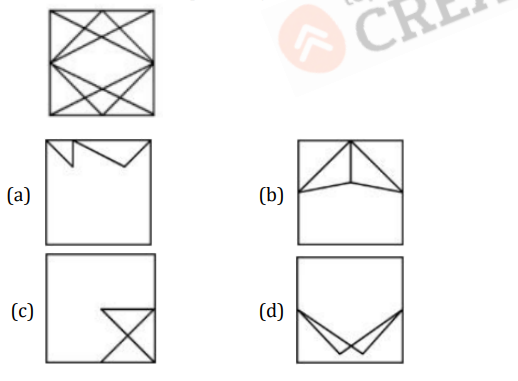
Ans: D
Q) Identify the next figure in the following series out of the given alternatives,which will continue the figure series:
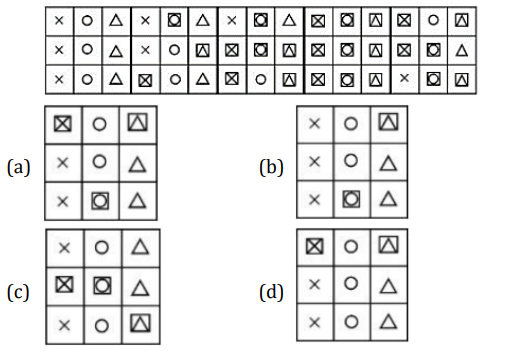
Ans: A
Q) The Governor of a State is appointed by the _________ .
(a) Vice President (b) Chief Minister (c) Chief Justice (d) President
Ans: D
Q) Which one is a protein fibre among the belowmentioned fibres?
(a) Rayon (b) Jute (c) Cotton (d) Silk
Ans: D
Q) Who is the author of the novel "The Color Purple"?
(a) Langston Hughes (b) Alice Walker (c) Emily Bronte (d) Philip K. Dick
Ans: B
How Should You Split Your Time Across NIFT GAT Sections?
With 120 minutes for 100 questions (roughly 72 seconds per question), and sections of very different question counts, a proportional time split works better than dividing time evenly by section:
|
Section |
Suggested Time (of 120 min) |
Reasoning |
|
Communication Ability & English |
40-42 min |
Largest section; many questions (vocabulary, spellings) can be answered in seconds if prepared |
|
General Knowledge & Current Affairs |
20-22 min |
Fast if prepared, but guessing wastes negative-marking risk |
|
Quantitative Ability |
30-32 min |
Fewer questions but each takes longer to calculate |
|
Analytical & Logical Ability |
25-28 min |
Reasoning questions typically take longest per question |
How Should You Balance Time Between NIFT GAT and CAT Preparation?
The time you allocate to each GAT and CAT depends on factors like individual strength/weakness, score gaps, and most importantly the weightage of each based on the program you are applying for.
For B.Des candidates, since CAT carries 50% weightage in the final merit list against GAT's 30%, the weekly prep time should lean towards CAT. But that does not mean that GAT is less important. Remember, clearing both is mandatory just to reach the Situation Test.
A practical split that works for most students who prepare themselves, is roughly 55% of study time on CAT (sketching, ideation, color practice) and 45% on GAT, adjusted based on personal practice requirements.
On the day of NIFT exam itself, these two are separate papers, not conducted back-to-back. GAT usually happens from 10:00 AM to 12:00 noon and CAT runs 3:00 PM to 6:00 PM. So the real challenge isn't switching between them in the middle of the test, but it's sustaining focus across a full day.
This is where mock practice comes in. A full-length GAT mock in the morning, a break, then a timed, full-length CAT mock in the afternoon- this will help build the stamina that a single-session mock won't.
What Are the Most Repeated Question Patterns in NIFT GAT?
Across past papers, a few patterns show up consistently enough to prioritize:
1. Percentage and ratio-based word problems
The quantitative ability section is dominated by quick questions on percentage, ratio, time/work, speed/distance/time, etc. rather than calculation-heavy or complicated higher Math problems.
2. One-word substitutes and idioms
This appear almost every year in the Communication ability section, often helping you score the fastest marks if prepared well.
3. Odd-one-out and series-completion reasoning
These are the most frequently asked question types in Analytical & Logical formats.
4. Recent government schemes and appointments
These topics are far more commonly tested in GK than historical static facts.
Common Mistakes Students Make While Preparing for NIFT GAT Syllabus
1. Ignoring negative marking discipline
Attempting every question regardless of how sure you are about it will costs more than it gains at -0.25 per wrong answer negative marking.
2. Treating GK as unpreparable and skipping it entirely
GK can become your scoring edge in the NIFT GAT exam. Unlike sections like quant that require calculations or logical reasoning, General Knowledge is actually fact-based. With consistent reading and regular revision, you can secure easy marks and even compensate for relatively weaker performance in other sections.
3. Over-indexing on Quant, under-indexing on English
English carries the most number of questions (40) yet gets the least dedicated practice time from most self-preparing candidates.
4. Not practicing on a computer-based mock
Since GAT is CBT, students who only practice aptitude questions on paper might feel unprepared for on-screen timing and navigation.
Understanding the difference between CAT and GAT in NIFT can help you prioritize your preparation and avoid common mistakes.
How to Prepare for NIFT GAT Syllabus in 6 Months: A Month-Wise Plan
|
Timeline |
Focus |
|
Months 1-2 |
Build fundamentals - vocabulary lists, basic arithmetic speed, daily current-affairs reading habit |
|
Months 3-4 |
Section-wise timed practice sets, especially Quant and Analytical & Logical |
|
Month 5 |
Full-length CBT mocks under 120 minute timer, also review negative-marking impact on score |
|
Month 6 (final) |
Revise high-frequency GK topics, redo weak-area question sets, light daily practice only |
Get a free NIFT GAT mock test with instant CBT-style scoring.
Which Books Cover the NIFT GAT Syllabus Best?
|
Book |
Best For |
|
NIFT Previous Year Papers Book (Fully Solved) by Creative Edge |
Has QR-based video solution for drawing questions and step-by-step solutions for aptitude questions |
|
NIFT Sample Papers Book (Latest NIFT Exam Pattern) by Creative Edge |
Huge exam-like question bank for intense practice |
|
General aptitude/quant books for management entrance exams like R.S. Agarwal |
Percentage, ratio, and work-time problem practice |
|
Any current affairs monthly digest |
To keep updated with NIFT type general awareness questions |
|
Any verbal and non-verbal reasoning guide |
Analytical & Logical Ability |
Can the NIFT GAT Syllabus Change for 2027?
The four core sections and their sub-topics have broadly remained same across recent years, and NIFT's official guidelines describe these as standard components of the NIFT exam syllabus.
What can vary year to year is the exact number of questions per section (NIFT itself notes that this may change), so treat the question counts above as the latest confirmed structure rather than a permanently fixed number, and revisit closer to your admit card release.
Conclusion: Your Next Steps for NIFT GAT Syllabus Preparation
The NIFT GAT syllabus pdf download most students look for exists because NIFT unlike other design exams like NID, actually list exact sections and important topics for the exam.
You don't need to guess what will be tested, you just need to understand the right proportion of weightage each section carries and curate a study plan accordingly.
For example - English has the most questions, Quant takes the most time per question, and GK is often the most under-prepared despite being fastest to score.
Here's how to move from reading this to preparing:
1. Download the NIFT GAT syllabus PDF with the section-wise topic list and past-year question bank.
2. Confirm your exact GAT structure based on your program (B.Des, B.F.Tech, or PG) using the tables above - don't prepare a generic structure.
3. Start a daily English and current-affairs habit now - these compound fastest and are the most neglected by self-preparers.
4. Practice under CBT mock conditions, not paper, so exam-day timing and navigation aren't a surprise.
5. Track your negative-marking impact in every mock - if wrong answers are costing you more than skipped questions, adjust your attempt strategy before the real exam.
Preparing for NIFT 2027? We can help you with exact strategic roadmap, study material and crucial feedback required to ace NIFT exam.
Join the best NIFT Online Coaching by Creative Edge and get expert guidance on all subjects.


1764684691.webp)
Attempt a Free NIFT Mock Test
Fill your details
Frequently Asked Questions
Is NIFT GAT syllabus the same for B.Des and B.F.Tech?

How many questions are asked in NIFT GAT for B.Des?
Is there negative marking in NIFT GAT syllabus topics?
Which NIFT GAT section carries the most questions?
Does GAT or CAT matter more for NIFT B.Des admission?
Is NIFT GAT syllabus different for M.Des and MFM candidates?

Vineeta Agrawal
Communications Executive


SHARE