


How to Prepare for NIFT Entrance Exam 2027: Complete Preparation Plan + Section-Wise Tips
November 6, 2026
To prepare for the NIFT entrance exam (now conducted by the NTA), you need to master two written stages - the GAT (General Ability Test - quant, reasoning, English, GK and current affairs) and the CAT (Creative Ability Test - sketching, idea generation and visualization) - plus a Situation Test (B.Des, model-making) or Personal Interview (PG programs).
Marks are weighted, not flat - for B.Des it's GAT 30% + CAT 50% + Situation Test 20%. A realistic plan is 6 months to 1 year - build GAT concepts and daily sketching early, add timed mocks mid-way, and finish with full-length practice.
NIFT 2027 Stage 1 is on 10 January 2027.
Key Highlights: NIFT 2027 Entrance Exam Preparation
- NIFT exam is conducted by the NTA - two written stages (GAT + CAT) + a Situation Test (B.Des) or PI (PG).
- Weightage, not flat marks - B.Des = GAT 30% / CAT 50% / Situation 20%; M.Des = GAT 30% / CAT 40% / PI 30%.
- Negative marking in GAT only - +1 correct, −0.25 wrong; CAT/Situation/PI are parameter-based.
- Start with understanding syllabus and exam pattern before preparation
- Follow a structured study plan: basics → practice → revision → mocks
- Daily sketching is non-negotiable for CAT; timed mocks are what fix GAT speed.
- Realistic prep window: 6 months - 1 year; under 6 months is possible but intense.
- Use high-quality study material aligned with syllabus and exam trends
- Focus on time management and consistency for better performance
- NIFT 2027 Stage 1 - 10 January 2027 (applications close ~16 Nov 2026).
Understanding the NIFT Entrance Exam
The NIFT entrance exam is conducted by the National Testing Agency (NTA) on behalf of the National Institute of Fashion Technology (NIFT), for admission to undergraduate (B.Des, B.FTech) and postgraduate (M.Des, MFM, M.FTech) programs across NIFT's 20 campuses in India. You register and download your admit card through the NTA portal.
Depending on the program you choose, the NIFT entrance exam has up to three stages:
- GAT (General Ability Test) - tests quantitative ability, reasoning, English, general knowledge and current affairs.
- CAT (Creative Ability Test) - tests creativity, idea generation, drawing and visual communication.
- Situation Test / Personal Interview - a hands-on model-making test for B.Des, or a Personal Interview for the PG programs.
NOTE:
- GAT and CAT papers are part of Stage 1 and both take place on the same day (on 1-th jan in 2027), and situation test / interview is Stage 2.
- Not every program uses all three - B.Des takes GAT + CAT + Situation Test, M.Des takes GAT + CAT + PI, while B.FTech, MFM and M.FTech are selected mainly on the GAT (with a PI for the PG courses).
NIFT Preparation: Month-by-Month Study Plan (6 Months)
| Phase | Focus | What to do |
|---|---|---|
| Months 1-2 | Foundation | GAT concepts (quant Class 8–10, reasoning basics, English); start 30 min daily sketching; read one fashion/design source daily. |
| Months 3-4 | Build + apply | Section-wise practice + daily CAT sketching with idea generation; begin 1 full GAT mock/week; build a GK/fashion journal. |
| Month 5 | Speed + accuracy | 2 full mocks/week, analyze every error; timed CAT compositions; start Situation-Test model-making (B.Des) or PI prep (PG). |
| Month 6 | Peak + revise | 2–3 mocks/week, revise weak areas only, daily quick sketches, mock interviews/model builds; taper 3 days before the exam. |
Build mock-test volume gradually. One full-length NIFT mock a week through the middle months, rising to two or three a week in the final month. The goal isn't just a score - it's analyzing every wrong answer until the same mistake stops recurring.
NIFT 2027 in 4 Weeks: Last-Stretch Crash Plan
With NIFT 2027 Stage 1 on 10 January 2027, a focused four-week sprint is about sharpening what you already know - not learning everything fresh. Work both papers every week: keep the GAT and CAT running in parallel so neither goes cold.
| Week | GAT Focus | CAT Focus |
|---|---|---|
| Week 1 Fix fundamentals |
Revise high-weight topics - quant shortcuts, reasoning, English basics and GK/current affairs. Solve 20-25 questions daily. | 30-45 min daily sketching; revise composition, perspective and color; practice quick idea generation from one-word prompts. |
| Week 2 Timed practice |
One full GAT mock every 3-4 days; analyze every wrong answer; build a one-page GK/fashion revision sheet. | One timed CAT composition daily; practice storytelling and visual communication; work on speed without losing clarity. |
| Week 3 Peak intensity |
2-3 full GAT mocks this week; drill only your recurring weak areas; sharpen time management per section. | Full timed CAT sheets; refine finishing and color; build a small bank of reusable ideas and layouts. |
| Week 4 Taper & revise |
Light revision of weak topics and your GK sheet only; one final GAT mock; no new topics. | Short daily warm-up sketches; revise your best compositions; stay loose – don’t over-practice the last 2 days. |
Mentor's Tip:
- B.Des aspirants: from Week 3, add 2-3 Situation Test model-making sessions a week so your hands are ready for the next stage.
- PG aspirants: start light Personal Interview prep - follow fashion/design news and do a couple of mock interviews.
- Rule of the final month: don't chase new topics now - convert what you know into speed and clean execution. Mocks and daily sketching are what move the needle.
Starting earlier, or preparing for NIFT 2028? Follow the full 6-month plan below instead.
Quick Overview of NIFT Exam Pattern & Marking Structure
To begin with, understand the NIFT Exam Pattern and marking schemes for all UG and PG programs as represented below to divide and dedicate longer time to the sections carrying more marks.
NIFT 2027 Exam Pattern & Weightage:
| Program | Stages | Weightage | Duration |
|---|---|---|---|
| B.Des | GAT + CAT + Situation Test | GAT 30%, CAT 50%, Situation 20% | GAT 2 hr (CBT), CAT 3 hr (PBT), Situation offline |
| B.FTech | GAT only | Section A + Section B | 3 hr (CBT) |
| M.Des | GAT + CAT + PI | GAT 30%, CAT 40%, PI 30% | GAT 2 hr, CAT 3 hr, PI offline |
| MFM | GAT + PI | GAT 70%, PI 30% | 3 hr |
| M.FTech | GAT + PI | GAT 70%, PI 30% | 3 hr |
GAT negative marking - +1 correct, -0.25 wrong, 0 un-attempted. CAT, Situation Test and PI are assessed on predefined parameters (no negative marking).
MFM aspirant? Follow the NIFT MFM section-wise syllabus to focus your reading.
What to Study: NIFT Exam Preparation Syllabus (GAT + CAT)
Smart NIFT exam preparation starts with knowing exactly what to study - and what to prioritise. The written exam has two papers: the GAT (General Ability Test) and the CAT (Creative Ability Test). Here's a focused overview of the high-weight areas to build your preparation around. For the complete topic-by-topic list, see the full NIFT syllabus.
GAT Syllabus - What to Focus On
| Section | High-Priority Topics | Priority |
|---|---|---|
| Quantitative Ability | Percentages, ratio & proportion, profit & loss, SI/CI, time-speed-distance, work & time, mensuration, basic geometry | High |
| Analytical & Logical Reasoning | Series, blood relations, direction sense, coding-decoding, syllogisms, mirror images, figure/pattern sequences | High |
| Communication & English | Reading comprehension, synonyms/antonyms, idioms, sentence correction, spotting errors, word usage | Medium |
| General Knowledge & Current Affairs | Fashion & design awareness, designers and brands, awards, recent events, art, craft and textiles | High |
CAT Syllabus - What to Practice
| Skill Area | What to Build |
|---|---|
| Drawing & Sketching | Freehand sketching, proportion, perspective, light & shade, quick figure and object drawing |
| Creativity & Idea Generation | Original concepts, visual storytelling, innovative use of a given theme or object |
| Color & Composition | Color theory, balanced layouts, effective use of space and contrast |
| Visualization & Observation | Memory drawing, real-world observation, converting ideas into clear visuals |
In your NIFT exam preparation, treat the GAT as a speed-and-accuracy game (drill the high-priority topics with timed practice) and the CAT as a daily-habit game (sketch every day and build original ideas). Balancing both is the core of how to prepare for NIFT effectively.


How to Prepare for NIFT Entrance Exam: Section-wise Preparation Strategy 2027
Cracking the NIFT entrance exam is the first step towards a coveted career in design. With thousands of students attempting the exam each year, acing it requires dedication and a proper NIFT preparation strategy.
It's crucial to be thorough with the syllabus so that you'll be able to understand the topics to be covered.
NIFT Preparation Tips - Quantitative Ability
- Familiarize yourself with the syllabus thoroughly.
- Revise basic arithmetic from Class 8-10. Solve NIFT maths questions on percentages, averages, ratios, and time-speed-distance
- Practice 20-25 numerical questions daily to improve accuracy.
- Strengthen your arithmetic skills and learn calculation shortcuts to speed up calculations.
- Focus on understanding concepts instead of memorizing formulas.
- Practice as many questions of varying difficulty level as possible.
- Solve maths questions from past year papers in timed conditions to improve speed and accuracy.
How to Prepare for NIFT - Analytical & Logical Reasoning Ability
- Practice as many sample questions as you can. Note your strengths and weaknesses. It will help personalize and improve you strategy on how to prepare for NIFT entrance exam.
- Solve a lot of image-based puzzle questions like figure sequences, mirror images, patterns, etc.
- Practice using diagrams and visual mapping for arrangement or direction-based puzzles.
- Take timed mock tests to improve time management skills.
NIFT GAT Preparation Tips - Communication Ability and English Comprehension
Strengthen Your Vocabulary Through Daily Reading:
Read newspapers, fashion blogs, and design magazines like Vogue Business or The Hindu Lifestyle daily. Note new words, understand their meanings, and revise them weekly.
Practice Reading Comprehension Every Day:
Read one passage daily and answer related questions to improve comprehension and inference skills. Focus on identifying the main idea, tone, and logical flow of the passage.
Revise Grammar Rules Regularly:
Brush up on the basics of tenses, articles, prepositions, subject-verb agreement, and sentence structure.
Learn Word Formation and Usage:
Understand how words change form (noun → adjective → verb → adverb). For example: create → creative → creativity.
Build a Personal Vocabulary Journal:
Maintain a notebook or digital list of 10–15 new words weekly, including synonyms, antonyms, and example sentences.
Practice Cloze Tests and Sentence Completion:
Cloze tests check grammar, vocabulary, and contextual understanding. Practice from NIFT sample papers or English aptitude books to learn how to fill blanks logically using contextual cues.
Improve Your Spelling and Common Confusions:
Revise frequently confused words like affect vs. effect, advice vs. advise, complement vs. compliment.
Focus on Idioms, Phrases, and One-Word Substitutions:
Learn 5–10 idioms per day and use them in daily communication to remember better.
Take Sectional Mocks and Analyze Mistakes:
Attempt 20–25 English comprehension and communication questions in a single timed session once or twice a week. Review every incorrect answer, understand why you made the error and note the pattern.
Read with a Designer’s Perspective:
Go beyond academic reading, explore design, fashion, and art-related articles. This not only strengthens English skills but also builds domain knowledge for interviews and situation tests.
NIFT GAT Preparation Tips - General Awareness and Current Affairs
1. Focus on Fashion, Art, and Design-Related GK:
NIFT’s GK questions often revolve around fashion designers, textile traditions, global brands, and design movements. Make a list of Indian and international designers, fashion houses, and craft clusters (e.g., Banarasi weaving, Madhubani art, Ikat patterns).
2. Stay Updated with Recent Fashion & Design Events:
Follow recent fashion weeks, exhibitions, collaborations, sustainability campaigns, and design awards.
3. Read Monthly GK & Fashion Magazines:
Refer to magazines like Design India, Vogue Business, Elle Decor, and Creative Gaga, along with standard GK digests like Pratiyogita Darpan or GK Today Monthly.
4. Revise Important National & International Organizations:
Learn about key institutions like NIFT, NID, FDCI, WDO (World Design Organization), UNESCO Creative Cities Network, etc. Questions often appear about their headquarters, founders, or recent initiatives.
5. Create Topic-Wise Flashcards:
Prepare short flashcards for quick revision, for example: 'Textile crafts by state' or 'Important fashion awards'.
6. Solve Previous Year NIFT GK Questions:
Analyze the last 5 years’ papers to identify recurring question types like awards, personalities, and cultural heritage.
Use YouTube channels like CreativEdge for design awareness, expected NIFT GK questions and GK prep tips. Also, it is important to read Daily Current Affairs to keep track of all the latest issues happening worldwide.
Wondering where NIFT leads? See the realistic jobs and salary after NIFT.
NIFT CAT 2027 Preparation Tips
How to prepare for NIFT entrance exam CAT section? Although there is no set syllabus for CAT, it mainly focuses on following areas to shine:
1. Practice Drawing Daily - Focus on Ideas, Not Perfection
Spend at least 30-45 minutes every day sketching real-life objects, human figures, and scenes. Don’t obsess over flawless lines or shading. Train your eye to observe details in everyday objects. Practice sketching them, capturing form, proportion, and perspective.
2. Develop the Habit of Visual Thinking
Train your mind to “see” design everywhere - packaging, posters, logos, interiors, clothing, or even street signs. When you notice something interesting, ask yourself: Why does it look appealing? and How can I make it better?.
3. Improve Observation and Storytelling Skills
Many CAT questions ask you to illustrate a story, emotion, or theme visually. Observe people, objects, and situations around you; note how body language, expressions, and surroundings convey emotions.
Regular practice in drawing everyday stories makes your sketches more natural and expressive.
4. Master Composition, Perspective, and Color Sense
Work on layout balance, perspective, and proportion, these basics make your drawings readable and professional. Experiment with color combinations, contrast, and texture using basic materials (pencils, crayons, watercolor). Even minimal use of color can make your work stand out if it’s thoughtful and harmonious. Also explore different drawing media like pencils, charcoal, and ink.
5. Practice Under Timed Conditions and Review Your Work
Simulate exam conditions once a week. Choose a past CAT topic and give yourself the same time limit as the real exam (about 2–3 questions in 3 hours).
After each mock, assess:
- Did I convey the theme clearly?
- Is the composition balanced?
- Did I manage time well?
6. Improve visual memory, spatial reasoning, and problem-solving skills.
Practice with real prompts from the NIFT drawing questions set.


How to Prepare for the NIFT Situation Test (B.Des)
The NIFT Situation Test is the final hands-on stage for B.Des aspirants who clear the written rounds (GAT + CAT). It carries 20% weightage in B.Des selection, so a strong model can lift a borderline written score into an admit.
Unlike the CAT, this isn't about drawing - it's about turning a brief into a real 3-D model on the spot, under time, using the materials you're given.
What Is the NIFT Situation Test?
On the day, you're handed a theme or situation, a set of materials, and a fixed time limit (around two hours). You build a three-dimensional model that responds to the brief, then write a short concept note explaining your idea, the materials you used and how they fit the theme. The model and the write-up are judged together.
What the Examiners Actually Score
| Parameter | What it means |
|---|---|
| Space visualization | Using the given space and proportion well in three dimensions |
| Innovative material use | Creative, non-obvious use of the materials provided |
| Construction & craftsmanship | How cleanly and sturdily the model is built |
| Neatness & finish | No stray glue, torn edges or clutter - a finished look |
| Colour & composition | Thoughtful, relevant color and arrangement |
| Concept note (write-up) | A clear, relevant explanation that ties the model to the theme |
Materials to Practice With:
NIFT provides base materials on the day; practice with the same kit so nothing feels new: mount board or thick card, colored paper, thermocol, thread/wool, ice-cream sticks, clay or foam, adhesive and colours. Carry your own permitted instruments - scissors, a cutter, scale, pencil and glue - and get fast and clean with them (always confirm the current permitted list in the official call letter).
A 4-Week Situation Test Prep Plan:
Week 1 - Learn the materials. Build small test pieces with each material. Learn what thermocol, card and thread can and can't do, and how to join them neatly.
Week 2 - Build to themes. Give yourself a theme (e.g. "a market", "monsoon", "celebration") and build one model in a timed 2-hour block. Write a 4–5 line concept note each time.
Week 3 - Speed & finish. Cut your build time, focus on clean joints and finishing, and practice color choices that read at a glance.
Week 4 - Full simulations. Do 3-4 complete mock situation tests under exact conditions; photograph each model and critique proportion, neatness and whether the idea is instantly readable.
NIFT Personal Interview Preparation
For how to prepare for NIFT entrance exam personal interview, following tips can be helpful -
- Conceptual clarity
- Knowledge of the topic assigned
- Contribution made to the topic
- Interpersonal skills
- Ability to generate new ideas
- Problem-solving approach
- Leadership qualities
- Effective communication
- Communication
- General awareness and aptitude, creative and lateral thinking
- Overall personal achievements in academics and co-curricular activities
Know your target - check the latest NIFT cut-off by campus and program.
How Much Time is Required to Prepare for NIFT 2027?
The ideal amount of time to prepare for the NIFT entrance exam can vary depending on several factors, including:
- If you already have strong drawing and design skills, observation abilities, and a solid foundation in general knowledge, you might require less preparation time than someone starting from scratch.
- The specific demands of the entrance exam can differ slightly depending on the program you're targeting. Research any particular requirements for your preferred program.
- Some students learn best through intensive, short-term bursts of studying, while others thrive with a more consistent, long-term approach.
Here's a general guideline you can follow:
- 6 Months to 1 Year: This is a good starting point for most students. Consistent practice with drawing, observation exercises, and familiarization with the exam format can significantly improve your chances of success.
- Less Than 6 Months: Preparing for NIFT in less than six months is challenging. It requires intense focus, prioritizing key areas like past exam papers, time management practice, and brushing up on core skills.
Best Books for NIFT Exam Preparation 2027
The resources you refer for NIFT exam preparation makes a lot of difference. Either you can join a professional coaching that will not only provide you structured professional guidance on how to prepare for NIFT entrance exam but will also provide ultra exam-focused study material. Or alternatively, you can get NIFT preparation books for studying at your own pace.
Here are our top recommendations:
1. NIFT Previous Year Papers [10 years fully solved papers for CAT & GAT (2015-2025)]
- This highly rated NIFT PYQ book by CreativEdge offers 10 years worth of real exam practice- compiled, solved, and explained by NIFT Alumni and design experts.
- Detailed solutions and tricks for solving GAT questions.
- QR-enabled video solution feature for CAT drawing questions. A step-by-step recorded solution process to guide you through approach, composition, and creativity for each question.
2. NIFT Sample Papers | 10 Full-length Practice Papers | Updated as per Latest Exam Pattern
- NIFT Sample papers book includes 10 full-length practice papers that mirror the actual NIFT entrance exam pattern in both structure and difficulty.
- 3 Exam-like Mock Tests with video solutions. Allow students to understand how to approach & draft high-scoring visual responses to creative questions.
Whether you’re self-preparing or complementing classroom coaching, this book gives you the real feel of the NIFT exam.
Both these books are now available to order on Amazon and Flipkart.
No coaching nearby? Our guide on how to prepare for NIFT at home maps a full self-study routine.
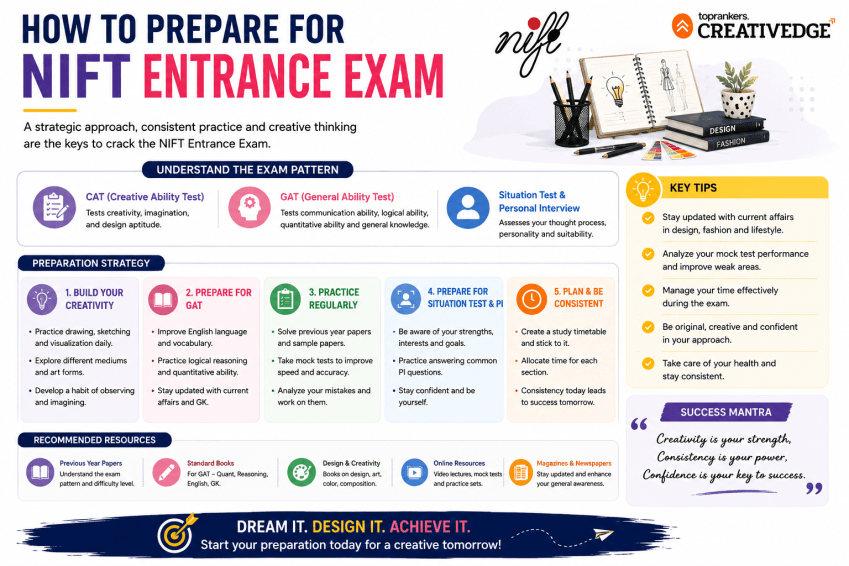
Key Takeaways
The article provides essential tips on how to prepare for NIFT entrance exam 2027, focusing on understanding the exam pattern, practicing with past papers, and staying updated on current affairs.
- Dedicate six months to 1 year (or more) for consistent practice. Create a study schedule to manage drawing, observation, mock tests, and general knowledge review.
- Hone your ability to capture form, proportion, perspective, and light. Practice still life and object drawing regularly.
- Develop design thinking by understanding design elements & principles. Practice creating balanced compositions and communicating ideas visually.
- Regularly solve NIFT previous year question papers and work on your portfolio. For extra support, consider coaching or online courses.
Preparing for NIFT 2027? We can help you with exact strategic roadmap, study material and crucial feedback required to ace this exam.
Join CreativEdge, India’s leading NIFT online coaching and get expert guidance on all NIFT 2027 subjects.



Attempt a Free NIFT Mock Test
Fill your details
Frequently Asked Questions
How do I start preparing for the NIFT entrance exam?

How many months are needed to prepare for NIFT?
Can I prepare for NIFT at home without coaching?
How should I prepare for the NIFT GAT?
How do I prepare for the NIFT CAT (Creative Ability Test)?
How do I prepare for the NIFT Situation Test?

Vineeta Agrawal
Communications Executive
SHARE