
1723534562.png)

UCEED Important Topics 2027 + Weightage & Most Asked Areas
September 3, 2026
The most important topics for UCEED 2027 include 3D visualization, object rotation, perspective drawing, shape counting, pattern recognition, puzzles, logical reasoning, geometry-based questions, visual observation, and creative problem-solving.
Based on previous year UCEED question papers, these topics appear frequently and should be prioritized while preparing. However, aspirants should cover the complete UCEED Official Syllabus (Part A & B) before focusing on these high-weightage areas.
Key Highlights - UCEED Important Topics 2027
- UCEED important topics are divided between Part A (aptitude-based questions) and Part B (drawing & design ability).
- Part A important topics - cube/paper folding/unfolding, surface counting, top view/side view, object rotation, etc.
- Part B important topics - scene creation, design thinking, creativity, and problem-solving.
- Prioritizing these important topics helps aspirants align preparation with the actual UCEED exam pattern and improve scoring potential.
Keep reading for:
1. A complete list of UCEED 2027 important topics (Part A and Part B) based on the latest UCEED exam pattern 2027 PDF.
2. A curated list of most repeated UCEED question types with solutions to understand what’s truly tested.
3. A list of the best books and study material for UCEED preparation to help you cover every concept efficiently.
Think of this blog as your roadmap, helping you focus only on what matters most. Because if you know where to spend your effort, half your UCEED exam preparation is already won.
Table of Content
Why Knowing UCEED Important Topics 2027 Matters
Before diving into the list, let’s clarify why focusing on the subject wise UCEED Important Topics is vital:
1. It ensures your time is spent on high-yield topics rather than low-probability ones. The UCEED important topics (part A and part B) correlate with how the paper is structured and weighted.
For example, if you know what kind of GK topics are usually asked in the exam, you can plan to spend more time reading about those instead of wasting time on others.
2. It helps in selecting the right resources (books, study material) rather than buying everything.
For instance, you can use UCEED Previous Year Papers book to decipher the most repeated UCEED questions with solutions. So you don’t have to source study material for subjects that are not much relevant to the exam.
Like from UCEED exam pattern, reading comprehension for example, have appeared only once in last 5-6 years. You can use online available resources to practice for it.
Subject-Wise UCEED Important Topics (2027): Priority Overview
UCEED has two parts - Part A (objective: NAT, MSQ, MCQ) and Part B (drawing). Here are the most high priority areas categorized as per importance, based on recent papers.
|
Priority |
Area (Part) |
Why it matters |
Focus |
|
Very High |
Visualization & Spatial Reasoning (Part A) |
Consistently the highest-weighted objective area |
3D visualization, cube/object manipulation, cut sections |
|
Very High |
Drawing & Design Creativity (Part B) |
Part B is a major score-swinger; hard to fake |
Perspective, composition, storytelling, idea generation |
|
High |
Observation & Design Sensitivity (Part A) |
Frequently tested; rewards attention to detail |
Spotting differences, hidden figures, visual detail |
|
High |
Reasoning & Problem-Solving (Part A) |
Steady presence across papers |
Patterns, puzzles, analytical & logical reasoning |
|
Medium |
Quantitative & Analytical Aptitude (Part A) |
Recurring, quick to score with practice |
Ratios, percentages, averages, real-world |
|
Medium |
Design Aptitude & Awareness (Part A) |
Tests design thinking, not memorization |
Product/usability thinking, environmental & social awareness |
|
Low |
Language & Communication (Part A) |
Lighter weight, but easy marks |
Word logic, meanings, verbal-visual connections |
For the complete topic-by-topic breakdown of every UCEED area, see the full UCEED syllabus.
Questions from All UCEED Important Topics with Solutions for 2027 Prep
To make your preparation concrete, here are 5 sample questions from each subject-group (variety of UCEED Important Topics) drawn from previous year UCEED question papers. These illustrate the kind of problems you’ll face and help you practice the 'most repeated UCEED questions with solutions'.
[For detailed solutions to all these questions, click the link provided at the end of this section]
Visualization and Spatial Ability:
Ability to visualize and transform 2D shapes and 3D objects and their spatial relationships.
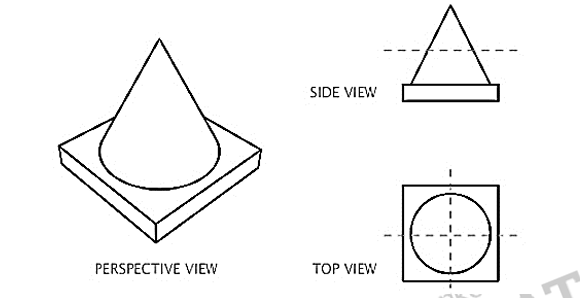
Q.1) A perspective view of a solid is shown below. The solid is symmetrical, and hidden surfaces such as the base are flat. What is the total number of surfaces in the solid?

Ans: 72
Q.2) A perspective view of a solid object is shown on the left. The object is cut simultaneously along THREE perpendicular planes as shown on the right. How many surfaces will the resulting pieces have in total (i.e. sum of the surfaces of all pieces)?
Ans: 48
Q.3) Two views of a solid object are shown on the left. Which of the following options is/are the view(s) of the same object?
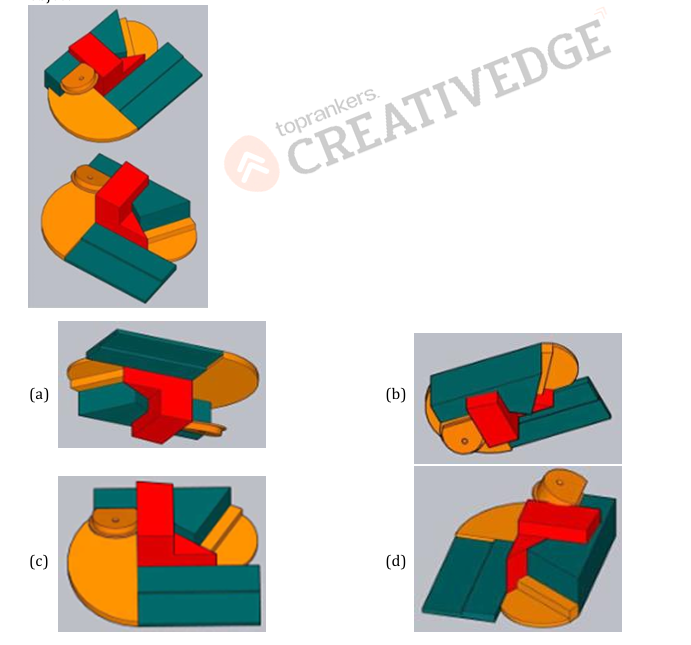
Ans: A,B, and C
Q.4) Shown in the top row are 4 pieces of building blocks. Which of the option(s) is/are made using all four pieces?

Ans: A
Q.5) Which options can be folded to form the cube shown?
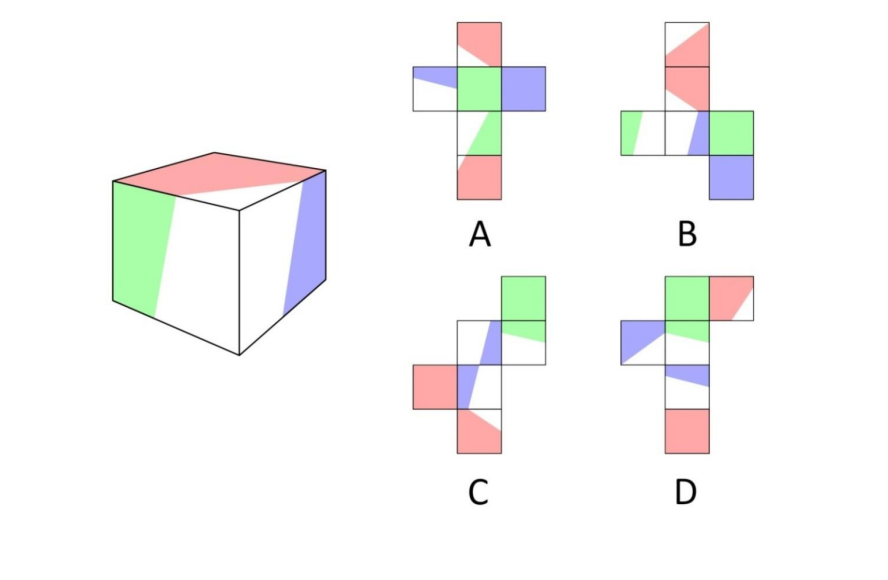
Ans: B, C
Know more: UCEED Seat Allotment Process
Practical and Scientific Knowledge
Q.1) Shown below are the vertical cross-sections of hand pumps. Which of the following options depict(s) the correct working principle?
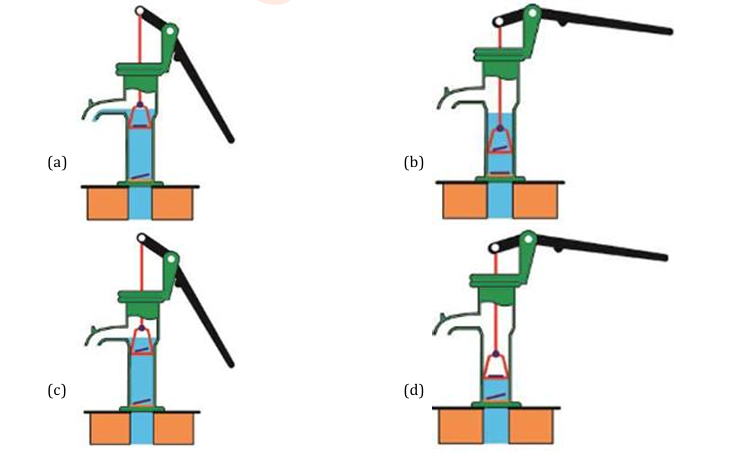
Ans: A, B
Q.2) Shutter speed is one of the parameters by which exposure of the image can be controlled. How does shutter speed control exposure?
(a) By increasing the size of the opening through which light enters the camera.
(b) By increasing sensitivity of the image sensor.
(c) By increasing the time for light to enter the camera.
(d) By increasing the number of pixels in the image.
Ans: C
Must-Read: 10 Best Tips to Tackle Trick Questions in UCEED Exam 2027
Q.3) The figure below shows four mechanisms made using links and hinges. If circles represent hinges, which of the option(s) will allow relative motions between the links?

Ans: A,B,D
Q.4) In which of the option(s) dust-bin lids will open?
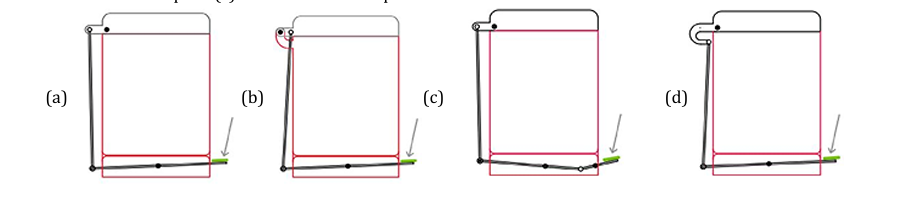
Ans: B, C
Q.5) Which of the options is / are CORRECT?
(a) The cap of a water bottle is tightened by rotating it in the clockwise direction (as seen from the top).
(b) To turn on a tap, the tap head is rotated clockwise; to turn it off it is rotated counter- clockwise (as seen from the top).
(c) To loosen a nut of a car wheel, a spanner is turned counter-clockwise clockwise (from the point of view of the person using the spanner).
(d) The earth as seen from the North Pole rotates clockwise about its axis.
Ans: A,C
Observation and Design Sensitivity:
The capacity to detect concealed properties in daily life and think critically about them. Attention to detail, classification, analysis, inference and prediction.
Q.1) What is the total number of triangles in the figure given below?
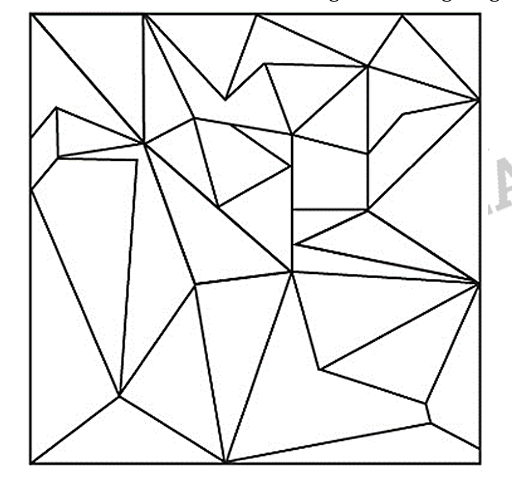
Ans: 24
Q.2) With reference to the image below, which of the statement(s) is/are false?

(a) Ramps are good solution for standard wheel chair users to access any building with entry above ground level.
(b) Height along with the length of the ramp will determine if standard wheel chair users can use it without assistance.
(c) People on standard wheel chair will need assistance to go up and down shorter length ramps irrespective of its height.
(d) A shorter length of ramp is convenient for standard wheel chair users without assistance, if the height of the ramp is high.
Ans: D
Q.3) A ball with a thin elastic rod moves from left to right as shown below. Which option represents the movement of the rod?
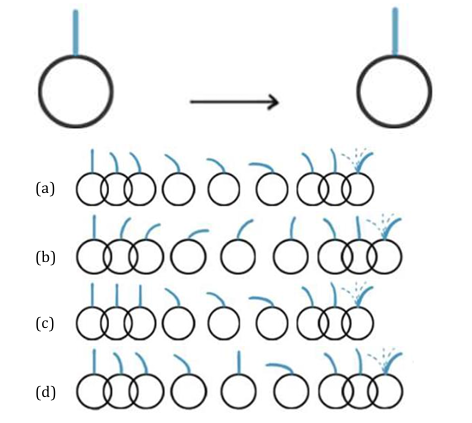
Ans: A
Q.4) Shown below are tables of a new design. Which table(s) will not tilt, if given a small perturbation in any direction?
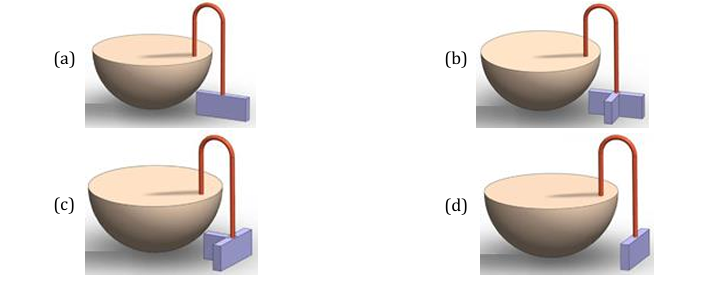
Ans: C,D
Q.5) The options show designs for a remote control and its battery cover. Which design will be feasible?
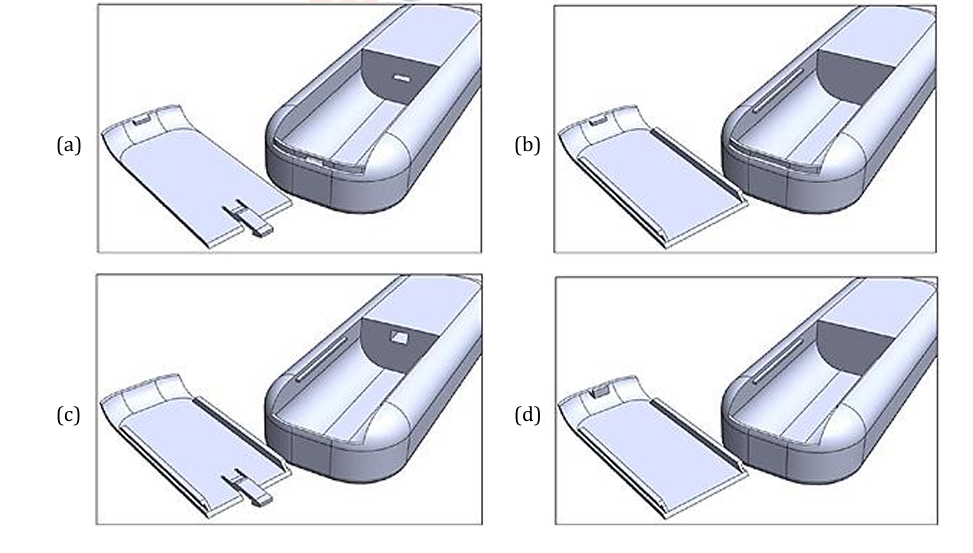
Ans: C
Check: Step-by-step Process to Fill UCEED Application Form 2027 (OUT Now!)
General Awareness:
Q.1) The Tropic of Cancer passes through which of the states shown below?
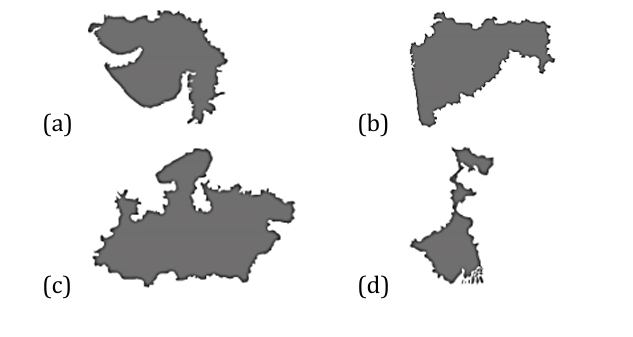
Ans: A,C,D
Q.2) Which of the options is the correct logo of India Post?

Ans: D
Q.3) Phulkari, Chikankari, Sambalpuri and Paithani are weaving traditions from different states of India. Which option lists them in the correct sequence?
(a) Uttar Pradesh, Maharashtra, Assam, Punjab
(b) Punjab, Uttar Pradesh, Odisha, Maharashtra
(c) Uttar Pradesh, Odisha, Punjab, Maharashtra
(d) Odisha, Uttar Pradesh, Assam, Punjab
Ans: B
Q.4) Which are the rivers numbered from 1 to 4 in the map below?

(a) Ravi, Ganga, Krishna, Cauvery
(b) Sutlej, Yamuna, Godavari, Cauvery
(c) Indus, Ganga, Godavari, Krishna
(d) Chenab, Yamuna, Godavari, Cauvery
Ans: B
Q.5) The _______ government organizes the Hornbill Festival each December, promoting cultural heritage and fostering interaction between tribes. The festival has been named after a ______.
(a) Chhattisgarh, bird
(b) Nagaland, bird
(c) Manipur, flower
(d) Shillong, tribal musical instrument
Ans: B
Analytical and Logical Reasoning:
Ability to analyse qualitative and quantitative information.
Q.1) Six concentric white rings, each of equal thickness but having different diameters, are positioned on different planes in space. A one-point perspective view of the rings is shown below. Based on this view, which of the option(s) is/are TRUE?
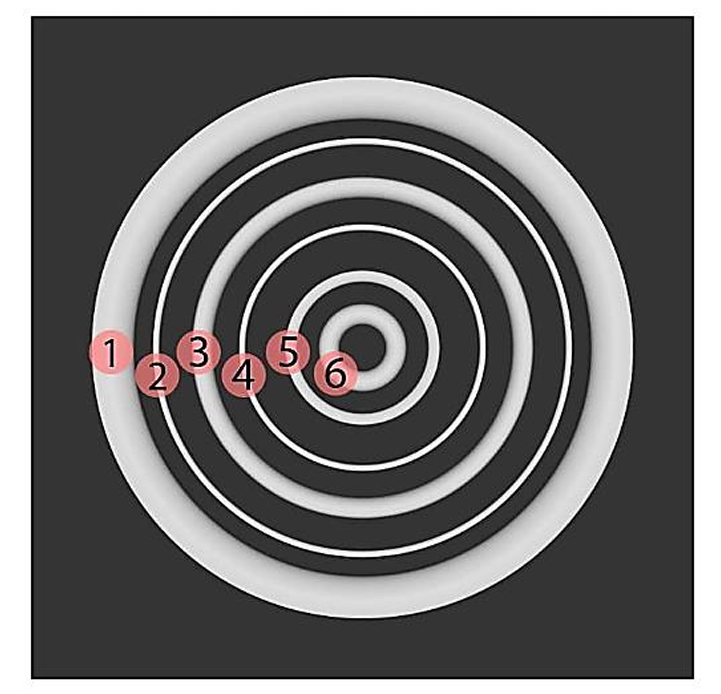
(a) Rings 6 and 3 are closer to the viewer compared to ring 5
(b) Rings 2 and 4 are at equal distance from the viewer
(c) Ring 1 is the nearest to the viewer
(d) Ring 5 is the farthest from the viewer
Ans: A,B,C
Q.2) "Betty bought some butter but the butter was too bitter, so she put a little gummy to make the bitter butter yummy." In the above sentence, if you replace every letter ' 𝑡 ' with letter ' 𝑏 ', what is the total number of instances in which the same letter appears at least twice in a word?
Ans: 14
Q.3) Shown below is a configuration of FOUR solid spheres each of radius 40cm that are placed on four corners of a regular tetrahedron with side 120cm. The centres of the spheres coincide with the corners of the tetrahedron. What is the radius (in cm) of the largest sphere that can be accommodated within the tetrahedron?
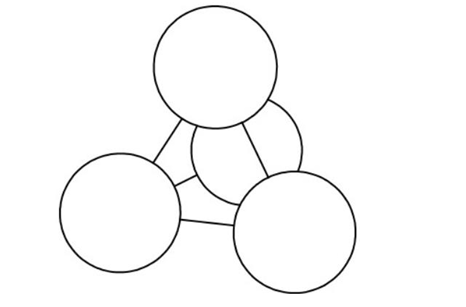
Ans: 32.5 - 34.5
Q.4) Which option from the right will replace the circles labelled 1, 2 and 3 in the image on the left?

Ans: C
Q.5) What is the length of the edge of the largest cube that can be placed inside a sphere of radius 10 cm?
(a) 10 / (√ 2) cm
(b) 10 / (√ 3) cm
(c) 20 / (√ 2) cm
(d) 20 / (√ 3) cm
Solution: To find the side length of the largest cube inscribed in a sphere of diameter d cm, we can follow these steps:
- Understand the relationship between the cube and the sphere
When a cube is inscribed in a sphere, the diagonal of the cube is equal to the diameter of the sphere.
- Calculate the diagonal of the cube
Let side of the cube be x, and diagonal be d.
d = x (√ 3) cm
- Calculate the diameter of the sphere
d = 2r = 2*10 = 20 cm
- Therefore, length of the edge of the largest cube
20 = x (√ 3) cm
and x = 20 / √ 3 cm
Ans: D
Read more: UCEED last minute tips 2027

1757510491.webp)
Language:
Proficiency in reading and comprehending Standard English.
Q.1) Consider the following quote from J C Kumarappa’s Economy of Permanence: “Man comes nearest to his God, the creator, when he utilises his brain power to marshal mechanical forces to serve his purposes. To do so in a way that will bring blessings and not destruction, he has to follow closely nature’s way to get the best out of it. We cannot get the co-operation of nature purely on our own terms. Any attempt to do so will bring violent destruction in its wake.” Which of the options is/are implied by the quote?
(a) Utilising brain power to marshal mechanical forces to serve our purposes, if not done properly, can lead to destruction.
(b) Utilising brain power to marshal mechanical forces to serve our purposes can bring man nearest to his God.
(c) While utilising brain power to marshal mechanical forces to serve our purposes, the best way to proceed is to follow nature’s way.
(d) Dealing with nature purely on our own terms will bring violent destruction.
Ans: A,B,C,D
Q.2) An animated character speaking a sentence in English is given below. Which sentence is the character saying?

Ans: B
Creativity:
Q.1) Which of the option(s) is/are from the same font family (i.e. weight and/or width variations) of the words given below?

Ans: A,B,D
Q.2) Which of the options is/are correct according to pigment colour theory?

Ans: A,D
Q.3) Which option has the same visual grammar of the letters on the left?

Ans: B
Q.4) Shown below is a transparent roller stamp. Identify the print made from the roller.
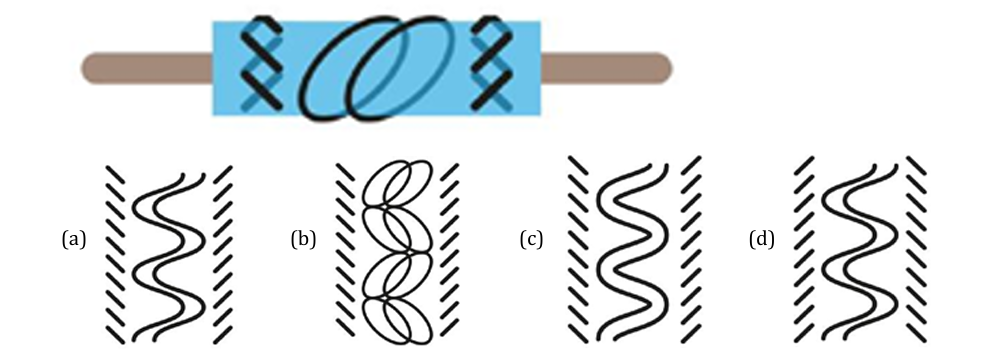
Ans: D
Q.5) Four students were given a task to design a stencil for the word ’pedagogy’ for spray painting. Shown in the options are designs of each student that are to be cut into stencils for painting. Identify the design that will NOT work as a stencil to paint the given word?
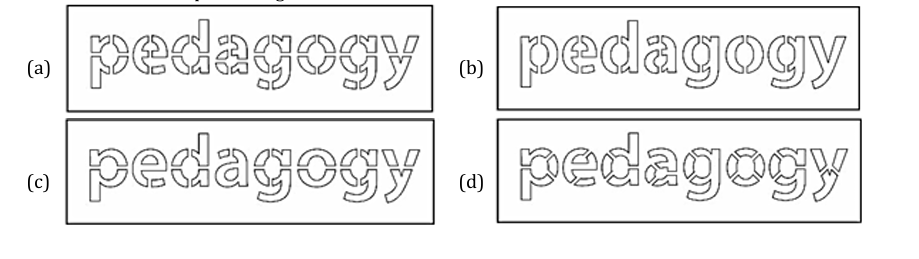
Ans: C
Part-B (Drawing and Design Aptitude)
Q.1) There is an old garage with a large window. A five-year-old boy is on a cleaning mission with his father and grandmother. The father is cleaning the cobwebs, while the grandmother finds an old guitar and starts playing it. The boy starts dancing. There is an old bicycle, a football, and other items. The garage also holds memories of the grandmother’s sports days and the father’s studious phase in school. Draw the whole scene from the point of view of another boy standing at the door of the garage.
Q.2) Design a lunchbox for a 6 year old school going girl who likes to eat proper Indian food (dal, rice, sabzi, roti and other liquid foods). The lunchbox should be designed so that it’s easy to eat and carry the food to school. Don’t write a separate explanation. Explain only through visuals and short labels.
Click Here for Step-by-step Solutions of Above UCEED Questions
For more such questions and their detailed solutions, get solved past year papers book by CreativEdge from Amazon or Flipkart.
Best Book & Study Material for Preparation of UCEED Important Topics 2027
To cover the UCEED important topics effectively, the right UCEED study material is crucial. Here are top recommendations:
|
UCEED Material |
Links |
|
UCEED study material for Maths / Numerical Ability |
|
|
UCEED study material for drawing |
|
|
UCEED drawing questions for practice free pdf |
|
|
UCEED study material for reasoning |
|
|
UCEED mock tests |
Or consider investing in UCEED study material from trusted coaching institutes like CreativEdge to access structured modules, mocks with full video analysis and solutions. Make sure you utilise actual past year UCEED question papers for real exam experience.
By aligning your study with these resources, you ensure coverage across all important topics to study for UCEED exam efficiently.
8-Week Study Plan to Cover All UCEED Important Topics (Repeatable)
Here’s a suggested plan:
Week 1-2: Cover high-weight topics first (Visualisation, Spatial Ability, Maths basics)
Week 3-4: Move to moderate-weight topics (Observation & Design Sensitivity, Reasoning)
Week 5-6: Focus on lower-weight but recurring topics (Language, Practical Knowledge)
Week 7-8: Focus on Revision, PYPs and Mocks
Ongoing: Once every two weeks, solve a full paper (use “most repeated UCEED questions with solutions”)
Find subject wise weekly study plan for UCEED 2027 below:
|
Week |
Focus Distribution (Across Subjects) |
UCEED Important Topics to Study & Revise |
Practice Tasks / Goals |
Weekly Outcome |
|
Week 1 |
Foundation & Concept Building |
Visualization: 2D-3D transformation, folding/unfolding, mirror pattern |
Study UCEED exam overview |
Strong conceptual base built across core subjects |
|
Observation & Design Sensitivity: design principles, balance, proportion |
Solve 1 sectional paper each |
|||
|
Reasoning: basic series, odd-one-out, analogy |
Draw 3 simple compositions |
|||
|
Maths: ratio, percentage, averages |
30 mins of UCEED GK every alternate day (make short notes) |
|||
|
Drawing: daily freehand sketch (simple objects) |
||||
|
Week 2 |
Strengthen Core Visual & Logical Skills |
Visualization: shape rotation, mirror & cube problems |
2 topic tests (Spatial + Reasoning) |
Accuracy improves to 70%+ |
|
Observation: product evolution, form vs. function |
Practice MCQs in timed conditions |
|||
|
Reasoning: pattern completion, blood relation puzzles |
Attempt 2 past UCEED papers (Part A) section-wise |
|||
|
Maths: time & work, geometry basics |
5 perspective sketches |
|||
|
Drawing: objects in perspective, shadow & depth |
30 mins of UCEED GK every alternate day (make short notes) |
|||
|
Week 3 |
Add Language & Creativity + Continue Visual/Spatial Mastery |
Visualization: orthographic/isometric views |
1 mock test (Part A) under timer |
Covered new subject (Language & Creativity) while maintaining visual/maths consistency |
|
Reasoning: coding-decoding, Venn diagram sets |
Revise visual theory via flashcards |
|||
|
Language & Creativity: analogies, metaphors, etc. |
Practice 1 creative writing + drawing fusion prompt |
|||
|
Maths: profit-loss, data interpretation |
||||
|
Drawing: human figures, product sketching questions |
||||
|
GK/Design Awareness: famous designers, design awards |
||||
|
Week 4 |
Integrated Practice + Design Awareness |
Visualization: paper folding, mirror symmetry |
Attempt 2 mock tests (alternate days) |
Ability to combine analytical & design awareness questions |
|
Observation: identify errors in given designs |
Review UCEED 2025 question paper (Part A) |
|||
|
Environmental Awareness: sustainable design, architecture basics |
Practice 10 design-awareness MCQs |
|||
|
Maths: coordinate geometry, averages |
||||
|
Drawing: perspective scenes (indoor + outdoor) |
||||
|
Week 5 |
Advanced Practice + Problem Solving |
Visualization: mental rotation & unfolding nets |
2 mock tests + timed reasoning practice |
Accuracy improvement; ready for full-length tests |
|
Reasoning: logical sequencing, data sufficiency |
1-hour drawing challenge daily |
|||
|
Observation: composition analysis, contrast, color balance |
Review errors log from past 2 weeks |
|||
|
Drawing: thematic sketch (story-based) |
||||
|
Maths: mensuration, number series |
||||
|
Week 6 |
Exam Simulation Phase 1 |
Revise all Part A topics from UCEED important topics PDF |
3 timed mini-mocks |
First full test simulated; weaknesses clearly identified |
|
Drawing: real exam-type prompts (products, human activities) |
Full 3-hour UCEED simulation |
|||
|
GK/Design: contemporary design trends |
Self-evaluate time vs accuracy |
|||
|
Maths & Reasoning: mixed-question sets |
||||
|
Week 7 |
Focused Revision + Drawing Refinement |
Prioritize weak topics (as per mocks) |
3 past-year papers |
Accuracy in mocks >80%, improved recall speed |
|
Visualization: folding-unfolding revision |
2 focused sketch sessions |
|||
|
Reasoning: logic grids, assumption questions |
Create “Top 50 Quick Notes” sheet |
|||
|
Drawing: human-environment interaction scenes |
||||
|
GK/Language: light revision |
||||
|
Week 8 |
Final Revision & Confidence Building |
Revise top 10 high-weight topics from all UCEED subjects |
3 final mocks (alternate days) |
Exam-ready: solid command over all UCEED important topics for 2027 exam and balanced time management |
|
Drawing: last 5 prompts (speed + clarity) |
Review all notes & error logs |
|||
|
GK: quick fact review (awards, movements) |
Light drawing warm-up daily |
|||
|
Language: quick analogy & vocab practice |
Final Takeaway
Knowing UCEED important topics for 2027 exam is not optional; it’s essential. By focusing on the high-yield areas identified above, utilizing the right books and study materials, solving objective questions, including UCEED Maths questions & visual/spatial skills related questions, and practising strong sketch work for Part B, you’ll maximize your chances of success.
Preparing for UCEED 2027? We can help you with exact strategic roadmap, study material and crucial feedback required to ace this exam.
Join best UCEED Crash Course by CreativEdge and get expert guidance on all UCEED 2027 subjects.

Attempt a Free UCEED Mock Test
Fill your details
Frequently Asked Questions
Which are the most important topics to study for the UCEED exam?

What is the weightage of different topics in the UCEED 2026 exam?
How can I cover all UCEED important topics in limited time?
Which book is best for practicing UCEED important topics?
Where can I download the UCEED important topics PDF?
Are the same topics repeated every year in UCEED?
Vineeta Agrawal
Communications Executive
SHARE