


NATA Sample Papers for 2027 Practice – Free PDF Download with Solutions
October 7, 2026
NATA sample papers are full-length practice tests built on the latest 200-mark pattern - Part A Drawing (80 marks, 3 questions) + Part B Aptitude (120 marks, ~50 questions), 3 hours, no negative marking. Download free, printable NATA 2027 sample papers with solutions and answer keys below, then solve them timed.
It can help students understand question types, time management, and scoring strategy for NATA 2027. Aim for 10-12 papers (sample + previous-year) before the exam.
Download NATA Sample Paper PDFs
Download the sample papers below - built on the current 200-mark pattern (Part A Drawing 80 + Part B Aptitude 120, no negative marking). Every paper is free, printable, and comes with an answer key or solutions. Solve subject-wise first, then attempt full-length sets under timed conditions.
| Paper Name | Pattern Covered | Download Link |
|---|---|---|
| NATA Sample Paper 1 | 50 Aptitude + 3 Drawing | |
| NATA Sample Paper 2 | 50 Aptitude + 3 Drawing | |
| NATA Mock Test with Performance Analysis | Aptitude Only | |
| NATA Previous Year Question Papers | As per respective year | |
| NATA Drawing Sample Paper Sets | Drawing Focused |
How Our Sample Papers Are Built (and Kept Accurate)
Each paper is created by Creative Edge's architecture faculty from the current Council of Architecture pattern and verified recent-exam trends - not random question dumps.
Drawing questions are chosen to test perspective, composition and object transformation the way NATA does; aptitude sets mirror the real Maths / Reasoning / AAT / GK / English weightage.
Every paper is reviewed for pattern accuracy and refreshed yearly, so you never practise an outdated format. For how the actual exam is structured, see the NATA exam pattern.
Why Creative Edge NATA Sample Papers Are Different
- Built on the current 200-mark pattern - 3 Drawing + 50 Aptitude questions, time-bound CBT simulation, no outdated formats.
- Difficulty calibrated to recent papers - modelled on actual NATA trends and section weightage, so it feels like the real exam.
- Updated every year - revised for pattern and weightage shifts, kept relevant for 2027 and 2028.
Key Highlights: NATA Sample Papers
- Latest exam pattern aligned (Drawing + Aptitude)
- Based on latest exam structure (50 aptitude + 3 drawing questions)
- Includes detailed solutions
- Covers questions from all sections of the NATA 2027 Syllabus - Maths/Quant, Logical Reasoning, architectural awareness, GK & English
- Drawing practice with evaluation framework
- Time-based simulation
- Answer key included
- Ideal for 2027 and 2028 aspirants
Table of Contents
- Sample Paper PDF Download Table
- What Are NATA Sample Papers?
- What Is Included in the Sample Papers?
- Sample Questions from NATA Question Papers
- NATA Important Topics Covered in Sample Papers
- How to Use these Sample Papers Effectively for 2027 Prep
- How Many Sample Papers Should You Solve - and When?
- Benefits of Solving Sample Papers for NATA Prep by CreativEdge
- Comparison: Sample Paper vs Mocks vs Past Year Papers
- Mistakes Students Make While Solving Sample Papers
- Who Should Solve these Sample Papers?
What Are NATA Sample Papers?
Because NATA's pattern has shifted several times since 2023, practice only with updated sample papers with solutions that match the current 200-mark structure. Solve each set timed, review the answer key line by line, and log the topics you miss - that review loop, not the number of papers, is what raises your score.
Unlike older question papers, modern sample tests:
- Reflect reduced aptitude question count
- Include drawing section (80 marks)
- Follow time-bound CBT structure
- Simulate real adaptive difficulty
These are not random question compilations but exam-pattern-aligned practice tools.
What's a Good Score - and How Hard Are These Papers?
NATA is scored out of 200. A score in the 120-150+ range is competitive for most government and top private B.Arch seats, with the exact cut-off varying by college and year. Our sample papers are set at moderate-to-exam difficulty (not easy "confidence boosters"), because practising slightly harder than the real paper is what builds speed.
Benchmark your target using the expected NATA cut-off.
What Is Included in NATA Sample Papers?
Part A - Drawing & Composition (80 Marks)
| Component | Skills Tested | Marks |
|---|---|---|
| Perspective Drawing | Spatial depth & proportion | 25 |
| Creative Scene Composition | Imagination & detailing | 25 |
| Design Transformation / Conceptual Sketch | Innovation & clarity | 30 |
Drawing questions in NATA entrance exam sample papers are structured to test speed, clarity, and perspective accuracy.
Part B - Aptitude (120 Marks)
| Subject | Question Type | Approx. Weightage |
|---|---|---|
| Mathematics | MCQ | 25-30 |
| Logical & Visual Reasoning | MCQ | 25-30 |
| Architectural Aptitude | MCQ | 25-30 |
| General Knowledge | MCQ | 15-20 |
| English / Interpretation | MCQ | 8-10 |
Each sample paper with answer key includes full explanations for aptitude solutions.
Sample Questions from NATA Question Papers
Below are representative examples reflecting actual exam trends:
Mathematics
Q1. Find the surface area of a cylinder with radius 7 cm and height 14 cm.
Q2. If the average of 20 numbers is zero, how many numbers could be greater than zero
(a) 19 (b) 49 (c) 17 (d) 33
Q3. The dimensions of a hall are 40 m,25m and 20m . If each person requires 200 cubic meters, find the number of persons who can be accommodated in the hall.
(a) 150 (b) 140 (c) 120 (d) 100
Q4. A cyclist moving at a speed of 20 km/hr crosses a bridge in 2 minutes. What is the length of the bridge?
(a) 555.5 m (b) 444.4 m (c) 777.7 m (d) 666.6 m
Q5. The respective ratio of milk and water in a solution is 7:9. After adding 8 litres another solution in which concentration of milk is 50%, the respective ratio of milk and water becomes 4:5. Find the original quantity of milk present in the solution? (Answer to be provided in litres)
Pair this practice with our free NATA 2027 study material to revise suvject-wise concepts before you attempt a full paper.
Logical & Visual Reasoning
Q1. If a cube is painted on all sides and cut into smaller cubes, how many cubes have exactly two painted faces?
Q2. For the given object below, how many numbers of surfaces make the 3D object?

(a) 12 surfaces
(b) 15 surfaces
(c) 16 surfaces
(d) 21 surfaces
Q3. Showing the man receiving the prize, Saroj said, "He is the brother of my uncle's daughter." Who is the man to Saroj?
(a) Son (b) Cousin (c) Nephew (d) Brother-in-law
Q4. The given surface can be folded into which of the following cubes?
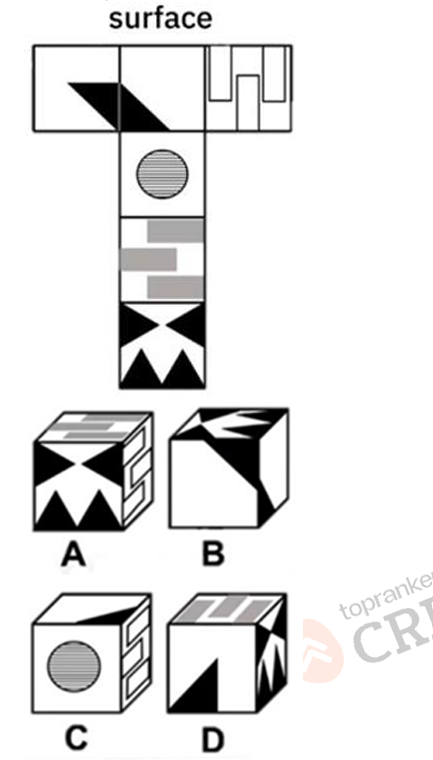
Q5. Identify the correct TOP view for the given 3D form:
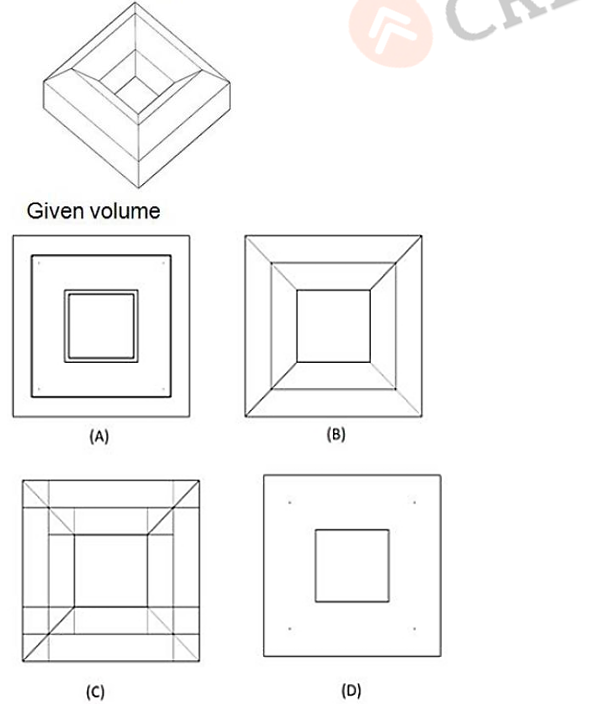
(a) (A) (c) (C) (b) (B) (d) (D)

Architectural Aptitude
Q1. Identify the four most appropriate architectural components and elements of architectural composition that you find in the image of one of the courts of the Jawahar Kala Kendra, Jaipur designed by Ar. Chares Correa. (Marks will be awarded only if all answers are right)

a. Open Air theatre
b. Geometric
c. Murals
d. Centrality
e. Dormer window
f. Skylights
g. Order
h. Curved columns
i. Stage
Q2. Image of the famous building shown below is well known as:
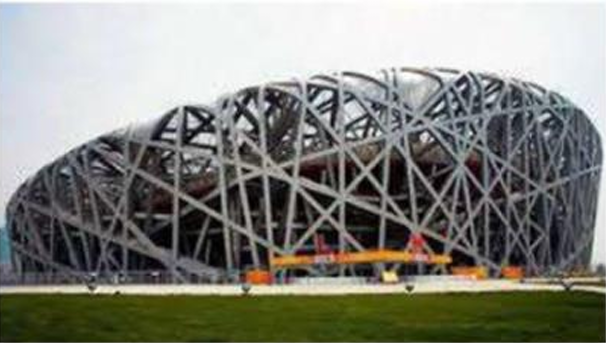
(a) Cocoon (c) Bird's Nest (b) Geodesic dome (d) Space Shuttle
Q3. Identify the type of staircase shown in the given image.
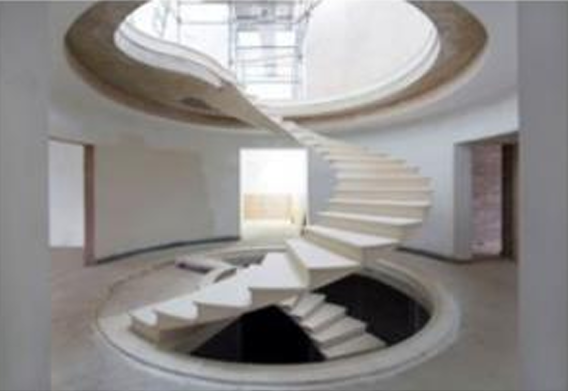
(a) Helical staircase (c) Spiral staircase (b) C Shaped staircase (d) Cylindrical staircase
Surface-counting and figure questions repeat often, so learn the shortcuts in our non-verbal reasoning & figure-counting lesson.
NATA GK
Q1. Which is the oldest architectural school in India?
(a) School of Architecture at MS University, Baroda (b) Sir J J School of Architecture, Mumbai (c) School of Architecture at Arts College, Lucknow (d) Department of Architecture, IIT, Kharagpur
Q2. Which of the following lakes were formed due to tectonic activities?
(a) Loktak (b) Wular (c) Dal (d) Bhimtal
Q3. If dimensions of Paper size A4 is 210 mm × 297 mm, what are the dimensions of Paper size A6
(a) 420 mm×297 mm (b) 105 mm×290 mm (c) 210 mm×148 mm (d) 105 mm×148 mm
Q4. The chair named the Pantone chair, which was designed by Verner Panton was made with a new material in the year 1967. What was the material?
(a) Glass (c) Plastic (b) Nylon (d) Stainless steel
English Vocab & RC
Q1. Choose the word with correct spelling from among the following:
(a) tyranny (b) tyrrany (c) tyranny (d) tyrany
Q2. An individual who is unable to express or interact easily is called a ___________.
(a) Extrovert (b) Introvert (c) Ambivert (d) Torrent
Q3. Choose from the following, the correct synonym of the given word "Exorbitant"
(a) Odd (b) Ridiculous (c) Excessive (d) Threatening
Q4. Choose from the following, the correct antonym of the given word "Suspend"
(a) Pend (b) Switch (c) Resume (d) Turn on
Drawing
Q1. Sketch a railway station platform in 2-point perspective including human figures and structural elements.
Detailed Breakdown: NATA Important Topics Covered in Sample Papers
Updated NATA sample paper sets are designed strictly as per the latest exam structure (80 marks Drawing + 120 marks Aptitude). Below is a subject-wise deep breakdown of the exact NATA important topics typically covered in structured sample papers.
Part A - Drawing & Composition (80 Marks)
Sample papers replicate the actual 3-question format. The focus is not just creativity but structured evaluation.
| Topic Category | Subtopics Covered |
|---|---|
| Perspective Drawing | 1-point & 2-point perspective |
| Urban Scene Creation | Railway station, market, street view |
| Interior Composition | Room view, study table setup |
| Design Transformation | Modify an object creatively |
| Light & Shadow | Shade placement |
| Human Figures | Action poses |
Part B - Mathematics (25-30 Marks Range)
Sample papers focus on frequently repeated quantitative aptitude / maths topics.
| Core Topic | Subtopics Asked | Level | Frequency in Sample Papers |
|---|---|---|---|
| Mensuration | Surface area, volume | Moderate | Very High |
| Trigonometry | Heights & distances | Moderate | High |
| Coordinate Geometry | Straight line, circle | Moderate | High |
| Algebra | Quadratic equations | Easy-Moderate | Moderate |
| Probability | Basic probability | Easy | Moderate |
| Matrices | Determinants | Moderate | Moderate |
| Ratio & Percentage | Word problems | Easy | Moderate |
Most NATA entrance exam sample papers give extra focus to Mensuration due to high recurrence.
Logical & Visual Reasoning (25-30 Marks Range)
Visual reasoning weightage has increased significantly in recent years.
| Topic | Subtypes Practiced in Sample Papers | Difficulty Trend |
|---|---|---|
| Cube Rotation and Surface Counting | Painted cubes, folded cubes, complex perspective figures to count surfaces | High |
| Mirror & Water Images | Reflection-based problems | High |
| Paper Folding | Hole punching | Moderate |
| Pattern Series | Figure continuation | High |
| 3D Shape Counting | Block counting | Very High |
| Analytical Puzzles | Seating, arrangement | Moderate |
| Direction Sense | Movement problems | Moderate |
Architectural Awareness Test (AAT)
This section bridges creativity and knowledge.
| Topic | Sample Paper Focus | Importance |
|---|---|---|
| Architectural Styles | Gothic, Mughal, Modern | High |
| Famous Architects | Corbusier, B.V. Doshi | High |
| Urban Planning | Smart cities concepts | Moderate |
| Sustainable Architecture | Green buildings | Moderate |
| Building Materials | Concrete, glass, steel | Moderate |
Watch: How to Solve High-weightage Non-Verbal Reasoning Questions
General Knowledge (Architecture-Oriented)
| Topic | Focus Areas in Sample Papers |
|---|---|
| Indian Monuments | Taj Mahal, Qutub Minar |
| World Landmarks | Eiffel Tower |
| Awards | Pritzker Prize |
| Current Affairs | Recent architectural events |
| Cultural Heritage | UNESCO sites |
English & Language Interpretation
| Question Type | Skill Tested |
|---|---|
| Vocabulary | Word meaning |
| Synonyms | Language precision |
| Reading Comprehension | Comprehension and Interpretation |
| Error Detection | Grammar awareness |
Although limited in number, these contribute quick scoring opportunities.
Weightage Distribution in NATA Exam Sample Papers
| Section | Approx. Marks in Sample Paper | Emphasis Level |
|---|---|---|
| Drawing | 80 | Very High |
| Logical & Visual Reasoning | 25-30 | High |
| Mathematics | 25-30 | High |
| Architectural Awareness | 25-30 | Moderate |
| GK | 15-20 | Moderate |
| English | 8-10 | Low-Moderate |
How to Use NATA Sample Papers Effectively
Many students solve practice papers casually. That approach does not maximize results. Here is a structured method:
Step 1: Simulate Real Exam Conditions
- 3-hour full simulation
- Follow CBT time discipline
- Attempt drawing within fixed timeframe
Step 2: Section-wise Analysis
| Section | What to Analyze |
|---|---|
| Maths | Formula recall speed |
| Logical | Error patterns |
| NATA GK | Memory gaps |
| Drawing | Proportion & perspective |
Step 3: Maintain an Error Log
Maintain a notebook tracking:
- Weak formulas
- Repeated logical traps
- Drawing feedback
Step 4: Improve Attempt Strategy
For top colleges (150+ target score):
| Section | Attempt Strategy |
|---|---|
| Drawing | Attempt all 3 confidently |
| Maths | Attempt 80-90% accurate |
| Logical | Focus on high-confidence |
| GK | Attempt known answers only |
In the final stretch, apply these last-minute NATA preparation tips.


How Many Sample Papers Should You Solve for 2027- and When?
Although experts suggest that quality beats quantity, but how many timed papers you solve, still matters near the exam.
Here’s an example of a workable target- 1 full-length paper per week in the foundation phase (building concepts), rising to 2-3 per week in the final 6-8 weeks. You can adjust this based on your preparation level, analysis habit and target score.
Always pair a full timed paper with a deep review day, and always keep drawing in your practice loop. It's 80 marks and the easiest to neglect. Aim to have solved at least 10-12 full-length papers (sample + previous-year) before exam day.
See how difficulty has shifted in the NATA exam analysis before strategizing your practice.
Benefits of Solving NATA Sample Papers by Creative Edge
Practicing a sample paper is important, but solving the right paper, aligned with the latest structure, in the right way makes the real difference. Creative Edge designs its practice material strictly according to the current NATA exam pattern (Drawing 80 marks + Aptitude 120 marks).
Below are the key advantages:
1. Latest Pattern Alignment
Creative Edge NATA sample papers are structured as per the 2026 format (expected to continue in 2027), including:
- 3 Drawing & Composition questions
- 50 Aptitude questions
- Time-bound CBT simulation
- Balanced weightage distribution
This ensures students are not practicing outdated formats.
2. Realistic Difficulty Simulation
Many practice sets are either too easy or unrealistically tough. Creative Edge papers are calibrated based on:
- Recent NATA question papers
- Section-wise weightage trends
- Logical reasoning difficulty evolution
- Drawing evaluation criteria
This creates an authentic exam-like experience.
3. Detailed Solutions & Concept Clarity
Each sample paper with answer key includes:
- Step-by-step mathematics solutions
- Logical reasoning explanations
- Architectural awareness references
- Drawing evaluation parameters
Students understand not just what is correct, but why it is correct.
4. Drawing Evaluation Framework
Unlike generic mocks, Creative Edge provides:
- Perspective accuracy checklist
- Proportion evaluation guidelines
- Light & shadow correction tips
- Composition balance scoring
This helps improve actual drawing marks, which carry 80 marks in NATA.
5. Performance Analytics & Feedback
Students receive:
- Section-wise score breakdown
- Accuracy percentage tracking
- Weak-topic identification
- Time management analysis
This turns each NATA entrance exam sample papers attempt into a measurable improvement step.
Turn practice into marks with this guide on how to improve your NATA score.
6. Score Improvement Strategy Integration
Creative Edge sample papers are paired with:
- Attempt strategy planning
- Topic mastery guidance
- 150+ score blueprint
- Revision planning templates
Practice becomes structured rather than random.
7. Adaptive Preparation Support
Since NATA is a lengthy 3 hour exam that tests both aptitude and drawing, Creative Edge prepares you to:
- Handle time pressure
- Maintain consistency
- Avoid guesswork
- Prioritize high-confidence questions
This improves real-exam performance stability.
8. Updated Yearly Revisions
Unlike static downloadable sets, Creative Edge updates its sample papers pdf versions annually based on:
- Exam pattern shifts
- Weightage changes
- Difficulty variations
This keeps preparation relevant for 2027 and beyond.
Set your target score by the colleges you're aiming for - see the best architecture colleges through NATA.
Comparison: Sample Papers vs Mocks vs Previous Year Papers for NATA
Both sample paper sets and NATA past real question papers are important - but they serve different preparation purposes. Understanding the difference helps students use both effectively.
- Sample papers - created as per latest exam pattern; best for sectional practice or full-length practice with solutions.
- Mock tests - timed exam-like tests, auto scoring with performance analytics; best for exam familiarity and testing speed for Part B.
- Previous-year papers - real past NATA questions; best for authentic difficulty level checking (use 2024 & 2025 for the current format, and older papers for aptitude questions practice).
Use all three. Learn from sample papers, test yourself with mocks, and benchmark against previous-year papers.
Mistakes Students Make While Solving Sample Papers for NATA
Solving a sample paper can significantly improve performance, but only if done correctly. Many students practice regularly yet fail to see improvement because of common strategic mistakes.
1. Treating Sample Papers Like Practice Worksheets
A NATA sample paper should be attempted in full exam simulation mode, not casually. Solving it without timing yourself defeats the purpose of preparation for a structured, time-bound test.
Fix: Always attempt full-length papers under strict exam conditions.
2. Ignoring the Drawing Section
Some students focus only on aptitude and skip drawing practice. Since Drawing carries 80 marks, ignoring it can drastically reduce overall score.
Fix: Practice all 3 drawing questions and self-evaluate using perspective, proportion, and detailing criteria.
3. Not Analyzing Mistakes
Many aspirants check answers but do not analyze why they were wrong. A sample paper with answer key is useful only when solutions are reviewed deeply.
Fix: Maintain an error log for repeated mistakes in Maths, Logical Reasoning, and GK.
4. Over-Attempting Low-Confidence Questions
In aptitude sections, students often guess answers, reducing overall accuracy.
Fix: Attempt high-confidence questions first. Avoid blind guessing even in a well-structured NATA entrance exam sample papers simulation.
5. Ignoring Time Management Strategy
NATA’s controlled timing for aptitude questions means students cannot afford to overthink.
Fix: Practice solving aptitude questions within average time limits while maintaining accuracy.
6. Solving Only Easy Papers
Some students repeatedly solve easy-level mocks and avoid moderate difficulty tests. This creates false confidence.
Fix: Attempt progressive difficulty levels across multiple sample papers with solutions.
7. Not Revising Weak Topics After Each Paper
Practice without revision does not build mastery. Solving multiple papers without improving weak areas leads to stagnant scores.
Fix: After every mock, revise weak topics before attempting the next paper.
8. Using Outdated Question Formats
Practicing only older NATA question papers without updated pattern-based mocks can misalign preparation.
Fix: Combine past year paper analysis with updated sample paper pdf sets aligned with current structure.
Avoid these traps by following core NATA writing and attempt strategies.
Who Should Solve NATA Sample Papers?
A sample paper is not just for last-minute preparation. It benefits aspirants at different stages of preparation. Below is a breakdown of who should actively solve structured nata sample papers with solutions.
1. NATA 2027 Aspirants (Immediate Exam Takers)
Students appearing this year must solve multiple sets to:
- Adapt to the latest exam pattern
- Improve drawing accuracy
- Build aptitude speed
- Practice time-bound simulations
This group benefits the most from updated mock tests.
2. Early Preparers (2028 Aspirants)
Students preparing one or two years in advance should solve at least sectional sample papers to:
- Understand question trends
- Identify strong and weak areas
- Build foundational drawing skills
Practicing structured NATA entrance exam sample papers early builds long-term confidence.
3. Repeat Candidates
Students who previously attempted NATA and want to improve scores should:
- Analyze mistakes from earlier attempts
- Practice full-length updated mocks
- Focus on drawing evaluation improvement
4. Students Transitioning from JEE B.Arch Preparation
Aspirants who prepared for JEE B.Arch but now want to focus on NATA must:
- Practice drawing section thoroughly
- Strengthen visual reasoning
- Adapt to NATA’s structure
Updated NATA sample paper pdf sets bridge this transition effectively.
Deciding between exams? Compare NATA vs JEE Main Paper 2.
Final Thoughts
Sample papers are a diagnostic, not just practice. With NATA's pattern changing several times in recent years, solving updated, pattern-aligned papers - and reviewing every mistake - is what moves your score. Aim for 10-12 full-length papers (sample + previous-year) before exam day, keep drawing in every session, and track weak topics in an error log.
Preparing for NATA 2027? We can help you with exact strategic roadmap, study material and crucial feedback required to ace this exam.
Join Creative Edge, India’s leading NATA online coaching and get expert guidance on all NATA subjects.
You can enroll in offline NID batches at your nearest centres also!


Attempt a Free NATA Mock Test
Fill your details
Frequently Asked Questions
Where can I download NATA sample paper PDF for 2027?

Do NATA sample papers include solutions and answer keys?
How many NATA sample papers should I solve before the exam?
Is solving previous NATA question papers enough?
Do NATA sample papers cover the drawing section?

Vineeta Agrawal
Communications Executive
SHARE