
1723534562.png)

Important Topics for NIFT 2027: Priority-Wise CAT & GAT Topics (B.Des vs M.Des) + Free PDF
September 28, 2026
The most important NIFT topics span both Stage-1 papers.
For the CAT (drawing), focus on perspective / scene composition, product design / redesign / unconventional uses of everyday objects, sequential drawing, storyboarding / comic strip, color and original concept.
For the GAT, the topics that repay preparation most are:
- Quantitative Ability - percentages, ratio & proportion, averages, time-speed-distance, profit & loss, data interpretation
- Logical Reasoning - series, coding-decoding, seating arrangement, direction sense, blood relations, analogies
- English - reading comprehension, vocabulary (synonyms/antonyms), error spotting, sentence correction
- General Knowledge & Current Affairs - last 12 months' current affairs, awards, and fashion GK (designers, brands, textiles, fashion history)
Based on previous-year trends, the highest-return areas are scene composition and perspective in CAT, and GK/current affairs and English in GAT - both give quick, reliable marks. While quantitative ability and logical reasoning pay off mainly for those already strong in them.
B.Des and M.Des take both papers; B.F.Tech, M.F.M and M.F.Tech take the GAT (with a case study).
NIFT Exam Overview
As per the official NIFT Information Bulletin and notification released by the National Institute of Fashion Technology (NIFT), the NIFT Entrance Exam 2027 or design aspirants comprises two major parts:
- Creative Ability Test (CAT) - Evaluates creative & visualization skills
- General Ability Test (GAT) - Tests general aptitude across multiple subjects
For B.Des and M.Des aspirants, both CAT and GAT are essential. CAT focuses on creativity while GAT covers broader academic areas.
How Are Marks Distributed Across NIFT Topics?
NIFT does not publish a fixed topic-wise mark split, but previous-year GAT papers suggest that each question across all sections - Quantitative Ability, Logical Reasoning, English and GK & Current Affairs - will have +1 marks for correct answer and -0.25 marks for wrong answers.
GK and quantitative sections offer the most reliable, fast-to-revise marks. In the CAT, scene composition, perspective and idea originality carry the most weight in evaluation. Treat these as indicative priorities from past trends, and confirm the section structure in the official NIFT 2027 exam pattern.
What Are the Important Topics for NIFT 2027?
The important topics for NIFT 2027 include Creative Ability (sketching, visualization, design thinking), Quantitative Ability (percentages, ratios, time-speed), Logical Reasoning (patterns, puzzles, sequencing), English Comprehension, and Fashion & Design GK.
For CAT, focus on drawing fundamentals, perspective, composition, creativity, and visual storytelling. For GAT, prioritize aptitude maths, analytical reasoning, vocabulary, reading comprehension, current affairs, and fashion industry awareness. These topics form the core of the NIFT entrance exam syllabus 2027 and appear consistently in previous year NIFT papers.
How to Use the Important Topics for NIFT PDF?
- Consolidates all CAT & GAT topic lists
- Helps you create a revision checklist
- Shows you topic-wise weightage expectations
- Serves as a single reference for practice & mock tests
Click below to Download the PDF:
Important Topics for NIFT 2027 in Creative Ability Test (CAT)
The CAT section is where design thinking meets visual execution. Important topics you must master include:
Idea Generation & Creativity
- Conceptualization of design ideas
- Unique design problem interpretation
- Out-of-box thinking
Drawing & Sketching Fundamentals
- Proportion and perspective
- Observation and representation
- Basic shading and form rendering
- Illustrative clarity of ideas
Visualization & Imagination
- Translating imagination into visual form
- Creative depiction of abstract concepts
Design Sensitivity & Innovation
- Creative narrative and thoughtful design solutions
- Identifying patterns, shapes & composition
Important Topics for NIFT 2027 - General Ability Test (GAT) [Multi-Subject Breakdown]
The GAT tests your academic aptitude across five major subjects that are crucial for NIFT success - especially for M.Des and B.Des aspirants.
|
Subject Area |
Important Topics for NIFT to Prepare |
Preparation Focus |
|
Quantitative Ability |
Percentages, Ratio & Proportion, Profit & Loss, Averages, Time & Work, Time-Speed-Distance, Simple Interest, Data Interpretation |
Build calculation speed, memorize formulas, practice mixed word problems daily |
|
Logical & Analytical Reasoning |
Series (number, alphabet), Coding-Decoding, Blood Relations, Direction Sense, Syllogisms, Puzzles, Seating Arrangement, Analogies |
Solve timed practice sets, focus on accuracy and elimination techniques |
|
English Comprehension & Language |
Reading Comprehension, Vocabulary, Synonyms/Antonyms, Idioms, Sentence Correction, Error Spotting, Grammar Rules |
Read editorials daily, maintain vocabulary notebook, practice RCs weekly |
|
NIFT General Knowledge & Current Affairs |
National & International Current Affairs, Awards, Sports, Government Schemes, Books & Authors, Static GK |
Revise monthly current affairs, use short notes and quizzes |
|
Fashion & Design GK |
Famous Designers, Fashion Brands, Textile Types, Fabric Properties, Fashion History, Indian Crafts, Design Terminology, Sustainability |
Follow fashion news, revise visual notes, analyze fashion campaigns |
Important Fashion GK Questions for NIFT 2027
Fashion General Knowledge plays a crucial role in the NIFT GAT section, especially for aspirants aiming for Fashion Design, Textile Design, Knitwear Design, and Fashion Communication. Questions are typically based on:
- Major fashion weeks & designers
- Important fashion awards
- Textile innovations
- Indian & global fashion icons
- Recent developments in fashion technology
Here are some of the most important fashion GK sample questions for NIFT 2027 based on previous year trends:
Q.1. Which designer pioneered the concept of “conceptual fashion” and deconstruction aesthetics in the 1980s?
Ans- Rei Kawakubo (Comme des Garçons)
Q.2. Which fibre has the highest moisture regain among natural fibres?
Ans- Wool
Q.3. Patola weaving involves which unique technique?
Ans- Double Ikat weaving
Q.4. Which certification ensures organic textile production standards globally?
Ans- GOTS (Global Organic Textile Standard)
Q.5. What principle of design creates visual dominance in composition?
Ans- Emphasis
Q.6. Which agency publishes global colour trend forecasts used by designers?
Ans- Pantone
Q.7. Which Indian textile is known as "woven air"?
Ans- Muslin (Dhaka/Bengal)
Q.8. The "Little Black Dress" is attributed to which designer?
Ans- Coco Chanel
Q.9. Which fashion capital hosts the "Big Four" fashion weeks alongside New York, London and Milan?
Ans- Paris
Q.10. Kalamkari is a hand-painted/block-printed textile art from which region?
Ans- Andhra Pradesh
If you're unsure which papers apply to you, our guide on the difference between CAT and GAT for NIFT clears it up by program.


What Other NIFT Questions from Important Topics Look Like?
Quantitative Ability - sample
Q) A person travelled a distance of 60 km in 8 hours. He travelled partly on foot at 4 km/h and partly on bicycle at 12 km/h. The distance travelled on foot is:
(a) 20 km (b) 22 km (c) 18 km (d) 25 km
Ans: c
Q) In x -y axis graph, which linear equation would plot as follows?
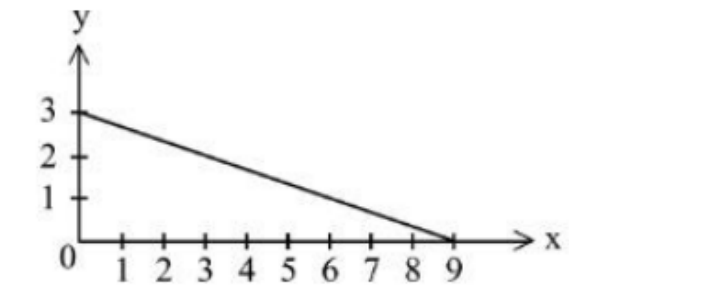
(a) x + 3y = 9 (b) y = x + 3 (c) x + y = 6 (d) x = y + 12
Ans: (a)
Practice more: NIFT Maths Questions.
Logical & Visual Reasoning - sample
Q) Choose the missing term out of the given alternatives in the following alpha-numeric series 2U3,6O9,10I15,14E21 , ?
(a) 15 A 27 (b) 18 C 27 (c) 18 A 27 (d) 15 C 27
Ans: (c)
Q) Identify the next figure in the following series out of the given alternatives,which will continue the figure series:
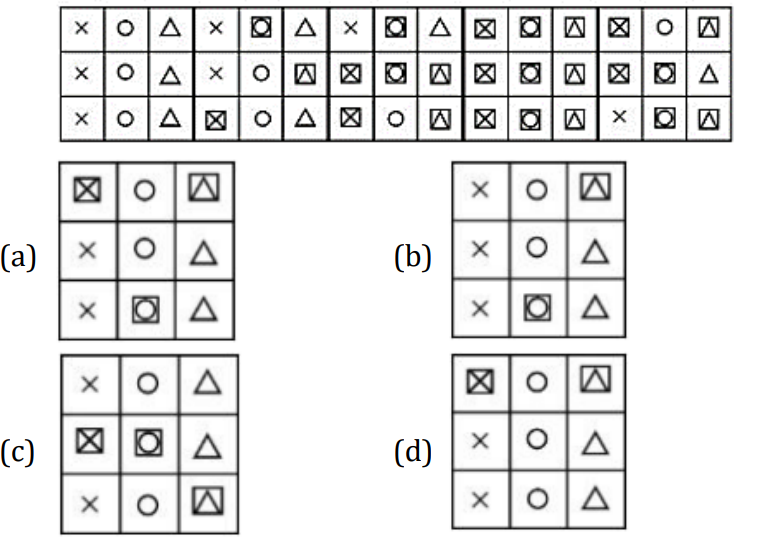
Ans: (a)
Practice more: NIFT Reasoning Questions
English - sample
Q) Fill in the blanks with suitable articles. ________Ganga is considered holy by ________ Hindus.
(a) The, the (b) A, a (c) A, the (d) The, a
Ans: (a)
Q) Choose the most appropriate antonym of the word 'exalt' from the options given below:
(a) rusticate (b) elevate (c) glorify (d) deprecate
Ans: (d)
Practice more: NIFT Communication Ability Questions
Sample Important Current Affairs Questions
Q) India's First Fashion Forecasting Initiative is ________ .
(a) Fashionforcast (b) Visionnext (c) 'VisioNxt' (d) 'Fashionext'
Ans: (c)
Practice more: Monthly Current Affairs for NIFT 2027
NIFT CAT Important Questions 2027
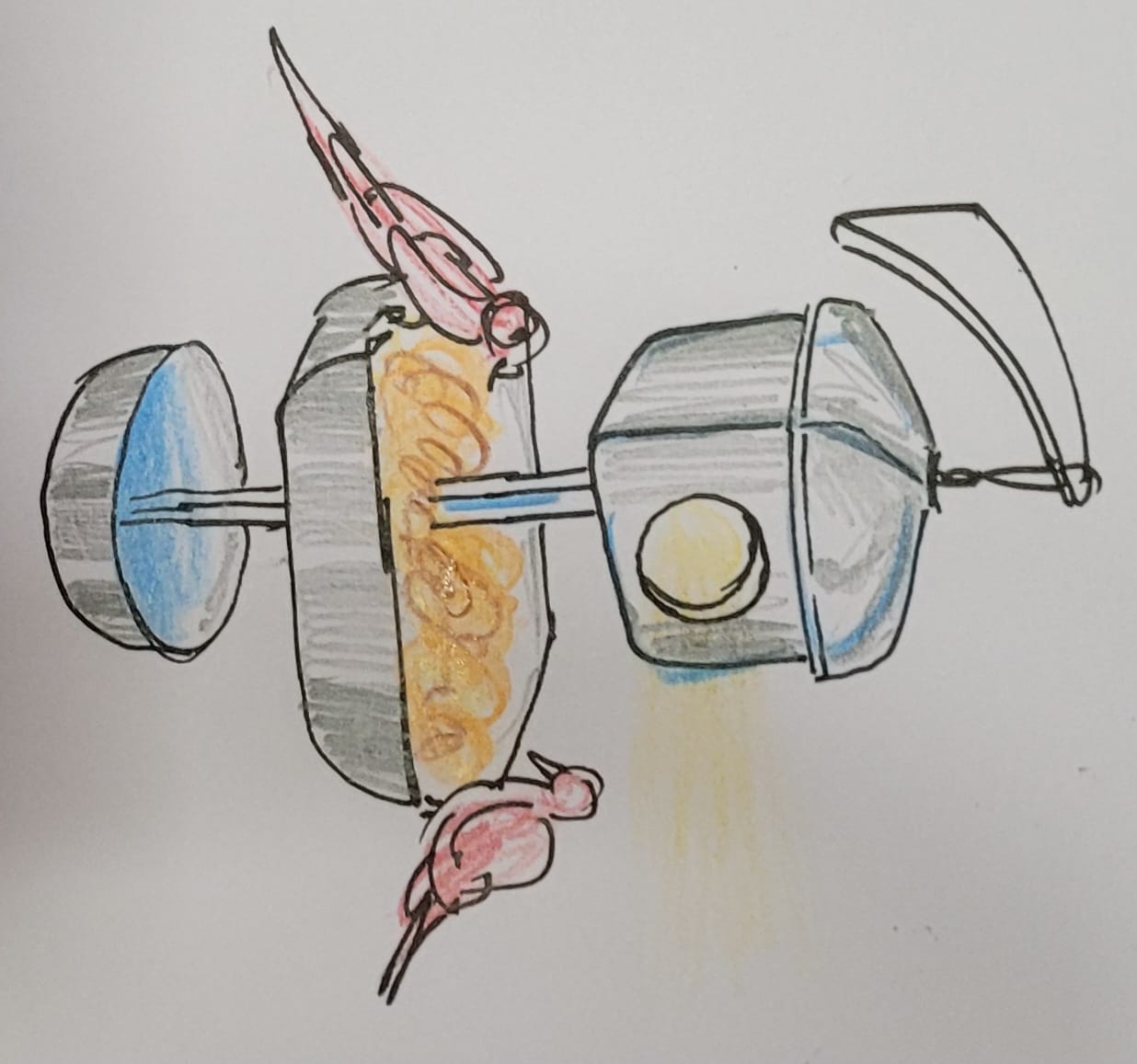
Q) Design a birdfeeder using the following shapes.
All shapes should be used at least once; you can change the size and dimensions but no striking of the shapes. All for outside window.
A. Hanging outside the Window of rooftop restaurant
B. For meditation centre
C. For the author's office.
D. for old age home
Solution:
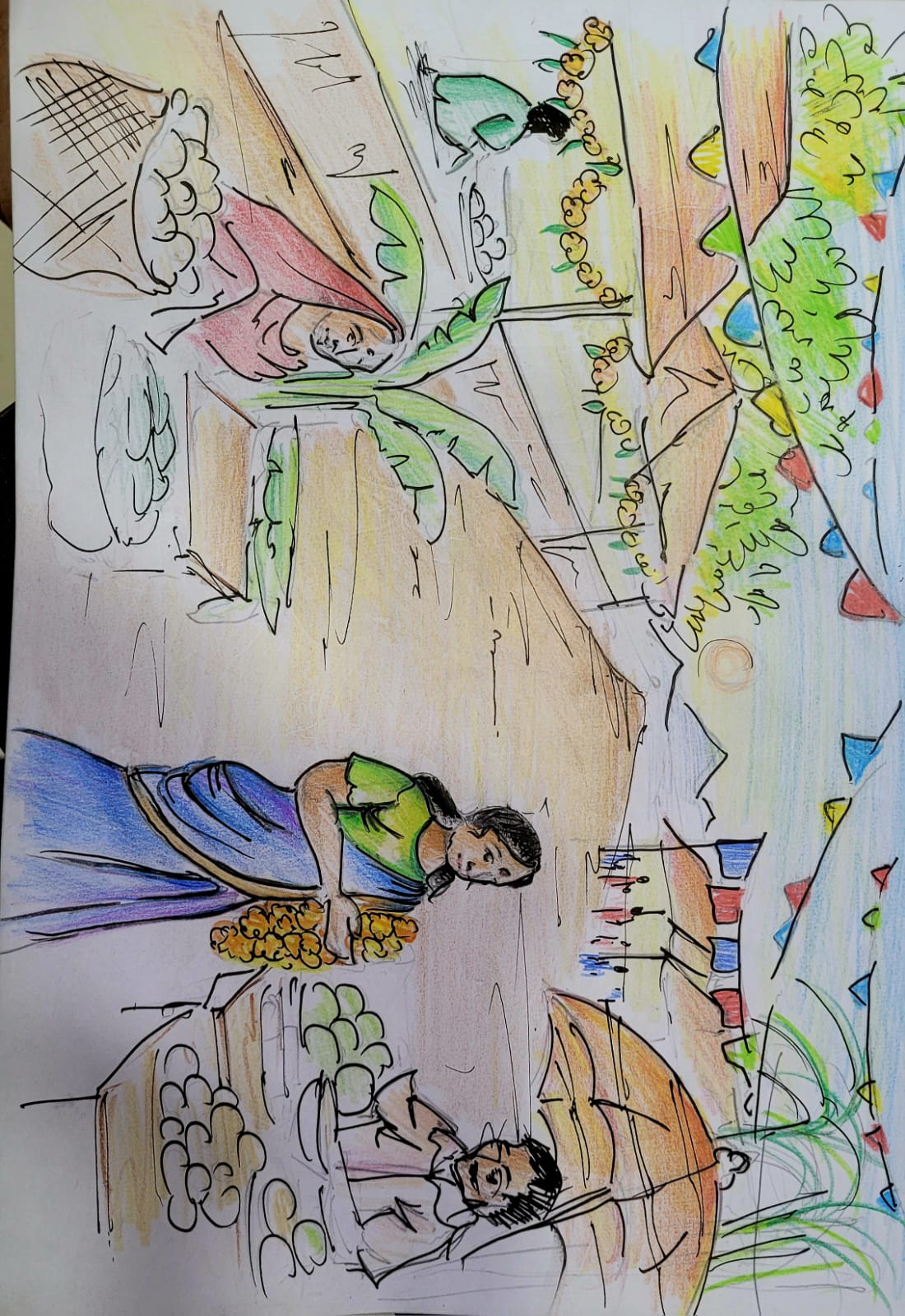
Q) Draw and render any festive season in a A marketplace in village.
Solution:

NIFT 2027 Important Topics - Priority-wise Distribution
The important topics for NIFT 2027 can be strategically divided into high-priority, moderate-priority, and low-priority areas based on analysis of NIFT previous year question papers and alignment with the NIFT entrance exam 2027.
Understanding this priority-wise distribution of important topics for NIFT 2027 helps aspirants allocate preparation time efficiently, avoid over-preparing low-yield areas, and maximize scoring potential in the NIFT entrance exam.
High Priority Topics for NIFT 2027 (Based on PYQs Analysis)
These topics appear consistently across past NIFT question papers and directly impact scoring potential. Every serious aspirant must master these first.
Creative Ability Test (CAT) - High Priority
|
Topic |
Why It’s High Priority |
|
Scene Composition & Visual Storytelling |
Frequently asked drawing themes involve daily life scenarios, user environments, social contexts. |
|
Perspective & Proportion |
Evaluators assess spatial understanding, depth, and realism in sketches. |
|
Product / Space Visualization |
Questions often require designing functional objects or spaces with usability thinking. |
|
Human Figures & Interaction |
Many CAT questions include people performing activities or interacting with objects. |
|
Creativity & Concept Originality |
Repetitive or cliché ideas score lower - originality is critical. |
|
Color Application & Composition Balance |
Judges look for clarity, harmony, and visual hierarchy. |
General Ability Test (GAT) - High Priority
|
Subject |
Important Topics |
|
Quantitative Ability |
Percentages, Ratio-Proportion, Averages, Time & Work, Speed–Distance |
|
Logical Reasoning |
Series, Pattern Recognition, Coding-Decoding, Direction Sense, Seating Arrangement |
|
English Comprehension |
Reading Comprehension, Vocabulary, Error Spotting |
|
General Knowledge |
Current Affairs (last 12 months), Fashion Industry News, Awards, Designers, Brands |
Strong CAT scores also improve your chances of a NIFT scholarship, which is accessible for students on merit after admission.
Moderate Priority Topics for NIFT 2027
These topics appear regularly but with slightly lower weightage. Strong fundamentals are sufficient.
CAT - Moderate Priority
|
Topic |
Focus Area |
|
Shading & Rendering Techniques |
Basic light–shadow understanding |
|
Texture Representation |
Fabric, wood, metal textures |
|
Lettering & Labeling Clarity |
Neat annotations and titles |
|
Basic Storyboarding |
Simple sequencing and narrative flow |
GAT - Moderate Priority
|
Subject |
Important Topics |
|
Quantitative Ability |
Simple Algebra, Number System |
|
Logical Reasoning |
Blood Relations, Venn Diagrams |
|
English |
Sentence Improvement, Synonyms/Antonyms |
|
GK |
Static GK (History, Geography, Culture basics) |
See how these topics actually appeared last cycle in our NIFT exam analysis.
Low Priority Topics for NIFT 2027
These topics appear rarely or carry minimal weight. Do not over-invest preparation time here.
CAT - Low Priority
|
Topic |
Reason |
|
Advanced Art Techniques |
Not evaluated in entrance exam |
|
Hyper-realistic Rendering |
Time-consuming, unnecessary |
|
Complex Perspective Constructions |
Rarely demanded explicitly |
GAT - Low Priority
|
Subject |
Low Priority Areas |
|
Quantitative Ability |
Trigonometry, Calculus, Advanced Algebra |
|
Reasoning |
Puzzles requiring long calculations |
|
GK |
Deep historical facts, obscure trivia |
|
English |
Advanced literature-based questions |
Smart NIFT preparation focuses on mastering high-priority topics first, strengthening moderate areas next, and avoiding over-investment in low-yield topics. This approach maximizes score efficiency for NIFT 2027.
TThis priority-wise distribution of important topics for NIFT 2027 is based on the official exam framework published by NIFT and reinforced through analysis of previous-year CAT and GAT question papers. While the exam framework defines the subject boundaries, past-paper trends highlight which topics may offer greater scoring opportunities.
Knowing the target helps you prioritize - see the expected NIFT cut off for your campus and category.
Important Topics for NIFT 2027 - [B.Des vs M.Des]
Although both undergraduate (B.Des, B.FTech) and postgraduate (M.Des, MFM, M.FTech) aspirants appear for the same NIFT entrance framework, the question intent, evaluation depth, and skill expectations differ significantly at undergraduate and postgraduate levels.
For undergraduate candidates, the exam primarily evaluates drawing fundamentals, visualization ability, creativity, and basic design thinking, whereas M.Des candidates are assessed on concept depth, problem-solving ability, user understanding, visual communication, and design maturity.
This means the important topics for NIFT 2027 are not identical for B.Des/B.FTech and M.Des/MFM/M.FTech preparation, even within the same CAT and GAT sections.
Aspirants who prepare using a generic exam framework often over-focus on the wrong skills for example, M.Des students spending excessive time on artistic detailing instead of concept development, or B.Des students neglecting visualization basics.
Understanding the program-wise topic emphasis helps candidates prioritize the right subjects for NIFT entrance exam, align their preparation with actual examiner expectations, and improve scoring efficiency in the NIFT 2027 exam.
Creative Ability Test (CAT) – B.Des vs M.Des Topic Emphasis Difference
Only B.Des & M.Des aspirants are required to appear for the 3 hour duration CAT paper after the 2 hour long GAT exam. Rest of the course candidates are required to attempt 3 hours GAT exam only.
|
CAT Question Type (Topic) |
B.Des Emphasis |
M.Des Emphasis |
|
Scene Illustration Questions |
Visual storytelling, environment clarity, character placement |
Context logic, activity flow, spatial usability |
|
Product Concept Sketching |
Creativity and form imagination |
Functionality, ergonomics, user relevance |
|
Space Design / Layout Problems |
Basic perspective and neat layout |
Zoning logic, circulation, usability planning |
|
Situation-Based Visual Problems |
Imaginative interpretation |
Problem framing, solution logic |
|
User Interaction Scenarios |
Expressive human figures |
Human-centered design and ergonomics |
|
Theme-Based Composition Tasks |
Creative visual expression |
Concept coherence and narrative intent |
|
Transformation / Before–After Concepts |
Visual impact and creativity |
System thinking and feasibility |
|
Storyboarding / Sequential Visuals |
Clear sequence depiction |
Logical flow and communication clarity |
|
Information Visualization / Explanation Sketches |
Simple labeling |
Structured communication and clarity |
Practise these directly with previous year NIFT drawing questions.
General Ability Test (GAT) – B.Des vs M.Des Topic Emphasis Difference
|
Topic Area |
B.Des/B.FTech Emphasis |
M.Des Emphasis |
|
Quantitative Ability |
Speed, calculation accuracy, fundamentals |
Application-based reasoning, data interpretation |
|
Logical Reasoning |
Pattern recognition and speed |
Analytical depth and decision-making |
|
English Language |
Vocabulary and grammar |
Reading comprehension and inference |
|
General Knowledge |
Broad general awareness |
Fashion, design, and industry knowledge |
|
Current Affairs |
Basic awareness |
Contextual understanding and trend relevance |
|
Exam Strategy |
Attempt maximum questions |
Accuracy-focused intelligent selection |
|
Time Management |
Speed-driven approach |
Strategic prioritization |
Other Relevant Links:
| NIFT CAT Question Paper with Solution | How to Attempt CAT in NIFT |
| NIFT Study Plan | GAT Preparation for NIFT |
| NIFT Drawing Questions | NIFT Sample Papers |
NIFT 2027 Most Important Topics - Preparation Strategy (Topic-wise)
Preparing for the NIFT entrance exam requires a clear understanding of the important topics for NIFT 2027 and a smart, topic-wise preparation strategy rather than random practice.
From sketching, visualization, and design thinking to quantitative aptitude, logical reasoning, English comprehension, and fashion GK questions for NIFT, each topic demands a different preparation approach and time investment. The table below breaks down the subjects for NIFT entrance exam, highlights high-weight topics, and shows exactly how to prepare each area effectively to maximize your score in NIFT 2027.
|
Topic Area |
High-Weight Subtopics |
How to Prepare Strategically |
Weekly Time Focus |
Common Mistakes to Avoid |
|
Creative Ability (CAT) |
Perspective drawing, Human figures, Composition, Storyboarding, Product redesign, Visual problem-solving |
Daily sketching (30-60 min), redraw PYQs, timed sketch drills, idea expansion using SCAMPER, weekly peer review |
6-8 hrs |
Over-detailing drawings, ignoring idea clarity, no time practice |
|
Quantitative Ability (GAT) |
Percentages, Ratios, Averages, Time-Speed-Distance, Data Interpretation |
Formula revision, daily 15-20 mixed problems, weekly timed sets, error-log tracking |
2-3 hrs |
Memorizing without practice, slow calculations |
|
Logical Reasoning (GAT) |
Series, Coding-Decoding, Seating Arrangement, Puzzles, Direction Sense |
Solve 2-3 sets daily, practice elimination techniques, timed drills |
2-3 hrs |
Guesswork without logic, poor time control |
|
English Comprehension (GAT) |
Reading Comprehension, Vocabulary, Grammar, Sentence Correction |
Daily reading, vocabulary notebook, weekly RC practice |
1-2 hrs |
Ignoring RC practice, rote vocab memorization |
|
Fashion & Design GK |
Famous Apparel Designers, Textiles, Indian crafts, Sustainability, Fashion brands, Trend awareness |
Weekly revision notes, visual flashcards, follow fashion news, solve GK quizzes |
1-2 hrs |
Only memorizing lists, ignoring concept understanding |
|
Mock Tests & Analysis |
CAT mock drawings, GAT full papers, Time management |
1-2 mocks/week, deep analysis, improvement tracking |
2-3 hrs |
Skipping analysis, repeating same mistakes |
Final Takeaway
Preparing smartly for Important topics for NIFT 2027 means:
✔️ Knowing what questions are asked in NIFT entrance exam
✔️ Covering both CAT (creative) and GAT (academic) topics
✔️ Practicing with real-exam style PDFs
✔️ Including fashion GK and current affairs in your study plan
With the right topics + preparation plan, you can gain confidence and maximize your NIFT 2027 score!
Preparing for NIFT 2027? We can help you with exact strategic roadmap, study material and crucial feedback required to ace this exam.
Join Creative Edge, India’s best NIFT online coaching and get expert guidance on all NIFT subjects.
You can enroll in offline NIFT batches at your nearest Creative Edge centres also!


1764684691.webp)
Attempt a Free NIFT Mock Test
Fill your details
Frequently Asked Questions
What are the most important topics for NIFT 2027?

What subjects are included in the NIFT entrance exam syllabus 2027?
What questions are asked in the NIFT entrance exam CAT paper?
Are the important topics for NIFT 2027 different for B.Des and M.Des?
How should I prioritize important topics for NIFT 2027 during preparation?
Is there an Important Topics for NIFT PDF available for revision?
How much time is required to cover all important topics for NIFT 2027?

Vineeta Agrawal
Communications Executive
SHARE