
1723534562.png)

NIFT Seats 2027 – Campus-Wise Intake, Category Reservation & Seat Allotment Process
September 21, 2026
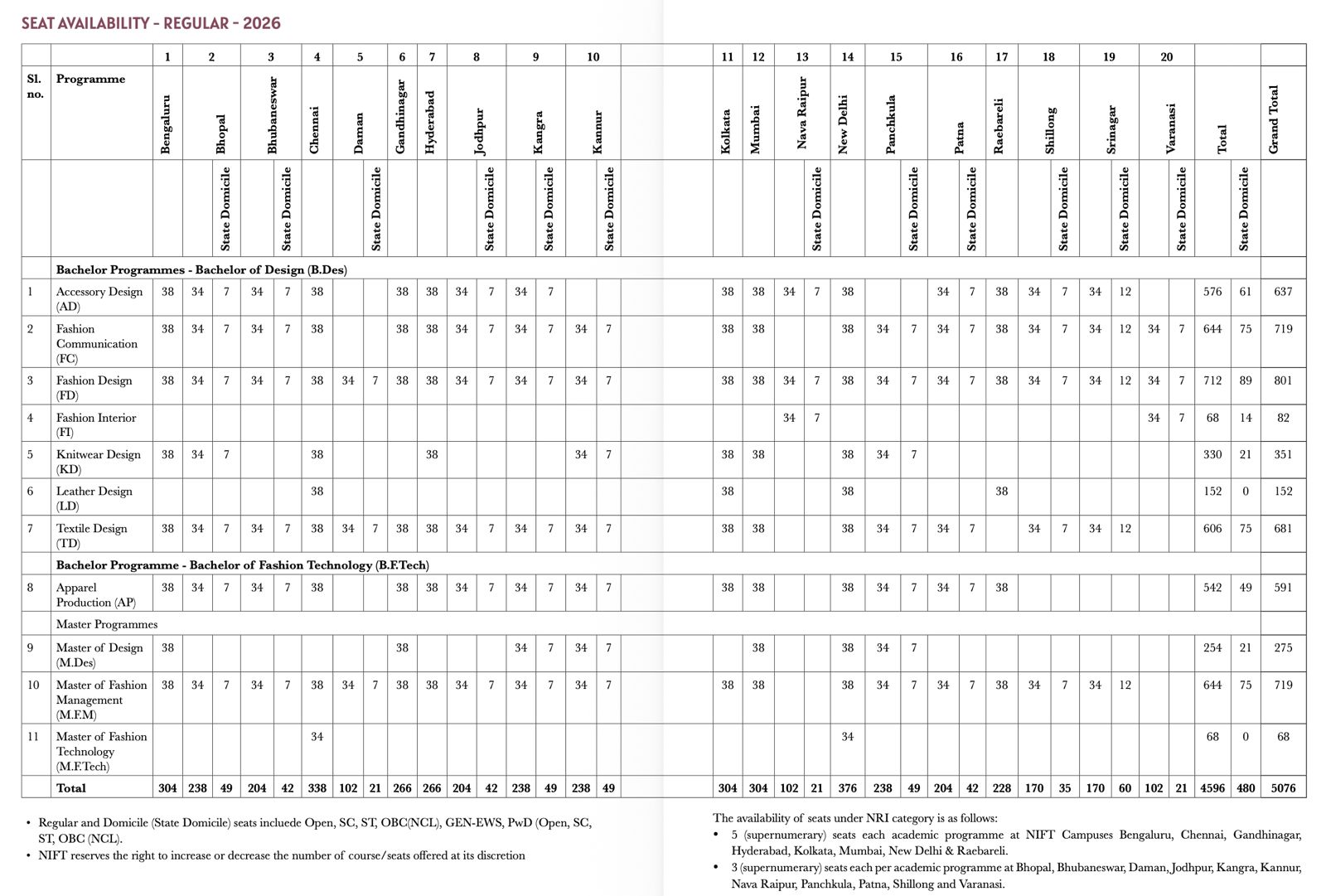
The total NIFT seats available across all 20 campuses are approximately 5076 combined (UG + PG) - Supernumerary NRI/Foreign National seats are additionally available above this regular intake. Seat availability varies by NIFT campus, specialization, and category, with flagship campuses like Delhi, Mumbai, and Bengaluru having competitive intake limits.
Key Highlights - NIFT Seats 2027
- Total NIFT seats include both B.Des, B.FTech, M.Des, M.FTech, and MFM program.
- Seat intake varies campus-wise and specialization-wise.
- NIFT Delhi seats are among the most competitive.
- Category-wise reservation applies as per Government norms.
- Supernumerary seats are available for NRI/Foreign nationals.
- Seat allotment is conducted through centralized counselling rounds.
- NIFT seat allotment depends on rank, category, and preference order.
NIFT 2027 Seat Matrix - Overview
Wondering about how many seats in NIFT? Below is an indicative structure of NIFT total seats distributed across campuses:
Total Seats (All Programs - Regular + State Domicile)
Grand Total: 5076 seats
|
Category |
Seats |
|
Regular Seats |
4596 |
|
State Domicile Seats |
480 |
|
Grand Total |
5076 |
Also Read: Job Opportunities after NIFT


Seat Availability for UG & PG Programs (NIFT 2027)
NIFT seats are distributed across Undergraduate (UG) and Postgraduate (PG) programs at 18 campuses in India. The total intake for 2027 is expected to be the same as in the last completed cycle (2026) 5076 seats, including Regular and State Domicile seats (the 2027 official brochure is awaited; exact number can only be confirmed after).
Undergraduate (UG) Programs – Seat Availability
UG programs include B.Des (7 specializations) and B.F.Tech (1 specialization).
|
Program |
Regular Seats |
State Domicile Seats |
Total Seats |
|
B.Des (All Specializations Combined) |
3088 |
335 |
3423 |
|
B.F.Tech (Apparel Production) |
542 |
49 |
591 |
|
Total UG Seats |
3630 |
384 |
4014 |
B.Des Specialization-wise Seats
|
Specialization |
Total Seats |
|
801 |
|
|
Fashion Communication |
719 |
|
Textile Design |
681 |
|
Accessory Design |
637 |
|
Knitwear Design |
351 |
|
Leather Design |
152 |
|
Fashion Interior |
82 |
Highest intake: Fashion Design
Lowest intake: Fashion Interior & Leather Design (high competition)
Check: How to Get Scholarship in NIFT
Postgraduate (PG) Programs - Seat Availability
PG programs include M.Des, M.F.M, and M.F.Tech.
Total PG Seats
|
Program |
Regular Seats |
State Domicile Seats |
Total Seats |
|
M.Des |
254 |
21 |
275 |
|
M.F.M |
644 |
75 |
719 |
|
M.F.Tech |
68 |
0 |
68 |
|
Total PG Seats |
966 |
96 |
1062 |
Highest PG intake: M.F.M
Lowest PG intake: M.F.Tech (limited availability, highly competitive)
Read: How to Create an Effective Fashion Portfolio as a NIFT Student
UG vs PG Seat Comparison
|
Level |
Total Seats |
Percentage of Total Intake |
|
Undergraduate |
4014 |
~79% |
|
Postgraduate |
1062 |
~21% |
|
Grand Total |
5076 |
100% |
NIFT Seat Matrix in Previous Years
Understanding historical data helps estimate trends.
|
Year |
Approx Total Seats |
Observations |
|
2023 |
~4,500 |
Stable intake across campuses |
|
2024 |
~4,700 |
Minor increase in select campuses |
|
2025 |
~4,800 |
Incremental seat growth |
|
2026 (Expected) |
5076 |
New campus added, seats increased |
|
2027 (Epected) |
Likely similar to 2026 |
Seat expansion typically occurs in newer campuses.
Also Check: High Salaries After NIFT Exam
Admission Process for NIFT Seats - How Are Seats Allotted?
Understanding how NIFT seats are allotted is crucial if you want to secure admission into your preferred campus and course. The NIFT seat allotment process 2027 is completely merit-based and conducted through centralized online counselling.
Below is a step-by-step breakdown of how NIFT seats are allocated.
Step 1: Qualify the NIFT Entrance Exam
Admission to NIFT seats begins with clearing the entrance examination:
|
Program |
Selection Stages |
|
B.Des |
NIFT CAT + GAT + Situation Test |
|
B.F.Tech |
GAT only |
|
M.Des |
CAT + GAT + Interview |
|
M.F.M |
GAT + Interview |
|
M.F.Tech |
GAT + Interview |
Final merit ranks are prepared based on weighted performance across stages.
Check: NIFT Year-wise Exam Analysis
Step 2: Merit Rank Generation
After evaluation:
- Separate All India Ranks (AIR) are generated.
- Category-wise ranks are prepared (General, OBC-NCL, SC, ST, EWS, PwD).
- Campus and program eligibility depend on your rank.
Higher rank = Better chances of getting preferred NIFT seats.
Step 3: Online Registration for NIFT Seat Allotment
Qualified candidates must:
- Register on the official counselling portal
- Fill preferred campus and program choices
- Lock choices before the deadline
This stage directly affects how NIFT seats are allotted.
Step 4: Choice Filling & Locking
Candidates must:
- Arrange campuses in order of preference
- Select specific courses
- Carefully review category and domicile eligibility
Seat allocation depends on:
- Rank
- Category reservation
- Seat availability
- Preference order
Check: NIFT Exam Pattern
Step 5: Round-wise NIFT Seat Allotment
NIFT conducts multiple rounds of counselling.
|
Round |
What Happens |
|
Round 1 |
Highest ranks get top preferences |
|
Round 2 |
Upgraded seats if vacancies remain |
|
Round 3 |
Remaining seat redistribution |
|
Spot Round (if applicable) |
Filling leftover vacancies |
Candidates can:
- Accept the allotted seat
- Opt for upgradation
- Withdraw (as per rules)
Step 6: Payment & Document Verification
To confirm your NIFT seat allotment, you must:
- Pay the prescribed admission fee
- Upload required documents
- Complete physical verification (if required)
Failure to comply leads to cancellation of allotted seat.
Check: Expected NIFT 2027 Cut Off


Key Factors That Decide NIFT Seat Allotment
The NIFT seat allotment process is centralized, rank-based, and preference-driven. Smart choice filling and category awareness are just as important as scoring high in the exam.
- Final Merit Rank
- Category Rank
- Campus Preference Order
- Seat Matrix Availability
- Reservation & Supernumerary Policy
Read more: Job opportunities and salary after NIFT
NIFT Category-Wise Seat Intake
Category reservation applies to NIFT seats for general category, OBC, SC, ST, EWS, and PwD as per norms.
|
Category |
Reservation Percentage |
|
General |
~40-45% |
|
OBC (Non-Creamy Layer) |
27% |
|
SC |
15% |
|
ST |
7.5% |
|
EWS |
10% |
|
PwD |
5% horizontal |
(Exact numbers vary based on total intake per campus.)
Check: How to Prepare for NIFT Entrance Exam
Reservation Structure Overview
As per Government of India norms followed by NIFT:
|
Category |
Reservation % |
|
OBC-NCL |
27% |
|
SC |
15% |
|
ST |
7.5% |
|
EWS |
10% |
|
PwD |
5% (Horizontal) |
After reserved categories are allocated, the remaining seats fall under the Unreserved (General) category.
General category candidates compete for:
- Open seats (non-reserved)
- Remaining unfilled reserved seats (after rounds)
If you're applying under the General category, understanding how NIFT seats for General category are distributed is crucial for planning your target rank and campus preference strategy.
Check: How to Prepare for the NIFT Situation Test?
How Many NIFT Seats Are Available for General Category?
Since reserved seats collectively account for a significant percentage, roughly 40-45% of total NIFT seats are available under the General category (subject to program and campus-wise variation).
Actual numbers depend on:
- Total seats in NIFT 2027
- UG vs PG program distribution
- Supernumerary seats (NRI / Foreign Nationals)
- Campus-specific intake
NIFT Seats for General Category = Campus Trend
Highly competitive campuses such as:
- NIFT Delhi
- NIFT Mumbai
- NIFT Bengaluru
have fewer effective seats available for the General category due to high demand and reservation distribution.
Popular programs like Fashion Design and Fashion Communication close at much higher ranks for General candidates compared to other categories.
Estimated General Category Seat Distribution (UG Programs)
|
Program Type |
Approx % of Seats for General |
|
B.Des Programs |
~40-45% |
|
B.F.Tech |
~40-45% |
|
M.Des |
~40-45% |
|
MFM / MFT |
~40-45% |
(Exact numbers vary campus-wise as per official seat matrix.)
Also Read: NIFT Placements
What Rank Is Required for NIFT Seats for General Category?
If you're targeting NIFT seats for General category, especially in top campuses like NIFT Delhi and NIFT Mumbai, here’s what the 2025 Round 1 & Round 3 data indicates for B.Des programs.
NIFT Delhi – General Category (All India Quota)
|
Program |
Round 1 Closing Rank |
Round 3 Closing Rank |
|
Fashion Communication |
54 |
— |
|
Fashion Design |
86 |
— |
|
Accessory Design |
151 |
155 |
|
Textile Design |
302 |
324 |
|
Knitwear Design |
448 |
539 |
|
Leather Design |
800 |
967 |
|
B.F.Tech (Apparel Production) |
41 |
— |
Insight:
To secure a top B.Des seat in NIFT Delhi (Fashion Design / Fashion Communication) under General category, you typically need a rank under 100. For other design specializations, a rank under 300–500 keeps you competitive.
Check: NIFT Previous Year Question Papers PDF
NIFT Mumbai – General Category
|
Program |
Round 1 Closing Rank |
Round 3 Closing Rank |
|
Fashion Communication |
79 |
— |
|
Fashion Design |
141 |
— |
|
Accessory Design |
187 |
— |
|
Textile Design |
477 |
— |
|
Knitwear Design |
577 |
655 |
|
B.F.Tech (Apparel Production) |
93 |
124 |
Insight:
For NIFT Mumbai seats, a rank under 150 is typically required for core programs like Fashion Design. Broader options open up till around 600-650 rank depending on specialization and round movement.
Check: Life at NIFT
Other Top Campuses – Fashion Design (General Category)
|
Campus |
Round 1 Closing Rank |
Round 3 Closing Rank |
|
NIFT Bangalore |
232 |
253 |
|
NIFT Chennai |
471 |
521 |
|
370 |
— |
|
|
NIFT Kolkata |
669 |
732 |
Insight:
For Fashion Design in other major campuses:
- Rank under 250 → Strong chance at Bangalore
- Rank under 400–500 → Chennai / Hyderabad
- Rank under 700+ → Kolkata and similar campuses
Final Takeaway
|
Campus Type |
Safe Rank Target (General Category) |
|
NIFT Delhi (Top Programs) |
Under 100 |
|
NIFT Mumbai |
Under 150 |
|
Top Tier Campuses (Bangalore, Chennai) |
Under 250-400 |
|
Mid Tier Campuses |
Under 600-750 |
Learn more: Which NIFT campus is better?


NIFT Delhi Seats – How Many Seats Are There in NIFT Delhi?
Approximate intake:
|
Program |
Seats |
|
B.Des |
240 |
|
B.FTech |
60 |
|
M.Des |
60 |
|
M.FTech |
30 |
|
MFM |
60 |
|
Total |
~450 |
Because of reputation and placement records, NIFT Delhi sees intense competition.
Check: All About NIFT Syllabus
NIFT Seat Allocation Rules
- Allotment strictly based on merit rank.
- Category rules applied before allocation.
- If candidate upgrades seat, previous allotment gets cancelled.
- Failure to pay fee within deadline leads to cancellation.
- Sliding option may be available in later rounds.
Supernumerary NIFT Seats
Supernumerary seats are additional seats beyond regular intake.
Categories:
- NRI Candidates
- Foreign Nationals
- SAARC Applicants
These seats do not reduce domestic category seats.
Supernumerary intake is limited and separate counselling applies.
Check: NIFT Fee Structure
Important Factors That Affect NIFT Seat Allotment
|
Factor |
Impact |
|
Rank |
Primary determinant |
|
Category |
Determines eligibility pool |
|
Campus Popularity |
High demand affects cutoff |
|
Program Demand |
Fashion Communication, Design, and Management often high demand |
|
Withdrawal & Upgradation |
Affects seat movement |
Read more: Basic differences between NID and NIFT exams
How Many Seats Are There in NIFT Delhi Compared to Other Campuses?
NIFT Delhi has one of the highest seat intakes among all campuses, especially in core B.Des and postgraduate programs.
NIFT Delhi Seat Intake (as of September 2026)
|
Program |
Total Seats (Regular + State Domicile) |
|
B.Des – Accessory Design |
38 |
|
B.Des – Fashion Communication |
38 |
|
B.Des – Fashion Design |
38 |
|
B.Des – Textile Design |
38 |
|
B.F.Tech – Apparel Production |
38 |
|
M.Des |
38 |
|
M.F.M |
38 |
|
M.F.Tech |
34 |
Total Seats at NIFT Delhi (All Programs Combined): 376 Regular + 49 State Domicile = 425
Comparison with Other Major Campuses
|
Campus |
Total Seats (All Programs Combined) |
|
New Delhi |
376 + 49 = 425 |
|
Bengaluru |
304 |
|
Chennai |
338 |
|
Mumbai |
304 |
|
Hyderabad |
266 |
|
Gandhinagar |
266 |
|
Kolkata |
238 |
|
Raebareli |
228 |
Key Insights
- NIFT Delhi has the highest seat intake among most NIFT campuses.
- It offers all major UG and PG programs, unlike some campuses that offer limited specializations.
- Delhi also has NRI supernumerary seats (5 per academic program) as mentioned in the seat matrix .
- Due to higher demand and national preference, cutoffs for NIFT Delhi are generally among the highest.
If you're targeting NIFT seats in Delhi, it is important to aim for a strong rank, especially for Fashion Design and Fashion Communication, which are highly competitive.
Check: NIFT Results here
Strategy for Securing NIFT Seats in 2027
- Target higher final weighted score (CAT + GAT + Situation Test).
- Fill maximum realistic campus preferences.
- Participate in all counselling rounds.
- Monitor upgrade opportunities.
- Be aware of category-based cutoffs.
Check: NIFT 2027 Important Drawing Questions
Summary - Understanding NIFT Seats 2027
- Total NIFT seats are distributed across 18 campuses.
- UG programs have higher intake than PG programs.
- Category reservations significantly impact seat allocation.
- NIFT Delhi seats remain the most competitive.
- Supernumerary seats offer additional opportunities.
- Seat allotment is merit-based and centralized.
Preparing for NIFT 2027 OR 2028? We can help you with exact strategic roadmap, study material and crucial feedback required to ace this exam.
Join Creative Edge, India’s leading NIFT online coaching and get expert guidance on all NIFT subjects.
You can enroll in offline NIFT batches at your nearest centres also!
1764684691.webp)
Attempt a Free NIFT Mock Test
Fill your details
Frequently Asked Questions
How many seats are there in NIFT 2026?

How many seats are there in NIFT Delhi?
How are NIFT seats allotted?
How many NIFT seats are available for General category?
Are there supernumerary seats in NIFT?
Do NIFT seats increase every year?

Vineeta Agrawal
Communications Executive
SHARE