
1723534562.png)

NID 2026 Question Paper with Solutions PDF (Memory-Based)
October 14, 2026
The NID 2026 question paper was 100% drawing-based - for the first time ever, NID DAT Prelims had no aptitude (GAT) section. It carried 6 design questions with multiple sub-parts, testing visual storytelling, product thinking, symbolism and social awareness.
NID never releases the official paper, so this memory-based NID 2026 question paper with solutions is reconstructed by our NID experts from verified student recall - is the closest, most accurate version available.
Below you'll find all 6 questions, expert model-solution approaches, and a downloadable PDF for NID 2027 and 2028 practice.
NID 2026 Question Paper with Answers PDF Download
| NID Question Paper 2026 & Answer Key | Download Link |
|---|---|
| NID 2026 Question Paper PDF | |
| NID 2026 Paper Solution |
Is the Official NID 2026 Paper Released?
No. NID does not release the question papers, answer key, or solutions officially on it's website due to the subjective nature of the exam. The institute has clearly stated that:
- The NID question paper 2026 will not be shared
- The NID 2026 answer key is not published
- Evaluation criteria and model answers remain confidential
To bridge this gap, our in-house NID experts reconstructed a memory-based NID question paper 2026 with solutions using verified student recall from multiple exam centers, aligned to the actual NID DAT 2026 Prelims paper.
- Student Recall Verification: Our experts collected detailed question recall from multiple NID 2026 exam centers and cross-verified them to reconstruct the most accurate version of the NID 2026 question paper.
- Pattern & Instruction Matching: Each reconstructed question was aligned with the actual paper instructions, marks distribution, and drawing-only format observed in NID DAT 2026.
- Examiner-oriented Solutions: Model solutions were created by experienced NID mentors, focusing on idea clarity, logic, and visual communication-the key evaluation criteria used by NID examiners.
- Realistic Scoring Approach: Solutions reflect high-scoring answer approaches, not idealized artwork, ensuring aspirants understand what genuinely works in the NID exam.
Unlike a plain answer key, this NID question paper 2026 with answers PDF shows you how to approach each question - the idea, the structure, and the scoring logic - so it works as a practice tool for NID 2027 and 2028, not just a post-exam checklist.
NID 2026 Question Paper (Prelims) - Quick Overview
|
Detail |
NID DAT 2026 Prelims |
|
Exam date |
21 December 2025 |
|
Total questions |
6 drawing/design questions (multiple sub-parts each) |
|
Total Marks |
100 |
|
Total Duration |
3 Hours |
|
Mode |
Pen-and-paper, subjective |
|
GAT / aptitude (Part A) |
Removed for the first time - 0 questions |
|
Skills tested |
Visual storytelling, product thinking, symbolism, social awareness, user-centric design |
|
Official paper released? |
No - NID never publishes it |
|
Best available reference |
This memory-based paper with expert solutions |
Before solving the paper, it's helpful to understand the latest NID exam pattern, including the marking scheme, question types, and section-wise weightage, to analyse your performance more effectively.
How NID 2026 Compares With 2024 & 2025 Papers?
The 2026 paper didn't appear out of nowhere - it was the end-point of a multi-year shift away from aptitude and toward pure creativity.
|
Year |
Part A (GAT/aptitude) |
Part B (drawing/creative) |
Big shift |
|
2024 |
Present (MCQs: GK, reasoning) |
Present |
Balanced |
|
2025 |
Reduced weight |
Dominant |
Creativity-heavy |
|
2026 |
Removed entirely |
100% of the paper |
Fully drawing-based |
What this trend tells a 2027 aspirant: even if NID reintroduces some aptitude, the core skill being rewarded is idea-led visual communication. Build that first. See our year-wise NID question papers to trace the shift yourself.
NID 2026 Question Paper - List of All Questions with Expert Solutions
The paper was completely drawing-based and tested aspirants on visual storytelling, product thinking, social awareness, symbolism, and functional design.
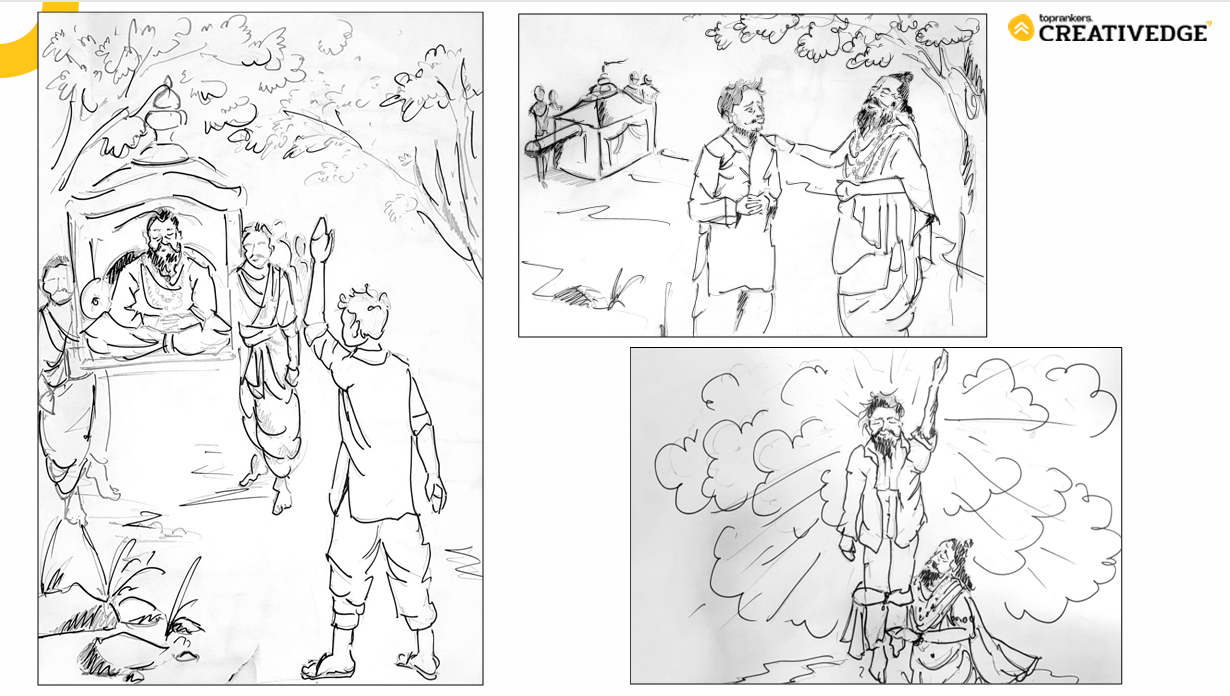
Question 1: Visual Storytelling Through Illustration
A Guruji is travelling in a palki along a pathway, accompanied by his group of disciples and followers. As the procession moves forward, an idiot man suddenly stands in the middle of the path and stops the palki. He insists that the Guruji must come down and meet him; only then will he allow the group to proceed. The followers consider the man foolish and try to ignore him.
Observing this, the Guruji calmly steps out of the palki and approaches the man. The man respectfully asks,
“Guruji, can you please show me the way to heaven?”
The Guruji replies simply, “The path to heaven is very easy. Raise your hand towards the sky and stand here at this very place.”
The Guruji and his followers then continue their journey, leaving the man standing there with his hand raised. After twelve years, the Guruji passes through the same place again. He notices the same man still standing in the exact position. However, the man’s appearance has changed, his beard has grown long and dense, his clothes are torn, dusty, and grey, showing the passage of time.
The Guruji steps closer and realizes that the man’s soul is now leaving his body and rising towards the sky. Understanding that the man has attained heaven through devotion and patience, the Guruji immediately holds onto the man’s feet. As the soul ascends, both the Guruji and the man are lifted together, moving towards heaven.
Task: Illustrate three key scenes from a story involving a Guru and an “idiot man”, highlighting transformation over time.
What NID Tested:
- Story comprehension
- Sequential visual narration
- Character consistency
- Emotional progression
Expert Solution Insight: High-scoring responses clearly differentiated:
- Beginning (conflict)
- Middle (devotion and time lapse)
- End (spiritual resolution)
Solution:
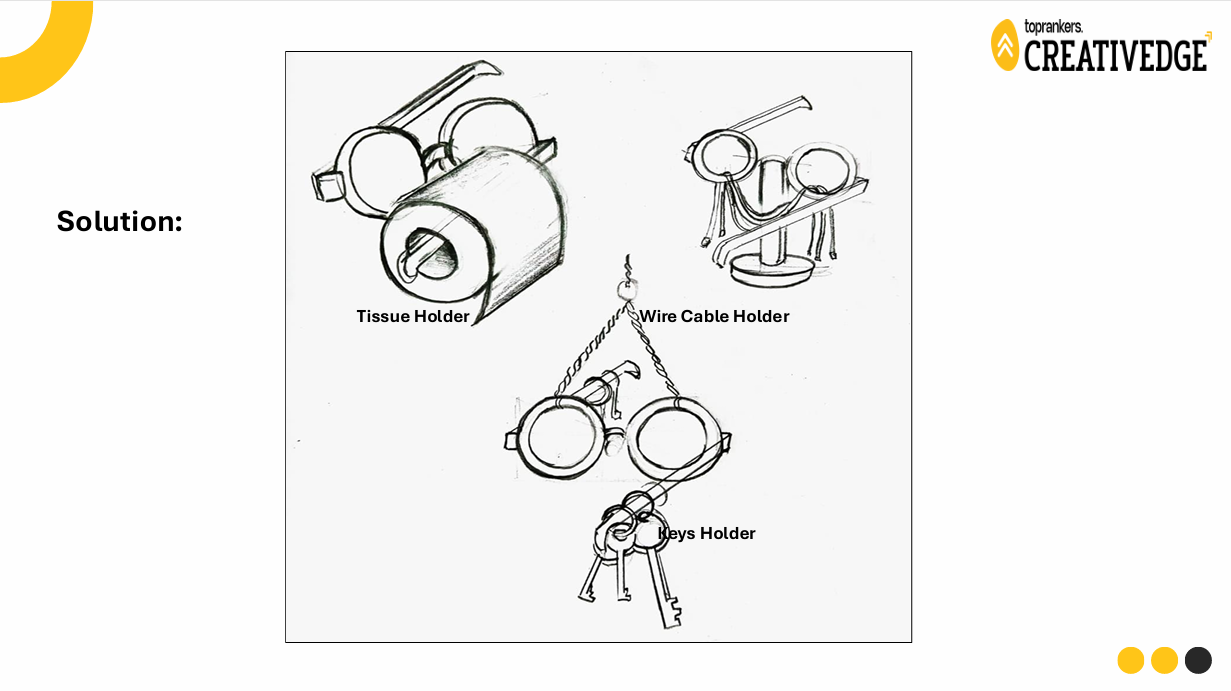
Question 2: Alternative Uses of a Given Product (15 Marks)
Using the given rigid plastic product (approximately 1 ft in size), illustrate three different functional uses of the same product.
Expert Insights for Solution
High-scoring answers in this question showed:
- Clear functional logic (why the product works for that use)
- Everyday relevance (uses that feel realistic, not forced)
- Minimal but readable sketches with labels
NOTE: Solutions are reviewed by Creative Edge's NID mentor panel - design educators who evaluate NID-style answers and have guided students into NID Ahmedabad, Gandhinagar & Bangalore.
Toprankers Tips: Time Management Tips for NID 2027
Question 3: Opinion + Visual Communication
Solar energy helps in reducing air pollution and harmful gas emissions. However, solar panels are manufactured using lithium, which is a limited and non-renewable mineral resource.
a) Write your opinion on this issue.
b) Draw three visual posts for social media to create awareness about the benefits and challenges of solar energy.
What NID Question Paper 2026 Tested:
- Balanced thinking
- Ability to translate opinion into visuals
- Social awareness
Themes Used in Model Answers:
- Reducing carbon footprint
- Promoting solar cooking
- Highlighting pollution caused by thermal power
Expert Insights for Solution:
Part (a): Opinion Writing
Strong answers:
- Acknowledged both benefits and limitations
- Avoided extreme opinions
- Showed solution-oriented thinking
Example approach:
- Accept solar energy as necessary
- Highlight need for sustainable alternatives or recycling of lithium
Part (b): Visual Posts
High-scoring visuals:
- Had one clear message per post
- Used symbols and metaphors instead of text-heavy explanations
- Maintained consistency across all three visuals
(For complete drawn solution of this question, click the button at the end of the section.)
Question 4: Child Safety Design Problem (15 Marks)
Design three safety solutions (other than seat belts) for bus seats that can help prevent injuries to children.
Evaluation Focus:
- Empathy-driven design
- Safety logic
- Age-appropriate solutions
Expert Insights for Solution
Top answers showed:
- Clear understanding of how children get injured
- Solutions tailored specifically for child users, not adults
Examples of strong approaches:
- Soft padding on impact-prone areas
- Structural seat modifications
- Supportive contours for posture and stability
What to avoid:
- Repeating seat belt–like ideas
- Generic safety features with no child-specific logic
Scoring Tip:
Explain why your solution prevents injury, not just what it is.
(For complete drawn solution of this question, click the button at the end of the section.)
Include these questions in your NID 2027 study plan and practice them under timed conditions just like real exam.
Question 5: Product Redesign for Different Users (15 Marks)
Redesign a water bottle for the following users:
- Hospital patient
- Restaurant use
- Family get-together
Instructions:
- Draw three separate product views
- Do not draw any background
- Clearly show user-specific functional features
- Use clean lines and minimal shading
- Briefly describe each design idea
What NID Question paper 2026 Tested:
- User-centric design thinking
- Ability to adapt one product for different contexts
- Clarity of visual communication
Expert Insights for Solution
High-scoring answers:
- Treated each user as a separate design problem
- Focused on function first, aesthetics second
What worked well:
- Hospital: easy grip, controlled flow, hygienic features
- Restaurant: elegant form, easy pouring, spill control
- Family use: larger capacity, durability, shared usability
What to avoid:
- Same bottle with minor cosmetic changes
- Over-designing details
Scoring Tip:
Clear differentiation between users is critical for marks.
(For complete drawn solution of this question, click the button at the end of the section.)
Check: Two Point Perspective PYQs with Solutions
Question 6: Symbolism & Conceptual Drawing (20 Marks)
Draw a hand (up to the wrist) holding one of the following objects to create a meaningful visual metaphor.
Add a title or caption and describe the image in not more than 200 words.
Objects:
- Hammer
- Plant
- Rope
Add:
- A meaningful title/caption
- A written description (under 200 words)
What NID Question Paper 2026 Evaluated:
- Symbolic thinking
- Metaphor usage
- Concept clarity
Expert Insights for Solution
High-scoring responses:
- Used simple compositions with strong meaning
- Clearly connected the object to an abstract idea
Examples of strong symbolism:
- Hammer: power, justice, destruction vs creation
- Plant: growth, hope, sustainability
- Rope: bondage, connection, rescue, or struggle
What to avoid:
- Literal or decorative drawings
- Overcomplicated scenes
Scoring Tip:
A simple image with a strong idea scores higher than a complex drawing with weak meaning.
(For complete drawn solution of this question, click the button below.)
Check: Download NID Subjects-wise Syllabus for 2027
NID 2026 Question Paper Analysis
The NID 2026 question paper marked a landmark change in the exam pattern, as the entire DAT Prelims paper was drawing-based. For the first time, NID completely removed the aptitude section and evaluated candidates purely on visual thinking, creativity, and design reasoning.
Based on student recall and expert analysis, the NID 2026 Prelims paper:
- Consisted of 6 major drawing questions, each with multiple sub-parts
- Tested visual storytelling, product thinking, symbolism, and social awareness
- Was lengthy and execution-heavy, making time management a critical challenge
- Focused more on clarity of ideas and relevance rather than artistic perfection
Overall, the paper clearly rewarded aspirants who could think fast, sketch clearly, and communicate ideas visually under pressure.
Read the full NID 2026 exam difficulty analysis for details on difficulty level, good attempts, etc.
NID 2026 Prelims - Nature of Questions Asked
The table below summarizes the nature and intent of questions asked in NID 2026 Prelims, based on memory-based reconstruction and expert evaluation.
|
Question Type |
What Was Asked |
What NID Tested |
|
Visual storytelling |
Illustrating scenes from a given story |
Narrative flow, consistency, emotional expression |
|
Functional creativity |
Alternative uses of a given product |
Practical thinking, usability, form understanding |
|
Opinion + visuals |
Writing an opinion and creating awareness visuals |
Balanced thinking, visual communication |
|
Safety-based design |
Child safety solutions for bus seats |
Empathy, user-centric problem solving |
|
Product redesign |
Redesigning a bottle for different users |
User analysis, functional differentiation |
|
Symbolic drawing |
Hand holding an object with metaphorical meaning |
Abstract thinking, symbolism, concept clarity |
Key Observation:
Most questions required a combination of thinking + drawing, not just sketching skill.
NID 2026 Question Paper Pattern
The NID 2026 question paper marked a historic shift in the exam pattern. For the first time in the exam's history, the GAT (General Ability Test / aptitude section was completely removed.
The entire NID DAT 2026 question paper consisted only of drawing-based and visual tasks, making it a purely creative, skill-oriented examination.
Key Highlights of the NID 2026 Question Paper Pattern
- The paper included only drawing and visualization questions
- No aptitude-based questions such as logical reasoning, GK, quantitative ability, or objective MCQs were asked
- All questions required sketching, visual storytelling, observation, and idea development
- Each question had multiple sub-parts, increasing time pressure
- The paper was lengthy and execution-heavy, testing stamina and speed
- Focus shifted strongly to:
- Observation skills
- Conceptual clarity
- Visual communication
- Creative thinking under time constraints
This change made NID 2026 one of the most unconventional DAT papers ever conducted, and significantly raised the importance of consistent drawing practice and ideation skills.
What This Change Means for Aspirants
The removal of the GAT section means that:
- Strong aptitude alone was not sufficient
- Candidates who relied heavily on logic or GK-based preparation were disadvantaged
- Students with daily drawing practice, fast ideation ability, and clear visual expression had a clear edge
This pattern shift also signals that future NID exams (2027 onwards) may continue to experiment with creativity-heavy formats, making drawing and design-centric preparation non-negotiable.
Why Analyzing the NID 2026 Question Paper Is Crucial
Since the NID 2026 question paper was entirely drawing-based, analyzing:
- Question types
- Sub-part structure
- Time vs execution demand
- Evaluation expectations
becomes extremely important for aspirants preparing for NID 2027 and NID 2028.
Our memory-based NID 2026 question paper with solutions, curated using student recall and expert review, reflects this new reality and helps aspirants adapt their preparation accordingly.
Since the paper is pure drawing, build the fundamentals with our tips to improve drawing skills for NID.
NID 2026 Cut Off - What a Qualifying Attempt Looked Like
Since GAT was completely removed, the cut-off depended purely on creative clarity, idea relevance, and completion level in the drawing questions. This means that no one can honestly publish exact category-wise cut-off marks for DAT Prelims 2026 - anyone showing precise numbers is guessing.
What we can share, from student recall and mentor evaluation, is the attempt quality that separated qualifiers from non-qualifiers.
| Category | Indicative qualifying benchmark (attempt quality) | Trend insight |
|---|---|---|
| Open / General | Strong, complete answers on at least 4-5 of 6 questions with clear ideas | Slight moderation expected due to lengthy, drawing-only paper |
| OBC-NCL | Complete, logical answers on 4 of 6 | Typically qualifies a notch below Open |
| EWS | Similar to OBC-NCL | Aligns closely with OBC-NCL |
| SC | 3-4 well-communicated answers | Consistent performers benefit from the drawing-only format |
| ST | 3 clear, idea-led answers | Lower bar due to high execution pressure |
| PwD | Varies with applicant pool each year | Depends on number of applicants |
However, if a range has to be guessed- based on experts' evaluation, it should fall anywhere between 48-50 marks in Prelims.
Apart from this, NID did release the final cut off - Final score and final rank of the last candidate admitted in NID colleges for all categories. NID Ahmedabad closed on Open rank 47 and score 67.28. For more details check - NID DAT cut off.
Does the NID 2026 Question Paper Indicate Future Exam Trends?
The NID 2026 question paper alone does not guarantee that future NID exams will be completely drawing-based, unless NID officially announces such a change. Historically, NID has been unpredictable and has frequently modified its exam pattern.
However, what can be confidently observed is a long-term trend in NID exam history. Over the years, the weightage of NID CAT questions (creative and drawing-based evaluation) has consistently increased from around 60% to 70%, and now effectively 100% in NID 2026 Prelims, while the role of GAT has gradually reduced.
This clearly indicates that design thinking, sketching ability, visual communication, problem-solving, and the ability to express ideas clearly in fewer words will always remain non-negotiable skills for NID aspirants, regardless of future pattern changes.
For students preparing for NID 2027 and 2028, focusing on these core design skills is the safest and smartest preparation strategy - even if the exam pattern evolves again.
Even in a drawing-heavy era, keep NID GK questions ticking over in case aptitude returns.

How to Use the NID 2026 Question Paper for NID 2027 & 2028 Preparation
Don't treat this as a past paper to read once. Use it as a six-step practice loop for NID 2027 and 2028.
|
# |
Step |
What to do |
Why it works |
|
1 |
Understand the shift first |
Before drawing anything, absorb what changed in 2026: no GAT/aptitude, 100% drawing-based, multiple sub-parts per question. Treat it as a signal of where NID is heading, not a one-off. |
Stops you wasting weeks on outdated aptitude prep and points your effort at ideation, sketching and execution. |
|
2 |
Attempt it timed, in one sitting |
Solve all 6 questions in a single 3-hour block, following the real time limit. Don't pause, don't polish. Practice finishing over perfecting. |
The biggest 2026 challenge was time, not difficulty. Simulating real conditions builds the stamina and speed the paper actually rewards. |
|
3 |
Classify questions by skill, not number |
Sort your practice by skill type - visual storytelling, product redesign, functional creativity, symbolism, social awareness, instead of "Q1, Q2, Q3." |
Reveals the repeating skills NID tests every year, so you improve the ability rather than memorizing specific questions. |
|
4 |
Compare against the model solutions |
Match your answers to the expert approaches here. Check clarity, logic and relevance - and understand why a solution scores, not just how it looks. |
With no official answer key, this is your only reliable benchmark. In NID, many answers can be "correct," but not all score equally. |
|
5 |
Prioritize idea over detail |
Limit sketching time; spend more time thinking and planning. One clear, well-labelled idea beats an over-shaded, decorative drawing. |
2026 rewarded simple sketches with strong ideas and penalized clutter. This is the single habit that lifts scores fastest - and it means weak drawing skill is not a barrier. |
|
6 |
Track progress across attempts |
Keep a simple log - date, time taken, strengths, what to fix - and re-attempt your two weakest questions with fresh ideas each week. |
Turns practice into measurable improvement and builds the design maturity (reflection + iteration) NID values most. |
Check: Important NID Sketching Questions
NID 2026 Question Paper with Answers PDF - How This Helps You
While the official NID 2026 question paper PDF is not available, our memory-based NID 2026 question paper with answers PDF helps aspirants:
- Understand actual exam difficulty
- Identify repeated question themes
- Practice NID-style answer framing
- Improve time management for CAT questions
This is especially useful for NID 2027 and 2028 aspirants.
Why Practicing This NID 2026 Question Paper with Solutions Is Important for 2027 & 2028 Aspirants
Using this memory-based NID 2026 question paper with solutions PDF helps aspirants:
- Understand real NID expectations
- Practice drawing-heavy papers under time pressure
- Improve idea generation and visual communication
- Avoid over-decorating answers
Important Disclaimer
- This NID 2026 question paper is memory-based and indicative
- Solutions represent ideal approaches, not official answers
- Actual evaluation depends on multiple qualitative factors
Stay exam-ready with Creative Edge's weekly current affairs for design aspirants.
Final Takeaway
If you are looking for the NID 2026 question paper with solutions, this curated, expert-verified resource gives you the closest possible questions that were asked in the real exam. If you appeared for NID DAT 2026 exam, you can use it to estimate your performance.
Also if used correctly, it can significantly improve your understanding of NID question patterns, evaluation style, and expected answer approach.
NID Previous Year Papers (Year-wise PDFs & Questions)
| NID 2025 Question Paper | NID 2024 Question Paper | NID 2023 Question Paper |
| NID 2022 Question Paper | NID 2021 Question Paper | - |
Targeting NID 2027 or 2028? We can help you with exact strategic roadmap, study material and crucial feedback required to ace this exam.
Join Creative Edge, India’s leading NID online coaching and get expert guidance on all NID subjects.
You can enroll in offline NID batches at your nearest centers also!


Attempt a Free NID Mock Test
Fill your details
Frequently Asked Questions
Is the official NID 2026 question paper released by NID?

Was there any GAT or aptitude section in the NID 2026 question paper?
How many questions were asked in the NID 2026 Prelims paper?
What type of questions were asked in the NID 2026 question paper?
Is the NID 2026 question paper with answers PDF available?
How should NID 2027 and 2028 aspirants use the NID 2026 question paper?
Was the NID 2026 question paper difficult?
Does the NID 2026 question paper indicate future exam trends?

Vineeta Agrawal
Communications Executive
SHARE