



JEE Main Paper 2 2024 Question Paper (B.Arch) Session-wise PDF & Solutions
November 20, 2026
The JEE Main Paper 2 2024 Question Paper (B.Arch / Paper 2A) carried 82 questions for 400 marks across three hours - Mathematics (100 marks), an Aptitude Test (200 marks) and a Drawing Test (100 marks).
The 2024 exam was conducted in two sessions, with the B.Arch paper held on 24 January 2024 (Session 1) and 12 April 2024 (Session 2). Mathematics and Aptitude sections were objective (conducted online), while Drawing was an offline pen-and-paper test.
The paper rewards a candidate who is strong in aptitude and observation, not only in Maths - Aptitude alone is worth half the total marks.
Download the JEE Main Paper 2 2024 Question Paper PDF (with Solutions & Answer Key)
| Particulars | Download Link |
|---|---|
| JEE Main Paper 2 2024 Question Paper PDF | |
| JEE Main Paper 2 2024 Question Paper PDF with Solutions |
Looking to practice papers from other years as well? Download the complete archive of JEE Main Paper 2 previous year question papers (2011-2025) with solutions.
Key Highlights - JEE Main Paper 2 2024 Question Paper
- Total: 82 questions (77 attempted), 400 marks, 180 minutes (240 for PwBD candidates).
- Three parts: Mathematics 100, Aptitude Test 200, Drawing Test 100.
- Mathematics: 20 MCQs + 10 numerical questions (attempt any 5 of the 10).
- Aptitude: 50 MCQs - architecture GK, visual reasoning, materials and 3D projection.
- Drawing: 2 questions - observational sketching + a composition/perspective task.
- Marking: +4 for a correct answer, −1 for a wrong one - for MCQs and the Section B numerical questions.
- Dates: B.Arch paper on 24 January 2024 and 12 April 2024.
The JEE Main Paper 2 2024 Question Paper is one of the most useful papers to study right now, because the JEE B.Arch exam pattern has held steady for years - which means the paper you solve from 2024 is a close rehearsal for what you will face in 2027 or 2028.
What the JEE Main Paper 2 2024 Question Paper Tested
Let us open the paper and look at it part by part. This is the section most listicles leave out, and it is the part that actually helps you prepare.
Part I - Mathematics (Questions 1-30, 100 marks)
The Mathematics section mixed the usual Class 11-12 level questions. Topics that appeared in the 2024 paper included:
- Vectors - a perpendicularity condition used to solve for unknown components.
- Differential equations - a first-order equation with an initial condition.
- Sequences and series - the sum of terms of an arithmetic progression that are not divisible by 3, and a geometry-of-progression question on a GP.
- Determinants and matrices - evaluating a determinant, and a matrix satisfying a given cubic relation.
- Permutations and combinations - selecting four cards from a pack under a denomination constraint.
- Binomial theorem - equating two coefficients in an expansion.
- Coordinate geometry - equations of lines and circles, including a circle on a given diameter.
- Quadratic equations - symmetric expressions in the roots, and a common-roots condition.
- Statistics - the effect of adding a constant and of scaling on mean and standard deviation.
- 3D geometry - the foot of a perpendicular from the origin to a line.
- Definite integrals, maxima-minima, and areas - including a profit-maximization set-up and a cylinder inscribed in a cone.
The takeaway for a future candidate:
The Maths in the JEE B.Arch Question Paper 2024 was not about speed-solving a hundred sums. It was about recognizing the standard form quickly. Questions 21-30 were the numerical-answer type, and you only need to attempt five of them, so the smart move is to scan all ten and pick the five you can close fastest.
Part II - Aptitude Test (Questions 31-80, 200 marks)
This is the heart of the paper and the half most engineering-minded students underestimate. Worth 200 marks on its own, the Aptitude Test in the 2024 paper broke down into clear themes:
- Architects and the Pritzker Prize - identifying who had or had not won it, and who is called the "father of contemporary architecture."
- Famous landmarks and monuments - the Louvre pyramid, the Sydney Opera House, Chand Baoli, the Qutub Minar, India Gate (and its designer, Edwin Lutyens), and Chandigarh's V7 concept linked to Le Corbusier.
- Building materials and construction - the lime content of ordinary Portland cement, terracotta processing, plaster types, partition walls, the material of the Great Wall of China, and the components of an arch.
- Technical and drawing concepts - representative fraction on an engineer's scale, FAR (Floor Area Ratio), sill level, the riser of a staircase, and architectural symbols.
- Visual reasoning - top views and direction-of-arrow views of 3D objects, true mirror images about an axis, the mirror image of the word "PROGRESS," and paper-folding patterns.
- Colour and design theory - primary colours, the "value" (lightness/darkness) of a colour, and visual weight.
- General awareness and logic - World Environment Day, the botanical name of the mango, coding–decoding (how "NETWORK" is written in a given code), a direction-sense problem, and number-series completion.
If you are solving the JEE Main Paper 2 2024 paper to understand where to spend revision hours, the 2024 Aptitude section tells you plainly - build a bank of architects, landmarks, materials and basic technical terms, and drill 3D visualisation and mirror-image questions until they are instant.
These are learnable, high-return topics and they carry the most marks in the whole paper.
Because this is the highest-scoring part of the paper, drill a wide bank of JEE Main Paper 2 Aptitude questions across architecture GK, 3D views, mirror images and visual reasoning.
Part III - Drawing Test (Questions 81-82, 100 marks)
The Drawing Test asked for two very different skills:
- Question 81 - observational rendering. Candidates were given an image (a figure on a bicycle) and asked to draw it in detail using monochromatic rendering, with light and shadow to show depth and intensity.
- Question 82 - composition / perspective (with a choice). One option asked candidates to design a G20 logo using a given set of elements - one alphabet, two numerals, a triangle, a circle and a rectangle in three colours. The alternative asked for a one-point-perspective sketch of a vehicular road with footpaths, vendors and hawkers.
This means you need both - accurate observation (proportion, shading, tonal control) and imaginative composition (perspective, scene-building, logo-style layout) to crack JEE Main paper 2 drawing questions. Practicing only for one would mean leaving half the Drawing marks on the table.
Every topic in the paper traces back to the JEE Main Paper 2 syllabus, so use the paper as a checklist against it.
JEE Main Paper 2 2024 Question Paper - Pattern at a Glance
| Part | Subject | Questions | Marks | Type |
|---|---|---|---|---|
| I | Mathematics | 30 (attempt 25) | 100 | 20 MCQ + 10 numerical (attempt 5) |
| II | Aptitude Test | 50 | 200 | MCQ |
| III | Drawing Test | 2 | 100 | Pen-and-paper drawing |
| Total | 82 (77 attempted) | 400 | 3 hours | |
Marking is +4 for a correct answer and −1 for a wrong one, applied to the MCQs and to the Section B numerical questions alike. Numerical answers are rounded to the nearest integer. Because there is negative marking on the numerical questions too, blind guessing on the five you attempt is a real risk - attempt the ones you can actually solve.
Sample Questions from the JEE Main Paper 2 2024 Question Paper
Try these real questions from the 2024 B.Arch paper under timed conditions, check your answer, then open the step-by-step solution.
Mathematics
Q. A college awarded 38 medals for cricket, 15 for tennis and 20 for football. If these medals were bagged by a total of 58 students and only 3 students got medals for all three games, how many students received medals for exactly two of the three games?
- 6
- 12
- 18
- 9
Answer: (d) 9
Q. A manufacturer can sell x items at a price of ₹(5 − x/100) each. The cost price of x items is ₹(x/5 + 500). The number of items he should sell to reach maximum profit is:
- 100
- 240
- 480
- 500
Answer: (b) 240
Aptitude Test
Q. Who among the following architects had NOT won the Pritzker Prize (till 2019)?
- B.V. Doshi
- I.M. Pei
- Arata Isozaki
- Moshe Safdie
Answer: (d) Moshe Safdie
Q. A glass pyramid forms the entrance to a famous museum. Identify the landmark.
- The Louvre, Paris
- Vitra Design Museum, Basel
- Crystal Palace, London
- German Pavilion, Barcelona
Answer: (a) The Louvre, Paris
Q. A man is facing East. He turns 45° anticlockwise, then 180° anticlockwise, and then 270° clockwise. Which direction is he facing now?
- South-West
- South-East
- North-East
- South
Answer: (b) South-East
Q. On an engineer's scale, 1 cm = 10 m. What is the representative fraction (R.F.)?
- 1/100
- 1/10
- 1/1000
- 1/10000
Answer: (c) 1/1000
Q. Identify the architectural symbol represented in the given figure.

- Sliding door
- Window
- Revolving door
- Rolling shutter
Answer: (a) Sliding door
Q. Match List I (building plan) with List II (building name).
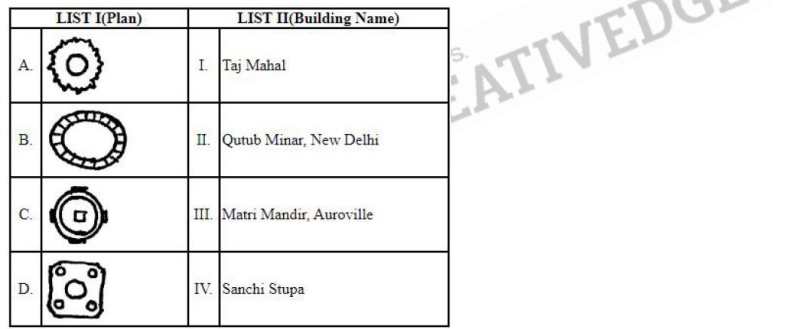
- A-IV, B-II, C-III, D-I
- A-III, B-II, C-IV, D-I
- A-II, B-III, C-IV, D-I
- A-IV, B-III, C-II, D-I
Answer: (b) A-III, B-II, C-IV, D-I
Q. A 3-D object is given. Identify the correct view of the object looking in the direction of the arrow, from the answer figures.
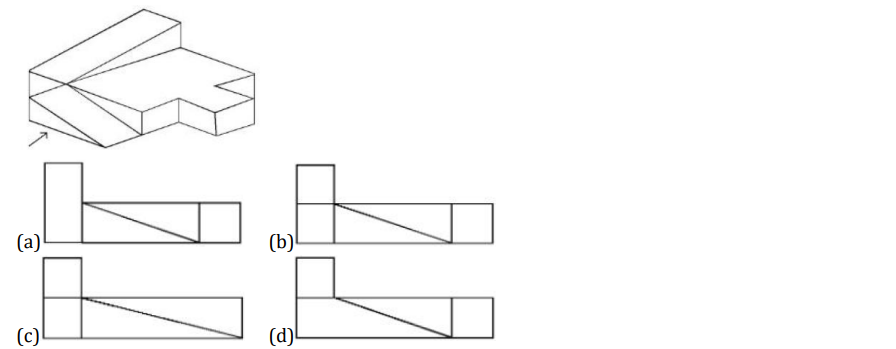
Answer: (b) Option B
Q. Identify the correct mirror image of the given figure along the x–y axis.
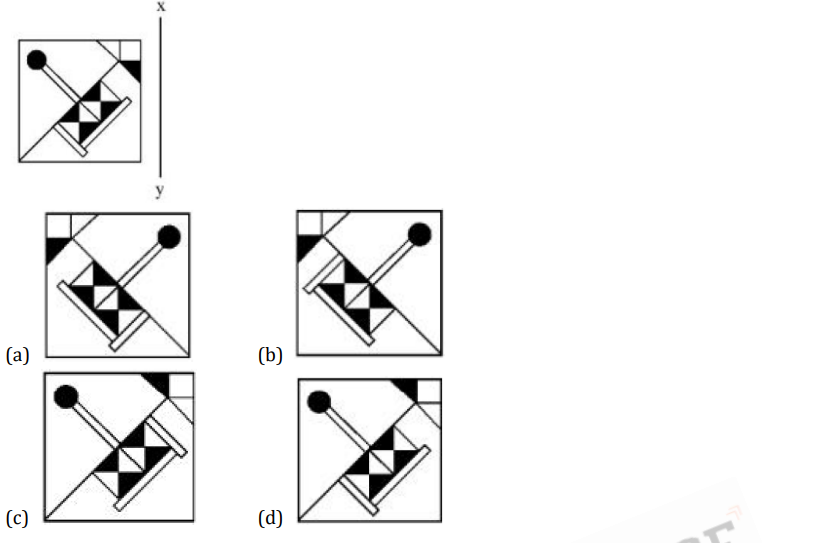
- Option A
- Option B
- Option C
- Option D
Answer: (a) Option A
Difficulty Level Analysis of the JEE Main Paper 2 2024 Question Paper
Across both sessions, candidates and analysts broadly rated the 2024 B.Arch paper easy to moderate. Here is the section-wise read (based on student feedback, published shift analyses and our own review of the paper):
| Section | Marks | Difficulty | What drove it |
|---|---|---|---|
| Mathematics | 100 | Moderate | Standard Class 11–12 topics, but a few numericals were lengthy and time-consuming |
| Aptitude Test | 200 | Easy-Moderate | Mostly quick recall and visual reasoning - the most scoring part of the paper |
| Drawing Test | 100 | Moderate | Observation sketch plus a composition task |
| Overall | 400 | Easy-Moderate | Balanced across the three parts; Mathematics was the main time sink |
For a 2027 or 2028 aspirant - the JEE Main Paper 2 2024 Question Paper is not a paper you "mug" your way through. It rewards a student comfortable across maths, general architecture awareness and freehand drawing beats a student who is brilliant at only one.
Because Aptitude is the biggest and most scoring block, that is where a well-prepared candidate pulls ahead, while Mathematics is where time is lost.
Difficulty Comparison: 2023 vs 2024 vs 2025
Across both sessions, candidates and experts broadly rated the 2024 B.Arch paper as easy to moderate. Here is the section-wise breakdown:
| Aspect | 2023 | 2024 | 2025 |
|---|---|---|---|
| Overall difficulty | Moderate | Easy–Moderate | Moderate–Tough |
| Mathematics | Moderate | Moderate (lengthy numericals) | Moderate |
| Aptitude Test | Moderate | Easy–Moderate | Moderate–Tough |
| Drawing Test | Moderate | Moderate | Moderate |
| Biggest time sink | Mathematics | Mathematics | Aptitude (data, maps, planning) |
Aptitude is what made 2025 feel harder than 2024. The 2025 paper leaned much more on data and map interpretation, urban-planning concepts and current affairs. Analysts widely described the 2025 B.Arch paper as tougher than 2024, while 2023 and 2024 were both broadly moderate.
For a 2027 or 2028 aspirant the message is simple - prepare for the harder, more application-heavy version the paper is trending toward, not the gentler 2024 one.
How Merit Is Decided in JEE Main Paper 2 (B.Arch)
Your raw score in the JEE Main Paper 2 exam is not the final metric. NTA will convert your marks into a percentile (NTA Score), which is then normalised across sessions, and then the better of your two session scores is used for ranking.
When two candidates have the same NTA Score, the official tie-breaking policy is applied:
- Higher NTA Score in Mathematics, then
- Higher NTA Score in the Aptitude Test, then
- Higher NTA Score in the Drawing Test, then
- The candidate with the lower ratio of wrong to correct answers, then
- The older candidate (by age), and finally
- The candidate whose application number is earlier.
Knowing this order quietly changes your strategy - Mathematics is the first tie-breaker, so a strong, accurate Maths section does double duty - it adds marks and protects your rank in a tie.


What Counts as a Good Score - and Good Attempts?
Admission to the top architecture colleges does not run on raw marks directly; it runs on your All India Rank through JoSAA counselling. So "how many marks are good" really means "what rank do those marks fetch, and does that rank clear the college I want?" Here is how the two connect for the 2024 cycle.
Closing ranks at top B.Arch colleges (JoSAA, General category):
- SPA Delhi - closing rank around 127 (All India quota)
- NIT Calicut - closing rank around 270 (home state), near 290 (other state)
- NIT Tiruchirappalli (Trichy) - closing rank around 318 (home state).
- SPA Bhopal - closing rank around 293 (All India quota).
- SPA Vijayawada - closing rank around 406 (All India quota).
Understand that for top tier colleges like SPAs you are aiming for an All India Rank inside roughly the top 400-700, which means a score of around 280 to 320 or more.
Since your raw score is converted before ranking, use a JEE Main marks vs percentile guide to see what your target actually translates to.
Turning that target into "good attempts"
Because every MCQ and every Section B numerical carries +4 for a right answer and −1 for a wrong one, a "good attempt" is an accurate attempt - not just a high attempt count. Here is a worked example of how a ~315/400 score, comfortably inside the top-college range, is actually built:
| Section | Attempt | Correct | Wrong | Score |
|---|---|---|---|---|
| Aptitude (200) | All 50 | ~44 | 6 | ~170/200 |
| Mathematics (100) | All 25 | ~20 | 5 | ~75/100 |
| Drawing (100) | Clean pair of answers | – | – | ~70/100 |
| Total (400) | ~315/400 | |||
Aptitude is where ranks are won. It carries 200 marks, the questions are quick, and lifting your Aptitude accuracy from 80% to 90% does far more for your rank than squeezing two extra numerical questions out of Mathematics.
Drawing, which is subjective and is marked manually, is the quiet differentiator - a good 70+ score there turns a borderline rank into a safe one.
College-wise target scores, ranks & good attempts (indicative):
| You are aiming for | Target score (/400) | Rough AIR | Good attempts (indicative) |
|---|---|---|---|
| Top SPAs & NITs | 300-330 | ~130-700 | Aptitude ~45/50 correct, Maths ~20/25 correct, Drawing 70+ |
| Other NITs / govt. colleges | 250–290 | ~1,900-4,000 | Aptitude ~40/50, Maths ~16/25, Drawing 60+ |
| Good state / private colleges | 180–230 | ~8,000-20,000 | Aptitude ~32/50, Maths ~12/25, Drawing 55+ |
Treat these as direction, not a guarantee. JEE Main Paper 2 cut-off move every year with difficulty-level of the paper and the number of examinees. Plus the drawing scores vary with evaluation. What remain constant is - accuracy in Aptitude, a steady Maths core, and a dependable Drawing score.
The Smart Way to Attempt the 2024 Paper
Once you have the paper in front of you, how you attempt it matters as much as what you know. Here is the order experienced B.Arch mentors recommend when you solve the JEE Main Paper 2 2024 Question Paper as a mock:
1. Start with the Aptitude Test (~50-55 min)
It carries 200 marks, the questions are short, and most are quick recall (architects, landmarks, materials) or visual reasoning - so you bank the largest pool of marks while your mind is fresh and your drawing hand is still rested.
2. Then Mathematics (~50 min)
Do the 20 MCQs in order and flag anything over ninety seconds. Scan all ten numerical questions before solving any - you attempt only five, so pick the five with the cleanest setup, not the first five on the page.
3. Finish with the Drawing Test (~60-70 min)
Rushed drawings lose marks that are hard to win back. Read both parts of the composition question, choose the option that suits your strength, and lightly block proportions before you commit ink.
4. Run a timer the whole way
Attempting the JEE Main Paper 2 2024 Question Paper in this sequence against the clock teaches pacing - the skill that separates students who know the material from students who actually finish the paper.
5. Score it, then target your weakest part
Note which section cost you the most marks, and let that decide what you revise next.
For an even tougher benchmark, attempt the JEE Main Paper 2 2025 Question Paper, where the Aptitude section leaned harder on data and planning.
JEE Main Paper 2 2024 Question Paper vs 2025 vs 2026
The exam's shape is the same each year, so the useful comparison is not what differs but what repeats. Reading the JEE Main Paper 2 2024 Question Paper beside the 2025 and 2026 papers shows which topics appear every single year and a topic in all three columns below is a near-certainty for your attempt, so that is where your hours belong.
| Topic area | 2024 | 2025 | 2026 |
|---|---|---|---|
| Maths core | Vectors, AP, binomial, circles, matrices, probability, statistics | Ellipse, GP, continuity, matrices, probability, statistics | Circles, GP, continuity, maxima, matrices, probability |
| 3D visualisation | Top & arrow views | Views + visible-surface counting | Top/side views + visible-surface counting |
| Mirror / water images | Figures + "PROGRESS" | Figures + "FROG", "ENTABLATURE" | Figures + water image |
| Architects & movements | Pritzker winners | Pritzker match-list, Guggenheim | Mies, Gropius, Behrens, Prairie/Corbusier, vernacular |
| Landmarks & monuments | Louvre, Sydney Opera House, Qutub Minar | Parthenon, Hawa Mahal, temple styles | Notre Dame, Statue of Unity, Tamil Nadu temple town |
| Building materials & terms | Cement/lime, terracotta, FAR, riser | Hardwood, exposed aggregate, arch parts | Vault, arcade, hip roof, shading devices |
| Architectural styles | Dravidian temple style | International Style, Mughal chhatris | Gothic, vernacular, modernism |
| Colour theory | Primary colours, value | Colour triangle, colour schemes | Tint & shade, tertiary, complementary |
| Scale & technical drawing | Engineer-scale RF | Golden ratio, proportion | Representative fraction (1:50, 1:100) |
| Logical reasoning | Coding, series, direction | Count triangles, series | Odd-one-out, direction sense |
| Map & data interpretation | Minimal | Contour map, land-use %, density | Pie/bar charts, contour, land-use, density |
| Current affairs & schemes | World Environment Day, G20 | PRASAD, Central Vista, Bharat Mandapam | PMAY, AMRUT 2.0, RERA, 73rd/74th Amendments, NITI Aayog |
| Drawing (2 questions) | Cyclist sketch + G20 logo/road | Kathakali face + crackers/court | Buland Darwaza + train station/still-life |
Once you’ve solved the previous-year papers, move to full-length JEE Main Paper 2 mock tests to build exam-day speed.
How to Use the 2024 Paper for Your 2027 Preparation
Because the B.Arch pattern and question style have stayed consistent, the JEE Main Paper 2 2024 Question Paper is an accurate rehearsal for a 2027 attempt. The key is to use the JEE Main Paper 2 Question Paper 2024 in stages rather than solving it once and moving on.
Here is a plan a 2027 aspirant can follow:
| Stage | When | How to use the 2024 paper |
|---|---|---|
| 1. First read | Early prep | Go through the paper untimed just to learn the format and the kinds of questions. Mark every topic you haven’t studied yet. |
| 2. Syllabus checklist | Topic building | Treat the paper’s topics (and the must-cover table above) as your study list. Learn each Maths and Aptitude area, then re-attempt those questions. |
| 3. Timed mock | Mid prep | Solve the whole paper in one 3-hour sitting. Score it honestly and find your weakest of the three sections. |
| 4. Targeted fixing | After the mock | Spend the next fortnight closing your weakest-section gaps. Redo only the questions you got wrong, until they are automatic. |
| 5. Final revision | Closer to 2027 | Re-solve the paper for speed and accuracy, and pair it with the 2023 and 2025 papers for a strong multi-year practice set. |
Pair this paper with a structured JEE Main Paper 2 preparation plan to turn practice into rank.
Conclusion
Reading about a paper is not the same as solving one. The JEE Main Paper 2 2024 Question Paper only works for you once it is solved, scored and reviewed. Download the JEE Main Paper 2 2024 Question Paper pdf, attempt all three parts under exam timing, and find out today where you stand across Maths, Aptitude and Drawing.
Then build your prep around your weakest part - while you still have the time to master it.
Want expert guidance for B.Arch? Creative Edge by Toprankers runs live lectures, full-length mock tests on the latest pattern, and one-to-one mentorship for Mathematics, Aptitude and Drawing - the same preparation behind our JEE B.Arch, NATA and NID toppers.
Explore Creative Edge's B.Arch coaching.


Attempt a Free JEE B.Arch Mock Test
Fill your details
Frequently Asked Questions
Where can I get the JEE Main Paper 2 2024 Question Paper pdf?

How many questions were there in the JEE Main Paper 2 2024 Question Paper?
What were the exam dates for JEE Main Paper 2 in 2024?
Is there negative marking in the JEE Main Paper 2 Question Paper 2024?
How many questions do I attempt in the Mathematics numerical section?
Is the Drawing Test taken online?
What is a good score in the JEE Main Paper 2 2024 Question Paper for top colleges?
Which topics from the JEE Main Paper 2 2024 Question Paper are most important to cover?
Is the 2024 paper still useful for a 2027 or 2028 attempt?
Vineeta Agrawal
Communications Executive
SHARE