
1723534562.png)

CLAT 2026 AIR 10: Aarav’s Simple Preparation Strategy, Mock Analysis Mindset & LegalEdge Bhopal Journey
March 17, 2026
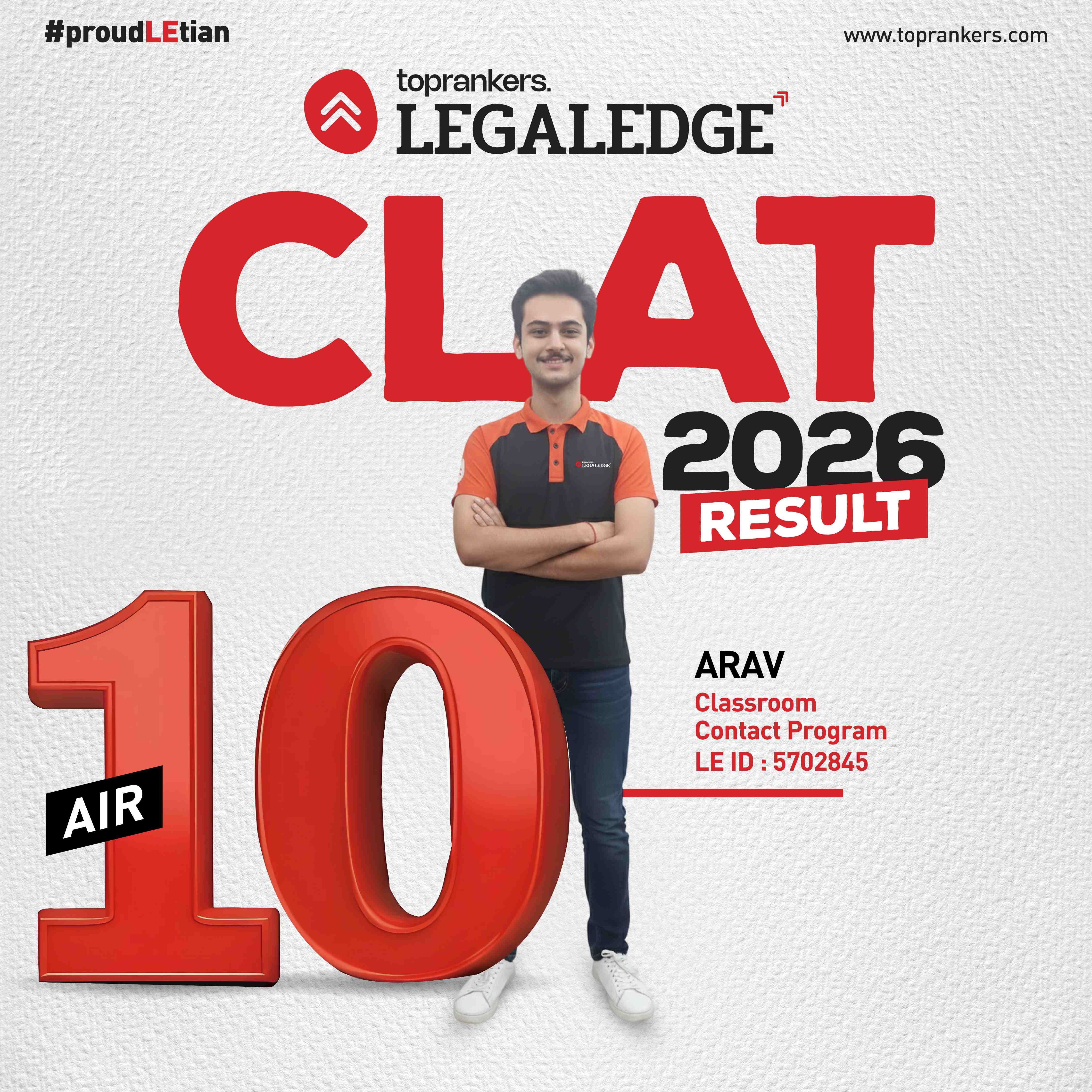
Aarav’s CLAT journey is a powerful reminder that success is not just about “how many mocks you give” but about how you learn from them. In this interview-style conversation, CLAT 2026 AIR 10 Aarav speaks candidly about keeping his preparation simple, giving equal respect to every subject, strengthening weak areas first, building confidence through newspaper-based reading, and relying on mock analysis instead of mock pressure.
CLAT 2026 Rank 2 Aarav also shares how LegalEdge Bhopal helped him transform from an online student into a confident national-level competitor—through offline mentorship, a structured ecosystem, exam-like mock environments, and a strong peer group that he didn’t have back home.
Who is CLAT 2026 AIR 10?
CLAT 2026 AIR 10 is Aarav TikKoo from LegalEdge. He followed a simple, balanced plan with a strong focus on weak areas—especially Critical Reasoning (CR) and Legal, which felt uncomfortable initially due to his background. Aarav credits starting GK early, staying newspaper-led and consistent daily, and prioritising mock analysis over mock count as the key drivers behind his AIR 10 result.
Quick Snapshot: CLAT 2026 AIR 10 Aarav's Journey
- Name: Aarav TikKoo
- AIR: CLAT 2026 AIR 10
- Preparation Style: Simple, balanced, & weak-area focused
- Focus Areas: Weak sections like CR & Legal (initially uncomfortable due to background)
- GK Approach: Start early + newspaper-led + daily consistency
- Mocks: Attempt + analysis (analysis mattered more than count)
- Coaching Centre: LegalEdge Bhopal
- Home State: Uttarakhand (Haldwani)
- Journey Type: Started online, shifted to the offline ecosystem at Bhopal
Interview: Sana Ma'am [LegalEdge] X Arav Tikkoo [CLAT 2026 AIR 10]
Q1. Aarav, you’ve done spectacularly well. How does it feel?
Aarav: It feels great, ma’am. But I feel this accomplishment doesn’t define who I am. The months of hard work define the person. This is just a moment—a great moment—captured in essence.
Q2. What was your CLAT preparation strategy like?
Aarav: My strategy was very simple—give each subject equal respect. No subject is better than the other. And working on your weak points is the most important thing.
Aarav: I worked especially hard on my weak points, like Critical Reasoning and Legal. I wasn’t comfortable with them because I’m not from that background. My family has a science background—both my parents were science students—so legal subjects felt harder for me to grasp initially.
Q3. How did you distribute your time across subjects?
Aarav: I used to give around 30% of my time to my weakest subjects. And at the start, I gave around 20% of my time to GK.
Aarav: GK isn’t something that should be feared. You do have to cover a lot, and the best way to tackle it is to start today.
Q4. You mentioned a “piecemeal approach.” What does that mean in real life?
Aarav: CLAT is heavily based on the newspaper and also on reading across different genres. So the best approach is to take small pieces from different aspects daily.
Aarav: For example, if you have trouble reading science-related content, start reading the science section in the newspaper. If you struggle with economics concepts, start reading the business section.
Aarav: In fact, once a mock in our coaching had only economics-based passages. That day, I realised my economics reading was weak. So for the next month or two, I started reading the business section of The Hindu daily thoroughly. It builds confidence.
Q5. So confidence plays a big role?
Aarav: Absolutely. This exam is based on confidence. If your confidence is at its highest point before the exam, you will perform at your highest level.
Q6. How did LegalEdge Bhopal contribute to your success?
Aarav: I started my CLAT journey in 2024 after my board exams. I was an online student initially. I’m not a native of Bhopal—I came from Uttarakhand, from Haldwani. For me, this entire journey was new and very interesting.
Aarav: In my hometown, there isn’t really an ecosystem for CLAT and law entrance exams. Here at LegalEdge Bhopal, I got offline classes, offline support, mentorship, and overall, it shaped me into a better aspirant.
Aarav: Even small things matter—for example, every mock we give is signed by an invigilator. That doesn’t happen everywhere. Students aren’t used to it at first, but it creates an exam-like seriousness.
Aarav: The external mocks, the marathons, the ecosystem, the network—everything helped. The biggest advantage was that I found people like me—other CLAT aspirants. Back home, I felt alone. Here, I built a strong support system and friendships. It helped in holistic development, too.
Q7. How important was your family’s contribution?
Aarav: Family contribution matters a lot. My mother has been like a rock—attending every PTM. My father has been the motivator. My brother helped me too.
Aarav: There were ups and downs in the journey. It’s a rollercoaster. But when I look back and analyse it, it feels great because all’s well that ends well.
Q8. The CLAT paper had surprises. How did you handle unpredictability?
Aarav: From 2020 onwards—after the pattern changed—every year CLAT has changed: question types, sources, methods. CLAT is an exam where you have to expect the unexpected.
Aarav: Every section was designed to trick you, frustrate you, waste your time. Even if after the exam, AR (Analytical Reasoning) doesn’t look very difficult, the added pressure of time and section load makes it harder in the moment.
Aarav: The best way I found to tackle CLAT was to see it not section-wise, but as one exam of 120 questions—you have 120 chances to get something right.
Q9. What was your approach to AR (Analytical Reasoning)?
Aarav: AR should be something everybody has a grip on. It tests your common sense and calmness.
Aarav: The best way to solve AR is to create a mental zone where there is no pressure. If you solve AR under pressure, you won’t be able to solve it because your mind needs to be open.
Aarav: Even during mocks, I used to leave AR for the last—especially for AILET—after finishing everything else.
Q10. How much did mocks and study material help? Was LegalEdge content relevant?
Aarav: The content was amazing. Everything—from mentor support to teaching style to mocks and the environment in which we gave mocks—was designed to simulate the pressure of the real CLAT exam.
Aarav: And I want to add one important thing: giving mocks just for the sake of giving mocks isn’t necessary. The analysis behind the mocks is where learning comes from. That’s how you figure out what’s important and what needs to be done.
Q11. Did you take any additional help from Telegram mocks or other sources?
Aarav: Yes, I did try some material from Telegram. Everybody does it—you should at least see different perspectives because this examination is unpredictable.
Aarav: You can see one news from perspective A, and another from perspective B. I tried some freely available mocks, and they were good. From everything you do, there should be learning—you maximise learning across the journey.
Q12. Any fond memories of LegalEdge Bhopal you’d like to share?
Aarav: I have a lot of memories. I remember my first day here—I was scared because I had always been an online student and had never attended offline classes like this.
Aarav: I remember my first English class—it went well. I also remember we celebrated your birthday that day, ma’am.
Aarav: And all those events—Chai Pe Charcha, No Bag Day, marathons—everyone was exhausted but still made it. I can’t pinpoint one single fondest memory because the whole journey has been very dear to me.
Aarav: This year and a half—this six-month offline journey—was one of the best times I’ve had. It gave me confidence that I can compete at the national level, and it helped me find purpose. Time flew so fast.
Key Takeaways from CLAT 2026 AIR 10 Aarav’s Strategy
- Keep preparation simple: Equal respect to every subject, no shortcuts.
- Weak areas first: Allocate the biggest share of effort to uncomfortable sections.
- GK isn’t scary: Start early, do a little every day, and stay consistent.
- Newspaper-led learning: Read sections based on what you struggle with (science/economics/business).
- Confidence is a score multiplier: The calmer you are, the better you perform.
- Mocks only work with analysis: Attempting is good; analysing is where learning happens.
- Create a pressure-free AR mindset: Calm zone > panic solving.
- Offline ecosystem matters: Peer group + mentorship + exam-like environment changes outcomes.
Explore LegalEdge Online Coaching Courses 2027-2028
Find the right preparation course for CLAT, MH CET Law, CUET Law, NLSAT, CULEE, and 3-Year LLB entrance exams. Explore LegalEdge’s online coaching programs designed for different law entrance aspirations.
| LegalEdge Courses | Course Link |
|---|---|
| CLAT 2027 Courses | Explore Courses |
| CLAT 2028 Courses | Explore Courses |
| MH CET Law Courses | Explore Courses |
| CULEE Courses | Explore Courses |
| CUET Law Courses | Explore Courses |
| NLSAT Courses | Explore Courses |
| 3-Year LLB Courses | Explore Courses |
| MHCET LLB Courses | Explore Courses |
Conclusion
CLAT 2026 AIR 10 Aarav’s story proves that the best CLAT strategy is not “more pressure” but “more clarity.” He didn’t overcomplicate preparation—he balanced subjects, attacked weak areas, made GK a daily habit, used newspapers to build real comprehension, and treated mocks as learning tools through analysis.
Most importantly, his LegalEdge Bhopal experience shows how an offline ecosystem—with mentorship, peers, and exam-style practice—can turn an online learner into a confident national-level competitor.
Start CLAT 2027-28 preparation with LegalEdge, Watch Free Demo Classes: CLAT Demo Classes
CLAT Consortium Official Website: https://consortiumofnlus.ac.in/
Relevant Important Links
| CLAT 2026 AIR 1 | CLAT 2026 AIR 2 |
| CLAT 2026 AIR 3 | CLAT 2026 AIR 7 |
| CLAT 2026 AIR 8 | CLAT 2026 AIR 9 |
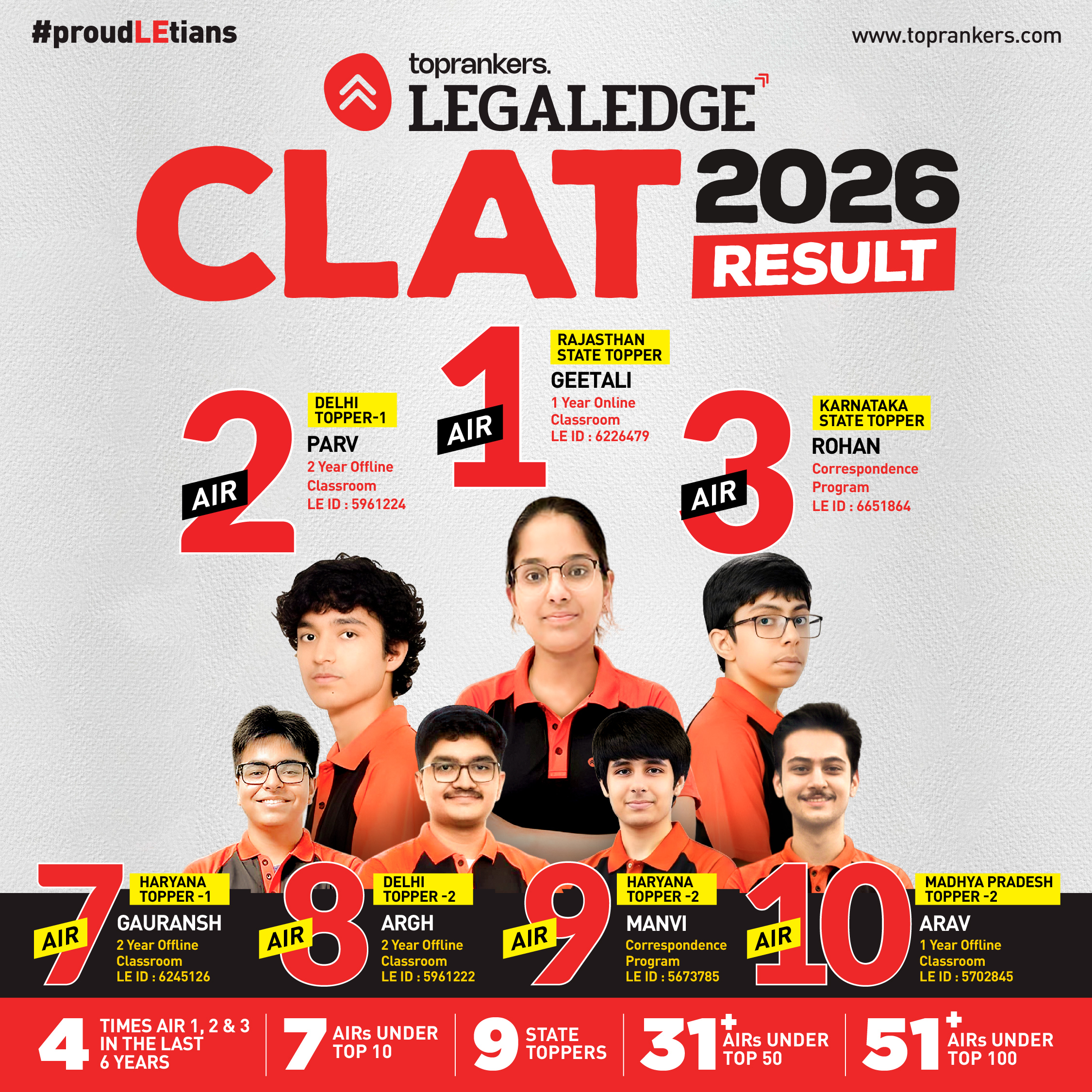
| CLAT 2026 AIR 10 | CLAT 2026 Toppers List |
| CLAT Rank List | CLAT 2026 Topper Interviews |
CLAT 2026 AIR 1 Geetali From LegalEdge Says
Stay consistent every day, even if it’s a small slot of study, and make sure you’re doing something CLAT-related daily—a mock, mock analysis, practice sets, or revision. She also stresses building a daily newspaper habit (even 30 minutes or selective reading) for GK/CA, and not getting mentally shaken by fluctuating mock ranks—focus on your own process, keep revising and practising, and trust that sustained effort will compound into results.
Preparing for CLAT 2027–2028? Watch FREE demo classes by LegalEdge—start here: CLAT Demo Classes
CLAT 2027 Latest Updates
| Event / Milestone | Expected Month (for CLAT 2027 cycle) | What to do (quick action) |
|---|---|---|
| Official notification/information brochure | Late July 2026 (expected) | Check the Consortium website and note eligibility, fees, and key dates. |
| Application form opens | August 2026 (expected) | Register early, upload documents, and lock your test city preferences. |
| Application last date | Late October / early November 2026 (expected) | Submit well before the deadline; avoid last-day payment issues. |
| Correction window (if announced) | October / November 2026 (expected) | Fix photo/signature/category details (only if the window is enabled). |
| Admit card release | Late November 2026 (expected) | Download and verify the centre, slot, and instructions. |
| CLAT 2027 exam date | Early December 2026 (expected) | Carry admit card + valid ID; follow exam-day instructions. |
| Provisional answer key | December 2026 (expected, shortly after exam) | Download key + response sheet (if released) and calculate score. |
| Objection window | December 2026 (expected) | Raise objections with proof within the given time window. |
| Final answer key | December 2026 (expected) | Recompute score using the final key. |
| Result declaration | Mid–late December 2026 (expected) | Download the scorecard and prepare a preference list for counselling. |
| Counselling registration & fee payment | December 2026 (expected) | Register for counselling immediately and lock your preferences carefully. |
| Seat allotment rounds | Late December 2026 – January 2027 (expected) | Choose Freeze/Float/Exit as per your target NLU and backup options. |
CLAT 2027 Roadmap
| Timeline | Stage | Primary Focus | What to Do (Non-negotiables) | Mocks/Test Target |
|---|---|---|---|---|
| Feb–Mar 2026 | Foundation | Build base + routine | Daily newspaper (30–40 min), RC habit, vocab (15–20 words/day), Legal basics (principle→fact method), QT fundamentals (percentages, ratio, averages), LR basics (assumption/inference) | 0–2 mini tests/week |
| Apr–May 2026 | Coverage | Complete core topics | Legal: contracts, torts, constitutional basics; LR: arguments + critical reasoning; QT: arithmetic-heavy topics + DI basics; English: RC + grammar error spotting; GK: weekly monthly CA notes | 2 sectional tests/week |
| Jun–Jul 2026 | Practice | Accuracy + speed building | Start timed sets, daily RC + LR, legal caselets, QT mixed practice, weekly GK compendium revision, start “error notebook” | 1 mock/week + 2 sectional |
| Aug–Sep 2026 | Mock Phase 1 | Strategy + analysis | Full mocks seriously, analyse every mock (why wrong, why slow), fix weak areas, revise Legal principles weekly, CA revision cycle (June–Sep) | 2 mocks/week |
| Oct 2026 | Mock Phase 2 | High intensity + revision | Increase mock frequency, repeat wrong questions, strengthen speed strategy (attempt order), QT formula sheet + drills, GK: revise June–Oct twice | 3 mocks/week |
| Nov 2026 | Final Prep | Peak revision + exam temperament | Only high-yield revision, daily RC + LR sets, legal mixed sets, GK rapid revision, reattempt mock errors, sleep discipline | 3–4 mocks/week |
| Dec 2026 (Last 2–3 weeks) | Exam Mode | Light practice + calm execution | Reduce load, focus on short notes + error notebook, 1 mock every 3–4 days, revise only what you’ve already studied | 2–3 mocks total |
Guidelines to Choose a CLAT Institute
Choosing the right CLAT coaching institute comes down to results consistency, mentor quality, and how well the program matches your learning style. Start by checking the institute’s past NLU selections, faculty profile, mock-test quality (difficulty + analytics + solutions), and doubt-solving/mentorship support. Prefer institutes that offer structured study plans, regular sectional + full-length mocks, performance tracking, and personalised feedback—because that’s what actually improves scores. If you’re looking for a recommendation, LegalEdge by Toprankers is a strong option due to its structured preparation approach, robust mock ecosystem, and student support system designed specifically for CLAT performance.
Relevant CLAT Blogs:

Admin
Subject Matter Expert


SHARE