
1723534562.png)

Is There Negative Marking in UCEED 2027:10 Expert Tips on How to Avoid Negative Marks
March 20, 2026
Overview: Learn practical tips on how to avoid negative marking in UCEED with smart time management, elimination techniques, and guessing strategies. Understand the UCEED marking scheme, exam pattern 2027, and safe attempt order to improve accuracy, boost confidence, and score higher in the UCEED exam 2027.
When you’re preparing for UCEED, every mark counts - especially with negative marking in certain sections. If you search for tips on how to avoid negative marking in UCEED, this guide gives you real, actionable strategies.
We’ll also explain UCEED exam pattern 2027, the UCEED marking scheme, total marks in UCEED, UCEED marks vs rank, and answer related queries like “Does UCEED have negative marking?” or “Is there negative marking in UCEED?” along the way.
Understanding the UCEED Marking Scheme 2027 & Where Negative Marking Applies
Before you can avoid negative marking, you must know exactly which sections penalize wrong answers. The UCEED 2027 exam pattern and marking scheme are nuanced.
- UCEED is divided into Part A (objective questions) and Part B (drawing & design aptitude).
- Total marks in UCEED = 300: 200 for Part A + 100 for Part B.
|
Attribute |
Part A (Objective / Computer Based) |
Part B (Drawing / Design Aptitude – Pen & Paper) |
|
Duration |
2 hours |
1 hour |
|
Number of Questions |
57 (across NAT, MSQ, MCQ) |
2 questions (sketching + design) |
|
Total Marks |
200 |
100 |
|
Question Types |
• NAT (Numerical Answer Type) |
Sketching & Design Aptitude (subjective) |
|
Marks for Correct Answer |
NAT: +4 |
Subjective / rubric-based (each question ~50 marks) |
|
Negative Marking / Penalty |
NAT: 0 (no negative) |
None (no negative marking) |
|
Marks for Un-attempted / Blank Answer |
0 (no penalty) |
-- |
|
Evaluation / Scoring |
Computer-based auto evaluation of Part A |
Manual evaluation based on creativity, clarity, presentation |
|
Mode / Medium |
Online / English |
Offline (on supplied answer book) / English |
|
Remarks |
It is mandatory to attempt all parts. Questions in MSQ require careful selection - selecting wrong options may incur penalties. |
Focus is on ideation, sketch clarity, originality rather than “right or wrong” answers. |
So when someone asks 'Is there negative marking in UCEED?' or 'Does UCEED have negative marking?', the correct answer is yes. But only for the MCQ & MSQ parts of Part A, not for NAT or Part B.
Because of this, one of the best tips on how to avoid negative marking in UCEED 2027 is to be especially cautious in MCQ & MSQ - avoid wild guessing unless you can eliminate wrong options.
Also Check: UCEED Eligibility Criteria 2027
Why UCEED Negative Marking Matters in 2027 (UCEED Marks vs Rank)
You might ask: "If I get a question wrong, can negative marking really affect my rank?" The answer is yes - especially in a competitive exam where UCEED marks vs rank differences are tight.
In UCEED, small fractions of marks lost due to negative marking can drop your rank significantly.
For example, if you take a chance and get one MCQ wrong, you lose 0.71 marks. That could cost you a few places, especially in the range around 70-100 marks.
Many aspirants aim for scores above cut-off, usually have been in the range of around 100-120 or more in part A to secure a good rank (depends on a lot of factors like difficulty level of exam in the year, number of candidates, seats availability & so on).
Losing even 1-2 marks to negative marking may push you lower in UCEED marks vs rank charts. Data suggests that for general category students 125 -135 or more marks out of 200 in part A and 50-60 marks out of 100 on part- B can be considered safe, if you are targeting top UCEED colleges like IIT Bombay, IIT Delhi, and IIT Hyderabad.
Case Study:
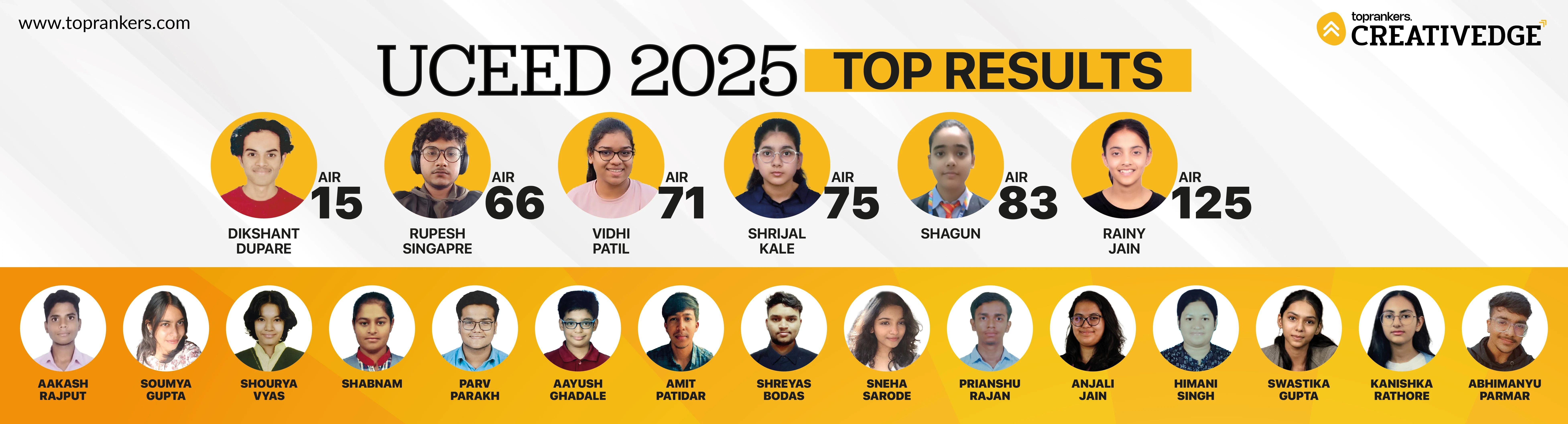
Dikshant, a student from CreativEdge’s Target 2025 batch, scored 115.45 in Part-A and 40 in Part-B and secured a rank of AIR 15 (but, in SC category).
Note: Please note that above numbers are based on past year data reported by students. Score requirements for selection may change with changes in exam pattern or difficulty level of the exam every year.
Therefore, avoiding negative marking is not optional - it’s should be the 'must-do' part of your uceed exam strategy.
Toppers' Tips on How to Avoid Negative Marking in UCEED 2027
Here’s a consolidated, actionable list of tips to help you minimize or avoid negative marking in UCEED, whether you're doing MCQs, MSQs, or NATs.
Tip 1: Prioritize NAT Questions First (Safe Zone)
Since NAT questions carry no penalty if wrong, begin with those. Securing NAT marks is a safe buffer - they don’t risk negative marking. After you attempt NATs, if time allows, move to MSQ and MCQ with more caution.
Tip 2: Eliminate Options Before Guessing
Before attempting MCQs or MSQs, first eliminate clearly wrong options. Even eliminating one or two options improves your odds and reduces risk. If you can narrow down to 2 possible choices, the risk-to-reward becomes manageable.
Tip 3: Avoid Blind Guesses in MCQ
If you’re unsure about an MCQ, and you can’t eliminate any option with confidence, better to skip it than risk −0.71. Only guess if you have some basis or partial confidence.
Tip 4: Be Careful with MSQs - Partial Credit & Penalty
MSQs allow partial credit of score when correct options are selected. But if you select even one incorrect option, you can be penalized with −1.
- Only select an options when you're reasonably sure they’re correct.
- Don’t over-select options in hope of catching extra marks, that’s way too risky.
- Sometimes selecting fewer correct options (but all correct) is safer than selecting more and including a wrong one.
Tip 5: Use Time Reviews Strategically
Allocate some time near the end to review questions you marked for revisit. If you had doubts earlier but later get clarity (through elimination or fresh thinking), then attempt them. But don’t introduce new guesses without logic.
Tip 6: Strengthen Conceptual Clarity
The more confident you are in concepts, the fewer guesses you’ll rely on. Solid UCEED preparation reduces the number of uncertain attempts, thereby reducing negative marking chances.
Tip 7: Practice Mock Tests Under Real Conditions
Simulate UCEED 2027 exam conditions, with time pressure and all rules. This trains your intuition for when to attempt vs skip. In mocks, note how many wrong attempts are hurting you and by what margin. If the negative marks are significant in number, you need a strategy redo.
Tip 8: Use Partial Marks in MSQ Wisely
In MSQ, sometimes selecting only some correct options (while avoiding wrong ones) gives partial positive marks. If you're not sure all correct, pick what you're confident about rather than risking a wrong pick.
Tip 9: Keep Negative Marking in Mind While Strategizing
Always mentally factor “if I get this wrong, how much will I lose?” If a question seems too risky, skip it. Your risk management mindset is key.
Tip 10: Last 10 Minutes - Don’t Guess Desperately
Many students resort to random guessing in final minutes. That’s often when negative marking bites hardest. Use that time to revisit easier flagged questions, not wild guesses.
By following these tips, you can reduce unnecessary negative marks and maximize your net score.
Check: Best books for UCEED Preparation [Section Wise Book List]
Breakdown of How Negative Marking Affects Different Sections in UCEED 2027
|
Section |
Correct Marks |
Negative Marking |
Strategy to Avoid Loss |
|
NAT (Part A) |
+4 |
0 |
Safe - attempt all confidently (no negative) |
|
MSQ (Part A) |
+4 full / partial |
-1 for wrong combinations |
Only select options you’re confident about; avoid over-guessing |
|
MCQ (Part A) |
+3 |
-0.71 |
Eliminate wrong options first; skip when unsure |
|
Part B (Drawing + Design Aptitude) |
subjective scoring |
no negative marking |
Focus on clarity, originality, presentation - mistakes don’t punish in the same way |
This table clarifies where negative marking truly matters and helps you plan which sections to attempt aggressively vs cautiously.
Tips on How to Avoid Negative Marking in UCEED 2027 - Time Management Strategy
If you study the UCEED exam pattern 2027 mentioned in the official UCEED 2027 brochure (out now), you’ll notice that Part A has 57 objective questions across NAT, MSQ, and MCQ, all to be completed in 2 hours.
With negative marking in UCEED applicable in MCQ and MSQ sections, managing time wisely becomes an absolutely 'crucial' defensive as well as scoring strategy.
Here’s how to plan your time to avoid unnecessary penalties while maximizing correct attempts:
1. Follow the “Safe - Smart - Strategic” Approach
Divide your 2-hour Part A into three zones:
- Safe Zone (First 40 minutes): Attempt all NAT questions first. They have no negative marking, so they’re your safest opportunity to secure marks confidently.
- Smart Zone (Next 50 minutes): Move to MSQs. Read each carefully and select options only when you are reasonably certain. Over-selection here leads to −1 mark per wrong answer.
- Strategic Zone (Last 30 minutes): Attempt MCQs where −0.71 applies. Start with sure ones; skip or mark doubtful questions for later review.
Even when it comes to touching the previously flagged questions, the ones you marked to revisit later, start with questions you are comparatively more confident about. Also remember, negative marking for wrong MSQ > negative marking for wrong MCQ in UCEED 2027.
2. Allocate Time Based on Strength
If you’re stronger in reasoning/aptitude, give more time to NAT; if you’re good at visualization, allocate extra time to MSQs.
|
Type of Aspirant |
Key Strengths |
Recommended Attempt Order |
Why This Works |
|
Logical / Analytical Thinker |
Strong in numerical aptitude, reasoning, and pattern-solving |
NAT → MCQ → MSQ → Review |
You secure marks early in problem-based questions (NAT/MCQ) while your mind is fresh, then attempt trickier MSQs later. |
|
Visual / Creative Thinker |
Better at design reasoning, observation, and visualization |
NAT → MSQ → MCQ → Review |
MSQs require creative reasoning and partial judgment - ideal for students with visual logic and design aptitude. |
|
Balanced Performer |
Equally good in reasoning and visualization |
NAT → MSQ → MCQ → Review |
Keeps risk moderate; you move from safe (NAT) to smart (MSQ) to risky (MCQ) attempts smoothly. |
|
Slow but Accurate Aspirant |
Needs more time to read carefully, less confident with risk |
NAT → MSQ → MCQ (Only Sure Ones) → Review |
Focuses on accuracy over attempt count. You minimize negative marking while ensuring every marked answer is confident. |
|
Fast but Impulsive Aspirant |
Finishes quickly but tends to make careless errors |
MSQ → NAT → MCQ → Review |
Doing MSQs first channels focus early; ending with review ensures double-checking before submission. |
This personalized pacing ensures you avoid rushing - and careless errors that trigger negative marking.
3. Use the “Flag & Review” Technique
Mark doubtful MCQs and return to them only if time allows. Don’t linger too long - every additional minute spent on one uncertain question risks losing time for guaranteed ones.
4. Keep a 10-Minute Buffer
Always reserve the last 10 minutes to recheck marked questions and ensure you didn’t click wrong options (a common reason for losing marks).
Key Insight: Most aspirants lose marks not because they didn’t know the answer, but because they mismanaged time and rushed guesses in the final minutes.
Must-Read: 10 Best Tips to Tackle Trick Questions in UCEED Exam
_(1)1754636837.webp)
Tips on How to Avoid Negative Marking in UCEED 2027 - Elimination Technique & Guessing Strategies
One of the most powerful tips on how to avoid negative marking in UCEED is mastering elimination and smart guessing.
The UCEED marking scheme rewards logic and penalizes blind guessing. You can still take calculated risks if you know when the math works in your favor.
1. Learn the Power of Elimination
Before attempting a question, actively eliminate obviously wrong options:
- Strike out anything that contradicts known facts or logic.
- Compare similar options - usually one contains an exaggeration or extreme word like always / never.
- Visualize the question if it’s a design- or spatial-based one. Incorrect options often defy physical feasibility.
The more options you eliminate, the higher your odds of guessing right.
> Example: In a 4-option MCQ, after eliminating two wrong options, your probability of guessing correctly rises to 50%.
Expected Value = (0.5 × +3) − (0.5 × 0.71) = +1.14 marks → worth attempting!
2. Use the “Two-Option Rule”
Only guess when you can confidently eliminate at least two options. If not, skip, because the expected loss (−0.71 MCQ or -1 in MSQ) outweighs potential gain.
Let's take an example (a past year UCEED MSQ reasoning question) to understand this:
Q. Which options can be folded to form the cube shown?

Observe the main cube: All 3 half-coloured faces meet at one white corner. This one criterion will help us manoeuvre through all the options to find the right one(s).
- If you carefully look at option D, the half-blue face is seen connected to the white half of the half-green face, which is not the case in the main cube. Hence, this option can also be safely rejected at once.
- In option B, it’s clearly visible that all half-coloured faces meet at a single white point. Hence, it’s definitely correct.
With 2 absolutely certain answers (out of 4 available options), it’s more logical to attempt this question and check the other 2 options as well.
Mock Test Practice to Avoid Negative Marking in UCEED 2027
Practicing mock tests is one of the most effective tips on how to avoid negative marking in UCEED, because it allows you to simulate the risk-reward balance before the real exam.
1. Attempt UCEED Pattern Mocks as many as possible, especially as the exam approaches.
Take at least 8-10 full-length mock tests following the exact UCEED exam pattern 2027. Include all three objective types- NAT, MSQ, MCQ, with the same time limit and marking scheme.
2. Maintain a Negative Marking Log
After every mock:
- Note how many questions you got wrong.
- Identify how many of them were avoidable (guessed or careless).
- Calculate marks lost due to penalties (e.g., 4 wrong MCQs = −2.84).
Over time, your goal is to reduce negative marks per test - ideally to below −3 total.
3. Analyze “Why” You Got It Wrong
Not every mistake is due to knowledge gaps. Sometimes it’s due to:
- Misreading a question.
- Overconfidence in guessing.
- Time pressure.
Tracking these patterns helps refine both accuracy and mindset.
4. Practice “Selective Guessing” in Mocks
Use UCEED mock tests to train your judgment. Attempt selective guessing using elimination only when you’re confident enough. Observe the results, your accuracy percentage will guide your risk level for the actual exam.
5. Mock Review > Mock Count
Attempting 10 mocks without review helps less than analysing 5 deeply. Each review should focus on:
- Wrong guesses → what triggered the error?
- Time mismanagement → which section delayed you?
- Unanswered but solvable → why did you skip it?
A well-analysed mock gives more insight than an unreviewed one.
Also Read: UCEED Last Minute Preparation Tips 2027
Section-Wise Attempt Order to Minimize Negative Marking in UCEED 2027
Your attempt order plays a huge role in both accuracy and score in UCEED. The ideal order depends on the UCEED question paper structure (14 NAT + 15 MSQ + 28 MCQ) and UCEED marking scheme.
Recommended Attempt Order:
|
Order |
Section |
Reasoning |
Marking Risk |
Strategy |
|
1 |
NAT (Numerical Answer Type) |
These questions have no negative marking and test your logic & reasoning directly. Attempt first for a confidence boost. |
None |
Attempt all confidently; even if wrong, no loss. |
|
2 |
MSQ (Multiple Select Questions) |
Moderate difficulty; requires partial knowledge + logic. |
Medium (−1 for wrong combo) |
Attempt carefully; pick only sure options. |
|
3 |
MCQ (Multiple Choice Questions) |
More straightforward but penalized (−0.71). |
High |
Attempt high-confidence ones only; skip uncertain. |
|
4 |
Review Round (Flagged Questions) |
Revisit doubtful questions if time remains. |
Variable |
Avoid adding new guesses; recheck misclicks. |
Alternative Order (If You’re Strong in Aptitude)
If your strength is logical/mathematical aptitude, start with NAT → MCQ → MSQ.
This order ensures you secure easier marks upfront while your mind is fresh, saving creative reasoning for later.
Why Order Matters:
A good attempt order helps you:
- Maintain confidence early (by attempting safe questions first).
- Avoid panic guessing near the end.
- Balance accuracy and time effectively.
Don’t shuffle randomly mid-test. Stick to your chosen order. Jumping between question types can break focus and increase careless errors.
Also Check: Category-Wise and Previous Years UCEED Cut off
Quick Recap: Tips on How to Avoid Negative Marking in UCEED
|
Category |
Key Focus Area |
Strategy / Action Plan |
Impact on Score |
|
Understanding the Exam |
UCEED 2027 Marking Scheme |
• Part A (200 marks): NAT (+4, no negative), MSQ (+4, −1 for wrong combos), MCQ (+3, −0.71 for wrong answers). |
Knowing where penalties apply helps avoid blind guessing and improves risk management. |
|
Section Selection |
Start with Safe Sections (NAT) |
Attempt all NAT questions first. They have no negative marking. |
Builds confidence early and secures risk-free marks. |
|
Time Management |
Safe–Smart–Strategic Time Division |
NAT - 40 mins (safe zone) MSQ - 50 mins (smart zone) MCQ - 30 mins (strategic zone) |
Prevents rushing and last-minute random guesses. Enhances accuracy. |
|
Elimination Technique |
Identify & Remove Wrong Options |
• Strike out illogical options. |
Increases odds of correct guesses and reduces negative marking. |
|
Guessing Strategy |
Use the 2-Option Rule |
• Guess only when ≥2 options are eliminated. |
Controlled guessing minimizes penalties and maintains net positive scoring. |
|
Mock Practice |
Negative Marking Audit |
• Attempt 8-10 full mocks under real UCEED pattern. |
Identifies risky habits and improves judgment for the real exam. |
|
Confidence Building |
Analyse, Don’t Just Attempt |
After each mock, check why you got it wrong. Is it time pressure, misread, or pure guess. |
Builds exam discipline and self-awareness. |
|
Attempt Order |
NAT → MSQ → MCQ → Review |
• Begin with NAT (no penalty). |
Ensures an accuracy-first approach and avoids careless loss due to negative marking. |
|
Speed vs Accuracy |
Maintain Balance |
• Don’t over attempt for quantity. |
Improves net marks even if total attempts are fewer. |
|
Psychological Control |
Avoid Panic Guessing |
• Breathe before marking. |
Keeps stress low and prevents impulsive penalties. |
|
Unique Edge |
Negative Marking Decision Matrix |
Apply logic-based matrix: |
Turns guessing into a mathematical decision, not an emotional one. |
|
Post-Mock Improvement |
Continuous Tracking |
• Track % of wrong guesses, reducing over time. |
Gradual mastery of risk control and exam temperament. |
These tips on how to avoid negative marking in UCEED 2027 collectively help reduce score loss and boost rank.
Check: How to fill UCEED application form
Final Thoughts
Mastering tips on how to avoid negative marking in UCEED 2027 isn’t just about skipping risky questions; it’s about smart strategy, disciplined practice, and mental clarity during the exam. Understand the UCEED marking scheme, know which sections penalise wrong answers, and use elimination techniques, time reviews, and mock practice to guide your decisions.
When you combine this with strong preparation in design, visualisation, and aptitude, you'll maximise your effective score, and that’s how you move from “just taking the exam” to scoring high.
Preparing for UCEED 2027? We can help you with exact strategic roadmap, study material and crucial feedback required to ace this exam.
Join India's best UCEED Online Coaching by CreativEdge and get expert guidance on all UCEED 2027 subjects.
Or you can enrol in offline UCEED batches at your nearest CreativEdge centres for in-person classes!



Attempt a Free UCEED Mock Test
Fill your details
Frequently Asked Questions
Is there negative marking in UCEED?

How can I avoid negative marking in UCEED 2026?
How is the UCEED marking scheme for 2026 structured?
What is the best time management strategy to reduce negative marking in UCEED 2026?
Is UCEED easier than JEE?
Does UCEED have 2 attempts?
What are the passing marks for UCEED 2026?
Does UCEED have negative marking for skipped questions?
What is the safest strategy to attempt UCEED Part A?

Vineeta Agrawal
Communications Executive


SHARE