
1723534562.png)

NATA Important Topics 2026 – Subject Wise List, Sample Questions, Weightage & Study Plan
February 23, 2026
Quick Answer: The NATA important topics for 2026 include Drawing & Composition (Part A) and Mathematics, Logical & Visual Reasoning, Aptitude, and Architecture Awareness (Part B). The NATA 2026 important topics emphasize perspective drawing, geometry, mensuration, 3D reasoning, and architectural GK based on recent exam trends.
Key Highlights: NATA Important Topics 2026
- Total Marks: 200, 53 questions
- Part A: Drawing & Composition
- Part B: Maths, Logical Reasoning, Aptitude & Architecture Awareness
- Geometry & Mensuration are high-weightage
- Visual/3D reasoning importance increasing
- Architecture GK stable across years
- Drawing quality + speed = decisive factor
- Practice previous year papers for trend clarity
Table of Contents
- NATA Exam Structure Overview
- Important Topics for NATA Part A (Drawing & Composition)
- Subject-Wise Important Topics for NATA Part B
- NATA Important Topics – Weightage Distribution
- Evolution of NATA Important Topics – Year-wise Comparison
- Target Score Strategy for NATA Important Topics 2026
- 8-Week Study Plan to Cover All NATA Important Topics
- Sample Questions from NATA Important Topics
- Score vs Topic Mastery Strategy - NATA 2026
- Best Books for NATA Important Topics
Exam Structure Overview (Understanding NATA Important Topics)
As per council of Architecture, following is the breakdown of NATA 2026 Exam Pattern:
|
Section |
Component |
Nature of Questions |
Marks Trend |
|
Part A |
Drawing & Composition |
Subjective |
High |
|
Part B |
Mathematics |
MCQ/NCQ |
Moderate |
|
Part B |
Logical & Visual Reasoning |
MCQ/NCQ |
High |
|
Part B |
MCQ/NCQ |
Moderate |
|
|
Part B |
Architecture Awareness |
MCQ |
Stable |
|
Part B |
English & Reading Comprehension | MCQ | Stable |
Sections & Duration:
- Part B - 42 questions, 90 minutes, 108 secs timer for each question
- Part A - 3 questions, 90 minutes
Understanding this structure is essential before studying the NATA important topics for architecture.
Important Topics for NATA Part A (Drawing & Composition)
|
Topic |
Skills Tested |
Importance Level |
|
Perspective Drawing (1-point, 2-point) |
Spatial depth |
Very High |
|
Observation & anatomy |
High |
|
|
Scene Creation |
Imagination |
Very High |
|
Composition Using Given Shapes |
Creativity |
High |
|
Object Transformation |
3D thinking |
High |
|
Light & Shadow |
Visual realism |
Moderate |
|
Architectural Sketching |
Structural clarity |
High |
|
Memory Drawing |
Recall ability |
Moderate |
Part A requires daily practice. These NATA 2026 important topics are decisive for high scores.
Check: Expected NATA 2026 Cut Off

Subject-Wise Important Topics for NATA Part B
1. NATA 2026 Important Topics - Quantitative Aptitude (Maths)
Geometry & Mensuration are among the most repeated NATA important topics.
|
Topic |
Subtopics |
Importance |
|
Trigonometry |
Identities, Heights & Distances |
High |
|
Coordinate Geometry |
Straight Line, Circle |
High |
|
Mensuration |
Surface Area & Volume |
Very High |
|
Algebra |
Quadratics, Progressions |
Moderate |
|
Probability |
Basic probability |
Moderate |
|
Matrices |
Determinants |
Moderate |
|
Permutation & Combination |
Arrangements |
Moderate |
|
Ratio & Percentage |
Applications |
Moderate |
Check: All-in-one Formula Sheet for NATA 2026
2. NATA 2026 Important Topics - Logical & Visual Reasoning
|
Topic |
Type |
Importance |
|
3D Cube Rotation |
Spatial reasoning |
Very High |
|
Mirror & Water Images |
Visual perception |
High |
|
Pattern Series |
Logical analysis |
High |
|
Direction Sense |
Analytical |
Moderate |
|
Paper Folding |
Spatial imagination |
High |
|
Analytical Puzzles |
Deduction |
Moderate |
|
Coding-Decoding |
Verbal logic |
Moderate |
|
Blood Relations |
Logical reasoning |
Moderate |
3. NATA 2026 Important Topics - General Aptitude
|
Topic |
Importance |
|
Analytical reasoning |
Moderate |
|
Numerical reasoning |
Moderate |
|
Data interpretation |
Moderate |
|
Logical deduction |
Moderate |
Check: Top Architecture Colleges that Accept NATA Scores
4. NATA 2026 Important Topics - Architecture Awareness & GK
|
Topic |
Importance |
|
Famous Architects |
High |
|
Architectural Styles |
High |
|
Indian Monuments |
High |
|
Building Materials |
Moderate |
|
Sustainable Architecture |
Moderate |
|
Urban Planning |
Moderate |
|
Historical Timeline |
Moderate |
|
Current Architectural Events |
Moderate |
5. NATA 2026 Important Topics - English & RC
|
Topic |
Importance |
|
High |
|
|
Grammar |
Moderate |
|
Synonyms, Antonyms, Vocab |
High |
NATA Important Topics – Weightage Distribution (Trend Based)
|
Section |
Approx Weightage |
Trend |
|
Drawing & Composition |
40-50% |
Stable |
|
Logical & Visual Reasoning |
25-30% |
Increasing |
|
Mathematics |
15-20% |
Stable |
|
Architecture Awareness |
10-15% |
Stable |
|
Aptitude |
10-15% |
Stable |
The NATA 2026 important topics clearly show a shift toward visual reasoning dominance.
Check: NATA Sample Question Papers with Answers
Evolution of NATA Important Topics - Year-wise Comparison
|
Year |
Major Emphasis |
|
2022 |
MCQ-heavy structure |
|
2023 |
Logical reasoning increased |
|
2024 |
Drawing reintroduced and number of MCQs decreased |
|
2025 |
Balanced + 3D emphasis |
|
2026 |
Visual reasoning + drawing focus expected |
Know more: What is Architecture Aptitude Test (AAT)?
NATA Section-wise Important Topics, Marks & Target Score Strategy
|
Subject / Section |
Approx. Questions Asked |
Marks per Question |
Total Section Marks |
Target Score for Top Colleges (120+ Overall) |
|
Drawing (Part A – Offline) |
3 Questions |
25 + 25 + 30 |
80 Marks |
55-65 Marks |
|
Quantitative Aptitude (Maths) |
12-16 |
2-3 marks |
25-30 Marks |
18-22 Marks |
|
Logical & Visual Reasoning |
12-16 |
2-3 marks |
25-30 Marks |
18-22 Marks |
|
Architectural Aptitude Test (AAT) |
10-12 |
2-3 marks |
25-30 Marks |
18-22 Marks |
|
General Knowledge (Architecture + Current Affairs) |
8-10 |
1-2 marks |
15-20 Marks |
10-14 Marks |
|
English / Language Interpretation |
1-2 |
4-5 marks |
8-10 Marks |
6-8 Marks |
|
Total Marks: 200 (80 Drawing + 120 CBT) |
||||
|
NATA Part B Distribution: 80% - Quant, Reasoning, AAT 20% - GK, English |
||||
Imp Note: If the NATA 2026 Exam pattern remains same as 2025 pattern, experts predict that candidates from GEN category would require at least 120+ marks out of 200 marks along with 90% in boards (Maths compulsory).
Strategic Insight for Top NATA Colleges
- Total Marks: 200 (80 Drawing + 120 CBT)
- Safe Target for Top Colleges: 150-165+
- Drawing alone contributes 40% weightage, so underperforming here drastically affects rank.
- Part B (CBT) requires consistent accuracy across sections, not sectional domination.
8-Week Study Plan to Cover All NATA Important Topics
|
Week |
Focus Area |
Tasks |
|
1 |
Maths Basics |
Trigonometry + Mensuration |
|
2 |
Pattern & 3D problems |
|
|
3 |
Drawing |
Perspective practice daily |
|
4 |
Architecture GK |
Monuments + Architects |
|
5 |
Advanced Maths |
Probability + Coordinate Geometry |
|
6 |
Full-Length Sectional Tests |
Time-bound practice |
|
7 |
Mock Tests |
3 full mocks + analysis |
|
8 |
Revision |
Formula revision + drawing speed |
This ensures complete coverage of all NATA important topics.
Check: NATA Previous Years Exam Analysis
Sample Questions from NATA Important Topics
Quantitative Aptitude:
1. Six bells commence tolling together and toll at intervals of 2,4,6,810 and 12 seconds respectively. In 30 minutes, how many times do they toll together?
(a) 3 (b) 15 (c) 16 (d) 6
2. A hollow iron pipe is 20 cm long and its external diameter is 10 cm . If the thickness of the pipe is 1 cm and iron weighs 8 g/cm3, then what is the weight of the pipe? (Answer to be provided in kg to the third decimal).
3. A sum of money is to be distributed among Arun, Banu, Chinu, Dany in the proportion of 5:2:4:3 respectively. If 𝐶 gets Rs. 1500 more than 𝐷, what is 𝐵 's share?
(a) Rs. 500 (b) Rs. 3000 (c) Rs. 900 (d) Rs. 5000
Logical Reasoning:
1. If 'diamond' is called 'gold', 'gold' is called 'silver', 'silver is called 'ruby' and 'ruby' is called 'emerald', which is the cheapest jewel?
(a) Silver (b) Gold (c) Diamond (d) Ruby
2. A and B are brothers. C and D are sisters. A's son is D's brother. How is B related to C?
(a) Father (b) Uncle (c) Brother (d) Grandfather
3. In a row of 40 girls, when Komal was shifted to her left by 4 places her number from the left end of the row became 10. What was the number of Swati from the right end of the row if Swati was three places to the right of Komal's original position?
(a) 25 (b) 24 (c) 23 (d) 22
Visual Reasoning:
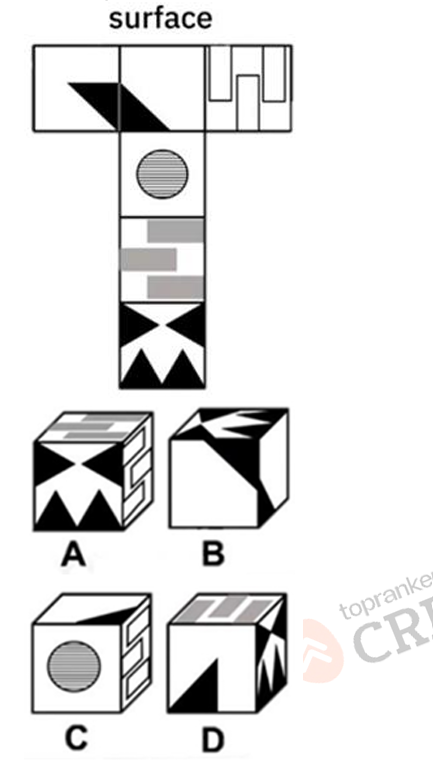
1. The given surface can be folded into which of the following cubes?
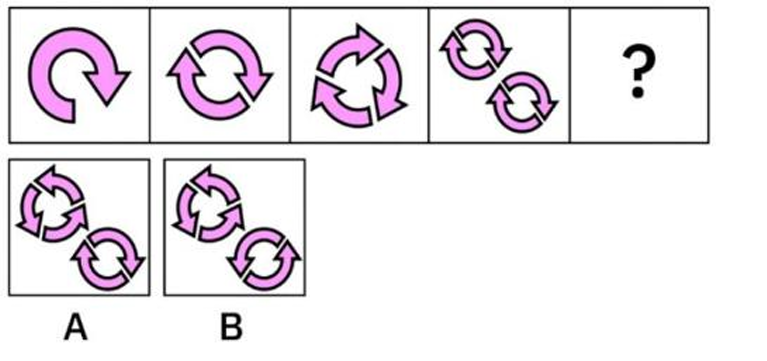
2. Identify the pattern which logically replaces the question mark in the given sequence.
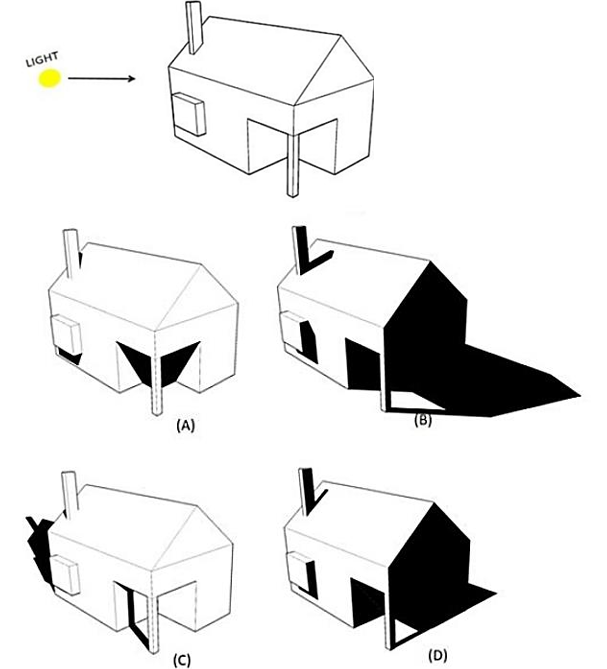
3. If the arrow marks the direction of light, which will be the image of the object with the correct shadow from the given answer options?
4. Identify the correct TOP view for the given 3D form:
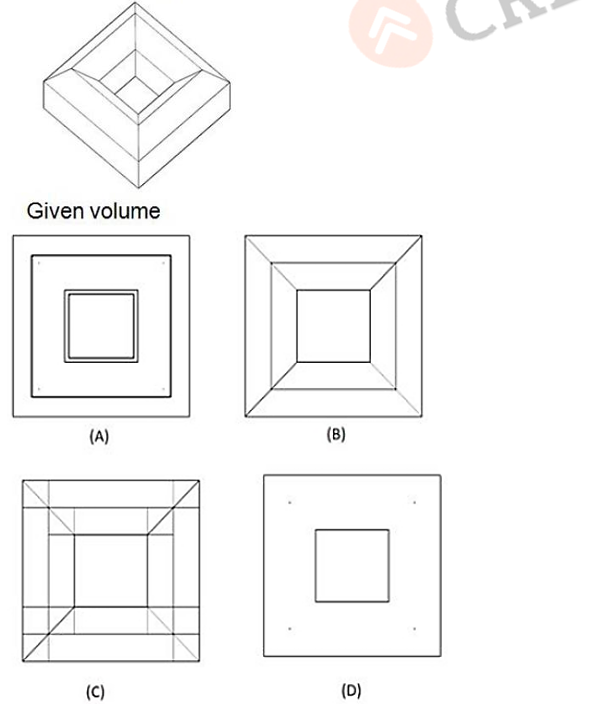
(a) (A) (c) (C) (b) (B) (d) (D)
Architecture Awareness:
1. Image of the famous building shown below is well known as:
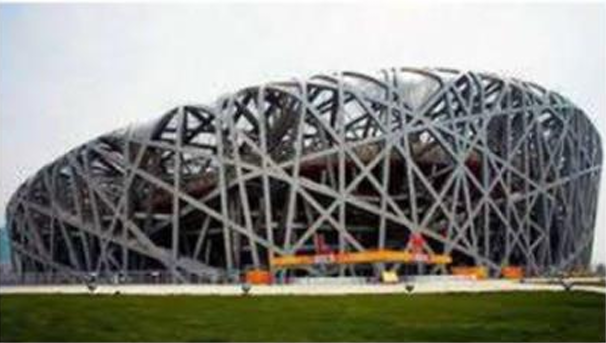
(a) Cocoon (c) Bird's Nest (b) Geodesic dome (d) Space Shuttle
2. Identify the type of staircase shown in the given image.
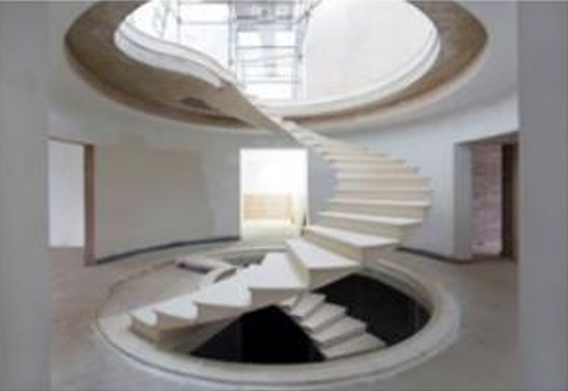
(a) Helical staircase (c) Spiral staircase (b) C Shaped staircase (d) Cylindrical staircase
3. The 4 x 4 (2003) house (on the left) designed by Tadao Ando in Hyogo, Japan; has a twin (on the right) designed by the same architect but constructed with different materials. What are they?
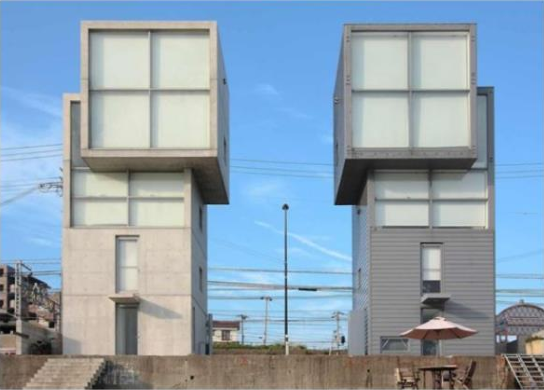
(a) Concrete and Steel (c) Concrete and Wood (b) Stone and Concrete (d) Concrete and Aluminum panels
NATA GK:
1. Who said "When we build, let's think that we build forever".
(a) Johann Wolfgang von Goethe (b) Louis Sullivan (c) John Ruskin (d) Rabindranath Tagore
2. Which among the following is known as India's first fully solar powered village?
(a) Chitrakoot, Uttar Pradesh (b) Damoh, Madhya Pradesh (c) Modhera, Gujarat (d) Agasthiyamalai, TN
3. The famous Fort St. George built by the ________ in India is situated in _______ .
(a) French, Pondicherry (c) Portuguese, Goa (b) Dutch, Cochin (d) British, Chennai
4. Name the country from this flag:

(a) Chile (c) Ukraine (b) Austria (d) Sri Lanka
5. Identify the correct representation of Google photos
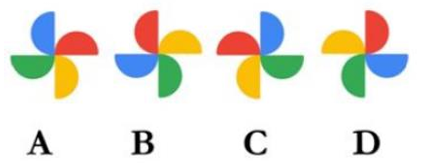
(a) (A) (c) (C) (b) (B) (d) (D)
English:
1. After reading the given TEXT answer the 4 questions based on the text by choosing the appropriate option.
TEXT:
The human body can tolerate only a small range of temperature, especially when the person is engaged in vigorous activity. Heat reactions usually occur when large amounts of water and/or salt are lost through excessive sweating following strenuous exercise. When the body becomes overheated and cannot eliminate this excess heat, heat exhaustion and heat stroke are possible. Heat exhaustion is generally characterized by clammy skin, fatigue, nausea, dizziness, profuse perspiration, and sometimes fainting, resulting from an inadequate intake of water and the loss of fluids. First aid treatment for this condition includes having the victim lie down, raising the feet 8 to 12 inches, applying cool, wet cloths to the skin, and giving the victim sips of salt water ( 1 teaspoon per glass, half a glass every 15 minutes) over a 1 -hour period. Heat stroke is much more serious; it is an immediate life-threatening situation. The characteristics of heat stroke are a high body temperature (which may reach 106∘F or more); a rapid pulse; hot, dry skin; and a blocked sweating mechanism. Victims of this condition may be unconscious, and first-aid measures should be directed at quickly cooling the body. The victim should be placed in a tub of cold water or repeatedly sponged with cool water until his or her temperature is sufficiently lowered. Fans or air conditioners will also help with the cooling process. Care should be taken, however, not to over-chill the victim once the temperature is below 102∘F.
Q. The most immediate concern of a person tending to a victim of heat stroke should be to __________.
(a) gets salt into the victim's body.
(b) raises the victim's feet.
(c) lowers the victim's pulse.
(d) lowers the victim's temperature.
Q. Which of the following is a symptom of heat exhaustion?
(a) unconsciousness
(b) profuse sweating
(c) hot, dry skin
(d) a weak pulse
Q. Heat stroke is more serious than heat exhaustion because heat stroke victims _______________.
(a) do not sweat.
(b) have no salt in their bodies.
(c) cannot take in water. (d) have frequent fainting spells
Q. Symptoms such as nausea and dizziness in a heat exhaustion victim indicate that the person most likely needs to ________________.
(a) be immediately taken to a hospital.
(b) be given more salt water.
(c) be immersed in a tub of water.
(d) sweat more.
Check: NATA vs JEE Main Paper 2 2026
Score vs Topic Mastery Strategy - NATA 2026
Understanding how much command you need over the NATA important topics helps you target realistic score goals. The table below shows what level of mastery is required to reach specific score ranges in NATA.
|
Target Score (Out of 200 - GEN category) |
Drawing Mastery Level |
Maths Mastery Level |
Logical & Visual Reasoning Mastery |
Architecture GK Coverage |
Recommended Strategy |
|
70+ (Qualifying) |
Basic perspective drawing & proportion |
Cover core formulas |
Attempt easy pattern questions |
Basic monument & architect knowledge |
Focus on high-accuracy easy questions |
|
90+ (Average Colleges) |
Clean composition & depth |
Geometry + Mensuration strong |
Good cube & mirror practice |
Cover 70% static GK |
Balanced NATA preparation strategy across sections |
|
100+ (Good Colleges) |
Strong perspective + shading |
All high-weightage topics mastered |
High accuracy in 3D reasoning |
Strong architectural awareness |
Attempt almost all confident questions |
|
120+ (Top Colleges) |
Creative scene building + detail |
Full syllabus clarity |
Near-perfect logical solving |
Advanced architecture concepts |
Time management critical |
|
130+ (Highly Competitive) |
Exceptional drawing quality |
Zero-error Maths |
Mastery of visual logic |
Complete NATA syllabus coverage |
Full mock-test-based strategy |
How to Use This Strategy Table:
- If targeting 100+, ensure at least 80% mastery of high-weightage NATA 2026 important topics.
- For 110+, drawing quality must stand out.
- For 120+, mock performance consistency becomes the deciding factor.
This structured approach helps aspirants convert topic preparation into score-focused preparation.
FREE Resource: Practice Questions for NATA One Point Perspective Drawing Questions
Best Books for NATA Important Topics
|
Section |
Recommended Source |
|
Mathematics/Quantitative Aptitude |
NCERT Class 11 & 12 |
|
Logical Reasoning |
R.S. Aggarwal |
|
Drawing Practice |
NATA Past Year Papers Book |
|
Architecture GK |
CoA Magazines |
|
Practice Papers |
Previous Year NATA Papers & Mock Tests |
Students often search for NATA 2026 important topics pdf free download, but structured preparation using official NATA exam syllabus pdf is more reliable.
Read More: Best Books for NATA 2026 Preparation
Final Thoughts
The key to cracking the exam lies in mastering the NATA important topics systematically rather than randomly covering chapters. The NATA 2026 important topics demand a balance between creativity and analytical skills.
Consistent practice, especially in perspective drawing and spatial reasoning, can significantly boost scores.
Preparing for NATA 2026? We can help you with exact strategic roadmap, study material and crucial feedback required to ace this exam.
Join CreativEdge, India’s leading NATA online coaching and get expert guidance on all NATA 2026 subjects.
You can enroll in offline NID batches at your nearest centres also!


Attempt a Free NATA Mock Test
Fill your details
Frequently Asked Questions
What are the most important topics for NATA 2026?

What is the weightage of NATA important topics in the 2026 exam?
Where can I download NATA important topics PDF?
Does NATA important topics overlap with JEE B.Arch syllabus?
How should I prepare all NATA important topics in 2 months?
Is drawing compulsory in NATA important topics?
Vineeta Agrawal
Communications Executive


SHARE