
1723534562.png)

CAT Exam Pattern 2026: Sections, Total Questions, Duration, and Negative Marking
June 10, 2026
Overview: CAT exam pattern 2026 is expected to remain a 3-section CBT (VARC, DILR, QA) with a total duration of 120 minutes and a strict 40-minute sectional timer. In this guide, you’ll get the latest section-wise question breakup, MCQ vs TITA split, total marks, and the +3/−1 marking rules plus what can change once IIM releases the official notification.
What You Will Learn in This Blog: Complete CAT exam pattern 2026 + Section-wise question distribution +Marking scheme + t
ime limits and more!
What is the CAT exam pattern for 2026?
CAT 2026 is expected to follow the recent pattern with three sections: VARC, DILR, and QA. The exam will likely be computer-based, held in multiple slots, with a total duration of 120 minutes. Any official changes will be confirmed in the notification by Indian Institutes of Management.
CAT 2026 Exam Pattern: Key Highlights
The CAT exam pattern 2026 has not been officially notified yet. However, based on the previous year test structure, CAT 2026 exam pattern is expected to follow the same overall format:
- A 120-minute CBT with a strict 40-minute sectional time limit and 66 questions distributed across VARC (24), DILR (22), and QA (22).
- Any changes announced by the IIMs in the CAT 2026 notification will be updated here.
CAT Exam Pattern and Total Marks: Section-wise Structure
The CAT exam pattern for 2026 is expected to remain consistent with previous years, featuring three main sections: Verbal Ability & Reading Comprehension (VARC), Data Interpretation & Logical Reasoning (DILR), and Quantitative Aptitude (QA). Each section is timed independently, and candidates must adhere to the allotted time for each.
Expected Sectional Breakdown for CAT 2026
Based on the latest trends and official notifications, the CAT 2026 exam is anticipated to have the following distribution of questions and marks:
| Section | Number of Questions | Total Marks | Time Allotted |
|---|---|---|---|
| Verbal Ability & Reading Comprehension (VARC) | 24 | 72 | 40 minutes |
| Data Interpretation & Logical Reasoning (DILR) | 20 | 60 | 40 minutes |
| Quantitative Aptitude (QA) | 22 | 66 | 40 minutes |
| Total | 66 | 198 | 120 minutes (2 hours) |
Note: MCQ vs TITA breakup is indicative and may vary slightly across slots/years.
The exam is highly challenging and requires a solid understanding of the CAT exam syllabus, as well as the ability to solve complex problems.
Check out | How to prepare for CAT 2026 in 10 months?
CAT Exam Pattern 2026: Detailed Section-wise Analysis
Verbal Ability & Reading Comprehension (VARC)
This VARC section typically comprises 24 questions, divided between Reading Comprehension passages and Verbal Ability questions like Para Jumbles, Para Summary, and Odd One Out. A strong command of English grammar, vocabulary, and critical reading skills is essential.
Data Interpretation & Logical Reasoning (DILR)
The CAT DILR section usually features 20 questions, presented in sets. These sets require candidates to analyze given data (tables, charts, graphs) and apply logical reasoning to solve problems. This section often tests analytical and problem-solving abilities rather than rote learning.
Quantitative Aptitude (QA)
With an expected 22 questions, the CAT QA section covers various topics including Arithmetic, Algebra, Geometry, and Modern Math. A solid foundation in mathematical concepts and efficient problem-solving strategies are key to excelling in this section.
Official CAT Notification and Updates
For the definitive CAT exam pattern 2026, including any minor adjustments to question distribution or marking scheme, always refer to the official notification released by the IIMs. We will update this page immediately upon the release of any new official information.
CAT 2026 Exam Pattern for VARC Section
The VARC section of the CAT exam focuses on assessing a candidate’s command of the English language through reading comprehension and verbal reasoning tasks.
Questions generally include comprehension-based passages as well as verbal ability topics like Para Jumbles, Sentence Correction, and Identifying Summaries.
The purpose of this section is to test reading speed, contextual understanding, and analytical interpretation of language. A mix of objective MCQs and TITA (type-in-the-answer) questions are included.
| CAT 2026 Exam Sections | No. of Questions | MCQs (Approx.) | Non-MCQs / TITA (Approx.) |
|---|---|---|---|
| VARC | 24 | 22 | 2 |
Note: MCQ vs TITA split may vary slightly across slots/years.
CAT 2026 Exam Pattern for DILR Section
The Data Interpretation and Logical Reasoning (DILR) section of the CAT exam assesses a candidate's ability to interpret data and apply logic to solve problems.
This section typically presents data in various formats, such as Tables, Charts, and Graphs, combined with logical reasoning questions.
The key focus is on evaluating how well candidates can analyse information, identify CAT exam pattern 2026, and draw valid conclusions. The DILR section contains a mix of MCQs and TITA questions.
| CAT 2026 Exam Sections | No. of Questions | MCQs (Approx.) | Non-MCQs / TITA (Approx.) |
|---|---|---|---|
| DILR | 22 | 12 | 10 |
Note: MCQ vs TITA split may vary slightly across slots/years.
Learn More | How to Prepare for CAT Exam in One Year?
Other Important Question Paper Links
| CAT DILR Questions | CAT Varc Questions | CAT QA Questions |
| CAT 2023 Question Paper | CAT 2022 Question Paper | CAT 2021 Question Paper |
| CAT 2025 Question Paper | CAT 2024 Question Paper | CAT 2026 Question Paper |
CAT 2026 Exam Pattern for QA Section
The Quantitative Ability (QA) section of the CAT exam tests a candidate's mathematical skills and problem-solving abilities.
This section covers a wide range of topics, including Arithmetic, Algebra, Geometry, and Modern Mathematics.
The QA section aims to assess a candidate's understanding of fundamental mathematical concepts, their ability to apply these concepts to solve complex problems, and their speed and accuracy in calculations.
| CAT 2026 Exam Sections | No. of Questions | MCQs (Approx.) | Non-MCQs / TITA (Approx.) |
|---|---|---|---|
| QA | 22 | 14 | 8 |
Note: MCQ vs TITA split may vary slightly across slots/years.
Similar to other sections, QA includes both MCQs and TITA questions.
Read More: CAT Cut Off For IIMs
How many questions are there in CAT and how are they divided section-wise?
Based on recent trends, CAT is expected to have around 66 questions in total. A common breakup is VARC: 24, DILR: 20, and QA: 22, though exact numbers may vary slightly. Candidates should prepare for flexible distribution rather than fixed counts every year.
CAT 2026 Slot-Wise Exam Pattern
While the overall CAT exam pattern remains consistent across slots, there can be some minor variations:
1. Number of Questions
The total number of questions and their distribution across sections (VARC, DILR, and QA) are generally the same across all slots.
2. Difficulty Level
The difficulty level of questions may vary slightly between slots. IIMs try to maintain a similar difficulty level, but some slots might be perceived as slightly easier or more challenging by test-takers.
3. Question Variation
The actual questions within each section will differ across slots to prevent any potential issues with exam integrity. This means candidates will encounter different sets of questions for VARC, DILR, and QA in each slot.
4. Normalisation
To account for any variations in difficulty level across slots, IIMs use a normalisation process. This process adjusts candidates' scores to ensure fairness and prevent any candidate from being advantaged or disadvantaged by the specific slot in which they appeared.
5. Sectional Order and Timings
The order of the sections and the time allotted for each section remain the same across all slots. Candidates will have a specific time limit for each section, and they cannot switch between sections during the exam.
Read more: Complete Details on CAT Exam Eligibility Criteria
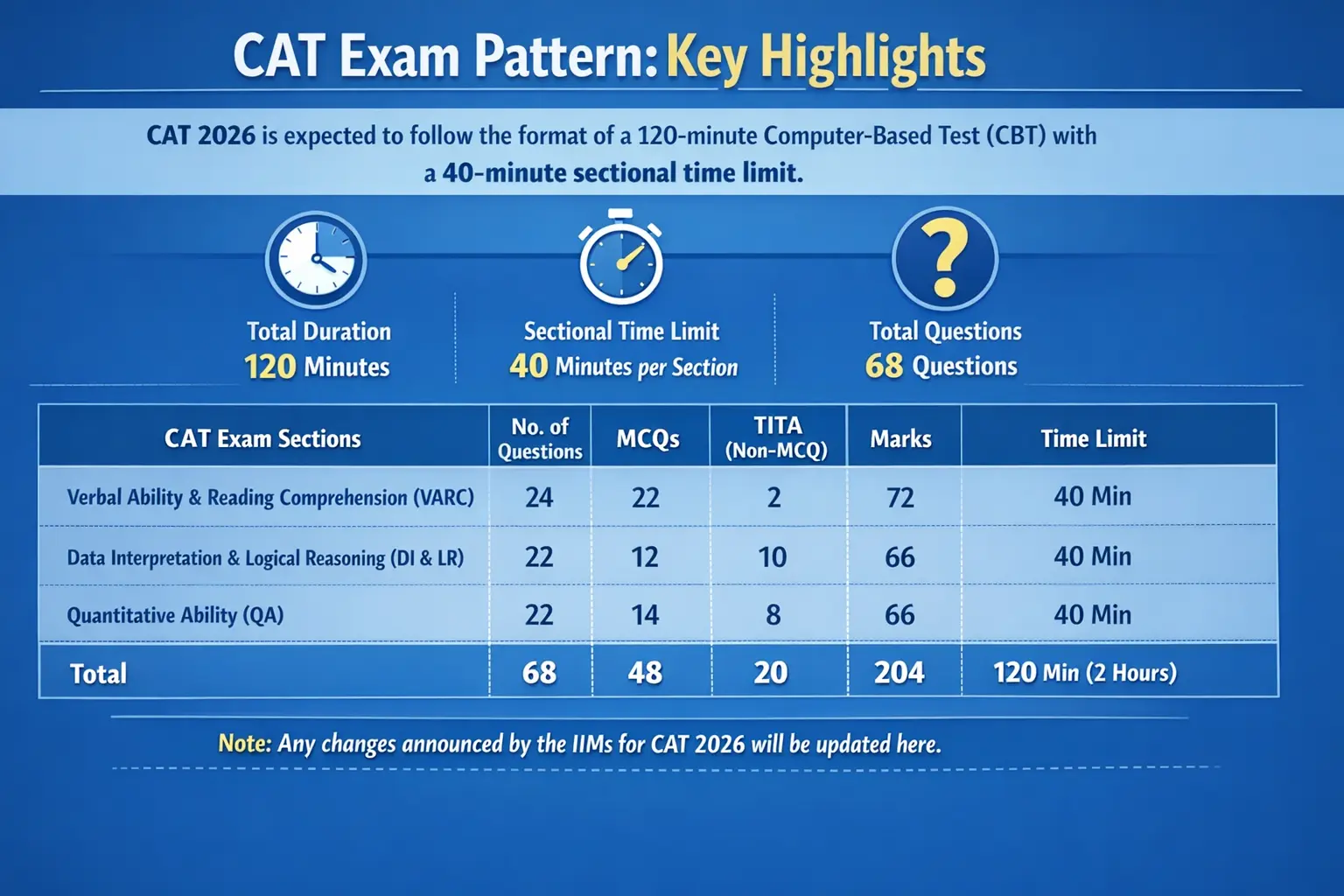
CAT 2026 Exam Pattern: Section-wise Question Distribution
Now that you know the section-wise breakup, let’s understand the overall and sectional time limits in CAT 2026.
| Section | Section Name | No. of Questions (Expected) | MCQ Questions (Approx.) | TITA (Non-MCQ) Questions (Approx.) | Sectional Time Limit |
|---|---|---|---|---|---|
| I | Verbal Ability & Reading Comprehension (VARC) | 24 | 22 | 2 | 40 minutes |
| II | Data Interpretation & Logical Reasoning (DILR) | 22 | 12 | 10 | 40 minutes |
| III | Quantitative Aptitude (QA) | 20 | 14 | 8 | 40 minutes |
| Total | — | 66 | 48 | 20 | 120 minutes (2 hours) |
Note: the MCQ vs TITA split can vary slightly across slots/years; use this as an approximate reference based on recent papers.
This section-wise CAT exam pattern indicates approximately 66 questions in total, with an indicative mix of 48 MCQs and 20 TITA questions (exact splits may vary slightly across slots/years).
CAT Exam Pattern: Understanding the Marking Scheme 2026
The CAT exam marking scheme is expected to remain the same as recent years.
Each correct answer usually carries +3 marks. MCQs generally have -1 negative marking for incorrect answers, while TITA (non-MCQs) usually have no negative marking.
| Question Type | Correct Answer | Wrong Answer | Un attempted |
|---|---|---|---|
| MCQ | +3 | -1 | 0 |
| TITA (Non-MCQ) | +3 | 0 | 0 |
Note: If any change is announced in the official CAT 2026 notification, it will be updated here.
What is the CAT marking scheme for MCQ and TITA questions?
Each correct answer usually carries +3 marks. For MCQs, there is generally a -1 negative mark for every wrong answer, while TITA (Type In The Answer) questions normally have no negative marking. This makes TITA questions important scoring opportunities with lower risk.
CAT Exam Pattern 2026: Overall and Sectional Time Limit
The CAT 2026 exam pattern consists of three sections: VARC, DILR, and QA. Each section is allotted 40 minutes, so candidates can only attempt it within that time frame.
Once the time limit is over, the next section will automatically appear on the screen. Additionally, the CAT 2026 exam pattern follows the same sequence of sections: VARC > DILR> QA.
The CAT exam pattern 2026 is expected to have a total duration of 120 minutes, with a strict 40-minute sectional time limit for each section (VARC, DILR, and QA).
- You must attempt each section within its allotted 40 minutes.
- Once a section’s time ends, the next section opens automatically.
- You cannot move back to a previous section or switch sections in between.
Section order (as followed in recent CAT papers): VARC → DILR → QA.
Read More | CAT 2026 Maths Syllabus Section-wise
Is there sectional time limit in CAT? Can I switch sections?
Yes, CAT normally has sectional time limits of 40 minutes per section for the standard paper. You cannot switch freely between sections during the test; the system automatically moves you to the next section after time ends. This makes time management within each section very important.
Important Changes in CAT Exam Pattern Over the Years
These changes in previous years explain why the current CAT exam pattern 2026 is expected to continue with around 66 questions and a 2-hour duration.
Earlier, CAT had 100 questions; the pattern changed to 76 questions in CAT 2020, 66 questions from CAT 2021 to CAT 2023, and 66 questions in the CAT 2024 and CAT 2025 papers.
Here is the CAT exam question pattern and its evolution over the years:
| CAT Exam Year | Number of Questions | Exam Duration | Sections |
|---|---|---|---|
| 2025 | 66 | 120 minutes | QA, DILR, VARC |
| 2024 | 66 | 120 minutes | QA, DILR, VARC |
| 2023 | 66 | 120 minutes | QA, DILR, VARC |
| 2022 | 66 | 120 minutes | QA, DILR, VARC |
| 2021 | 66 | 120 minutes | QA, DILR, VARC |
| 2020 | 76 | 120 minutes | QA, DILR, VARC |
| 2019 | 100 | 180 minutes | QA, DILR, VARC |
| 2018 | 100 | 180 minutes | QA, DILR, VARC |
| 2017 | 100 | 180 minutes | QA, DILR, VARC |
Check: CAT Exam is for What Purpose?
Difference Between the CAT Exam Pattern 2026 and Other MBA Entrance Exams?
Although all the MBA entrance exams share some common features, there are still some differences between them, such as XAT, CMAT, MAT, GMAT, NMAT, and SNAP. So, let’s have a look at the differences between the CAT paper 2026 and other MBA entrance exams:
|
Exam Name |
Time Duration |
No. of Questions |
Sections |
Overall Score |
|
CAT |
120 minutes |
66 |
3 |
204 |
|
XAT |
180 minutes |
95 |
4 |
95 |
|
CMAT |
180 minutes |
100 |
5 |
400 |
|
MAT |
120 minutes |
150 |
5 |
150 |
|
NMAT |
120 minutes |
108 |
3 |
36-360 |
|
SNAP |
60 minutes |
60 |
3 |
60 |
Does CAT have an on-screen calculator? Are rough sheets provided?
Yes, CAT provides an on-screen basic calculator for calculations during the exam. Test centres also usually provide rough sheets or writing pads for solving questions manually, which must be returned after the exam. Candidates should practise mocks using both tools for familiarity.
CAT Exam Pattern 2026 and Preparation Strategy
To make the most of the CAT exam pattern 2026, you need a preparation strategy that matches the time limits, question distribution and marking scheme.
✅Familiarise Yourself with the CAT 2026 Exam Pattern
Thoroughly understand the exam structure, including the number of sections, time limits, question types, and marking scheme.
✅Section-wise Preparation
Based on your strengths and weaknesses, allocate dedicated time for each section (VARC, DILR, and QA).
✅Focus on Fundamentals
Strengthen your basic concepts in each subject area.
- For VARC, improve your reading speed, comprehension, and vocabulary.
- For DILR, practice interpreting data and solving logical reasoning problems.
- For QA, focus on arithmetic, algebra, and geometry.
✅Practice Regularly
Consistent practice is crucial for enhancing speed and accuracy. Solve a variety of questions from different topics.
✅Mock Tests
Take mock tests to simulate the actual exam environment. This will help you become familiar with the CAT 2026 exam pattern, time constraints, and pressure. Analyse your performance in mock tests to identify areas that need improvement.
✅Time Management
Develop effective time management strategies for each section. Learn to allocate time to different types of questions and avoid spending too much time on any single question.
✅Analyze Previous Year Papers
Solving previous years' CAT question papers can provide valuable insights into the CAT 2026 exam pattern, difficulty level, and types of questions asked.
Conclusion
The CAT 2026 exam pattern is expected to be broadly similar to the recent CAT papers, especially CAT 2024 and CAT 2025.
You can safely assume a 2-hour computer-based test with 3 sections, around 66 questions, and a mix of MCQ and TITA questions until the IIMs officially announce any changes.
If you clearly understand the CAT exam pattern 2026, it becomes much easier to plan your preparation, set realistic attempt targets, and build a strong mock test strategy.

Smart Prep for CAT: Join Our Free Demo Class
Fill your details
Frequently Asked Questions
what is the CAT exam pattern in simple terms?

How long is the CAT Exam?
How many questions are expected in CAT 2026 as per the latest pattern?
Is there any negative marking in CAT exam pattern 2026?
Is there any sectional time limit for the CAT Exam?
How many questions in VARC CAT?
What type of questions are asked in the CAT exam?
What questions are asked in the CAT exam?
How has CAT paper pattern changed over the years?
Is the CAT exam pattern 2026 confirmed by the IIMs
Is CAT mcq based?
How many questions are there in CAT?
Will there be any change in sections for CAT exam pattern 2026
How does the CAT exam pattern 2026 affect my preparation strategy?

Lalita Vishwakarma
Content Writer


SHARE