
1723534562.png)

How to Balance Accuracy and Speed in CAT 2026
July 7, 2026
Overview: "Learn how to balance accuracy and speed in CAT with just 60 days left for the exam. Discover proven strategies to boost your score by sharpening your test-taking approach, not just your knowledge."
Hey aspirant, only 60 days are left for the CAT 2026 exam, and this is the crucial phase where every aspirant needs to sharpen not just their knowledge, but their approach.
Hey aspirant, only 60 days are left for the CAT 2026 exam, and this is the crucial phase where every aspirant needs to sharpen not just their knowledge, but their approach.
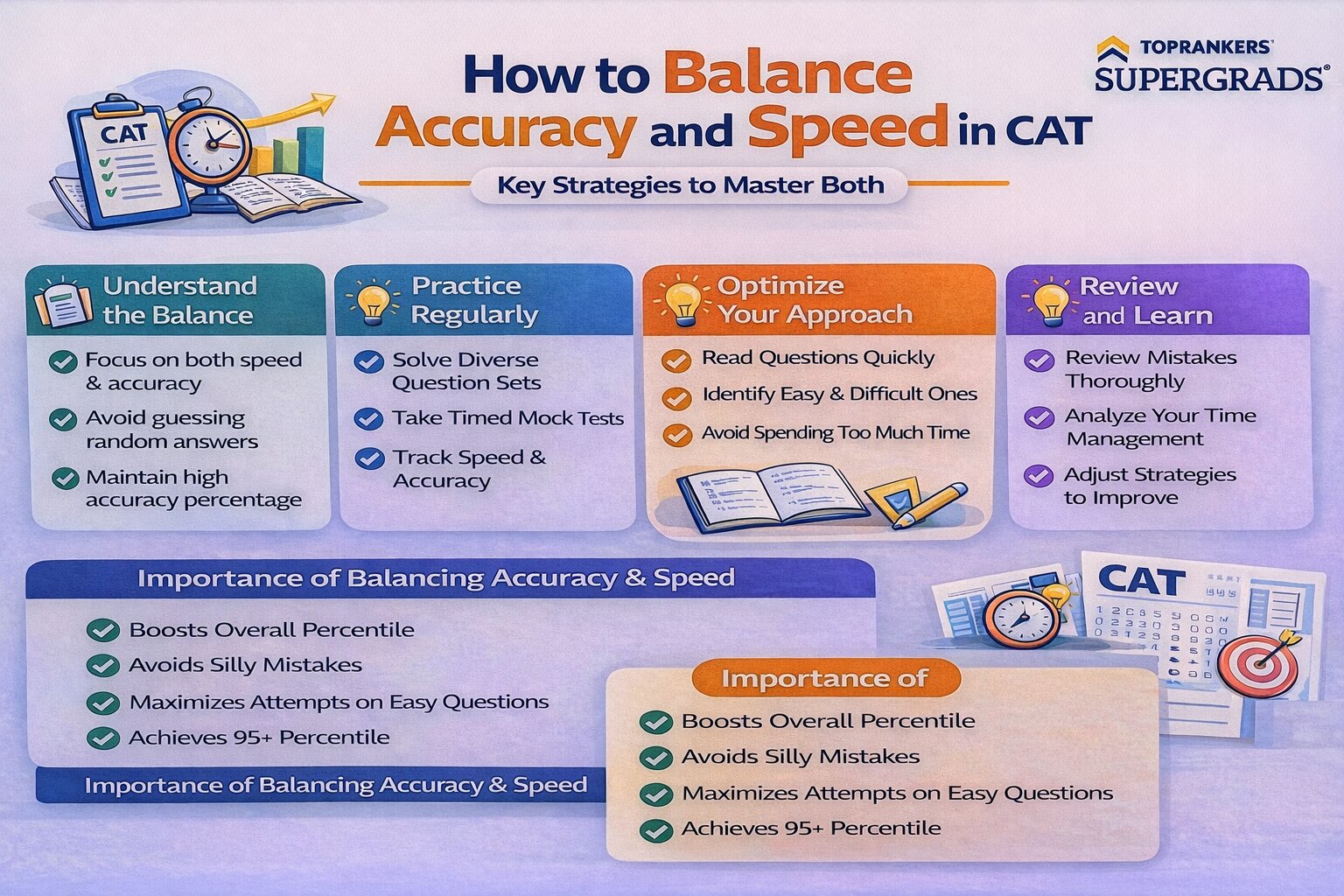
Cracking CAT isn’t about attempting every question - it’s about attempting the right ones with the perfect blend of speed and accuracy.
Many fall into the trap of rushing through questions and accumulating negative marks, while others spend too much time chasing absolute accuracy and miss out on valuable attempts.
Here we will help you balance speed and accuracy in the CAT exam, ensuring you perform at your absolute best when it matters most.
How to Balance Speed and Accuracy in the CAT Exam 2026: The 3 Phases to Follow
Improving your speed is crucial. Here are three main ways to do it:
1. Spend Less Time on Each Question
To solve questions faster, you must cut down the time you spend on each one.
Use Shortcuts and Formulas
Strengthen your basic concepts. Know the key QA formulas, theorems, and rules well. This helps you solve problems more efficiently.
Try the Elimination Method
Many CAT questions, especially in Quantitative Aptitude and Reading Comprehension, come with options. Use the elimination method. Rule out incorrect choices first. If you can narrow it down to two options, or even one, you save a lot of time.
Use Hit and Trial
For some Quant questions, you can pick options one by one. Then, check if they fit the conditions in the question. This can be much faster than solving from scratch.
Analyze Mock Tests
After each mock test, look at the questions you solved. Check if there was a faster way to get the answer. Revisit questions you got right. Could you have finished them in less time? Learning better methods during analysis helps you for the next test. Check out "How to analyse mock test: The right approach".
2. Sequence Questions Strategically: The ABC Approach
The order in which you tackle questions is very important. This helps you maximise your CAT score and percentile. We call this the ABC Approach:
A (Abhi): Do It Now
These are the questions you can solve quickly and easily. They give you a good "return on investment" for your time. Solve these first to build confidence.
B (Baad Mein): Do It Later
These questions might take a bit more time, but you know you can solve them. Bookmark these and come back after you finish all the 'A' questions.
C (Chhodo): Leave It
These are very difficult questions. Do not spend time on them, no matter how much time you have left. It is better to leave them and move on.
Never get stuck on one question. If an easy question takes too long, put it in the 'B' category and come back later. Prioritise quick wins first.
CAT & OMETs Products by Supergrads To Boost Your Prep
Here are the exclusive CAT & OMETs products that will help you improve your preparation. Check them now!
| VARC Demo | |
| QA Demo | |
| DILR Demo | |
| CAT & OMETs Test Series Batches | |
| CAT & OMET 2026 Study Material and Test Series by Supergrads | |
| CAT 2026 Mock Test Series by Supergrads |
3. Master the Art of Leaving Questions
Knowing when to quit a question is as important as knowing how to solve it.
Selectivity is Key
Don't feel you must answer every question in order. Be selective. If you start a question and realise you're stuck after a minute or a minute and a half, leave it immediately.
Set a Threshold Time
Decide on a maximum time you will spend on a question in each section. For example, in Quant, a good threshold is one to one and a half minutes. If you're not making progress by then, move on.
Avoid the trap of thinking, "Just one more minute." This often wastes precious time. Managing time while solving CAT questions is a must for scoring well.
Avoid Early Scanning for All Questions
For a 40-minute section, trying to read all the questions first and decide which to answer can be risky. Spending 20-30 seconds on each question to decide means you might use 9-10 minutes before solving anything. This can create a lot of pressure. Instead, use the ABC approach as you go.
Use a Rough Sheet as a Reminder
During the exam, take a rough sheet. Write "Threshold" and "ABC" on it. Keep it on your desk. This visual reminder helps you stick to your strategy and avoid getting stuck.
How to Balance Speed and Accuracy in CAT Exam: Section-Specific Strategies
Each section of the CAT exam requires a slightly different approach to manage speed and accuracy.
1. Verbal Ability and Reading Comprehension (VARC)
The VARC syllabus consists of questions that come from Reading Comprehension (RC) passages. You must learn to pick the right RC passages and answer questions accurately
Choose RC Passages Wisely
- Spend 30-45 seconds reading the first paragraph of each RC passage.
- This helps you understand the topic (genre) and the language style.
- Pick the RC passages that you find clearest and easiest to understand first.
Focus on Accuracy, Not Just Quantity
- If an RC passage has five questions, you do not need to answer all five. Aim to answer three or four questions accurately and then move to the next passage.
- Use the elimination method to rule out wrong answer choices.
- Do not just match words or phrases from the passage to the options. Understand the full meaning and logic behind each choice.
Time Allocation for RC
- In a 40-minute VARC section, with around 18 RC questions (from previous patterns), give the first 25 to 30 minutes to RC passages.
- This means about 10-12 minutes per passage. After that, move to independent questions like a para summary or a para completion.
Para Jumbles
-
If para jumbles are not your strength, or if they do not have options, consider giving them less time or skipping them. They can be very time-consuming for low accuracy.
2. Logical Reasoning & Data Interpretation (LRDI)
This section requires strong logical thinking and calculation skills.
Develop Calculation Speed and Estimation Skills
- LRDI often involves intense data. Improve your calculation speed and learn approximation techniques.
- Memorize squares, cubes, and percentage equivalents of fractions.
- Practice your multiplication tables. These skills will save you time.
Avoid Traps
- Be careful with the language in LRDI sets. Sometimes, a set may sound simple but have very complex conditions. Do not get tricked by easy language; look at the actual complexity of the data.
Apply the Threshold Rule to Sets
Just like with individual questions, set a threshold for LRDI sets. If you spend four to six minutes on a set and still do not understand it or cannot make progress, leave that set. Do not waste more time. Many students lose more than 20 minutes trying to solve a difficult LRDI set.
Don't Waste Time on One Question in a Set
Even within a chosen set, some questions might be harder. If one question in a data interpretation set is very complex or needs a lot of calculation, consider skipping it. You can solve the easier questions in the set and move on.
3. Quantitative Aptitude (QA)
The Quant section demands careful reading and efficient problem-solving.
Manage Your Ego
Many students waste valuable minutes on questions from their strong areas. For example, if you are good at Time, Speed, and Distance, you might spend seven to eight minutes on a complex problem. Even if you get it right, you could have solved three other easier questions in the same time. Leave your ego outside the exam hall.
Read Questions Carefully
This is a common mistake. After solving a question, go back and read the last sentence or two of the question statement.
Always double-check what the question truly asks. This small step can prevent negative marks in the CAT exam.
Boost Calculation Efficiency
- Your calculation speed should be high. Practice using:
- Estimations and approximations.
- Knowing tables, squares, and cubes of numbers.
- Understanding percentage equivalents of fractions (e.g., 1/3 = 33.33%).
Conclusion
The last few days before the CAT exam are very important. Stay calm and do not overthink. Meanwhile, get a good hold on the CAT QA formulas and theorems. Also, practice the CAT previous year papers to familiarise yourself with the difficulty level and exam pattern.
Remember, both speed and accuracy are skills you can improve. It just takes presence of mind during the exam. By using these tips, you can balance both to achieve a great score.

Smart Prep for CAT: Join Our Free Demo Class
Fill your details
Frequently Asked Questions
How many questions from DILR should I attempt?

How to maintain accuracy under time pressure?
Should I focus on DI or LR more?
How many questions are there in the CAT QA section, and what is the time limit?
What are the key topics in the CAT QA section to focus on for better speed and accuracy?

Zubeen Siddiqui
Content Writer | MBA & CAT Preparation
SHARE