
1723534562.png)

CAT Quantitative Aptitude Syllabus 2026 (QA) – Topic-Wise List + Weightage PDF
May 2, 2026
Overview: Looking for the CAT Quantitative Aptitude syllabus 2026? Here’s the complete QA topic list (Arithmetic, Algebra, Geometry & Mensuration, Number Systems, Modern Math) with expected weightage, question types (MCQ/TITA), and a downloadable PDF. Use the TOC below to jump to any topic and start with the highest ROI chapters first.
The Quantitative Aptitude (QA) section of the CAT exam is one of the most crucial and challenging parts of the test. It evaluates a candidate’s mathematical ability, problem-solving skills, and numerical aptitude. A clear understanding of the CAT Quantitative Aptitude syllabus is essential for building a strong preparation strategy.
This guide covers everything you need to know about the CAT QA syllabus 2026 from a complete topic-wise breakdown and historical weightage analysis to a phase-wise preparation strategy.
Quick Answer:
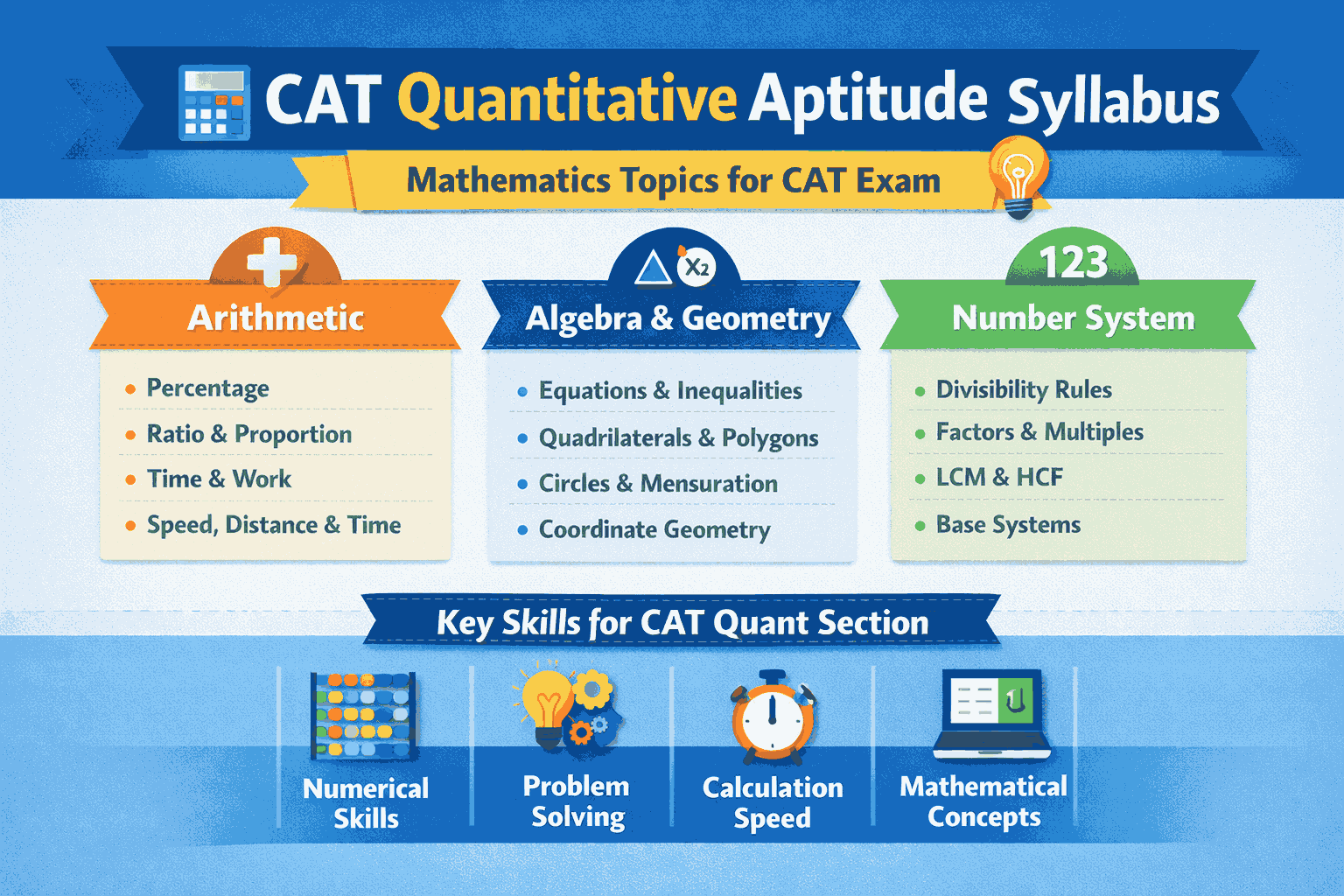
What Is the CAT Quantitative Aptitude Syllabus 2026? The CAT QA Syllabus 2026 covers five major areas: Arithmetic, Algebra, Geometry & Mensuration, Number Systems, and Modern Mathematics. The section has 22 questions (MCQ and TITA) to be attempted in 40 minutes. Core topics include percentages, profit & loss, linear and quadratic equations, triangles, circles, permutation & combination, number theory, and probability. No official CAT quant syllabus is published by IIM; this breakdown is based on analysis of CAT papers from 2017–2024.
Is the CAT Quantitative Aptitude syllabus officially defined?
No, CAT does not provide an official syllabus, but it is based on commonly tested topics from high school mathematics.
CAT 2026 Exam Pattern: Understanding the QA Section
Before diving into the CAT Quantitative Aptitude Syllabus, it is essential to understand the exam pattern of CAT 2026 as a whole and the specific characteristics of the QA section. This context will directly influence how you allocate your study time.
Overall CAT 2026 Exam Structure
|
Section |
No. of Questions |
Time Allotted |
Max Marks |
|
Verbal Ability & Reading Comprehension (VARC) |
24 |
40 Minutes |
72 |
|
Data Interpretation & Logical Reasoning (DILR) |
20 |
40 Minutes |
60 |
|
Quantitative Aptitude (QA) |
22 |
40 Minutes |
66 |
|
Total |
66 |
120 Minutes |
198 |
CAT QA Section — Detailed Parameters
|
Parameter |
Details |
|
Total Questions |
22 |
|
MCQ Questions (with options) |
Approx. 14–16 |
|
TITA Questions (type-in-the-answer) |
Approx. 6–8 |
|
Marks per Correct Answer |
+3 for both MCQ and TITA |
|
Negative Marking |
-1 per wrong MCQ; No negative for TITA |
|
Time Allotted |
40 Minutes (strictly sectional) |
|
Maximum Sectional Score |
66 |
|
Calculator |
On-screen basic calculator provided |
|
Mode of Exam |
Computer-based test (CBT) |
|
Medium |
English only |
Understanding the MCQ vs TITA split is strategically important. Since TITA questions carry zero negative marking, they present an opportunity to attempt and guess intelligently without risking a score drop. However, TITA questions are generally harder to solve as they require exact answers without the benefit of answer choices to guide or verify your solution.
CAT Quantitative Aptitude Syllabus 2026: Detailed Topic-Wise Breakdown
The CAT QA syllabus can be divided into five broad topic areas. Below is an in-depth breakdown of each area, including all key subtopics, concept types, and the nature of questions you can expect in CAT 2026.
| Main Topic | Subtopic | Key Concepts / Question Types |
|---|---|---|
| Arithmetic (30–35% weightage) | Percentages | Percentage increase/decrease, successive changes, percentage point vs % change, base value finding, applications in population, elections, mixtures |
| Profit, Loss & Discount | Cost price (CP), selling price (SP), marked price (MP), discount vs MRP, successive discounts, dishonest dealer problems, partnership profit sharing | |
| Simple Interest & Compound Interest | SI & CI formulas, SI vs CI comparison, compounding periods (annual, quarterly, etc.), effective interest rate, depreciation | |
| Ratio, Proportion & Variation | Ratio properties, compounded ratios, componendo-dividendo, direct/inverse proportion, third & fourth proportional, partnership problems | |
| Averages, Mixtures & Alligations | Weighted averages, rule of alligation, replacement problems, moving averages | |
| Time, Speed & Distance | Relative speed, trains, boats & streams, circular motion, average speed, escalators & walkways | |
| Time & Work | Work equivalence, man-days, pipes & cisterns, workers joining/leaving, wages proportionality |
CAT Quantitative Aptitude (QA) Syllabus 2026 – Algebra
| Main Topic | Subtopic | Key Concepts / Question Types |
|---|---|---|
| Algebra (4–6 questions) | Linear Equations | Single-variable, two-variable, three-variable systems; unique, infinite, or no solution conditions; word problems (age, digit, number); applications in mixtures, averages, profit/loss |
| Quadratic Equations | Standard form, factorization, quadratic formula; discriminant & nature of roots; Vieta’s formulas; forming quadratics from root conditions; max/min of quadratic expressions; reducible-to-quadratic equations | |
| Inequalities & Modulus | Solving linear/quadratic inequalities algebraically & graphically; modulus inequalities | |
| Functions | Domain & range; composite functions f(g(x)) & inverses; even, odd, periodic functions; greatest integer & fractional part functions; graphical transformations; functional equations like f(x+y)=f(x)+f(y) | |
| Logarithms & Surds | Logarithm properties (product, quotient, power); change of base; logarithmic equations & inequalities; surd comparison & rationalization; exponents including negative/fractional powers | |
| Sequences & Series (AP, GP, HP) | nth term & sum of n terms; AM, GM, HM and AM–GM–HM inequalities; sum of special series (natural numbers, squares, cubes); infinite GP sum ( |
CAT Quantitative Aptitude Syllabus 2026 – Number Systems
| Main Topic | Subtopic | Key Concepts / Question Types |
|---|---|---|
| Number Systems | Classifications & Properties of Numbers | Natural, whole, integers, rational, irrational, real numbers; properties of even/odd, positive/negative; composite, prime, co-prime; perfect, amicable, Armstrong numbers |
| Divisibility & Factorisation | Divisibility rules (2–13); prime factorization; number/sum/product of divisors formulas; highest power of prime in n! (Legendre’s formula) | |
| HCF & LCM | Euclidean algorithm; HCF & LCM of fractions/decimals; relation between HCF, LCM, product of numbers; word problems (bells, tiles, rectangles) | |
| Remainders & Congruences | Cyclicity of remainders for powers; Fermat’s Little Theorem & Euler’s Theorem; Chinese Remainder Theorem basics; Wilson’s Theorem; polynomial division remainders | |
| Unit Digit, Last Two Digits & Base Conversions | Cyclicity of unit digits; last two digits of powers; conversions (binary, octal, decimal, hexadecimal); arithmetic in non-decimal bases | |
| Factorials & Special Topics | Trailing zeros in n!; highest power of composite numbers; counting numbers with specific properties in a range |
CAT Quantitative Aptitude (QA) Syllabus 2026 – Geometry & Mensuration
| Main Topic | Subtopic | Key Concepts / Question Types |
|---|---|---|
| Geometry & Mensuration (20–25% weightage) | Lines, Angles & Triangles | Parallel lines: corresponding, alternate, co-interior angles; triangle inequalities; congruence (SSS, SAS, ASA, AAS, RHS); similarity (AA, SSS, SAS); Pythagoras theorem & triplets; special triangles (30-60-90, 45-45-90); area formulas (base-height, Heron, ½ab sin C); medians, altitudes, angle bisectors; centroid, orthocentre, incentre, circumcentre; Apollonius & Stewart’s theorem |
| Circles | Chord properties; inscribed angle theorem; tangent-radius perpendicularity; power of a point theorem; cyclic quadrilateral properties; internal/external tangents; alternate segment theorem | |
| Quadrilaterals & Polygons | Properties of parallelogram, rhombus, rectangle, square, trapezium, kite; diagonal properties; area formulas; sum of interior/exterior angles; number of diagonals & triangles in polygons | |
| Coordinate Geometry | Distance, midpoint, section formulas; slope, collinearity; line equations (slope-intercept, point-slope, two-point, intercept form); distance from point to line; angle between lines; parallelism/perpendicularity; locus problems; basic circle equations | |
| Mensuration — 2D Shapes | Area & perimeter of triangle, rectangle, square, parallelogram, rhombus, trapezium, regular hexagon; area & circumference of circle, semicircle, sector, segment; combined & shaded regions | |
| Mensuration — 3D Solids | Cube & cuboid (volume, LSA, TSA, space diagonal); cylinder (volume, LSA, TSA); cone (slant height, volume, LSA, TSA); sphere & hemisphere (volume, surface area); frustum of a cone; water filling, melting, recasting solids |
CAT Quantitative Aptitude Syllabus 2026 – Modern Mathematics
| Main Topic | Subtopic | Key Concepts / Question Types |
|---|---|---|
| Modern Mathematics (2–3 questions) | Permutation & Combination | Fundamental Counting Principle (FCP); factorial notation; permutations (nPr, with repetition, restricted); combinations (nCr, Pascal’s triangle); circular permutations; distribution of objects into groups; selecting/arranging from multiple groups; counting words with/without repetition; rank of a word in dictionary arrangement |
| Probability | Classical probability; complement, addition, multiplication rules; conditional probability (P(A | |
| Set Theory & Venn Diagrams | Union, intersection, complement, difference; De Morgan’s laws; 2-set & 3-set Venn problems; max/min element problems in overlapping sets; survey and real-life application problems |
CAT QA Topic-Wise Weightage & Difficulty Analysis (2017–2024)
The table below provides a data-driven view of each topic area in the CAT Quantitative Aptitude Syllabus, based on CAT papers over the past seven years. Use this to prioritise your preparation intelligently.
|
Topic Area |
Avg. Questions |
Weightage |
Difficulty |
Scoring Potential |
|
6–8 |
30–35% |
Easy–Moderate |
Very High |
|
|
Algebra |
4–6 |
20–25% |
Moderate–Hard |
High |
|
Geometry & Mensuration |
4–5 |
20–25% |
Moderate–Hard |
Moderate–High |
|
Number Systems |
3–4 |
15–20% |
Moderate |
High |
|
Modern Mathematics |
2–3 |
10–15% |
Moderate |
High |
|
Important Note: IIM CAT does not publish an official CAT quant syllabus. The weightage figures above are derived from analysis of official CAT question papers from 2017 to 2024 and are indicative, not guaranteed. Treat all five areas as equally important during preparation. |
CAT + OMETs Mock Test to Boost Your Prep
| Free CAT Mock Test -01 | |
| Free CAT Mock Test- 02 | |
| Free CAT Mock Test- 03 | |
| Free CAT Mock Test- 03 | |
| Free CAT Mock Test- 03 |
High-Priority CAT QA Topics You Must Not Skip
Across CAT previous year papers from 2017 to 2024, certain topics from the CAT Quantitative Aptitude Syllabus have appeared with remarkable consistency. Mastering these high-frequency topics should form the core of your CAT QA preparation:
|
Priority |
Topic |
Reason for Priority |
|
1 |
Percentages & Applications |
Foundational for Arithmetic + DILR overlap |
|
2 |
Time, Speed & Distance |
Complex scenarios; repeated every year |
|
3 |
Quadratic Equations & Functions |
Algebraic mainstay; high difficulty ceiling |
|
4 |
Triangles & Circle Theorems |
Geometry cornerstone; ~2–3 questions guaranteed |
|
5 |
Remainder Theorem & Number Theory |
High TITA frequency; scoring for prepared aspirants |
|
6 |
Permutation & Combination |
Increasing trend; scoring with focused preparation |
|
7 |
Arithmetic & Geometric Progressions |
Appears consistently; moderate difficulty |
|
8 |
Inequalities & Modulus |
High-difficulty differentiator in 99 percentile range |
|
9 |
Coordinate Geometry |
Moderate frequency; often combined with Geometry |
|
10 |
Mixtures & Alligations |
Classic CAT topic; quick to master |
CAT QA Preparation Strategy 2026: A Phase-Wise Roadmap
A structured, phased approach is the most efficient way to prepare for the CAT Quantitative Aptitude Syllabus. The strategy below is designed for a 6-month preparation window, which is the recommended timeline for most aspirants. Adjust the pace based on your current mathematical proficiency.
Phase 1: Foundation Building (Months 1–2)
The goal of this phase is to eliminate all conceptual gaps and build a strong mathematical foundation. Rushing through this phase to get to harder problems is a common mistake that leads to plateauing later in preparation.
- Start with NCERT Mathematics Textbooks (Classes 8, 9, and 10) — these cover all foundational concepts tested in CAT QA.
- Follow a strict topic-by-topic approach: do not jump between topics. Complete one topic fully before moving to the next.
- Prioritize Arithmetic in the first three weeks, as it has the highest weightage and applications across sections.
- Maintain a dedicated Formula & Concept Notebook — write every formula, theorem, property, and important result. Revise this notebook daily.
- Solve 25–30 basic-level questions per topic before considering the topic ready for advancement.
- Use free YouTube resources (Anuj Jindal, Rodha, 2IIM) for conceptual explanations when stuck.
- Do not attempt mock tests yet. Foundation phase is about quality of understanding, not speed.
Phase 2: Concept Consolidation & Speed Building (Months 3–4)
Once your foundation is solid, shift focus to CAT-level problems and building the speed required for the exam. This phase bridges the gap between understanding concepts and applying them under exam conditions.
- Solve 40–50 CAT-level questions daily, mixing topics to simulate the randomness of the actual exam.
- Practice Vedic Mathematics and mental math techniques — squaring numbers, multiplication by 11/99, fraction-to-decimal conversions.
- Benchmark yourself: aim to solve standard CAT QA questions within 2 minutes each.
- Categorise every error into: (a) Conceptual mistake, (b) Calculation error, or (c) Misread question. Address each category differently.
- Begin solving previous year CAT papers from 2017 onwards. Focus on understanding why each answer is correct, not just what it is.
- Attempt topic-wise timed tests (30 questions in 60 minutes) to build sectional stamina.
- Identify your three weakest sub-topics and dedicate extra 30-minute sessions to them weekly.
Phase 3: Advanced Problem Solving (Month 5)
This phase is dedicated to pushing your ceiling — solving high-difficulty problems that differentiate 90th percentile from 99th percentile scores. Many aspirants skip this phase, which explains why many get stuck at the 85–90th percentile range.
- Solve high-difficulty problems from sources like Arun Sharma Level 3, AIMCAT papers, and IMS SimCATs.
- Focus on Algebra (especially Functions and Inequalities) and Geometry — the two areas with the steepest difficulty curves.
- Practice approximation techniques to quickly eliminate wrong answer choices in MCQs.
- Revisit and consolidate your formula notebook, adding new insights and shortcuts discovered during practice.
- Attempt 2–3 sectional QA mocks per week under timed conditions (40 minutes, 22 questions).
Phase 4: Mock Tests, Analysis & Revision (Month 6 Onwards)
The final phase transforms your preparation into exam-readiness. Mock tests are not just practice — they are diagnostic tools that reveal your preparation gaps and help you build an optimal exam-day strategy.
- Attempt at least 2 full-length CAT mock tests per week under real exam conditions (no breaks, no phone).
- Spend equal time on post-mock analysis as you do on the mock itself — this is where most of the learning happens.
- Track your QA sectional score, accuracy percentage, and attempts per mock in a spreadsheet to monitor trends.
- Revise your formula notebook every 3–4 days. Reduce it to a rapid-revision sheet of one page in the final month.
- Practice question selection: in the final 2 weeks, work on your ability to quickly identify easy, medium, and hard questions within the first 5 minutes of the QA section.
- Simulate exam anxiety by timing yourself strictly and not allowing yourself to skip or revisit during the 40-minute window.
Recommended Weekly Study Plan for CAT QA Syllabus 2026
Consistency beats intensity. A well-structured weekly plan ensures all topic areas in the CAT Quantitative Aptitude Syllabus receive adequate attention throughout your preparation. Here is a recommended schedule that can be adapted based on your specific strengths and weaknesses:
|
Day |
Morning Session (1.5 hrs) |
Evening Session (1.5 hrs) |
Night Review (30 min) |
|
Monday |
Arithmetic: Concept + 25 questions |
Number Systems: Concept + 20 questions |
Formula notebook revision |
|
Tuesday |
Algebra: Concept + 25 questions |
Geometry: Concept + 20 questions |
Error log review |
|
Wednesday |
Arithmetic: Advanced problems (30 Q) |
Modern Math: P&C + Probability |
Shortcut techniques practice |
|
Thursday |
Algebra: Functions & Inequalities (25 Q) |
Coordinate Geometry (20 Q) |
Formula notebook update |
|
Friday |
Mixed Practice: All topics (40 Q timed) |
Weak topic deep-dive (30 Q) |
Review today's errors |
|
Saturday |
Sectional Mock: 22 Q in 40 mins |
Detailed mock analysis |
Revise all flagged concepts |
|
Sunday |
Full CAT mock (in Phase 4) |
Rest or light revision |
Weekly formula review |
Smart Scoring Strategies for CAT QA Syllabus on Exam Day
Preparation and exam-day execution are two different skills. Many well-prepared aspirants underperform in the actual exam due to poor strategy. Here are battle-tested strategies for maximizing your QA score on exam day:
- Scan before you solve: Spend the first 4–5 minutes scanning all 22 questions. Categorize them mentally as easy, medium, or hard. Attempt easy questions first to build momentum and secure marks quickly.
- Accuracy over attempts: Attempting 16 questions with 90% accuracy (~43 marks) is far better than attempting 22 questions with 70% accuracy (~31–37 marks after negative marking). Never sacrifice accuracy for volume.
- TITA first in doubtful cases: If you are moderately confident about a TITA answer, attempt it — there is no downside. For MCQs, if you cannot eliminate at least two options, skip rather than guess.
- Time management checkpoints: At the 20-minute mark, you should ideally have 10–11 questions attempted with high confidence. If behind, increase pace on your strong-topic questions.
- Avoid calculation rabbit holes: If a question seems to require very long calculations, you are likely missing a smarter approach. Step back, re-read the question, and look for a conceptual shortcut.
- Use answer choices strategically: For MCQ questions, back-substituting answer choices is often faster than solving from scratch — especially for quadratic equations, number theory, and inequality problems.
- Manage mental fatigue: QA is the last section in CAT. If you find yourself mentally drained, tackle your strongest topic area first to rebuild confidence and momentum.
Best Study Resources for CAT Quantitative Aptitude Syllabus 2026
Choosing the right resources is critical for efficient preparation. Below is a curated list of CAT preparation books, online platforms, and free resources, organized by category.
Recommended Books
|
Book Title |
Author |
Best For |
Level |
|
Quantitative Aptitude for CAT |
Arun Sharma |
Complete CAT QA preparation |
Beginner to Advanced |
|
Quantitative Aptitude for Competitive Examinations |
R.S. Aggarwal |
Arithmetic basics & speed building |
Beginner |
|
Magical Book on Quicker Maths |
M. Tyra |
Shortcuts and tricks |
Beginner to Intermediate |
|
How to Prepare for QA for the CAT |
Arun Sharma (Latest Ed.) |
Level-wise progressive practice |
Intermediate to Advanced |
|
NCERT Mathematics (Class 8–10) |
NCERT |
Foundational concept clearing |
Beginner |
|
Algebra for CAT |
Sarvesh Kumar Verma |
Deep algebraic concept building |
Intermediate to Advanced |
CAT QA Score vs. Percentile: What You Need to Target
Understanding the score-percentile relationship helps you set realistic targets and gauge your performance relative to the test-taking population. The table below is based on historical CAT QA score distributions:
|
Target Percentile |
Approx. Score Required |
Correct Answers Needed |
Acceptable Errors (MCQ) |
|
99th Percentile+ |
55–66 |
18–22 correct |
0–2 |
|
95th–99th Percentile |
45–54 |
15–18 correct |
2–4 |
|
90th–95th Percentile |
36–44 |
12–15 correct |
3–5 |
|
80th–90th Percentile |
27–35 |
9–12 correct |
4–6 |
|
70th–80th Percentile |
18–26 |
6–9 correct |
5–7 |
|
Target for IIM ABC calls: Most IIMs (Ahmedabad, Bangalore, Calcutta) expect a QA sectional percentile of 80–90+ in addition to an overall 99th+ percentile. A balanced sectional performance across all three sections is often more important than being exceptional in just one. |
Common Mistakes CAT Aspirants Make in CAT QA Preparation 2026
- Skipping Geometry and Modern Math: Many aspirants avoid these areas, leaving 6–8 easy marks on the table. With focused 4-week preparation, these can become reliable scoring areas.
- Formula memorisation without conceptual understanding: CAT is designed to test concepts, not rote formulas. If you cannot derive a formula, you will struggle with its nuanced applications.
- Ignoring NCERT basics: Jumping to CAT-level practice without clearing school-level foundations leads to conceptual gaps that surface only in the actual exam.
- Not maintaining an error log: Aspirants who do not track their mistakes repeat them. An error log is one of the highest-ROI activities in CAT preparation.
- Overloading on resources: Using 5–6 books simultaneously leads to scattered preparation. Pick 2–3 high-quality resources and exhaust them completely.
- Mock tests without analysis: A CAT mock test without a 60-90 minute analysis session is a wasted opportunity. The analysis, not the attempt, drives score improvement.
- Ignoring time management in practice: Always practice with a timer. Real-exam time pressure feels very different from untimed practice sessions.
- Negative marking casualness in MCQs: A -1 penalty in CAT requires 3 correct answers to recover. One careless guess every 5 questions can cost you 5+ percentile points.
Conclusion: Building Your CAT QA 2026 Game Plan
The CAT Quantitative Aptitude section rewards those who prepare smartly, practice consistently, and execute strategically on exam day. With a clear understanding of the CAT Quantitative Aptitude Syllabus, a well-structured preparation roadmap, and the right resources, achieving a 90th+ percentile in QA is an attainable goal for any aspirant — regardless of their academic background.
Here are the key takeaways from this comprehensive guide:
- The CAT QA syllabus 2026 covers five major areas: Arithmetic (highest weightage), Algebra, Geometry & Mensuration, Number Systems, and Modern Mathematics.
- Arithmetic should be your first and deepest area of focus — it has the highest number of questions and the most cross-section applications.
- TITA questions carry no negative marking. Always attempt them on exam day, even with partial confidence.
- Follow a strict four-phase preparation plan: Foundation → Speed Building → Advanced Problems → Mock-Based Revision.
- Maintain an error log and a formula notebook throughout your preparation — these two tools significantly accelerate improvement.
- Aim for a QA score of 45+ to target a 90th+ percentile. IIM ABC aspirants should target 55+.
- Mock test analysis — not just the attempt — is the single highest-impact activity in the final 2 months of preparation.
- On exam day, prioritise accuracy and strategic question selection over attempting every question.
Your CAT 2026 journey begins with this syllabus. Invest the next 6 months in mastering every topic outlined above, take mock tests seriously, and you will walk into the exam hall with the confidence of thorough preparation. Best of luck!

Smart Prep for CAT: Join Our Free Demo Class
Fill your details
Frequently Asked Questions
What is the syllabus for the Common Admission Test (CAT)?

How many sections are there in the CAT exam?
What is the duration of the CAT exam?
Is there a negative marking in the CAT exam?
Is there a sectional cut-off in the CAT exam?
What is the syllabus of CAT quantitative aptitude?
What are the important CAT Quantitative Aptitude Tips to crack the exam?
Is the CAT Quantitative Aptitude Syllabus the same every year?
What topics are included in the CAT Quantitative Aptitude Syllabus?
Has the CAT Quant syllabus changed for 2026?
How many questions come from each topic in CAT QA?

Komal Tabhane
Content Writer | MBA & CAT Preparation
SHARE