


How to Prepare for Logical Reasoning for CAT 2026 (LR/DILR Strategy + PDF)
October 28, 2026
Logical Reasoning is a key part of the CAT DILR section. To prepare well, you need to practise different LR set types, learn how to arrange information, and identify which sets are easier to solve.
CAT Exam preparation for Logical Reasoning should start with topics like arrangements, games and tournaments, Venn diagrams, and routes. In this guide, you will find the important LR topics, a month-wise study plan, and useful practice resources to help you prepare. We will discuss tips and study materials to maximise your success and learn how to prepare for logical reasoning for CAT 2026.
How to Prepare for Logical Reasoning for CAT 2026
The Data Interpretation and Logical Reasoning section of the Common Admission Test (CAT) is designed to test your ability to analyse and interpret data and reason logically.
This section typically includes a variety of question types, including graphs, tables, and other visual data representations, as well as logical reasoning problems.
Detailed Preparation Strategy for DILR for CAT Exam 2026
The right preparation plan for DILR starts with understanding the Syllabus for CAT Exam and giving enough time to both Data Interpretation and Logical Reasoning. Follow this month-wise strategy to cover important topics, practise different question types, and improve your speed before the CAT Exam 2026.
First Month Preparation Strategy for DILR for CAT Exam
| Months | Strategy |
|---|---|
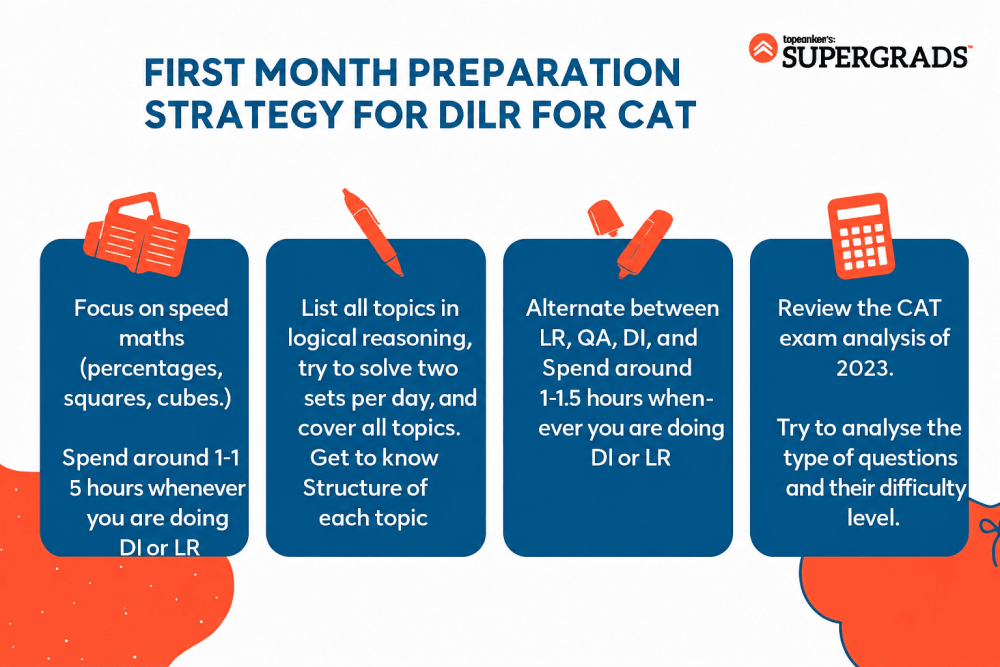
| First Month | List all topics in logical reasoning, try to solve two sets per day, and cover all topics. Get to know the structure of each topic. |
| In DI, focus on speed maths (percentages, squares, cubes). Review the CAT exam analysis | |
| Alternate between LR, QA, DI, and QA. Spend around 1-1.5 hours whenever you are doing DI or LR. |
Month 1 Preparation Strategy for Logical Reasoning for CAT 2026
How to Prepare for Logical Reasoning for CAT? Use the first month to get familiar with topics like arrangements, number series, and cubes. Spend some time revising percentages and calculations, too, as they can be useful when solving data-based questions.
Month 2 Preparation Strategy for Logical Reasoning for CAT 2026
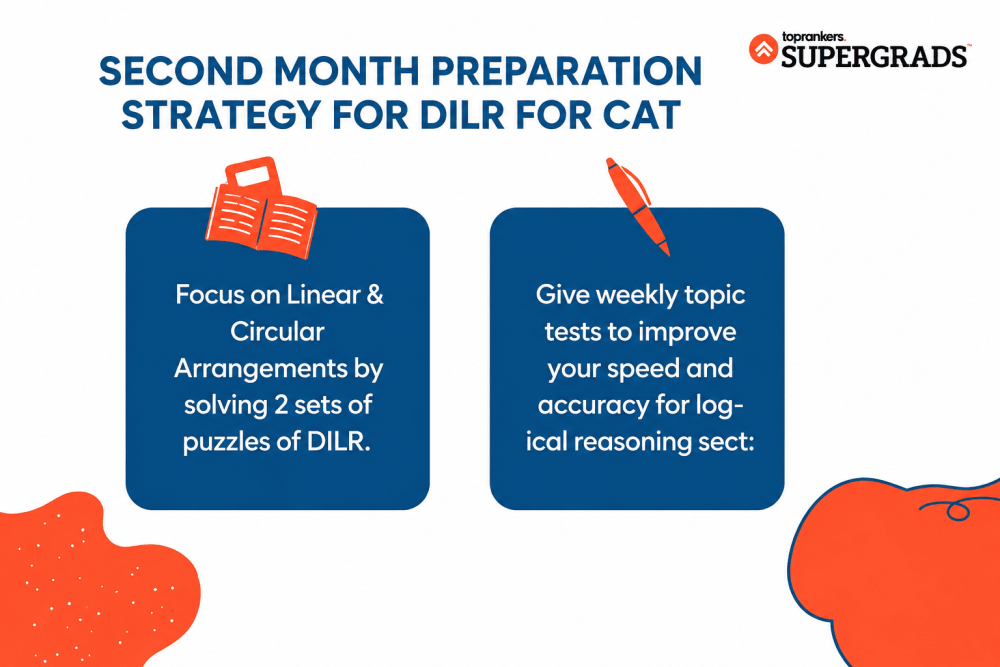
In the second month, focus on solving different types of Logical Reasoning sets and improving your accuracy. Practise topics like arrangements, games and tournaments, and selection-based questions. You can also solve CAT Previous Year Papers to understand the types of LR sets asked in the exam and learn how to manage your time while solving them.
| Months | Strategy |
|---|---|
| Second Month | Focus on Linear & Circular Arrangements by solving 2 sets of puzzles of DILR. |
| Give weekly topic tests to improve your speed and accuracy for the logical reasoning section. |
Month 3 Preparation Strategy for Logical Reasoning for CAT 2026
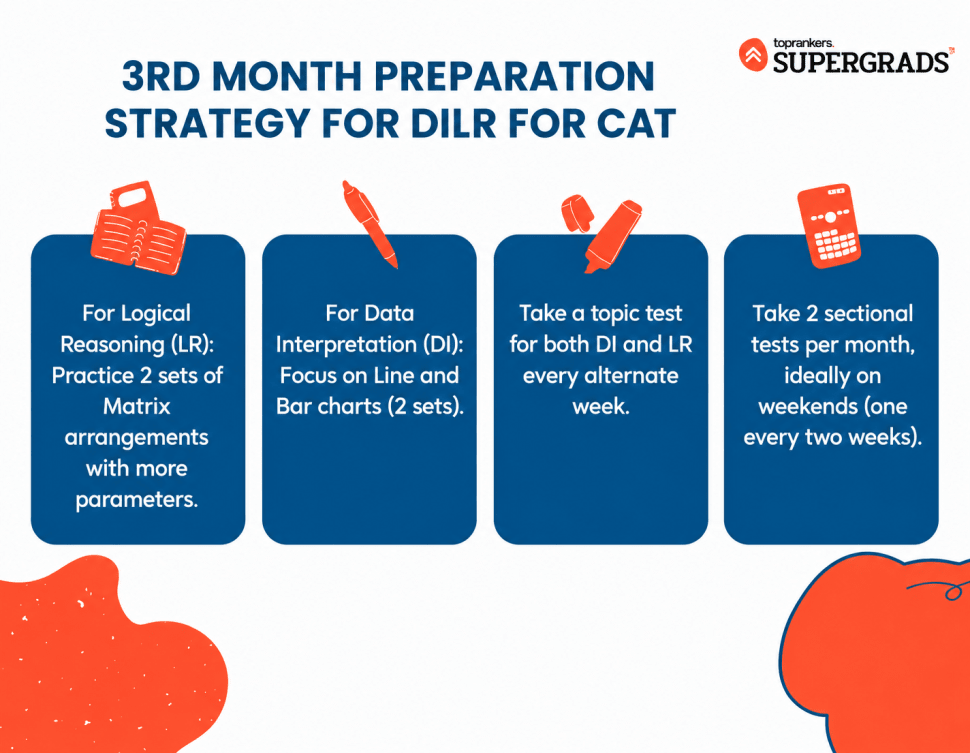
In the third month, focus on solving more complex LR sets and getting comfortable with DI charts. Practise matrix arrangements with multiple conditions and solve line and bar chart questions regularly. If you need help with practice and test analysis, CAT Online Coaching can help you follow a study plan and track your progress.
| Months | Strategy |
|---|---|
| Third Month | For Logical Reasoning (LR): Practice 2 sets of Matrix arrangements with more parameters. |
| For Data Interpretation (DI): Focus on Line and Bar charts (2 sets). | |
| Take a topic test for both DI and LR every alternate week. | |
| Take 2 sectional tests monthly, ideally on weekends (one every two weeks). |
Month 4: Focus on Weak Areas in Logical Reasoning for CAT 2026
In the fourth month, spend more time on topics that you find difficult. Practise two Games and Tournaments sets for LR and two Pie Chart sets for DI. Take a topic test every alternate week and attempt two sectional tests each month. Regular practice with CAT Mock Tests will also help you check your progress and work on areas where you lose marks.
| Months | Strategy |
|---|---|
| Fourth Month | For Logical Reasoning (LR): Practice 2 sets on Games and Tournaments. |
| For Data Interpretation (DI): Focus on Pie Charts with 2 sets. | |
| Take one topic test for both DI and LR every alternate week. | |
| Complete 2 sectional tests per month, preferably on weekends (one every two weeks). |


Month 5 Preparation Strategy for Logical Reasoning for CAT 2026
In the fifth month, focus on solving LR and DI sets within a fixed time. Practise different set types, revise topics you have already covered, and take sectional tests to check your progress. Keep the CAT Pattern in mind while practising so you get used to the exam format and can manage your time better.
Fifth Month Preparation Strategy for DILR for CAT Exam
| Months | Strategy |
|---|---|
| Fifth Month | For Logical Reasoning (LR): Practice 2 sets of Reasoning-Based questions. |
| For Data Interpretation (DI): Focus on Scatter Plots with 2 sets. | |
| Take one topic test for both DI and LR every alternate week. | |
| Complete 2 sectional tests per month (one every two weeks). |

Month 6 Improvement Goals for Logical Reasoning for CAT 2026
| Months | Strategy |
|---|---|
| Sixth Month | For Logical Reasoning (LR): Practice 2 sets of Reasoning-Based questions. |
| For Data Interpretation (DI): Focus on Radar Plots with 2 sets. | |
| Take topic tests for DI and LR, alternating each week. | |
| Complete 2 sectional tests per month (one every two weeks). |

Month 7: Practice Sets and Venn Diagrams
| Months | Strategy |
|---|---|
| Seventh Month | Focus on Venn Diagrams - 2 sets whenever it is LR's turn & Combo Graph - 2 sets whenever it is DI's turn 2. |
| Topic tests alternate between DI and LR weekly, for two monthly sectional tests—one every two weeks. | |
| Try to write all open mocks whenever possible. |

Month 8: Mock-Based Preparation for Logical Reasoning for CAT 2026
| Months | Strategy |
|---|---|
| Eighth Month | For Logical Reasoning (LR): Practice 2 sets of Scheduling-based questions. |
| For Data Interpretation (DI): Focus on Combo Graphs with 2 sets. Take two topic tests every week, alternating between DI and LR. |
|
| Complete 2 sectional tests per month (one every two weeks) |

Month 9: Final Strategy for Logical Reasoning in CAT 2026
| Months | Strategy |
|---|---|
| Ninth Month | Focus on solving the CAT previous year question papers for at least the last 5 years. |
| Two topic tests are administered weekly, alternating between DI and LR. There are a total of three sectional tests per month—one per week for three weeks, with a one-week break as per convenience. |
|
| Spend 1.5 hours every alternate day on DILR in total. |

Important Topics That Come in the DILR Section of CAT Exam 2026
To understand How to Prepare for Logical Reasoning for CAT 2026, start by learning the topics that appear regularly in the DILR section. Focus on common LR sets such as arrangements, games and tournaments, routes, and Venn diagrams. Practising these topics regularly will help you get familiar with different question types and solve sets with better accuracy.
The CAT Logical Reasoning syllabus includes the topics below:
| Sr. No. | Topics | Topics in PYQP 2017–23 |
|---|---|---|
| 1 | Miscellaneous | 11 |
| 2 | Reasoning-based DI | 10 |
| 3 | Matrix arrangement | 7 |
| 4 | Venn diagram | 7 |
| 5 | Matrix and grid | 7 |
| 6 | Scheduling and matrix | 6 |
| 7 | Unconventional and hybrid and Games and tournaments | 6 |
| 8 | Mathematical AR | 4 |
| 9 | Arithmetic caselet | 3 |
| 10 | Order and ranking | 3 |
| 11 | Missing data | 3 |
| 12 | Logic-based table | 3 |
| 13 | Routes and networks | 3 |
| 14 | Arithmetic-based DI | 2 |
| 15 | Gantt chart | 2 |
| 16 | Maxima-minima concept | 2 |
| 17 | Algebra caselet | 2 |
How to prepare for CAT logical reasoning 2026? The CAT Logical Reasoning section focuses mostly on candidates' problem-solving aptitude. It combines rational thought with analytical abilities, which are used to solve any problem.
If well planned, it can be one of the scoring parts. Familiarize yourself with the curriculum and preparation strategy for the CAT.
How to Effectively Prepare for Logical Reasoning for CAT 2026
How to Prepare for Logical Reasoning for CAT? You can prepare for the CAT logical reasoning section through the best preparation books. Check out the table below with CAT preparation books to ace this section.
| Books | Authors |
|---|---|
| Logical Reasoning and Data Interpretation | Nishit K. Sinha |
| Analytical and Logical Reasoning for CAT | Peeyush Bhardwaj |
| Data Interpretation for CAT | Arun Sharma |
| CAT Data Interpretation and Logical Reasoning | Gautam Puri |
| A Modern Approach to Logical Reasoning | RS Agarwal |
| How to Prepare Logical Reasoning for CAT | Arun Sharma |
Conclusion
How to Prepare for Logical Reasoning for CAT 2026? Preparing for logical reasoning for the CAT exam requires careful planning, practice and dedication.
It is important to familiarise yourself with different types of questions and practice them regularly to become comfortable with the types of questions appearing in the CAT exam.
Along with regular practice, try different ways to solve questions. This will help you prepare better for the CAT exam and improve your chances of scoring well.

Smart Prep for CAT: Join Our Free Demo Class
Fill your details
Frequently Asked Questions
What logical reasoning questions will I be asked in the CAT exam?

How to prepare for logical reasoning for CAT exam?
What is the best way to tackle the logical reasoning questions?
How much time should I dedicate to logical reasoning while preparing for the CAT exam?
Is it important to practice logical reasoning questions regularly?
How to improve logical reasoning for CAT?

Jainab Alvi
Content Writer | MBA & CAT Preparation
SHARE