
1723534562.png)

How to Prepare for NATA 2026 [Subject-wise NATA Preparation Tips]
March 16, 2026
Quick Answer: What Is the Best Way to Prepare for NATA?
The best way to prepare for NATA is to follow structured NATA preparation tips that balance drawing practice, aptitude preparation, and mathematics revision.
Focus on regular drawing exercises (perspective, scene composition, 3D objects), solving NATA previous year question papers, and taking mock tests to improve speed, accuracy, and time management for the exam.
Key Highlights – NATA Preparation Tips
- NATA preparation tips emphasize drawing practice and general aptitude, the most important sections for scoring well.
- The exam typically includes ~125 questions in a 3-hour paper, testing creativity, reasoning, and mathematical ability.
- NATA study plans recommend structured preparation with daily subject distribution and revision of weak areas.
- Candidates should devote 1.5-2 hours per subject daily to cover drawing, mathematics, and aptitude effectively.
- Solving previous year question papers and mock tests regularly helps understand the exam pattern and improve speed.
- The NATA syllabus covers Mathematics (Class 11-12), Logical & Spatial Reasoning, Architectural Awareness, and Drawing skills.
- Around 6–7 months of focused preparation is generally considered sufficient to prepare effectively for the NATA exam.
Read more to streamline our NATA preparation tips for NATA 2026 everything from strategic planning and resource selection to subject-specific strategies, ensuring you’re well-prepared to tackle the exam confidently.
Table of Contents
- NATA Preparation Tips by Toppers
- NATA Preparation Tips for Aptitude & Maths
- NATA 2026 Preparation Tips for Drawing Section
- Score Strategy: How to Score 150+ in NATA 2026?
- Revision Schedule for NATA 2026 (Weekly)
- When to start NATA Preparation 2026?
- NATA PYQ Practice Strategy for 2026 Exam Preparation
- Common Mistakes in NATA 2026 Preparation
- Best Books for NATA Preparation 2026
How to Prepare for NATA 2026? NATA Preparation Tips by Toppers
Many aspirants ask how to prepare for NATA effectively. The answer is simple - preparing for the National Aptitude Test in Architecture is not challenging if you follow a well-structured study Plan and preparation strategy for NATA.
1. Know the NATA Syllabus 2026
A critical step in how to prepare for NATA is understanding the complete syllabus. By knowing the syllabus, you will familiarize yourself with the topics from where the questions are asked in the exam.
The following are some essential topics from NATA syllabus 2026 from the exam point of view.
| Diagrammatic Reasoning | NATA Verbal Reasoning |
| Numerical Reasoning | Logical Reasoning |
| Mathematics | Elements and Principles of design |
| Visual Perception and cognition | General knowledge and current affairs |
2. Understand the Exam Pattern
Before diving deep into how to prepare for NATA, familiarize yourself with the exam format: Through the question paper pattern for NATA, you will get an idea about the number of questions asked, type of questions, marking scheme, exam mode, and more.
- The exam is conducted in online mode, i.e., a Computer-Based Test.
- There will be a total of 125 questions and the time duration of the exam is 3 hours.
- The exam is conducted only in the English Language.
3. Practice NATA Previous Year Papers & Attempt Mock Tests
Try solving as many NATA mocks & question papers as possible during your NATA 2026 preparation, as this can be one of the most effective preparation strategy for NATA to improve your time management skills and problem-solving skills.
Plus you get more and more familiar with the test format, difficulty level of questions & build confidence.


NATA Preparation Tips for Aptitude & Maths
There is no negative marking in the exam, and it is an excellent opportunity for you to attempt the maximum number of questions without fear of marks deduction. Let us look at the best NATA preparation tips for general aptitude, drawing, and mathematics from the post below.
|
Focus Area |
NATA Preparation Tip for Aptitude & Maths |
|
Core Maths Topics |
Focus on geometry, mensuration, trigonometry, ratios, and basic algebra, which are commonly asked in the NATA exam. |
|
Visual & Spatial Reasoning |
Practice questions on 2D-3D transformations, cubes, mirror images, and pattern completion to improve visualization ability. |
|
Revise famous architects, iconic buildings, materials, and architectural styles regularly for quick scoring marks. |
|
|
Formula Revision |
Maintain a quick formula sheet for geometry and trigonometry and revise it daily during the final preparation phase. |
|
Logical Reasoning |
Practice questions on series, analogies, odd-one-out, and visual logic puzzles to improve reasoning accuracy. |
|
PYQ Practice |
Solve NATA previous year aptitude and maths questions to understand exam difficulty and recurring question types. |
|
Time Management |
Practice solving aptitude questions quickly, aiming to complete each question within 1-2 minutes. |
|
Error Analysis |
After every mock or PYQ paper, review mistakes and identify weak concepts in maths or reasoning. |
|
Regularly read about architecture news, monuments, and design concepts to strengthen awareness questions. |
|
|
Mock Tests |
Attempt full-length mock tests to improve speed, accuracy, and exam temperament for the aptitude section. |
NATA Exam Tips for General Aptitude
- To score good marks in this section, you should keep your general knowledge updated.
- You should have strong knowledge on topics like Buildings in India and the World, speed distance and time, Important Architects of India and the World, Logical and Reasoning Ability questions, General Maths questions like area, volume Mirror Images, Building Materials and Terminology, etc.
- Practice important aptitude questions for NATA exam from the previous year's papers, as this will help help you get an idea about the type of questions asked in the exam.
NATA Preparation Tips for Mathematics
The questions asked in this section are mainly based on the 12th-grade syllabus.
- You can easily score well if you have studied your CBSE Maths Books Properly.
- Revise basic maths formulas from profit and loss, area and proportion, probability, speed and distance, interest, etc.
- Practice is the key to scoring full marks in this section.
NATA 2026 Preparation Tips for Drawing Section
NATA drawing preparation is comparatively easy if you are good at sketching. NATA exam's Part A in drawing section includes questions like creating an exciting 2-D composition using given shapes and forms, understanding scale and balance, drawing from day-to-day experiences, sense of perspective drawing, etc.
Here are some focused NATA Exam Tips to help you prepare effectively for the Drawing part of the NATA exam.
|
Focus Area |
NATA Preparation Tip for Drawing Section |
|
Perspective & 3D |
Practice 1-point and 2-point perspective drawings such as streets, rooms, or buildings to improve spatial accuracy. |
|
Scene Composition |
Regularly sketch everyday scenes (park, classroom, market) with background elements and human activity. |
|
Proportion & Scale |
Maintain realistic size relationships between people, objects, and buildings to improve drawing clarity. |
|
Human Figures |
Practice simple human figures and actions so scenes look lively and natural. |
|
Detailing & Shading |
Use light shading, textures, and line variation to make drawings visually appealing without overcrowding. |
|
Time Management |
Train yourself to complete each drawing within 25-30 minutes to match exam conditions. |
|
Idea Visualization |
Before sketching, spend 1–2 minutes planning composition and object placement. |
|
PYQ Practice |
Solve NATA previous year drawing questions to understand common themes and scoring expectations. |
|
Observation Skills |
Sketch real buildings, interiors, furniture, and street scenes to improve visual memory and creativity. |
|
Presentation |
Keep drawings clean, balanced, and well-structured as presentation strongly influences scoring. |
Explore: Complete List of NATA Exam Centres
Score Strategy: How to Score 150+ in NATA 2026?
Scoring 150+ in NATA (out of 200 marks) is a strong score that can significantly improve your chances of getting into top architecture colleges.
Since the exam typically includes 120 marks from aptitude and 80 marks from drawing, students should plan a balanced attempt strategy across both sections.
|
Section |
Total Marks |
Target Score |
Strategy to Achieve Target |
|
Aptitude (MCQ + NCQ) |
120 |
80-90 |
Focus on visual reasoning, architecture awareness, and logical questions. Attempt high-confidence questions first and avoid spending too much time on complex maths. |
|
Drawing |
80 |
60-70 |
Maintain clear composition, correct perspective, and neat presentation. Include human figures, environment elements, and balanced detailing. |
|
Time Management |
— |
— |
Allocate around 90 minutes for aptitude and 90 minutes for drawing to ensure quality answers in both sections. |
|
PYQ Strategy |
— |
— |
Solve NATA previous year question papers regularly to understand repeating question patterns and improve speed. |
|
Accuracy Focus |
— |
— |
Aim for 70–75% accuracy in aptitude questions, which is enough to reach the 80–90 mark range. |
|
Drawing Presentation |
— |
— |
Use clean outlines, light shading, and proper proportion to improve evaluation scores. |
Revision Schedule for NATA 2026 (Weekly)
A good revision schedule or study plan for NATA 2026 should focus on strengthening the three major scoring areas - drawing, aptitude, and mathematics - while regularly practicing previous year question papers and mock tests.
The NATA exam is conducted for 200 marks with 80 marks for drawing and 120 marks for aptitude questions, so revision should be balanced across both sections.
|
Day |
Revision Focus |
What to Revise |
Practice Task |
|
Day 1 |
Maths Revision |
Geometry, mensuration, trigonometry formulas |
Solve 20-25 aptitude questions |
|
Day 2 |
Visual & Logical Reasoning |
Pattern recognition, cube rotation, spatial reasoning |
Practice reasoning questions |
|
Day 3 |
Architecture Awareness |
Famous buildings, architects, design concepts |
Revise short GK notes |
|
Day 4 |
Drawing Practice |
Perspective drawing, composition, 3D visualization |
Complete 1 drawing question |
|
Day 5 |
Aptitude Consolidation |
Language interpretation, design thinking |
Solve mixed aptitude questions |
|
Day 6 |
PYQ Revision |
Review questions from NATA previous year papers |
Attempt 1 timed practice set |
|
Day 7 |
Full Mock + Analysis |
Attempt a mock or PYQ paper |
Analyze mistakes and revise weak areas |
When to start NATA Preparation 2026?
Students often wonder not only how to prepare for NATA but also when to start. Starting NATA 2026 preparation early, ideally a year before the exam, provides ample time to build strong fundamentals in drawing, aptitude, and mathematics. Early preparation helps identify strengths and weaknesses, allowing you to create an effective study plan.
However, even with less time, a focused approach with consistent practice and mock tests can yield great results. Begin as soon as possible and prioritize time management to cover all essential topics thoroughly.
Join CreativEdges NATA Coaching Institutes in India
| NATA Coching in Indore | NATA Coching in Andheri | NATA Coching in Mumbai |
| NATA Coching in Agra | NATA Coching in Lucknow | NATA Coching in Kolkata |
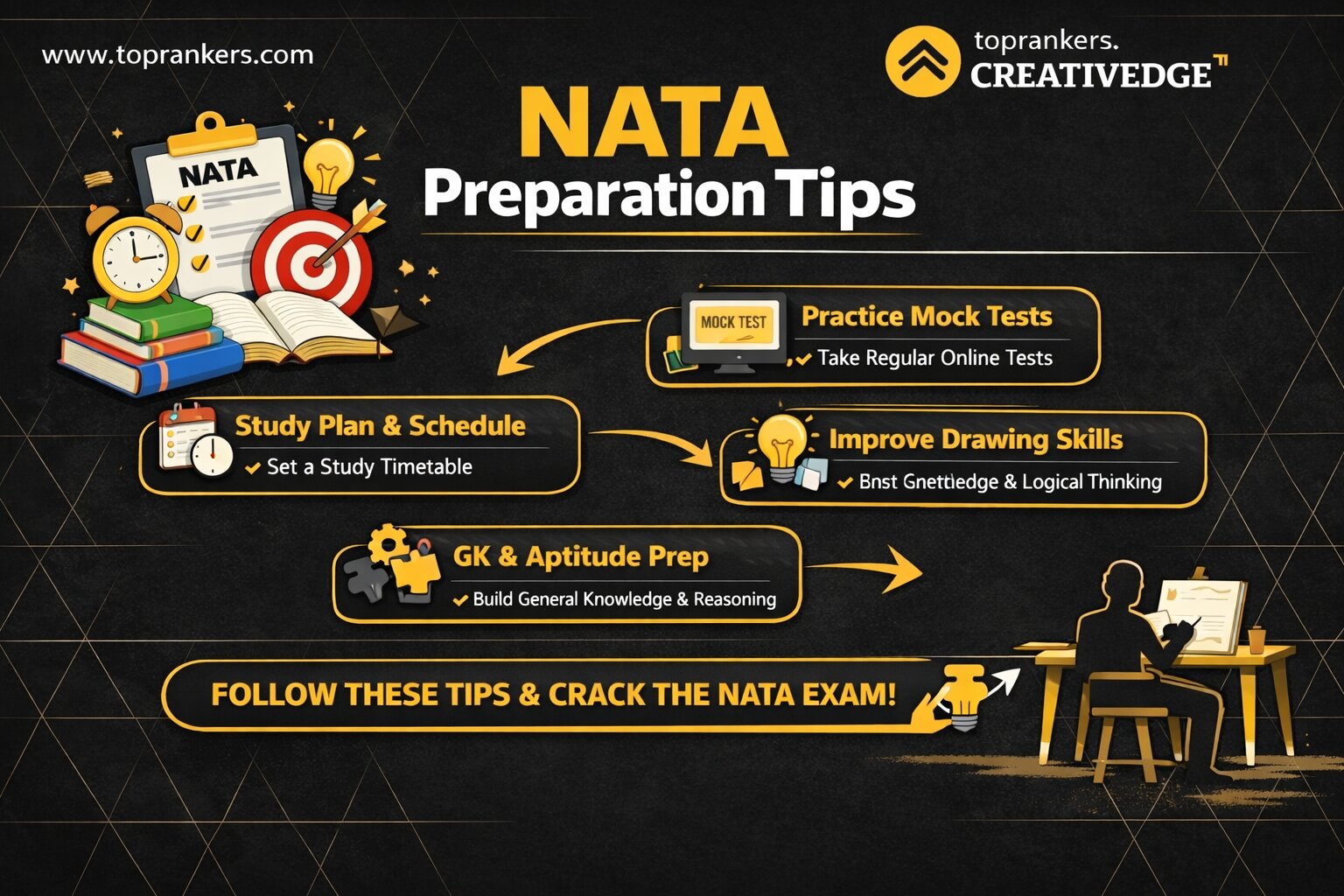
How to Prepare for NATA Exam at Home
The table provides a quick three-step guide to prepare effectively for the NATA exam at home.
| Step | Preparation Approach |
|---|---|
| 1 | Make a study plan covering drawing, mathematics, and general aptitude. |
| 2 | Solve previous years’ papers and attempt online mock tests for accuracy. |
| 3 | Revise regularly and practice daily sketching to boost creativity and observation. |
NATA Preparation Tips for - 2026 PYQ Practice Strategy
One of the most effective NATA preparation tips is to consistently practice NATA previous year question papers (PYQs). PYQs help aspirants understand question patterns, difficulty level, and time management, which are crucial for scoring well in the exam.
Instead of solving random questions, students should use PYQs strategically to simulate the real NATA exam environment.
|
Step |
What to Do |
Why It Helps |
|
Full Paper Simulation |
Solve 1 complete NATA previous year question paper under timed exam conditions. |
Builds exam temperament and time management. |
|
Error Analysis |
Review incorrect questions and identify weak areas in maths, aptitude, or drawing. |
Helps eliminate repeated mistakes. |
|
Concept Revision |
Revise formulas, reasoning patterns, or architecture awareness topics related to mistakes. |
Strengthens weak concepts quickly. |
|
Drawing Reattempt |
Redraw the drawing question from the PYQ with better composition and detailing. |
Improves drawing presentation and creativity. |
|
Pattern Recognition |
Identify commonly repeated topics like visual reasoning, geometry, and architecture awareness. |
Helps prioritize high-frequency topics. |
|
Weekly PYQ Target |
Solve 2–3 NATA previous year question papers per week during preparation. |
Maintains exam rhythm without burnout. |
|
Mock Simulation |
Occasionally attempt PYQs exactly like the exam with strict time limits. |
Improves speed and accuracy. |
Read more: Logical Reasoning Questions for NATA
Common Mistakes in NATA 2026 Preparation (and How to Avoid Them)
While following NATA preparation tips, many aspirants unknowingly make mistakes that reduce their scores. Avoiding these common errors can significantly improve performance in the NATA aptitude and drawing sections.
|
Mistake |
Why It Hurts Your Score |
Correct NATA Preparation Tip |
|
Ignoring Drawing Practice |
The drawing section carries 80 marks, and weak drawing skills can drastically reduce the overall score. |
Practice scene composition, perspective drawing, and 3D objects regularly. |
|
Focusing Only on Maths |
NATA also heavily tests visual reasoning and architecture awareness, not just mathematics. |
Balance preparation between aptitude, maths, and drawing. |
|
Not Solving PYQs |
Many students skip NATA previous year question papers, missing out on understanding the exam pattern. |
Solve 2–3 NATA PYQs every week to improve speed and accuracy. |
|
Poor Time Management |
Spending too much time on difficult aptitude questions can reduce time for drawing. |
Practice timed mock tests to build better exam strategy. |
|
Overcrowded Drawings |
Adding too many elements without proper composition makes drawings look messy. |
Focus on clean composition, proportion, and neat presentation. |
|
Ignoring Architecture Awareness |
Questions about famous buildings, architects, and design concepts often appear in the exam. |
Regularly revise architecture GK and design awareness topics. |
|
No Revision Strategy |
Many aspirants keep learning new topics but do not revise earlier concepts. |
Maintain a formula sheet and weekly revision schedule. |
|
Lack of Mock Practice |
Without mock tests, students struggle with exam pressure and time limits. |
Attempt full-length NATA mock tests regularly. |
Avoiding these mistakes and following structured NATA preparation tips can help students improve their accuracy, drawing quality, and overall exam performance in the NATA exam.
What are the Best Books for NATA Preparation 2026?
Preparing from the right books is essential to understand the concepts in-depth. The following are some of the best books for NATA exam preparation.
| NATA Books Name | Author & Publisher |
| A Complete Self Study Guide for B.Arch Entrance Examination 2018/19/20 | PK Mishra |
| NATA (B.Arch) Guide to Bachelor of Architecture Entrance Examination B.Arch Entrance Examination Guide | Surendra Kavimandan |
| Quantitative Aptitude | R S Agarwal |
Use CreativEdge Free Resources 2026 Strategically
| NATA Mock Test | |
| NATA Preparation Video 2026 | |
| NATA Syllaus 2026 | |
| NATA PYQs |
Check: NATA Exam Day Instructions
Key Takeaways:
- Simplified Exam Structure: NATA 2026 focuses only on the aptitude section, eliminating the drawing part, making preparation more straightforward.
- Structured Study Plan: Emphasizes the importance of a well-organized study schedule and regular practice, particularly in sketching and perspective drawing.
- Use of Resources: Stresses utilizing the right study materials, previous year papers, and mock tests to understand the exam pattern and improve time management.
- Knowledge of Syllabus and Exam Pattern: Understanding the syllabus and online exam format is crucial for targeted preparation.
- Creativity Enhancement: Highlights the need for intensive practice in creative skills, especially in perspective and proportion, to excel in the integrated drawing questions within the aptitude section.
Preparing for NATA 2026? We can help you with exact strategic roadmap, study material and crucial feedback required to ace this exam.
Join CreativEdge, India’s leading NATA online coaching and get expert guidance on all NATA 2026 subjects.
You can enroll in offline NID batches at your nearest centres also!


Attempt a Free NATA Mock Test
Fill your details
Frequently Asked Questions
What are the important topics that need to be prepared under General aptitude section of NATA Syllabus?

Can I prepare for NATA aptitude exam in two months?
How can I improve my creative skills for NATA drawing?
Is NATA Exam easy to crack on the first attempt?
How much time does it take to prepare for NATA Exam 2027?
How much time should I keep aside for revision in the NATA Exam Preparation plan?
How to prepare for NATA exam at home?

Vineeta Agrawal
Communications Executive


SHARE