
1723534562.png)

NATA Aptitude Questions 2027: Subject wise Questions Download PDF Here
July 28, 2026
Quick Answer: NATA aptitude questions are part of Part-B of the NATA exam (120 marks, 90 minutes) and are designed to evaluate critical thinking ability, mathematical skills and domain awareness essential for an architecture aspirant.
It includes problems on visual reasoning, analytical & logical reasoning, architectural awareness, language interpretation, design sensitivity, and basic numerical ability relevant to architecture studies.
Preparing for the current cycle? These aptitude questions and solutions apply to every NATA cycle, so you can use them right now.
Key Highlights: NATA Aptitude Questions 2027
- NATA aptitude questions are part of Part-B (120 marks, 90 minutes) conducted as an online adaptive test.
- The aptitude section contains 50 questions total - 42 MCQs and 8 NCQs (No-Choice Questions).
- Major topics tested: Visual Reasoning, Logical Derivation, General Knowledge (Architecture & Design), Language Interpretation, Design Sensitivity & Thinking, and Numerical Ability.
- Visual reasoning questions evaluate the ability to understand 2D-3D compositions and spatial reconstruction.
- Logical derivation questions test interpretation of situations, patterns, and hidden information in visual or contextual problems.
- Architecture & design awareness questions assess knowledge of important buildings, architectural history, materials, and design innovations.
- Design sensitivity questions evaluate observation of people, spaces, products, and environments along with critical thinking and reasoning.
- Numerical ability questions involve basic mathematics and geometry concepts linked to spatial understanding.
The NATA aptitude questions play a crucial role in determining your overall score in the National Aptitude Test in Architecture (NATA). While many students focus heavily on drawing and mathematics, aptitude questions often become the make-or-break factor, especially in competitive attempts where every mark counts.
Table of Contents
- What Are NATA Aptitude Questions?
- NATA 2027 Aptitude Syllabus
- Sample Aptitude Questions with Solutions
- How Many Questions Are Asked from Aptitude in NATA?
- Why Aptitude Questions Are Scoring in NATA
- How to Prepare for NATA Aptitude Effectively
- Common Mistakes Students Make in NATA Aptitude Section
- More NATA Aptitude Sample Questions for Practice
- FREE Study Material for NATA Aptitude Section
- Advantages of Solving NATA Aptitude Questions
What Are NATA Aptitude Questions 2027?
NATA aptitude questions are designed to assess whether a student has the natural thinking ability, observation skills, and spatial awareness required for studying architecture. Unlike mathematics or drawing, aptitude questions do not test formulas or artistic skills.
Instead, they evaluate how you think, perceive space, interpret visuals, and apply logic to real-world situations.
In simple terms, these questions check whether your mind works like an architect’s mind.
Nature of NATA Aptitude Questions
As per NATA 2027 exam pattern, the aptitude questions are:
- Conceptual, not memory-based
- Visual-heavy, involving images and diagrams
- Logic-oriented, but without complex math
- Contextual, often linked to architecture, design, or environment
Many questions test your ability to connect ideas rather than recall information.
What Does Aptitude Questions in NATA Commonly Test?
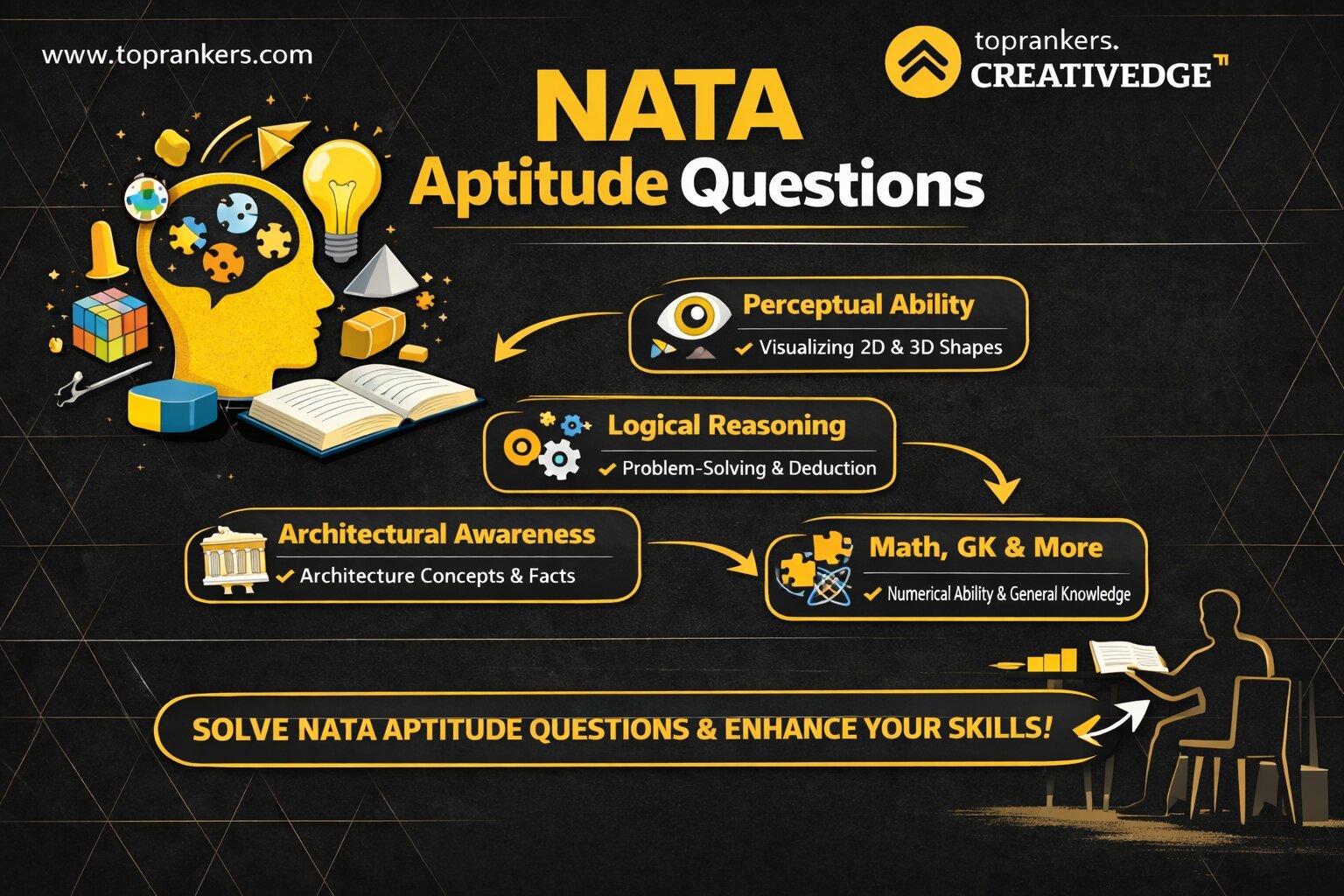
1. Spatial Understanding
Ability to mentally rotate objects, understand depth, symmetry, and perspective.
2. Visual Observation
Identifying differences, patterns, proportions, and relationships between forms.
3. Logical Application
Applying reasoning to visual or situational problems rather than abstract puzzles.
4. Architectural Awareness
Recognizing buildings, materials, construction elements, and design concepts.
5. Environmental Sensitivity
Understanding sustainability, climate response, and use of space.
Check: Logical Reasoning Questions for NATA
_(1)1764330056.webp)
Section-wise Most Important NATA Aptitude Questions with Solutions for 2027 Prep
To help you understand the type of NATA aptitude test questions asked in the NATA entrance exam, we have provided some sample NATA aptitude questions with answers here.
NATA Aptitude Questions 2027 - Numerical Reasoning
As per the NATA aptitude test syllabus, questions under the Maths section are mainly based on the 12th-grade syllabus.
Q.1. Shatabdi Express has a capacity of 600 seats out of which 15% is in the Special VIP class, rest being VIP class seats. During its journey the train was booked to 80% of its full capacity. If Special VIP class was booked to 70% of its capacity, how many VIP class seats were empty during that journey?
Answer: 93 seats
Q.2. Choose the correct option 2 tan 30∘/1 + tan (square) 30∘ = ?
(a) sin 60∘
(b) cos 60∘
(c) tan 60∘
(d) sin 30∘
Ans: a, sin 60∘
Q.3. The fraction of total volume occupied by atoms in a simple cube is:
(a) 𝜋÷4
(b) √2𝜋
(c) √2𝜋 ÷6 ÷8
(d) 𝜋 ÷6
Ans: d
Check: Best study timetable for the NATA exam
NATA Aptitude Questions for 2027 Prep - Visual & Spatial Reasoning
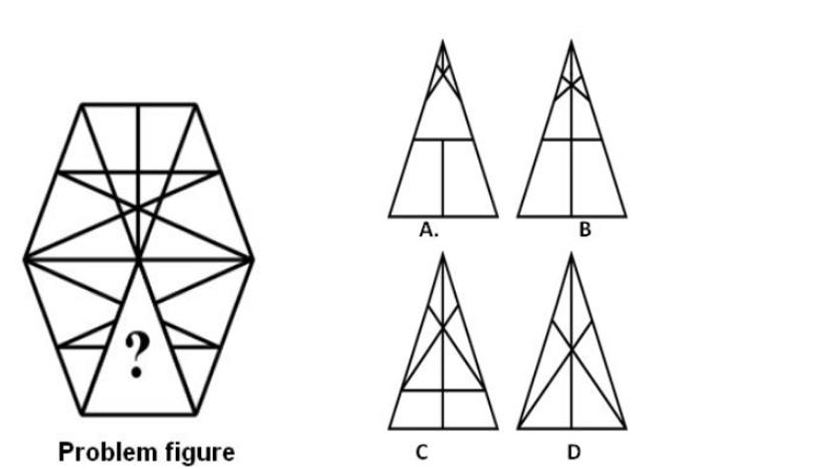
Q.1. Find the appropriate figure from the alternatives given below which best fits into the blank space of the symmetrical problem figure indicated by a (?)
(a) (A)
(b) (B)
(c) (C)
(d) (D)
Ans: b
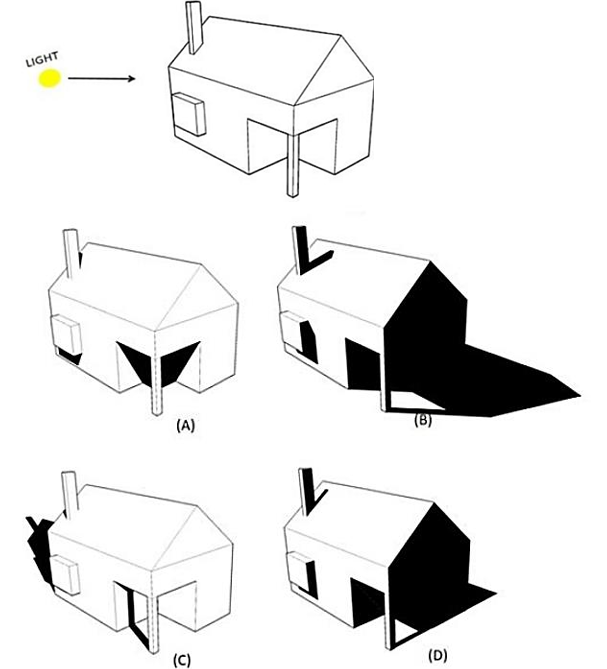
Q.2. If the arrow marks the direction of light, which will be the image of the object with the correct shadow from the given answer options?
(a) (A)
(b) (B)
(c) (C)
(d) (D)
Ans: b
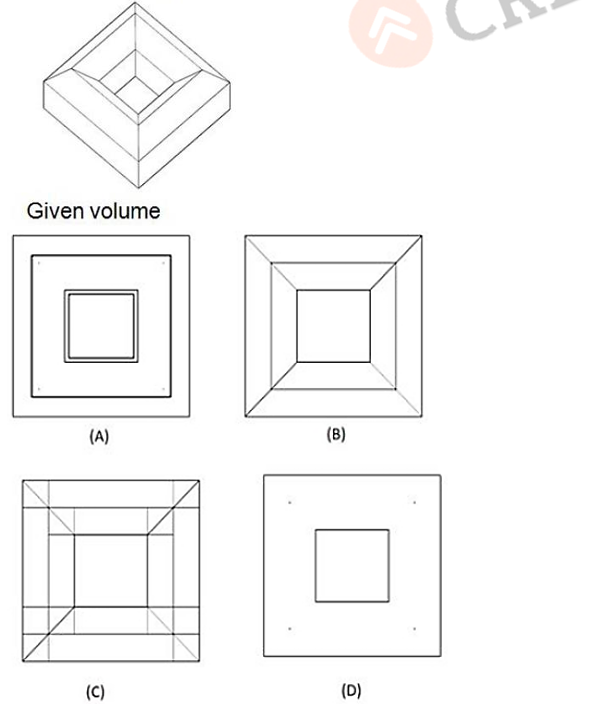
Q.3. Identify the correct TOP view for the given 3D form
(a) (A)
(c) (C)
(b) (B)
(d) (D)
Ans: a
Check: Short tricks to crack the NATA exam on the first attempt
Q.4. The given surface can be folded into which of the following cubes?.
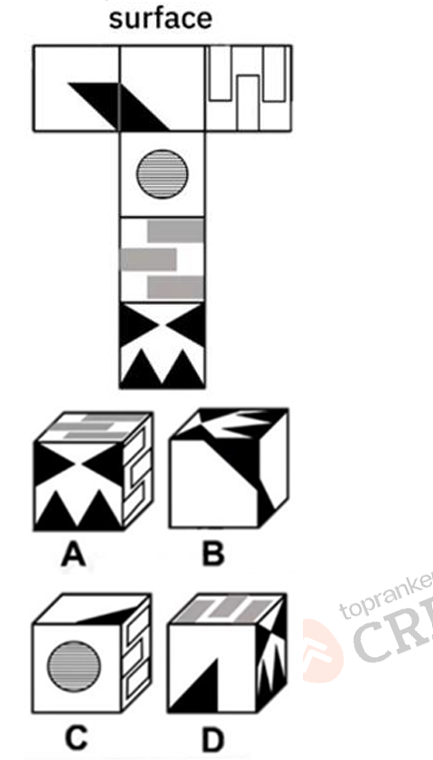
Ans: B
Check: How to Improve NATA Score in 2027
NATA Aptitude Questions for 2027 Prep - Analytical & Logical Reasoning
Q.1. If 'diamond' is called 'gold', 'gold' is called 'silver', 'silver is called 'ruby' and 'ruby' is called 'emerald', which is the cheapest jewel?
(a) Silver (b) Gold (c) Diamond (d) Ruby
Ans: d, Ruby
Q.2. A and B are brothers. C and D are sisters. A's son is D's brother. How is B related to C?
(a) Father (b) Uncle (c) Brother (d) Grandfather
Ans: b, Uncle
Q.3. In a row of 40 girls, when Komal was shifted to her left by 4 places her number from the left end of the row became 10. What was the number of Swati from the right end of the row if Swati was three places to the right of Komal's original position?
(a) 25 (b) 24 (c) 23 (d) 22
Ans: b, 24
NATA Aptitude Questions for 2027 Prep - GK & Architectural Awareness
Q.1. Universal time is based on:
(a) Rotation of the earth on its axis
(b) Earth's orbital motion around the earth
(c) Vibrations of caesium atom
(d) Oscillation of quartz crystal
Ans: (a) Rotation of the earth on its axis.
Q.2. The symbols in the given image are associated with which of the following?

(a) Building signage (c) Food and beverages (b) Vehicle warning signs (d) Sustainable principles
Ans: b, Vehicle Warning Signs
Q.3. Identify the four most appropriate architectural components and elements of architectural composition that you find in the image of one of the courts of the Jawahar Kala Kendra, Jaipur designed by Ar. Chares Correa. (Marks will be awarded only if all answers are right).
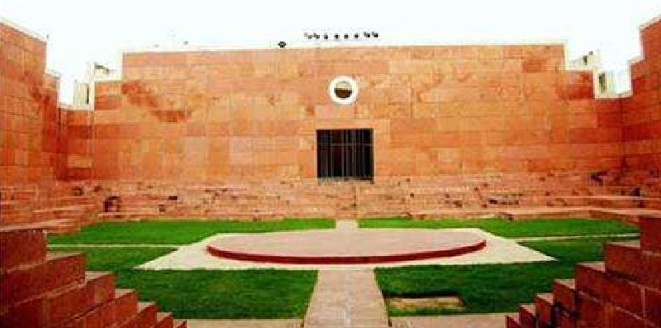
- Open Air theatre
- Geometric
- Murals
- Centrality
- Dormer window
- Skylights
- Order
- Curved columns
- Stage
Ans: a,b,d,g
Q.4. Pick the ODD image out of the following:
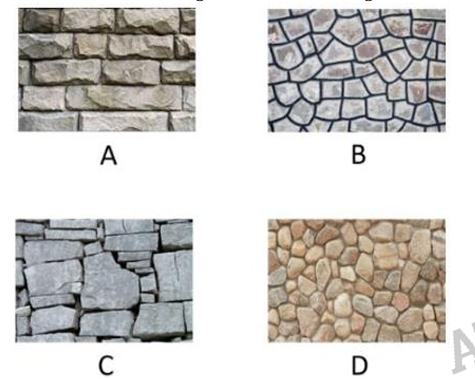
(a) (A) (c) (C) (b) (B) (d) (D)
Ans: D
Read more: How to prepare for NATA in a month?
NATA Aptitude Questions for 2027 Prep - Reading Comprehension
Directions (Q-1 to Q-4): After reading the given TEXT answer the 4 questions based on the text by choosing the appropriate option.
TEXT:
The coconut is an unusual food for many reasons. It is technically a seed, produced by the coconut palm tree, and as such is one of the largest edible seeds produced by any plant. Its unusual contents also make it unique in the seed world-the interior consists of both "meat" and "water." The meat is the white pith with which we are all familiar, as it is used extensively for cooking and flavorings; the coconut water is a white liquid that is very sweet and thirst-quenching.
Portuguese explorers gave the nut its name in the 15th century, referring to it as coco, meaning "ghost" in their language. The three dimples and the hairy texture reminded them of a ghost's face. It is used to make margarine, as well as various cooking oils. The coconut fluid is a favorite drink in hot climates, providing a cool and refreshing beverage right off the tree. This water is also used by manufacturers of various sports drinks because of its isotonic electrolyte properties.
Even the shell itself has many uses, including cattle food and fertilizer. Coconut oil is used for cosmetics, medicines, and can even be used in place of diesel fuel. Dried coconut shells are used in many countries as a tool, such as a buffer for shining wood floors. The shells are also used for shirt buttons; they are even used for musical instruments and bird houses! And all these are only some of the uses found for the coconut fruit. The coconut palm tree, which produces the nut, also produces countless useful items. It's no wonder that the coconut palm has been called "the tree of life."
1. The word pith used in the first para of the text; most nearly means?
(a) helmet.
(b) hairy material.
(c) black.
(d) meaty substance.
2. What is the main focus of this passage?
(a) the history of coconuts
(b) coconut trees have many uses
(c) how cooking oil is made
(d) Portuguese discoveries
3. The passage implies that
(a) coconut palms are a valuable plant.
(b) coconut oil is the best way to cook.
(c) Portuguese explorers loved coconuts.
(d) coconut palms are good shade trees.
4. Which of the following is NOT a use for the coconut shell?
(a) polishing wooden floors
(b) musical instruments
(c) shirt buttons
(d) diesel fuel
Check: How to fill NATA Application form
For DETAILED step-by-step explanations on how to solve each question discussed above, click the following button:
How Many Questions Are Asked from Aptitude in NATA?
As per the official NATA Information Brochure, the aptitude component is tested primarily through Part B, which is a computer-based MCQ and NCQ section.
Here is the exact breakup:
Part A (Drawing & Composition)
- Mode: Offline
- Questions: 3 descriptive drawing/composition questions
- Marks: 80
Part B (Aptitude Test - MCQ & NCQ)
- Mode: Online
- Questions: 50 aptitude-based questions
- 42 MCQs
- 8 NCQs (No Negative Choice questions)
- Marks: 120
While the exact distribution may vary slightly each year, aptitude-related questions form a major portion of the non-drawing section of the NATA exam.
NOTE: NATA 2026 Phase 2 is on 7-8 August 2026 (open only to candidates who did not attempt Phase 1). The Council of Architecture has not yet released the official NATA 2027 notification - we'll update this for any changes, as soon as 2027 dates and the brochure are announced.
(Last verified: 28 July 2026.)
What this means for aspirants?
NATA Part B aptitude carries 120 of 200 marks - 60% of the total weightage - making it the single most decisive section. These questions test logical reasoning, visual reasoning, numerical ability, design sensitivity, and critical thinking rather than academic memory.
If your goal is to maximize your NATA score, Part B aptitude preparation cannot be optional. It is where consistent practice directly converts into marks.
Read More: Is NATA necessary for Architecture?
Which Topics are Included in NATA Aptitude Syllabus 2027?
Unlike traditional aptitude tests, NATA focuses heavily on visual intelligence and applied reasoning, rather than numerical speed or memorization. A clear understanding of the NATA aptitude syllabus helps aspirants avoid unnecessary NATA aptitude test questions and focus only on high-yield, important topics for NATA that must be prepared for better results.
NATA Aptitude Syllabus - Topic-Wise Table
|
Syllabus Area |
Topics Included |
What Is Actually Tested |
|
Logical Reasoning |
Series, analogies, odd-one-out, cause & effect, direction sense |
Ability to identify patterns, relationships, and logical flow |
|
Visual Reasoning & Spatial Ability |
2D-3D visualization, mirror images, paper folding, object rotation, symmetry |
Spatial intelligence and mental visualization skills |
|
Architectural Awareness |
Famous buildings, monuments, architects, basic construction elements |
Awareness of architecture as a discipline |
|
General Knowledge (Applied) |
Art & culture, environment, basic science linked to buildings |
Contextual understanding, not current affairs |
|
Numerical & Analytical Ability |
Ratios, percentages, averages, basic geometry |
Logical application of numbers, not heavy calculation |
|
Diagrammatic Interpretation |
Reading plans, layouts, figures, and symbols |
Ability to interpret architectural-style diagrams |
|
Environmental & Social Sensitivity |
Sustainability, climate response, public spaces |
Understanding design impact on people and environment |
Read More: NATA Maths Syllabus Section Wise
Key Focus Areas Within the NATA Aptitude Syllabus
1. Visual & Spatial Ability (Highest Priority)
This is the most important part of the NATA aptitude syllabus. Questions often require you to mentally rotate objects, visualize transformations, or interpret spatial relationships.
Regular practice here directly improves your aptitude score.
This is one of the most important areas in NATA aptitude questions and closely aligns with architectural thinking.
2. Architectural Awareness (Basic but Essential)
You are not expected to be an architecture expert, but you should recognize:
- Famous architects and buildings
- World-famous monuments
- Indian architecture styles
- Building materials and construction basics
- Urban spaces and landmarks
Questions from this area test whether you have basic exposure to architecture as a field.
Refer: Important NATA GK Questions With Answers
3. Logical Reasoning (Visual, Not Verbal)
Logical reasoning in NATA is mostly visual and diagram-based. Expect fewer wordy puzzles and more image-driven logic questions that check pattern recognition and reasoning clarity.
- Series and sequences
- Analogy-based questions
- Cause and effect
- Direction sense
- Blood relations (basic level)
4. Applied General Knowledge
NATA does not ask:
- Daily current affairs
- Political events
- Sports or awards
Instead, GK questions are linked to:
- Environment
- Art and culture
- Science in everyday life
- Architecture-related terms and concepts
5. Numerical Ability (Low Difficulty, Low Volume)
NCERT-level maths appears in aptitude:
- Percentages
- Ratios
- Averages
- Algebra
- Logarithms
- Trigonometry
- Calculus
- Speed, distance, time
- Permutations & combinations
- Probability
- 2D & 3D coordinate geometry
These questions are meant to test logical application, not speed or formula memorization.
6. Reading Comprehension (Mostly Architecture or related concepts based)
Reading comprehension questions in NATA test a student’s ability to understand, interpret, and analyze written information quickly and accurately. More often than not, the passages are directly or indirectly related to architecture, design, buildings, or spatial concepts, making basic architectural awareness especially helpful. Strong reading skills combined with contextual understanding can significantly improve accuracy in this section.
Check: NATA 2027 Subjects - Section-wise Important Topics
Join Creative Edges NATA Coaching Institutes in India
| NATA Coaching in Indore | NATA Coaching in Andheri | NATA Coaching in Mumbai |
| NATA Coaching in Agra | NATA Coaching in Lucknow | NATA Coaching in Kolkata |
More Sample NATA Aptitude Questions for 2027 Practice
Here are a few NATA sample papers and questions asked in previous year's NATA Exam. Practice aptitude test questions for NATA and enhance your NATA preparation for the upcoming exam.
1) Find the area of the figure given below if the triangles given are equilateral?

2) A’ starts his walk-in north and turns left; similarly, `B’ starts his walk from the same point in the east direction and then turns right, goes straight, and then turns left. A & B faces are?
- A. In the same direction
- B. In the opposite direction
- C. Perpendicular to each other
- D. None of above
3) In a certain code language, COMPUTER is written as RFUVQNPC. How will MEDICINE be written in that code language?
- A. MFEDJJOE
- B. EOJDEJFM
- C. MFEJDJOE
- D. EOJDJEFM
4) Which city is known as PINK CITY?
- A. Delhi
- B. Jaipur
- C. Udaipur
- D. Jodhpur
5) Which of the following does not form a part of Reinforced Cement Concrete?
- A. Steel
- B. Cement
- C. Sand
- D. Lime
Read more: Short Tricks to enhance your last-minute NATA preparation
6) If South East becomes North, North East becomes West, and so on. What will West become?
- A. North East
- B. North West
- C. South East
- D. South West
7) One morning after sunrise, Suresh was standing facing a pole. The shadow of the pole fell exactly to his right. To which direction was he facing?
- A. East
- B. West
- C. South
- D. Data is insufficient
8) The sum of the Ages of the family members is 70, the father is 30 years old, and there are five members in the family. Find the age of the youngest member of the family? Each member of the family is five years younger than the other.
9) A man's speed with the current is 15 km/hr, and the current speed is 2.5 km/hr. The man's speed against the current is
- A. 8.5 km/hr
- B. 9 km/hr
- C. 10 km/hr
- D. 12.5 km/hr
10) Which of the following film was directed by SatyajitRay?
- A. Bhumika
- B. Satranjkekhiladi
- C. Nishant
- D. Ardhyasatya
11) Which of the following famous Indian leaders coined the slogan 'Jai Jawan Jai Kisan.'
- A) Mahatma Gandhi
- B) Pt Jawaharlal Nehru
- C) Lal Bahadur Shastri
- D) Sardar Vallabai Patel
Know more: Basic Strategies to Write NATA Exam
12) Which among the following planets of our Solar system is the biggest?
- A) Venus
- B) Mercury
- C) Earth
- D) Mars
13) In a college of 300 students, every student reads 60 students read five newspapers and every newspaper. The no. of the newspaper is
- A) At least 30
- B) At most, 20
- C) Exactly 25
- D) None of these
14) Concerning a universal set, the inclusion of a subset in another is a relation, which is
- A) Symmetric only
- B) Equivalence relation
- C) Reflexive only
- D) None of these
Q15). Which of the following would lead to lowering your carbon footprint?
- A) Purchase of NIKE T-shirt
- B) Frequent use of cars
- C) Purchase of locally grown vegetables
- D) Purchase of refrigerated vegetables
Why NATA Aptitude Questions Are Scoring
Part B is where marks are most recoverable. It carries 60% of the paper (120/200).
Here’s why this section consistently offers high scoring potential:
1. Concept-Based, Not Formula-Heavy
NATA aptitude questions are built around conceptual understanding rather than complex formulas or calculations. Once you understand the logic behind a question, the answer becomes straightforward, reducing silly mistakes and boosting accuracy.
2. Visual Questions Have Clear Answers
Most aptitude questions involve images, patterns, diagrams, or spatial relationships. These questions often have one logically correct answer, which becomes obvious with practice. There is less ambiguity compared to subjective sections.
3. Repeated Question Patterns
An analysis of previous year NATA papers shows that question types repeat frequently. Topics like 3D visualization, pattern recognition, and architectural awareness appear year after year. That predictability means focused practice converts almost directly into score, unlike the more subjective drawing section.
Also check: NATA Exam Dates 2027
How to Prepare for NATA Aptitude Questions Effectively
Aptitude questions in NATA test how you think, not how much you memorize. To score well, your preparation must focus on visual reasoning, logical clarity, and architectural awareness. Here’s a preparation approach that actually works.
1. Practice Visual Reasoning Daily (Non-Negotiable)
Most NATA aptitude questions are visual. Treat visual reasoning like a skill, not a subject.
What to do:
- Practice 10-15 visual questions daily (3D rotation, mirror images, pattern completion).
- Use a timer. Aim for 30-45 seconds per question.
- Redraw shapes if needed to understand transformations.
2. Study Architecture Through Observation, Not Memorization
You don’t need architectural theory, you need awareness.
What to do:
- Every day, observe one building, structure, or space around you.
- Ask: Why is it shaped this way? What material is used? How does light or space work?
- Maintain a one-page notebook with quick notes or sketches.
3. Solve Previous Year NATA Aptitude Questions PDF Strategically
Don’t just solve, analyze patterns.
What to do:
- Solve past year aptitude questions topic-wise.
- Categorize questions into: visual, logical, architectural, numerical.
- Note which types repeat and which take more time.
Also Read: Explore abstract reasoning questions and answers for NATA
4. Keep Numerical Aptitude Basic and Sharp
NATA aptitude maths is simple but time-bound.
What to do:
- Revise ratios, percentages, averages, and basic geometry.
- Practice mental calculations daily for 10 minutes.
- Avoid advanced maths, it’s not tested.
Why it helps:
You’ll solve numerical aptitude questions faster without panic or calculation errors.
5. Avoid Generic GK and Focus Only on Applied GK
General knowledge in NATA is contextual, not current affairs-based.
What to do:
- Study art, culture, environment, and science related to buildings.
- Skip daily news, politics, sports, and awards.
- Focus on visuals, monuments, materials, and environmental concepts.
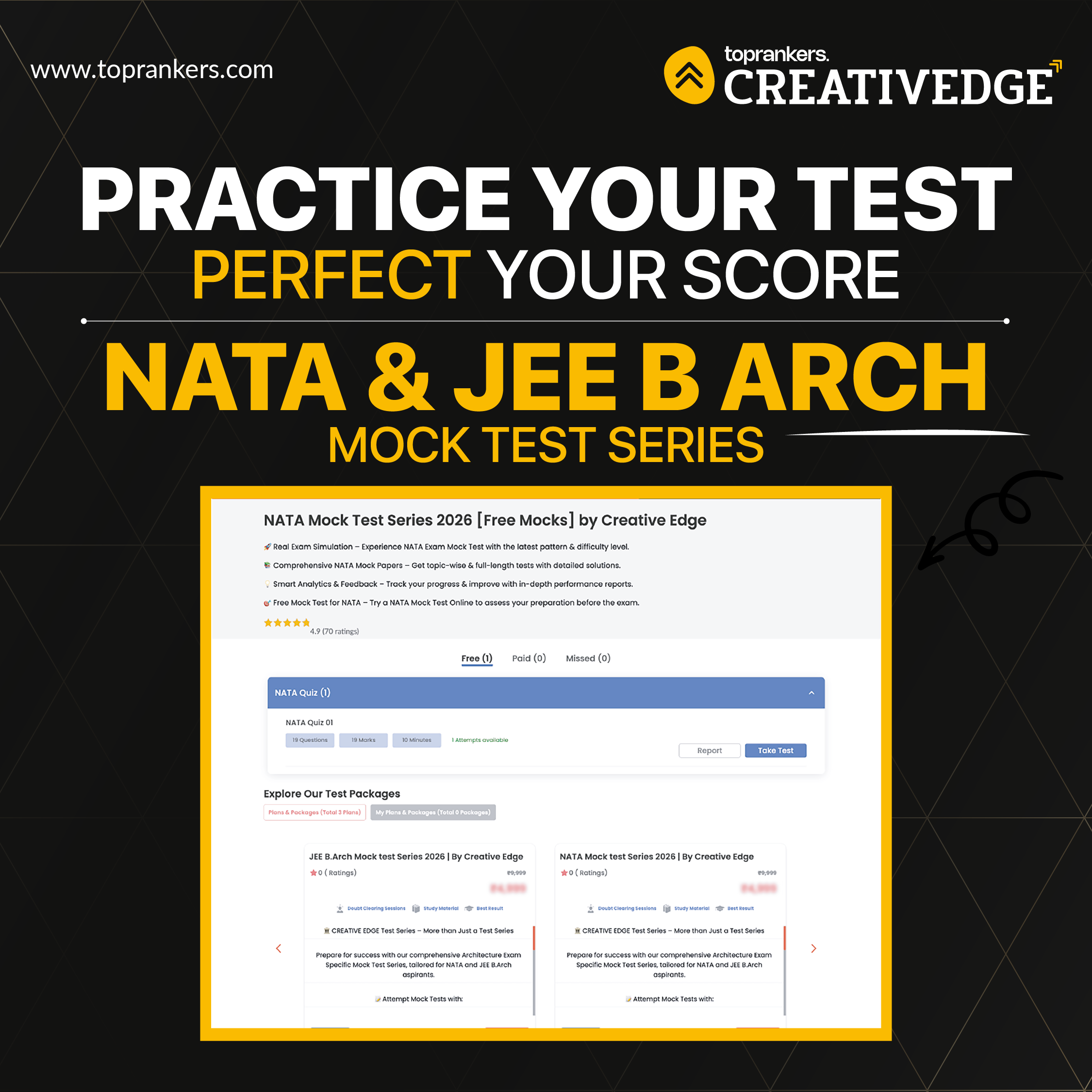
Prepare with: NATA Free Mock Tests by Creative Edge
6. Use Timed Mini-Tests Instead of Long Study Sessions
NATA aptitude rewards speed and clarity.
What to do:
- Create 20-minute aptitude drills with 20–25 questions.
- Simulate exam pressure at least twice a week.
- Review mistakes immediately.
Use Creative Edge Free Resources 2027 Strategically
| NATA Mock Test Series | |
| NATA Preparation Videos 2027 | |
| NATA Syllabus 2027 | |
| NATA Previous Year Question Papers for 2027 Prep |
Ensure you refer to the best preparation books for NATA that cover the entire NATA syllabus with detailed explanations.
What is the Advantage of Solving NATA General Aptitude Questions with Answers?
- The NATA aptitude section evaluates critical thinking, mathematical skills, and problem-solving abilities.
- Excelling requires understanding and applying fundamental concepts across scenarios.
- Practicing with NATA aptitude question papers improves familiarity, speed, and focus.
- Topics include diagrammatic, numerical, verbal reasoning, and logical thinking.
- Success hinges on thorough practice, concept review, and strategic problem.
Conclusion
In conclusion, mastering NATA aptitude test questions and answers for NATA is crucial for aspiring architects. Navigating through the intricacies of architecture aptitude questions, nata previous year question papers and nata aptitude questions demands more than just conceptual understanding; it necessitates the adept application of these principles.
By dedicating themselves to diligent practice and adopting a strategic approach to NATA preparation, focusing particularly on problem-solving techniques, candidates can substantially enhance their performance in the NATA 2027 exam. This lays a robust groundwork for their future endeavors in architecture.
Preparing for NATA 2027? We can help you with exact strategic roadmap, study material and crucial feedback required to ace this exam.
Join CreativEdge, India’s leading NATA online coaching and get expert guidance on all NATA subjects.


Frequently Asked Questions
What is General Aptitude in NATA?

What type of aptitude questions can be asked in NATA 2027?
Are NATA aptitude questions difficult?
How can I prepare for NATA 2027 aptitude questions?
How many aptitude questions are asked in NATA?
Which topics are most important for NATA 2027 aptitude section?
Are previous year NATA aptitude questions useful for 2027 exam preparation?

Vineeta Agrawal
Communications Executive


SHARE