
1723534562.png)

JIPMAT Syllabus 2027: Complete Topic-Wise Guide with PDF Download
August 13, 2026
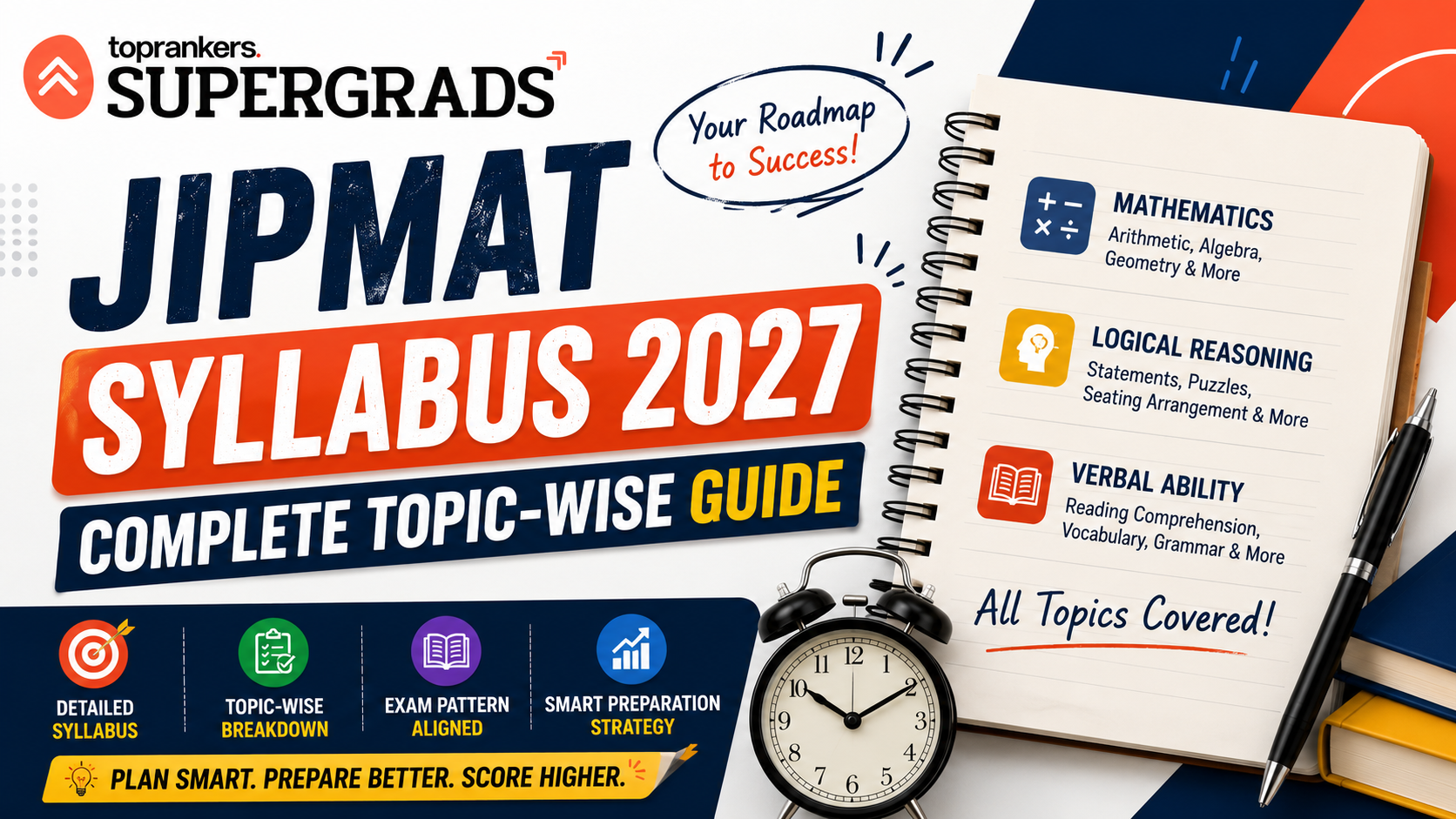
Looking for the JIPMAT syllabus? This guide lists the complete topic-wise syllabus for Quantitative Aptitude, DILR, and VARC, along with the exam pattern (100 questions, 150 minutes) and section-wise weightage.
We’ve compiled it from the NTA information bulletin and previous year papers, since NTA doesn’t publish an exhaustive standalone syllabus document.
The JIPMAT Syllabus 2027 is the foundation of your exam preparation, and knowing the important topics and sections through the JIPMAT 2027 syllabus can actually help improve your preparation.
Continue reading to know all about the JIPMAT exam syllabus for 2027 with us!
What Is the JIPMAT Syllabus 2027?
JIPMAT, the Joint Integrated Programme in Management Admission Test, is your single entry route into the five-year Integrated Programme in Management (IPM) at IIM Jammu and IIM Bodh Gaya.
The exam is divided into three sections
- Quantitative Aptitude (QA)
- Data Interpretation & Logical Reasoning (DILR)
- Verbal Ability & Reading Comprehension (VARC)
JIPMAT is conducted as a computer-based test (CBT) comprising 100 multiple-choice questions for a total of 400 marks, with a duration of 150 minutes.
One application, one score, both institutes. If you're still deciding between exams, our comparison of whether JIPMAT is easier than IPMAT is a useful starting point.
The JIPMAT syllabus 2027 is the same for both IIMs. Here's the key thing most students miss: NTA does not release a separate, exhaustive syllabus PDF for JIPMAT.
Instead, the exam draws from the standard Class 10–12 curriculum, and the reliable way to map it is through JIPMAT previous year question papers plus the section descriptions in the information brochure. That's exactly what this guide is built on.
You are tested on three sections:
| Section | Skills Tested | What It Covers |
|---|---|---|
| A – Quantitative Aptitude | Numerical and mathematical application | Concepts up to Class 10 Mathematics |
| B – Data Interpretation & Logical Reasoning | Analytical thinking, data handling | Interpreting datasets; critical reasoning and puzzles |
| C – Verbal Ability & Reading Comprehension | English usage and comprehension | Grammar, vocabulary, and passage-based reasoning |
JIPMAT Syllabus 2027 Section-Wise Weightage
A quick snapshot of where the marks sit, so you can plan your hours where they count:
| Section | Questions | Share of Paper | Typical Difficulty |
|---|---|---|---|
| Quantitative Aptitude | 33 | ~33% | Moderate; speed-dependent |
| DILR | 33 | ~33% | Moderate–High; the differentiator |
| VARC | 34 | ~34% | Moderate; scoring if read daily |
Mentor tip: DILR is where JIPMAT rank is won or lost. QA and VARC are scoring sections most serious candidates clear; the DILR sets puzzles, seating arrangement, caselets separate the top percentiles.
That's also clear from the JIPMAT exam analysis of recent papers.
| Subject | Download PDF |
|---|---|
| Quantitative Aptitude | |
| Data Interpretation & Logical Reasoning (DILR) | |
| Verbal Ability & Reading Comprehension (VARC) |
JIPMAT 2027 Syllabus for Quantitative Aptitude
This section tests concepts up to Class 10 Mathematics- no advanced calculus, but plenty of application and speed. Master the formulas, then drill mental calculation. Our list of important IPM maths formulas is worth pinning above your desk.
| Topic | Key Areas | Priority for a 60-Day Plan |
|---|---|---|
| Number System | Integers, Rational numbers, LCM, HCF, Fractions, Decimals, Surds | High |
| Arithmetic | Percentages, Profit & Loss, SI & CI, Ratio & Proportion, Averages, Time-Speed-Distance, Time & Work | High |
| Algebra | Linear & Quadratic Equations, Polynomials, Inequalities | High |
| Geometry & Mensuration | Lines, Angles, Triangles, Circles, Areas, Volumes | Medium |
| Probability & Statistics | Basic Probability, Mean, Median, Mode, Variance, SD | Medium |
| Set Theory | Union, Intersection, Venn Diagrams | Low–Medium |
| Trigonometry | Basic Ratios, Heights & Distances | Low |
| Data Sufficiency | Solving with the data provided | Medium |
Common mistake:
Students over-invest in Trigonometry and Geometry proofs while under-practising Arithmetic, yet Arithmetic (percentages, ratios, TSD) is the highest-yield, most-repeated cluster.
Fix your Arithmetic first. For targeted practice, work through our algebra questions for IPM/JIPMAT, number theory questions, and multiplication and division short tricks to build speed.
JIPMAT 2027 Syllabus for Data Interpretation & Logical Reasoning
Time management makes or breaks this section. Build the habit of scanning a set, quickly judging whether it's solvable, and moving on if it isn't.
Data Interpretation: reading and concluding tables, charts, and caselets.
Logical Reasoning: pattern recognition, deduction, and structured problem-solving.
| Data Interpretation & Logical Reasoning Topics | |||
|---|---|---|---|
| Blood Relations | Clocks & Calendars | Syllogism | |
| Series | Statements | Venn Diagram | |
| Proposition | Data Arrangement | Data Structures | |
| Direction Sense | Family Tree | Tables | |
| Coding–Decoding | Binary Logic | Pie Charts | |
| Assumptions | Seating Arrangement | Data Sufficiency | |
| Puzzles | Sets & Caselets | Bar & Line Graphs | |
Faculty insight:
In recent JIPMAT papers, the Logical Reasoning portion ran long and mixed straightforward questions with dense, multi-condition puzzles.
Practise timed puzzle sets, not just topic drills, so you learn to select which sets to attempt.
Sharpen individual skills with our JIPMAT logical reasoning questions, DI questions for IPMAT/JIPMAT, and a dedicated walkthrough on how to solve syllogism questions.
JIPMAT 2027 Syllabus for Verbal Ability & Reading Comprehension
This section rewards consistent reading more than last-minute cramming. A student who reads an editorial daily for three months walks in with an unfair advantage.
| Topic Category | Topics Covered |
|---|---|
| Reading Comprehension | Passages with inference, tone, and summary questions |
| Vocabulary | Synonyms, Antonyms, One-word Substitution, Idioms, Phrases |
| Grammar | Sentence Correction, Spotting Errors, Fill in the Blanks |
| Sentence Structuring | Para-jumbles, Cloze Test |
| Critical Reasoning | Inference-based Questions, Logical Consistency, Arguments |
Watch out:
Recent papers introduced newer formats such as match-the-columns and punctuation-based questions.
Don't prepare only for "classic" grammar MCQs; expose yourself to a variety of question types through mocks.
Strengthen this section with our guide on how to solve verbal ability questions, practice sets of JIPMAT verbal ability questions, and tips to build vocabulary for IPMAT & NPAT.
Has the Syllabus Changed for JIPMAT 2027?
Short answer: no structural change is expected. The three-section format, the 100-question / 400-mark pattern, the +4 / −1 marking, and the Class 10–12 scope have all been consistent for multiple cycles.
Until NTA publishes the official 2027 information brochure, treat the JIPMAT syllabus 2027 above, grounded in the latest papers, as your working map. We'll update this page the moment the 2027 notification is live.
What may shift in 2027 (and is not yet confirmed): exam date, registration window, application fee, and the eligibility birth/passing years.
These will be verified against the official NTA notification, expected around Feb–April 2027. To understand how these feed into admission, see the JIPMAT selection process.
Best Books for JIPMAT 2027 Syllabus
Right books, focused practice- that's the formula. These are based directly on the JIPMAT syllabus 2027 above; for the complete annotated list, see our JIPMAT books guide.
English / Verbal Ability
- High School English Grammar & Composition Wren and Martin
- Objective General English S.P. Bakshi
- Word Power Made Easy Norman Lewis
- From Plinth to Paramount Neetu Singh
Quantitative Aptitude
- Quantitative Aptitude R.S. Aggarwal
- Quantitative Aptitude Arihant
- NCERT Mathematics (Classes 9–10)
Data Interpretation & Logical Reasoning
- A New Approach to Reasoning B.S. Sijwali & Indu Sijwali
- 501 Challenging Logical Reasoning
- Verbal & Non-Verbal Reasoning R.S. Aggarwal
JIPMAT 2027 Exam Pattern & Marking Scheme
The pattern has held steady for several cycles, so you can prepare against it with confidence. For the full breakdown, see the dedicated JIPMAT exam pattern guide.
| JIPMAT Section | No. of Questions | Marks/Question | Total Marks |
|---|---|---|---|
| Quantitative Aptitude | 33 | 4 | 132 |
| Data Interpretation & Logical Reasoning | 33 | 4 | 132 |
| Verbal Ability & Reading Comprehension | 34 | 4 | 136 |
| Total | 100 | — | 400 |
JIPMAT 2027 Marking scheme:
| Aspect | Detail |
|---|---|
| Correct answer | +4 marks |
| Incorrect answer | −1 mark |
| Unattempted | 0 (no penalty) |
| Mode | Computer-Based Test (CBT), English only |
| Duration | 2 hours 30 minutes |
Because there's negative marking, accuracy beats volume. A student who attempts 80 questions at high accuracy usually outscores one who rushes all 100.
Leave a question blank when you genuinely can't narrow it to two options. To see how raw marks translate into a rank, check the JIPMAT marks vs percentile analysis.
Key Takeaways
-
Structure: three sections — QA, DILR, VARC — at Class 10–12 level.
-
Pattern: 100 questions, 400 marks, +4 / −1, 2.5 hours, CBT in English.
-
Weightage: DILR is the rank differentiator; Arithmetic is the highest-yield QA cluster.
-
2027 status: syllabus stable; dates/fees/eligibility pending the official NTA notification.
-
Books: Wren & Martin, R.S. Aggarwal, Sijwali reasoning — paired with mocks.
Continue Your JIPMAT Preparation
| JIPMAT Cut Off | JIPMAT Marks vs Percentile | JIPMAT Exam Analysis — All Years |
| JIPMAT Selection Process | JIPMAT Important Questions | |
| JIPMAT Result | JIPMAT Important Topics |
Download Your Free JIPMAT Study Material
Fill your details
Frequently Asked Questions
How many sections are included in JIPMAT 2027 Exam?

What are the important topics in JIPMAT Syllabus 2027?
What is the marking scheme of JIPMAT Exam 2027?
How can I effectively prepare for the JIPMAT syllabus 2027?
What are the important topics that I need to be prepared from JIPMAT Quantitative Syllabus?
Can I complete the JIPMAT Syllabus 2027 in two months months?

Lalita Vishwakarma
Content Writer


SHARE