
1723534562.png)

JIPMAT Marks vs Percentile 2027: Score Needed for 99 Percentile
August 13, 2026
Understanding JIPMAT Marks vs Percentile is essential if you're aiming for admission to IIM Jammu or IIM Bodh Gaya through JIPMAT 2027.
Your JIPMAT score (raw marks) is calculated out of 400 based on the official marking scheme, while your percentile reflects how you performed compared to every other candidate who appeared for the exam.
In JIPMAT 2026, a General-category candidate needed around 328 marks, roughly equivalent to the 99 percentileto secure a direct first-list offer from IIM Bodh Gaya.
Based on recent trends, aspirants targeting the top percentile should aim for a mock score between 320 and 340 marks before the exam.
Simply put, if you're comparing JIPMAT marks vs percentile, remember this:
- Marks show how many questions you answered correctly.
- Percentile shows where you rank among all candidates.
- IIM Jammu primarily considers percentile, whereas IIM Bodh Gaya prepares its merit list mainly using raw JIPMAT marks.
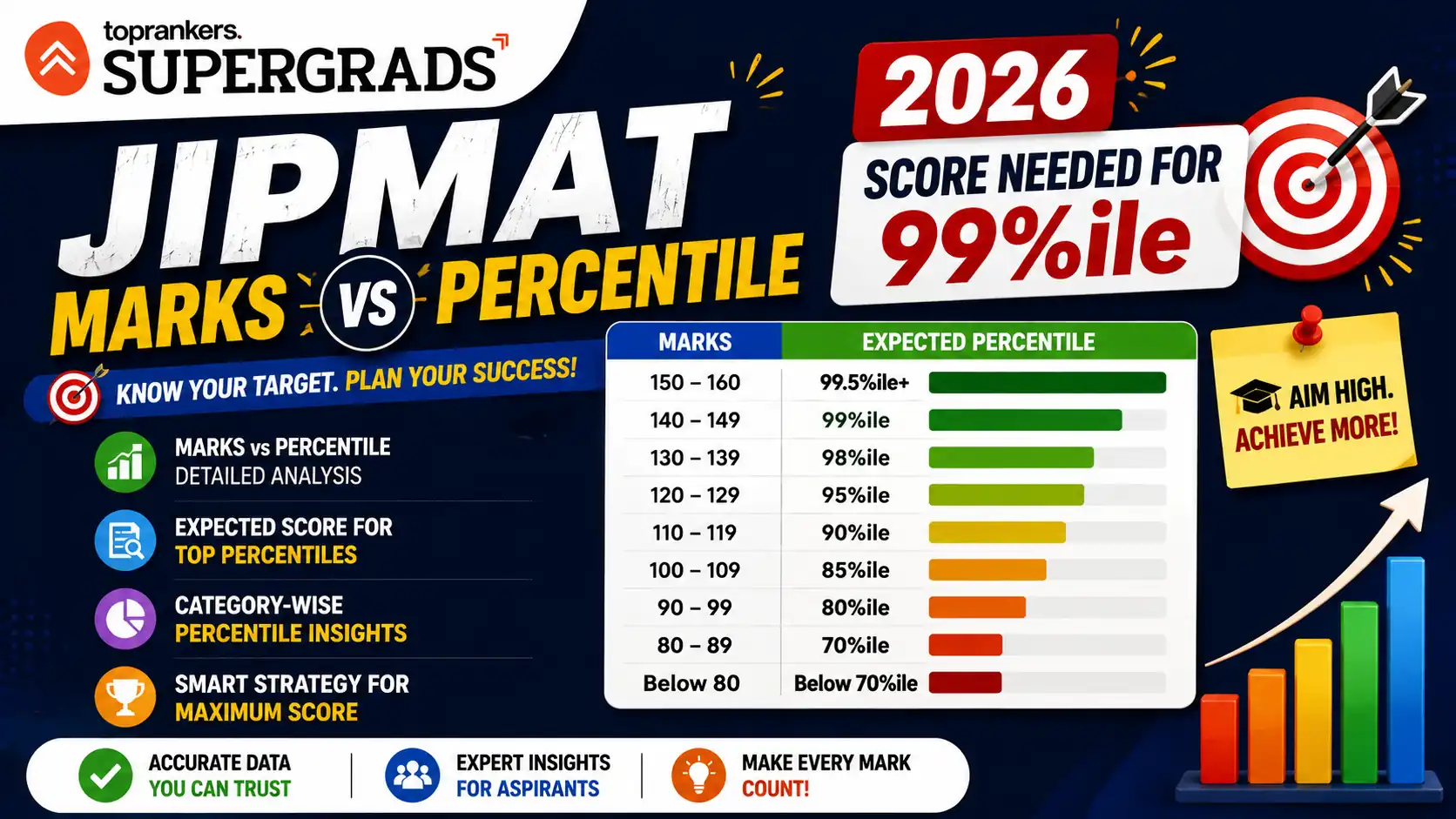
Table of Contents
- JIPMAT Marks vs Percentile: What's the Difference?
- How Is JIPMAT Percentile Calculated?
- Why Does the JIPMAT Marks vs Percentile Trend Change Every Year?
- How Many Marks Are Needed for 99 Percentile?
- How Does IIM Jammu Prepare Its Merit List Through JIPMAT?
- How Does IIM Bodh Gaya Prepare Its Merit List Through JIPMAT?
- IIM Jammu vs IIM Bodh Gaya: Which Admission Strategy Should You Follow?
- What Is a Good JIPMAT Score for 2027?
- Common Mistakes Students Make While Interpreting JIPMAT Marks vs Percentile
- Expert Preparation Tips for JIPMAT 2027
- Conclusion
JIPMAT Marks vs Percentile: What's the Difference?
Once you receive your JIPMAT result, you'll notice two important numbers on your scorecard: your raw marks and your percentile. While they're closely related, they are not interchangeable, and understanding the difference is crucial when evaluating your admission chances.
Your JIPMAT marks represent the total score you earned based on your answers in the exam. Your JIPMAT percentile, however, indicates how you performed compared to the rest of the candidates who appeared for the test. In simple terms, marks reflect your performance, whereas percentile reflects your relative position.
This distinction matters because the two participating IIMs use these numbers differently. IIM Jammu gives primary importance to percentile while preparing its composite merit list, whereas IIM Bodh Gaya ranks candidates mainly on their raw marks after applying sectional eligibility criteria.
Think of it this way:
- Your marks answer the question: "How well did I perform?"
- Your percentile answers: "How well did I perform compared to everyone else?"
Since more than 11,500 candidates appeared for JIPMAT 2026, even a small improvement in marks near the top of the score range can significantly improve your percentile and overall rank.
| Parameter | JIPMAT Marks | JIPMAT Percentile |
|---|---|---|
| Meaning | Your raw score out of 400 | Your ranking relative to all candidates |
| Based On | Correct and incorrect answers | Overall score distribution |
| Changes After Evaluation? | No | Yes, depending on everyone's performance |
| Used By IIM Jammu | Mainly for tie-breaking | 70% weightage in final merit |
| Used By IIM Bodh Gaya | Primary ranking criterion | Reference only |
What Is the JIPMAT Score?
The JIPMAT score is your final raw score calculated using the official marking scheme prescribed by NTA.
Every correct answer earns four marks, every incorrect answer attracts a one-mark penalty, and unattempted questions neither gain nor lose marks.
The calculation is straightforward:
JIPMAT Score = (Correct Answers × 4) − (Incorrect Answers × 1)
For example, suppose you answer:
- 82 questions correctly
- 10 questions incorrectly
- 8 questions unattempted
Your score would be:
(82 × 4) − 10 = 318 marks
This raw score becomes the basis for percentile calculation and the admission process. However, the same score can correspond to different percentiles in different years depending on the overall performance of candidates.
If you're calculating your expected score after the exam, use the official JIPMAT answer key and marking scheme rather than relying on memory-based estimates.
What Is the JIPMAT Percentile?
The JIPMAT percentile shows the percentage of candidates who scored the same as or lower than you in that year's examination. Unlike marks, it doesn't indicate how many questions you answered correctlyit tells you where you stand in the competition.
For example:
- A 95 percentile means you performed better than or equal to 95% of all candidates.
- A 99 percentile means only about 1% of candidates scored higher than you.
Because JIPMAT is conducted in a single shift, there is no need for score normalisation. Every candidate writes the same paper, so the percentile is calculated directly from the final score distribution.
This also explains why percentile is often a better indicator of competitiveness than marks alone. A score that seems modest in one year may translate into an excellent percentile if the paper is particularly difficult.
How Is JIPMAT Percentile Calculated?
The National Testing Agency (NTA) calculates the JIPMAT percentile using a standard statistical formula based on the performance of all candidates who appeared for the examination.
Percentile = (Number of candidates scoring less than or equal to your score ÷ Total candidates who appeared) × 100
Let's understand this with a simple example.
Assume that 11,527 candidates appeared for JIPMAT and 10,951 candidates scored less than or equal to your marks.
Your percentile would be:
(10,951 ÷ 11,527) × 100 = 95.00 percentile
The important thing to remember is that percentile is not calculated independently. It depends entirely on the distribution of scores across all candidates. If more students score highly in a particular year, higher marks will be required to achieve the same percentile.
Why Does the JIPMAT Marks vs Percentile Trend Change Every Year?
One of the biggest misconceptions among aspirants is assuming that the same score will always fetch the same percentile. In reality, the relationship between JIPMAT marks vs percentile changes every year.
That's because percentile is a relative measure, not an absolute one.
Several factors influence this conversion:
- Paper difficulty: An easier paper usually results in higher average scores, increasing the marks required for top percentiles.
- Competition level: A stronger candidate pool pushes percentile benchmarks upward.
- Overall score distribution: Even if the highest score remains similar, changes in the middle and upper score ranges can shift percentile values.
For instance, if the paper is tougher than the previous year, a score of 320 may correspond to a higher percentile than it did earlier. Conversely, in an easier paper, the same score could lead to a lower percentile because more candidates score above it.
That's why experts recommend using previous years' JIPMAT marks vs percentile data as a benchmark rather than treating it as a fixed conversion chart.
In the next section, we'll look at the latest verified JIPMAT marks vs percentile trend and estimate how many marks you need to secure the 99 percentile in JIPMAT 2027.
JIPMAT Marks vs Percentile 2027: How Many Marks Are Needed for 99 Percentile?
If you're targeting admission to one of the participating IIMs, this is probably the question you care about most: How many marks are required for a 99 percentile in JIPMAT?
Based on verified scorecards from recent admission cycles, candidates scoring between 335 and 340 marks typically fall around the 99 percentile.
While there is no official JIPMAT marks vs percentile conversion table released by NTA, verified student scorecards provide reliable benchmarks to estimate your standing.
Keep in mind that these figures are not fixed cutoffs. The exact conversion changes every year depending on the paper's difficulty level and the overall performance of candidates.
| JIPMAT Raw Score (/400) | Expected Percentile |
|---|---|
| 382 | 100 |
| 375 | 99.97 |
| 365 | 99.93 |
| 355 | 99.85 |
| 350 | 99.66 |
| 336 | 99.14 |
| 325 | 98.20 |
| 315 | Approximately 97 |
| 295 | Approximately 93–94 |
| 285 | Approximately 90–91 |
| 265 | Approximately 84–85 |
| 250 | Approximately 79–80 |
Note: NTA publishes candidates' raw scores and percentiles in the official scorecard but does not release a consolidated JIPMAT marks vs percentile chart.
The lower score bands above are estimated using historical score distributions and should be treated as indicative rather than exact.
How Many Marks Are Required for Other Percentiles?
While the 99 percentile receives the most attention, many candidates secure admission with lower percentiles depending on their category, board marks, and preferred institute.
| Target Percentile | Expected Marks | Competitiveness |
|---|---|---|
| 99+ | 335–340+ | Excellent chance for top-ranked candidates |
| 98+ | 320–330 | Highly competitive |
| 95+ | 305–315 | Strong score for most aspirants |
| 90+ | 280–290 | Competitive depending on category |
| 85+ | 260–270 | Moderate competitiveness |
| 80+ | 245–255 | Needs category advantage for top IIMs |
These ranges are especially useful while analysing mock tests. Instead of asking, "Is my score good?", compare your average score with the percentile band you're targeting.
Can the Same JIPMAT Score Result in Different Percentiles?
Yes. This happens because the percentile depends on relative performance, not just your raw marks.
Imagine two different years:
- In a tougher paper, many candidates score below 300. A score of 320 could therefore correspond to a very high percentile.
- In an easier paper, a larger number of candidates may cross the 320-mark level, causing the percentile for the same score to drop.
This is one of the reasons experts advise against relying solely on previous years' cutoff scores.
Use historical JIPMAT marks vs percentile data to set realistic goals, but always adjust your expectations after reviewing the latest exam analysis and answer-key trends.
What Should Be Your Target Score for JIPMAT 2027?
If you're preparing for JIPMAT 2027, it's better to aim slightly higher than the previous year's benchmarks. Building a comfortable margin protects you against changes in paper difficulty and rising competition.
- 340+ marks: Ideal target for candidates aiming for the highest percentile and maximum admission flexibility.
- 320–335 marks: Strong competitive range for most General-category aspirants.
- 300–320 marks: Good score with realistic admission opportunities, particularly when supported by strong academics.
- Below 300 marks: Focus on improving accuracy before increasing attempts. In JIPMAT, converting incorrect answers into correct ones has a much bigger impact than simply attempting more questions.
Now that you know the latest JIPMAT marks vs percentile trend, the next step is understanding how each participating IIM actually uses your score during the admission process.
Although both institutes accept the same entrance exam, their merit list preparation is very different, and that's exactly what we'll explore next.
How Does IIM Jammu Prepare Its Merit List Through JIPMAT?
Scoring well in JIPMAT is only the first step. To receive an admission offer from IIM Jammu, you must also understand how the institute evaluates candidates after the results are declared.
Unlike IIM Bodh Gaya, which primarily considers raw marks, IIM Jammu prepares its final merit list using a composite score.
This means your admission depends not only on your JIPMAT performance but also on your academic consistency in Classes 10 and 12.
According to the latest admission policy, the final composite score consists of:
- 70% weightage: JIPMAT Overall Percentile
- 15% weightage: Class 10 Marks
- 15% weightage: Class 12 Marks
There is no Personal Interview (PI), Written Ability Test (WAT), or Group Discussion (GD).
Once you clear the IIM Jammu eligibility criteria and sectional cutoffs, your composite score alone determines your position in the merit list.
IIM Jammu Admission Criteria at a Glance
| Admission Component | Weightage |
|---|---|
| JIPMAT Overall Percentile | 70% |
| Class 10 Marks | 15% |
| Class 12 Marks | 15% |
| Personal Interview (PI) | Not Conducted |
| Written Ability Test (WAT) | Not Conducted |
| Group Discussion (GD) | Not Conducted |
This admission process rewards students who have performed consistently throughout their academic journey rather than relying solely on their entrance exam score.
IIM Jammu Sectional Cutoff Percentiles (Official)
Before your composite score is considered, you must first qualify the minimum sectional percentile in each of the three sections of JIPMAT.
Failing to clear even one sectional cutoff can make you ineligible for admission, regardless of your overall percentile.
| Category | Quantitative Aptitude | DILR | VARC |
|---|---|---|---|
| General | 50 | 50 | 50 |
| EWS | 35 | 35 | 35 |
| NC-OBC | 35 | 35 | 35 |
| SC | 30 | 30 | 30 |
| ST | 25 | 25 | 25 |
| PwD | 25 | 25 | 25 |
Source: IIM Jammu IPM Admission Policy (Latest Available).
Notice that these are percentile cutoffs, not sectional marks. This means the qualifying score can vary slightly from year to year depending on the difficulty level of each section.
Why Board Marks Matter More Than Most Students Realise?
Many aspirants spend months trying to improve their JIPMAT percentile by one or two points while overlooking the impact of their board marks. At IIM Jammu, that can be a costly mistake.
Since Class 10 and Class 12 marks together contribute 30% of the final composite score, a strong academic record can compensate for a slightly lower percentile.
In other words, two students with similar JIPMAT performance may receive very different admission outcomes simply because one has stronger board results.
How Should You Prepare If IIM Jammu Is Your First Preference?
Your preparation strategy should reflect the institute's IIM Jammu admission policy.
If you're still in Class 11 or 12, improving your board marks can significantly strengthen your profile. Every additional percentage point contributes to your final composite score and can offset a small difference in percentile.
If you've already completed school, your focus should shift entirely to maximising your JIPMAT percentile while ensuring you comfortably clear all sectional cutoffs.
A balanced score across Quantitative Aptitude, DILR, and VARC is usually more valuable than excelling in one section while underperforming in another. Clearing the sectional benchmarks is the first hurdle; improving your overall percentile is the next.
How Does IIM Bodh Gaya Prepare Its Merit List Through JIPMAT?
If IIM Bodh Gaya is your preferred destination, your preparation strategy should be slightly different. Unlike IIM Jammu, which evaluates candidates using a composite score, IIM Bodh Gaya prepares its merit list almost entirely on the basis of raw JIPMAT marks.
There is no weightage for Class 10 or Class 12 marks during merit preparation, and candidates are not required to appear for a Personal Interview (PI), Group Discussion (GD), or Written Ability Test (WAT).
In simple terms, once you satisfy the IIM Bodhgaya eligibility requirements and clear the minimum sectional scores, your total JIPMAT marks determine your position in the merit list.
IIM Bodh Gaya Admission Criteria at a Glance
| Admission Component | Weightage |
|---|---|
| JIPMAT Raw Marks | 100% |
| Class 10 Marks | Eligibility & Tie-breaking only |
| Class 12 Marks | Eligibility & Tie-breaking only |
| Personal Interview (PI) | Not Conducted |
| Written Ability Test (WAT) | Not Conducted |
| Group Discussion (GD) | Not Conducted |
Because the admission process is driven by raw marks, every correct answer has a direct impact on your chances of receiving an offer. Improving your accuracy by even a few questions can make a noticeable difference in your final rank.
IIM Bodh Gaya Sectional Minimum Marks (2026)
Before candidates are considered for the merit list, they must achieve the minimum qualifying marks in each section. These sectional thresholds are published separately and can vary each year depending on the overall performance of candidates.
| Category | Quantitative Aptitude | Data Interpretation | Verbal Ability |
|---|---|---|---|
| General | 52 | 88 | 76 |
| EWS | 38 | 79 | 65 |
| NC-OBC | 38 | 79 | 65 |
| SC | 27 | 69 | 54 |
| ST | 21 | 60 | 46 |
| PwD | 21 | 60 | 46 |
One interesting observation from the 2026 admission cycle is that the qualifying score for Data Interpretation was significantly higher than that for Quantitative Aptitude.
This doesn't necessarily mean DI is more important. Instead, it reflects how candidates performed in that particular section. When a section is relatively easier, more students score well, pushing the qualifying marks upward.
The takeaway is simple: don't ignore any section while preparing. A strong overall score cannot compensate for failing to meet a sectional requirement.
IIM Bodh Gaya Cutoff Marks (2026 First Merit List)
After candidates clear the sectional eligibility criteria, admission offers are released based on the overall merit list. The table below shows the first-round cutoff marks announced for the 2026 admission cycle.
| Category | Gender-Neutral Seats | Girls' Supernumerary Seats |
|---|---|---|
| General | 328 | 318 |
| EWS | 295 | 275 |
| NC-OBC | 270 | 265 |
| SC | 230 | 225 |
| ST | 190 | 170 |
| PwD | 190 | 170 |
These figures represent the first admission list and should be used as benchmarks for future preparation rather than fixed targets. Every year, the final admitted score may change as candidates accept or decline offers and waitlists move.
What Do These Cutoffs Mean for JIPMAT 2027 Aspirants?
The 2026 cutoff data provides a realistic benchmark for setting your preparation goals.
- 330+ marks: A strong target for General-category candidates seeking a direct admission offer.
- 300–325 marks: Competitive range with a realistic chance of waitlist movement, depending on category and JIPMAT Seat availability.
- Below 300 marks: Improvement is recommended to remain competitive for the top participating IIMs in the General category.
Rather than aiming for the exact previous year's cutoff, it's always safer to target a score that gives you a comfortable margin. Competition, paper difficulty, and the overall score distribution can shift admission thresholds from one year to the next.
What Are Supernumerary Seats for Girls?
One unique feature of the IIM Bodh Gaya admission process is the availability of supernumerary seats for female candidates.
These seats are created in addition to the regular intake and are intended to improve gender diversity without reducing opportunities for other candidates.
As a result, the cutoff for these seats is often slightly lower than the corresponding gender-neutral category.
For example, in the General category during the 2026 admission cycle:
- Gender-neutral cutoff: 328 marks
- Girls' supernumerary cutoff: 318 marks
This does not create a separate competition. Female candidates remain eligible for both the regular merit list and the supernumerary seats, effectively increasing their chances of admission.
IIM Jammu vs IIM Bodh Gaya: Which Admission Strategy Should You Follow?
Although both institutes accept JIPMAT scores, their admission philosophies are quite different. Understanding these differences can help you prioritise your preparation more effectively.
| Factor | IIM Jammu | IIM Bodh Gaya |
|---|---|---|
| Primary Selection Criterion | Composite Score | Raw JIPMAT Marks |
| Weightage for Board Marks | 30% | No Merit Weightage |
| Importance of Overall Percentile | Very High | Reference Only |
| Primary Focus During Preparation | Balanced percentile + academics | Maximise raw score and sectional performance |
| Interview / PI / WAT | Not Conducted | Not Conducted |
So, which institute should influence your preparation strategy?
- If your Class 10 and 12 scores are already strong, IIM Jammu's admission policy works in your favour because your academic record contributes to the final composite score.
- If your board marks are average but you're confident in competitive exams, maximising your raw JIPMAT score becomes especially important for IIM Bodh Gaya.
- Female candidates should also keep the supernumerary seat policy in mind while estimating their admission chances.
Ultimately, the best strategy is to prepare for both institutes simultaneously. A higher JIPMAT score improves your options regardless of which admission policy eventually benefits you more.
What Is a Good JIPMAT Score for 2027?
There's no single score that guarantees admission because every year brings a different paper difficulty level, competition, and cutoff.
However, based on recent admission trends, a JIPMAT score of 330 or above is generally considered an excellent target for General-category aspirants aiming for IIM Jammu or IIM Bodh Gaya.
That said, a "good" score isn't just about crossing a number. It should put you in a competitive position after accounting for annual variations in the JIPMAT marks vs percentile trend.
Instead of chasing last year's cutoff, focus on reaching a score range that gives you a comfortable margin.
A Practical Target Score Framework
Use the following benchmarks to evaluate your current preparation level and identify your next milestone.
| Mock Score Range | Preparation Status | What You Should Do |
|---|---|---|
| 340+ | Outstanding | Maintain consistency, minimise careless mistakes, and continue full-length mocks. |
| 320–339 | Highly Competitive | Focus on accuracy and sectional balance rather than increasing attempts. |
| 300–319 | Competitive | Strengthen one weak section while preserving your strengths. |
| 280–299 | Needs Improvement | Improve fundamentals and reduce negative marking before attempting more questions. |
| Below 280 | Building Phase | Prioritise concept clarity, sectional practice, and consistent revision. |
The biggest difference between students scoring 290 and those scoring 330 isn't always knowledge. More often, it's decision-making under exam pressure, question selection, and accuracy.
How to Improve Your JIPMAT Score Faster?
Many aspirants assume that improving their score means attempting more questions. In reality, the quickest gains usually come from improving accuracy.
Remember the marking scheme:
- A correct answer earns +4 marks.
- An incorrect answer results in a −1 penalty.
That means every careless mistake costs you five marks compared to getting the question right.
Imagine you convert just 10 incorrect answers into correct ones during the actual exam.
Your score improves by:
10 × 5 = 50 marks
Near the top of the leaderboard, those 50 marks can move you across multiple percentile bands and significantly improve your admission prospects.
Before increasing your attempts, ask yourself one question after every mock:
"Which mistakes could I have avoided?"
You'll often discover that reviewing errors produces better results than solving another hundred questions.
Common Mistakes Students Make While Interpreting JIPMAT Marks vs Percentile
Every year, mentors notice the same misconceptions among aspirants. Avoiding these mistakes can save you months of inefficient preparation.
1. Treating Last Year's Cutoff as a Guaranteed Target
Admission cutoffs are not fixed. They depend on the difficulty level of the paper, the number of candidates, and the overall score distribution. Use previous years' data as guidance, not as a promise.
2. Ignoring Sectional Performance
A high overall score won't help if you fail to meet the required sectional eligibility criteria. Give equal attention to Quantitative Aptitude, DILR, and VARC throughout your preparation.
3. Comparing Percentage with Percentile
This is one of the most common misconceptions.
Scoring 300 marks out of 400 means you achieved 75% marks, but it does not mean you secured the 75 percentile.
Your percentile depends entirely on how everyone else performs in the same examination.
4. Chasing Attempts Instead of Accuracy
Attempting every question is rarely the best strategy. Intelligent question selection and high accuracy generally produce better scores than aggressive guessing.
5. Ignoring Board Marks (For IIM Jammu Aspirants)
If you're still in school, don't underestimate your Class 10 and 12 performance. Since board marks contribute 30% to IIM Jammu's composite score, they can meaningfully improve your admission prospects.
Expert Preparation Tips for JIPMAT 2027
After analysing hundreds of mock tests, one pattern appears repeatedly: students who consistently improve don't necessarily study longer; they review smarter.
Here are a few strategies recommended by experienced JIPMAT mentors:
- Attempt one full-length JIPMAT mock test every week during the early phase of preparation, then gradually increase the frequency as the exam approaches.
- Spend at least as much time analysing each mock as you spend taking it. Solving JIPMAT previous year question papers alongside your mocks makes this analysis far more realistic.
- Maintain an error log to track recurring mistakes and revise it regularly.
- Strengthen your weakest section first because balanced sectional performance is more valuable than excelling in only one area.
- Avoid comparing your mock scores with friends. Compare them with your own previous performance instead.
- Aim for gradual improvement. Consistently scoring 320 in mocks is a better indicator of exam readiness than achieving one exceptional score of 340.
Conclusion
Understanding JIPMAT marks vs percentile is about much more than interpreting your scorecard.
It helps you set realistic goals, evaluate your mock performance correctly, and prepare according to the admission policies of the participating IIMs.
If your target is IIM Jammu, remember that your percentile and academic profile work together. If you're aiming for IIM Bodh Gaya, your raw score becomes the deciding factor after clearing the sectional requirements.
Rather than chasing an exact cutoff, focus on building a score range that keeps you competitive regardless of minor yearly fluctuations. A consistent mock average between 320 and 340 marks, combined with strong sectional performance, remains one of the safest targets for serious JIPMAT 2027 aspirants.

Download Your Free JIPMAT Study Material
Fill your details
Frequently Asked Questions
What is the JIPMAT Marks vs Percentile?

What is a good score in JIPMAT 2027?
How much percentile is required for IIM Jammu JIPMAT?
How can I improve my JIPMAT percentile if my scores in mock are average?
What is the expected cutoff for JIPMAT 2027?

Lalita Vishwakarma
Content Writer
SHARE