
1723534562.png)

JIPMAT Important Questions 2027: High-Weightage Topics + PDF Download
September 15, 2026
Understanding which topics consistently generate JIPMAT important questions helps you focus your preparation efficiently and maximise your scores.
The Joint Integrated Programme in Management Admission Test (JIPMAT), conducted by the National Testing Agency (NTA), is the gateway to the five-year Integrated Programme in Management offered by IIM Bodh Gaya and IIM Jammu.
With JIPMAT 2025 now over, students preparing for JIPMAT 2027 should focus on identifying the JIPMAT important questions - the concepts and question types that have appeared consistently over the years.
Recognising these areas helps aspirants prepare strategically, improve accuracy, and manage time effectively.
This guide breaks down the JIPMAT important questions section by section, highlighting recurring topics, preparation strategies, and key insights drawn from past exam trends.
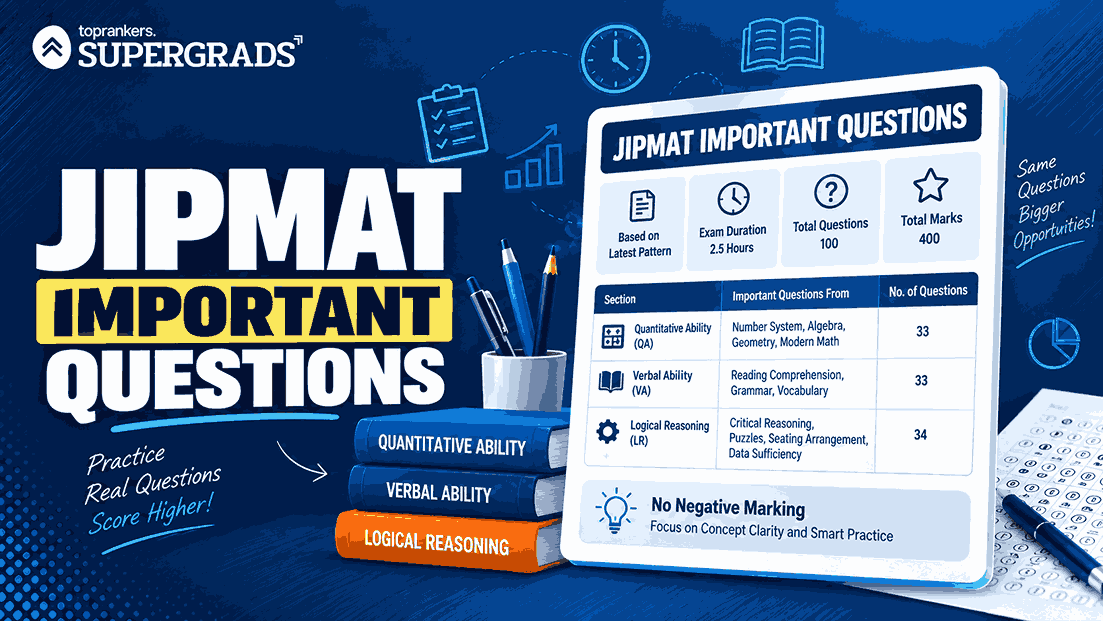
Table of Contents
- Understanding the Nature of JIPMAT Important Questions 2027
- Quantitative Aptitude: Core Areas for Important JIPMAT Questions 2027
- Data Interpretation and Logical Reasoning: Consistent Scoring Area
- Verbal Ability and Reading Comprehension: Key Areas for JIPMAT Important Questions
- Strategic Approach to Practicing Important JIPMAT Questions for 2027
Understanding the Nature of JIPMAT Important Questions
The JIPMAT exam pattern has remained stable since its inception in 2021, though the difficulty level has gradually shifted from easy to moderate.
The structure is as follows:
| Section | Number of Questions |
|---|---|
| Quantitative Aptitude (QA) | 33 |
| Data Interpretation & Logical Reasoning (DILR) | 33 |
| Verbal Ability & Reading Comprehension (VARC) | 34 |
| Total | 100 Questions |
JIPMAT important questions are derived from topics that repeatedly appear across years, form the foundation of conceptual testing, and contribute significantly to overall performance.
Candidates who recognise and practise these areas strategically can secure a competitive advantage.
Download Subject Wise JIPMAT Important Questions
| Question Paper | Download |
|---|---|
| Download JIPMAT Verbal Ability Question Paper | |
| Download JIPMAT Quantitative Aptitude Question | |
Download JIPMAT Important Questions PDF
JIPMAT previous year papers are highly beneficial for candidates preparing for the JIPMAT examination.
Practicing these papers helps aspirants understand the types of questions asked and enhances their preparation.
Explore JIPMAT important questions and download them for free in PDF format:
Quantitative Aptitude: Core Areas for JIPMAT Important Questions
Quantitative Aptitude remains the section where many aspirants excel or fall behind.
A review of papers from 2021 to 2025 shows a clear shift from simple arithmetic questions in the first two years to a more balanced mix of arithmetic, algebra, and geometry in later editions.
Below are the most relevant areas from which JIPMAT important questions are consistently drawn:
1. Arithmetic
Topics such as Percentages, profit and loss, Simple and Compound Interest, ratio and proportion, and Averages have featured prominently every year.
These are high-yield areas that serve as the basis for multiple question types. Candidates should expect conceptual problems involving percentage change, successive discounts, or time-based comparisons.
2. Time, Work, and Speed
Time and Work, along with Time, Speed and Distance, are among the most frequently recurring topics.
JIPMAT questions usually test logical reasoning rather than complex calculations, so fluency with concepts of efficiency and relative speed is essential.
3. Algebra
Over the last three years, algebra has become a key determinant of performance.
Linear and quadratic equations, identities, and inequalities often form multi-concept questions.
Many JIPMAT important questions combine algebraic reasoning with arithmetic applications.
4. Geometry and Mensuration
From 2023 onward, an apparent increase has been observed in geometry-based questions, particularly involving triangles, circles, and 3D shapes.
Mastery of standard formulas and spatial reasoning will be crucial for 2026 aspirants.
5. Number System
While under-represented in the first two editions, number theory, divisibility rules, and HCF-LCM questions appeared more prominently in 2023 and 2025.
This shift indicates the examiner's intention to rebalance the paper across foundational areas.
6. Modern Mathematics
Topics such as Progressions (AP/GP/HP), Probability, and Permutation-Combination appear occasionally but can significantly influence final scores when attempted correctly.
Aspirants should treat these as secondary but not negligible parts of their preparation.
Overall, Quantitative Aptitude questions in JIPMAT are designed to test clarity of fundamentals rather than speed-based calculation.
Therefore, candidates should prioritise conceptual understanding and logical application over rote memorisation of shortcuts.
Data Interpretation and Logical Reasoning: Consistent Scoring Area
Historically, the DILR section of JIPMAT has been easier to moderate than Quantitative Aptitude.
However, time management is crucial, as the questions require both interpretation and reasoning.
Based on recent papers, the following areas regularly contribute to JIPMAT's important questions:
1. Data Interpretation (DI)
Questions based on tables, bar charts, and pie charts continue to dominate this section.
The data sets are generally straightforward, but interpreting relationships, ratios, and percentage changes quickly is vital.
2. Logical Reasoning (LR)
The reasoning component includes Series, Coding-Decoding, Blood Relations, Directions, Analogy, and Classification.
These topics are highly predictable and frequently repeated, making them essential for aspirants focusing on accuracy.
3. Puzzles and Arrangements
While not as complex as those seen in CAT or IPMAT Indore, JIPMAT does include linear and circular arrangements, seating puzzles, and logical caselets.
These moderate-difficulty questions can be decisive for top scores when attempted with proper planning.
4. Syllogisms and Venn Diagrams
These topics often appear every alternate year and are considered easy marks for well-prepared candidates.
Understanding diagrammatic representations and basic logical statements will ensure accuracy in answering these JIPMAT-important questions.
Candidates are advised to practice comprehensive sets of DI and LR IPMAT questions to become more familiar with patterns and reduce their solving time during the exam.
Verbal Ability and Reading Comprehension: Key Areas for JIPMAT Important Questions
The JIPMAT VARC section tests English proficiency through comprehension, grammar, and usage.
While Reading Comprehension accounts for a large portion of the marks, language-based items are equally critical.
1. Reading Comprehension (RC)
Passages are shorter than those in CAT or IPMAT, but the test involves analytical reading.
Questions often focus on inference, tone, and main idea rather than factual recall. RC passages have remained a stable component of JIPMAT important questions.
2. Grammar and Error Detection
Each year includes questions on sentence correction, tenses, subject-verb agreement, and prepositions. These topics are straightforward for students with consistent grammar practice.
3. Vocabulary and Usage
Synonyms, antonyms, and contextual vocabulary are other recurring components. While individually small in weight, these can provide easy marks if revised systematically.
4. Para-Jumbles and Sentence Rearrangement
A logical arrangement of sentences to form coherent paragraphs is common.
Aspirants should focus on understanding connectors, pronouns, and transitional cues.
A consistent takeaway from past JIPMAT papers is that the verbal section rewards accuracy and comprehension more than advanced vocabulary.
Therefore, balanced reading practice across different genres remains the best approach to preparation.
Strategic Approach to Practising JIPMAT Important Questions
Understanding which topics produce important JIPMAT questions is only the first step.
The second is structuring preparation to utilise that knowledge effectively.
The following strategy can help candidates maximise returns from their study time:
Build Conceptual Foundations Early: Start by mastering basic formulas and grammar rules across sections before attempting full-length mocks.
Use Topic-Wise Practice Sets: Focus on one topic at a time, starting with high-frequency areas like arithmetic and DI.
Integrate Mock Analysis: After every JIPMAT mock test, identify which types of essential questions you struggled with and revisit those topics.
Balance Coverage: Since JIPMAT topics vary each year, ensure all areas are covered to at least a moderate level.
Prioritise Accuracy over Attempts: Negative marking can significantly affect final percentiles. Attempt only those questions you can solve with confidence.
Revise Frequently: Create a condensed formula sheet for quantitative and grammar rules for VARC. Regular revision keeps core areas fresh.
Key Takeaways
- Arithmetic, Algebra, Geometry, and DI remain the highest-yield areas for JIPMAT important questions.
- The overall difficulty JIPMAT 2027 is expected to remain moderate, similar to 2025.
- JIPMAT Preparation should emphasise clarity, consistency, and a speed-accuracy balance rather than memorising complex tricks.
- Regular exposure to authentic past-pattern questions will help identify recurring structures and improve test-readiness.

Download Your Free JIPMAT Study Material
Fill your details
Frequently Asked Questions
How can I identify JIPMAT important questions for 2026?

Are JIPMAT important questions repeated every year?
What is the typical difficulty level of JIPMAT important questions?
Is practising previous papers enough for JIPMAT 2026?
Should I skip less frequent topics to save time?
When should I start practising JIPMAT important questions for 2026?

Lalita Vishwakarma
Content Writer
SHARE