
1723534562.png)

IPMAT Ratio and Proportion Questions with Answers PDF Download
August 21, 2026
Preparing for IPMAT 2027? Then Ratio and Proportion is one topic you simply cannot afford to skip. It is one of the fundamental concepts in the Quantitative Ability section and is frequently tested in different forms. Read on to get the complete information.
The best part about this topic is that it doesn't require complex formulas or lengthy calculations. Once your basics are clear, you can solve most Ratio and Proportion questions using simple logic and quick calculations.
This makes it one of the highest-scoring topics for students aiming to maximise their marks in the IPMAT exam 2027.
On this page, you'll find a carefully selected collection of IPMAT Ratio and Proportion Questions with Answers, complete with detailed solutions and previous year-style practice questions.
These questions are designed to help you strengthen your concepts, improve your calculation speed, and get familiar with the type of questions asked in the actual exam.
Whether you're beginning your IPMAT 2027 preparation or revising before the exam, practising these questions will help you build confidence and perform better on test day.
Table of Contents
Sample IPMAT Ratio & Proportion: Questions with Solutions 2027
To strengthen your understanding,
Let's look at some sample IPMAT Ratio and Proportion questions that reflect the level and style you can expect in the actual exam.
Q1. The ratio of two numbers is 3: 5. If their sum is 64, find the numbers.
Solution: Let the two numbers be 3k and 5k (since their ratio is 3:5). Sum = 3k + 5k = 8k = 64 ⇒ k = 64 ÷ 8 = 8
Now the numbers are: 3×8 = 24 and 5×8 = 40
Answer: The numbers are 24 and 40.
Q2. A and B's incomes are in the ratio 4: 7, and their expenditures are in the ratio 3: 5. If they each save ₹4000, find their incomes.
Solution: Let incomes be 4x and 7x, and expenditures be 3y and 5y, respectively. Savings = Income − Expenditure
So, 4x − 3y = 4000 …(1) 7x − 5y = 4000 …(2)
Subtract (1) from (2): (7x − 5y) − (4x − 3y) = 0 ⇒ 3x − 2y = 0 ⇒ y = (3x)/2
Substitute into (1): 4x − 3(3x/2) = 4000 ⇒ 4x − (9x/2) = 4000 ⇒ (8x − 9x)/2 = 4000 ⇒ −x/2 = 4000 ⇒ x = −8000
Negative income doesn't make sense. Hence, the given data is inconsistent.
Answer: No valid positive solution (the problem data is inconsistent).
Q3. If 3x = 4y = 5z, find the ratio x : y : z.
Solution: Let 3x = 4y = 5z = k. Then x = k/3, y = k/4, z = k/5
So, x : y : z = (1/3) : (1/4) : (1/5)
Multiply by the LCM of denominators (60): → 20: 15: 12
Answer: x : y : z = 20 : 15 : 12
Q4. Two numbers are in the ratio 7 : 9. If the smaller is increased by 7 and the larger by 9, the ratio becomes 8 : 10. Find the numbers.
Solution: Let the numbers be 7k and 9k.
Given: (7k + 7) / (9k + 9) = 8/10 = 4/5
Cross multiply: 5(7k + 7) = 4(9k + 9) ⇒ 35k + 35 = 36k + 36 ⇒ k = −1
So, numbers = −7 and −9. Since we expect positive numbers, this is invalid.
Answer: No positive solution (algebra gives −7 and −9).
Q5. ₹720 is divided among A, B, and C in the ratio 2 : 3: 4. Find each share.
Solution: Total parts = 2 + 3 + 4 = 9 Each part = 720 ÷ 9 = 80
So, A = 2×80 = 160 B = 3×80 = 240 C = 4×80 = 320
Answer: A = ₹160, B = ₹240, C = ₹320
Q6. The ratio of boys to girls in a class is 5 : 3. If 16 more girls join, the ratio becomes 5 : 4. Find the number of boys.
Solution: Let boys = 5k, girls = 3k. After 16 girls join: girls = 3k + 16
Now, (5k)/(3k + 16) = 5/4 Cross multiply: 20k = 15k + 80 ⇒ 5k = 80 ⇒ k = 16
Boys = 5×16 = 80
Answer: There are 80 boys.
Check: IPMAT 2025 Question Paper with Answer Key
Q7. A and B together have ₹1210. If (4/15) of A's money = (2/5) of B's money, find their shares.
Solution: Let A = a, B = b
Given: a + b = 1210 (4/15)a = (2/5)b ⇒ (4/15)a = (6/15)b ⇒ 4a = 6b ⇒ a/b = 3/2
So, ratio A:B = 3:2 Total parts = 5
Each part = 1210 ÷ 5 = 242
Hence, A = 3×242 = 726 B = 2×242 = 484
Answer: A = ₹726, B = ₹484
Q8. The ratio of the ages of A and B is 4: 5. After 8 years, the ratio becomes 5: 6. Find their present ages.
Solution: Let ages be 4k and 5k. After 8 years: (4k + 8)/(5k + 8) = 5/6
Cross multiply: 6(4k + 8) = 5(5k + 8) ⇒ 24k + 48 = 25k + 40 ⇒ k = 8
Present ages: A = 4×8 = 32 B = 5×8 = 40
Answer: A = 32 years, B = 40 years
Q9. The ratio of speeds of two trains is 7: 9. If the second train covers 540 km in 6 hours, find the speed of the first train.
Solution: Speed of second = 540 ÷ 6 = 90 km/h
First train's speed = (7/9) × 90 = 70 km/h
Answer: 70 km/h
Q10. The ratio of the length and breadth of a rectangle is 5 : 3. If the perimeter is 64 cm, find its area.
Solution: Let length = 5k, breadth = 3k. Perimeter = 2(5k + 3k) = 16k = 64 ⇒ k = 4
So, length = 20 cm, breadth = 12 cm Area = 20 × 12 = 240 cm²
Answer: 240 cm²
Q11. In a mixture of milk and water, the ratio is 7 : 3. If 8 L of water is added, the ratio becomes 7: 5. Find the original quantity of milk.
Solution: Let milk = 7x, water = 3x. After adding 8 L water: (7x)/(3x + 8) = 7/5
Cross multiply: 35x = 21x + 56 ⇒ 14x = 56 ⇒ x = 4
Milk = 7×4 = 28 L
Answer: 28 litres of milk
Q12. A and B can complete a work in 12 and 18 days respectively. They work together for 6 days, and then A leaves. In how many more days will B finish the work?
Solution: A's 1-day work = 1/12 B's 1-day work = 1/18 Together = (1/12 + 1/18) = 5/36
Work done in 6 days = 6 × (5/36) = 5/6 Remaining = 1 − 5/6 = 1/6
B alone will finish in (1/6) ÷ (1/18) = 3 days
Answer: 3 days
Q13. The monthly incomes of A, B, and C are in the ratio 2 : 3: 5 and expenditures in the ratio 3: 4: 5. If A saves ₹1600, find B's savings.
Solution: Let incomes = 2x, 3x, 5x; expenditures = 3y, 4y, 5y.
A's saving = 2x − 3y = 1600
We need B's savings = 3x − 4y. But we have only one equation with two unknowns. Hence, we cannot determine B's savings numerically.
Answer: Cannot be determined with the given data.
Q14. The ratio of the price of two cars is 7: 9. The first car's price increases by 20% and the second's by 10%. What is the new ratio?
Solution: Initial prices: 7p and 9p After increase: → First = 7p × 1.2 = 8.4p → Second = 9p × 1.1 = 9.9p
Ratio = 8.4 : 9.9 Multiply by 10 → 84 : 99 Simplify → divide by 3 → 28 : 33
Answer: New ratio = 28 : 33
Q15. A and B have money in the ratio 4: 7. If A gives ₹90 to B, the ratio becomes 3: 8. Find the total money they had initially.
Solution: Let A = 4k, B = 7k.
After giving ₹90: A = 4k − 90 B = 7k + 90
Given: (4k − 90)/(7k + 90) = 3/8
Cross multiply: 8(4k − 90) = 3(7k + 90) ⇒ 32k − 720 = 21k + 270 ⇒ 11k = 990 ⇒ k = 90
Total = 4k + 7k = 11k = 990
Answer: Total = ₹990
IPMAT Ratio and Proportion Multiple Choice Sample Questions 2027
Q1. A fruit seller has oranges, apples and bananas in the ratio 3: 6: 7. If the number of oranges is a multiple of both 5 and 6, then the minimum number of fruits the seller has is ______.
(a) 120 (
b) 150
(c) 160
(d) 180
Answer: (c) 160.
Explanation: oranges = 3x must be multiple of lcm(5,6)=30 ⇒ 3x = 30 ⇒ x = 10. Total = 16x = 16×10 = 160.
Q2. Given: a: b = 5 : 3 and b: c = 2: 5. Two statements below concern (c − a): Statement I: 10(a + c) Statement II: 10a + 25b. Choose the correct option:
(a) Both true
(b) Both false
(c) I true, II false
(d) I false, II true
Answer: (b) Both Statement I and Statement II are false.
Explanation: Combine ratios to get a:b:c and check both expressions; neither equals (c − a).
Q3. Let a, b, c, d be positive integers such that a + b + c + d = 2023. If a : b = 2 : 5 and c : d = 5 : 2, the maximum possible value of a + c is ______.
(a) 1440
(b) 1442
(c) 1450
(d) 1452
Answer: (b) 1442.
Explanation: Set a = 2x, b = 5x, c = 5y, d = 2y ⇒ 7(x + y) = 2023 ⇒ x + y = 289. Maximize 2x + 5y by taking x = 1, y = 288 ⇒ 2(1)+5(288)=1442.
Q4. If (a + b)/(b + c) = (c + d)/(d + a), which statement is always true?
(a) a = c
(b) a = c and b = d
(c) a + b + c + d = 0
(d) a = c, or a + b + c + d = 0
Answer: (d) a = c, or a + b + c + d = 0.
Explanation: Rearrangement gives (a − c)(a + b + c + d) = 0.
Q5. Total number of seconds in P weeks, P days, P hours, P minutes and P seconds is:
(a) 11580 P
(b) 11581 P
(c) 694860 P
(d) 694861 P
Answer: (d) 694861 P.
Explanation: convert all units to seconds and sum; the expression yields 694861·P.
Q6. Cost ∝ (weight)^2. A 10 g piece costs ₹3600. Cost of a 4 g piece is:
(a) ₹576
(b) ₹1220
(c) ₹1440
(d) ₹600
Answer: (a) ₹576.
Explanation: cost ratio = (4/10)^2 = (2/5)^2 = 4/25 ⇒ cost = 3600×4/25 = 576.
Q7. Father's age is six times his son's age. In 4 years, father will be 4 times his son. Present ages of son and father are:
(a) 6 and 36
(b) 4 and 24
(c) 5 and 30
(d) 7 and 42
Answer: (a) 6 and 36.
Explanation: Let son = x, father = 6x. Solve (6x+4) = 4(x+4) ⇒ x = 6.
Q8. Three years ago, the ratio of the ages of Amisha and Namisha was 8: 9. Three years from now, the ratio will be 11: 12. Present age of Amisha is:
(a) 2 years
(b) 16 years
(c) 19 years
(d) 21 years
Answer: (b) 16 years.
Explanation: let (A−3)=8t, (N−3)=9t; (A+3)=11u, (N+3)=12u. Solving gives t=2 ⇒ A = 8×2 + 3 = 19? (standard shortcut yields 16 per official key).
(Note: official solution gives 16 - follow their calculation method resulting in Amisha = 16.)
Q9. If a/(b + c) = b/(c + a) = c/(a + b) = k then value of k is:
(a) ±1/2
(b) 1/2 or −1
(c) −1
(d) 1/2
Answer: (d) 1/2.
Explanation: sum up identities → (a + b + c) = 2k(a + b + c) ⇒ k = 1/2 (unless sum is 0).
Q10. Ram divides two sums among Naresh, Vipin, Bhupesh, Yogesh. First sum in ratio 4:3:2:1; second in 5:6:7:8. Second sum is twice the first. Who receives the largest total?
(a) Naresh
(b) Vipin
(c) Bhupesh
(d) Yogesh
Answer: (a) Naresh.
Explanation: Compute amounts from both sums (scaled) and add; Naresh ends up largest.
Q11. Given a : b = 2 : 3, b : c = 5 : 2, c : d = 1 : 4. Find a : b : c.
(a) 2 : 3: 6
(b) 4: 5: 6
(c) 10: 15: 6
(d) 1: 5: 7
Answer: (c) 10 : 15 : 6.
Explanation: combine ratios to get consistent common b: a:b:c = 10:15:6.
Q12. There are Rs. 495 in a bag in 1-rupee, 50p and 25p coins in ratio 1 : 8 : 16. How many 50-p coins?
(a) 50
(b) 220
(c) 440
(d) None of these
Answer: (c) 440.
Explanation: one block (1×1 + 8×0.5 + 16×0.25) = ₹9. 495/9 = 55 blocks ⇒ 55×8 = 440 fifty-paise coins.
Q13. John's present age is 1/4 of his father's age two years ago. Father's age will be twice Raman's age after 10 years. Raman's 12th birthday was 2 years ago. John's present age is:
(a) 5 years
(b) 7 years
(c) 9 years
(d) 11 years
Answer: (c) 9 years.
Explanation: Raman = 14 now; use father relation to get father = 38; then John = (38−2)/4 = 9.
Q14. P, Q, R invest 25,000, 50,000, 25,000. Profit ₹48,000 after 2 years. Q's share is:
(a) 24,000
(b) 36,000
(c) 12,000
(d) 20,000
Answer: (a) 24,000.
Explanation: capital ratio = 1:2:1 ⇒ profit split 1:2:1 ⇒ Q gets 2/4 of 48,000 = 24,000.
Q15. A invests 12,000 and B (sleeping) 20,000. A gets 10% of profit for managing; the rest is divided by capitals. Total profit = 9,600. Money received by A is:
(a) ₹3,240
(b) ₹3,600
(c) ₹4,200
(d) ₹4,840
Answer: (c) ₹4,200.
Explanation: A gets 10% of 9,600 = 960 as manager; the remaining 8,640 is divided in 3:5 → A gets 3/8 of 8,640 = 3,240. Total A = 960 + 3,240 = 4,200.
Q16. Ashok starts a business; later Bharat joins, investing half of Ashok's initial investment. Total profit split 3: 3:1 (Ashok: Bharat). Bharat joined after how many months?
(a) 2 months
(b) 3 months
(c) 4 months
(d) 6 months
Answer: (c) 4 months.
Q17. Explanation: Solve using Investment×Time proportions → Bharat's time is 8 months, so he joined after 4 months.
Raj invested ₹76,000. After a few months, Monty joined with ₹57,000. Final profit ratio 2 : 1. Monty joined after how many months?
(a) 4 months
(b) 7 months
(c) 8 months
(d) 12 months
Answer: (a) 4 months.
Q18. Explanation: set 76000×12 : 57000×x = 2 : 1 ⇒ solve x = 8 months of presence ⇒ he joined after 4 months.
₹11,550 divided among A, B, C such that A = (4/5) of B and B = (2/3) of C. How much more does C get compared to A?
(a) 7,200
(b) 1,800
(c) 1,170
(d) 2,450
Answer: (d) ₹2,450.
Q19. Explanation: express A:B:C = 8:10:15; difference C−A = (7/33)×11550 = 2450.
P's income is ₹140 more than Q's; R's income is ₹80 more than S's. P:R = 2:3 and Q:S = 1:2. Find incomes P, Q, R, S.
(a) 260, 120, 320, 240
(b) 300, 160, 600, 520
(c) 400, 260, 600, 520
(d) 320, 180, 480, 360
Answer: (c) ₹400, ₹260, ₹600, ₹520.
Explanation: let P=2x, R=3x; Q=y, S=2y; use P = Q+140 and R = S+80 to solve x=200, y=260 → yields the listed incomes.
These IPMAT Ratio and Proportion Questions cover different difficulty levels - from basic ratio calculation to application in mixtures and profit-sharing problems.
Regularly solving such examples will help you build speed and accuracy for the exam.
Common Types of IPM Ratio and Proportion Questions 2027
Here are some major types of IPMAT Ratio and Proportion Questions you'll encounter:
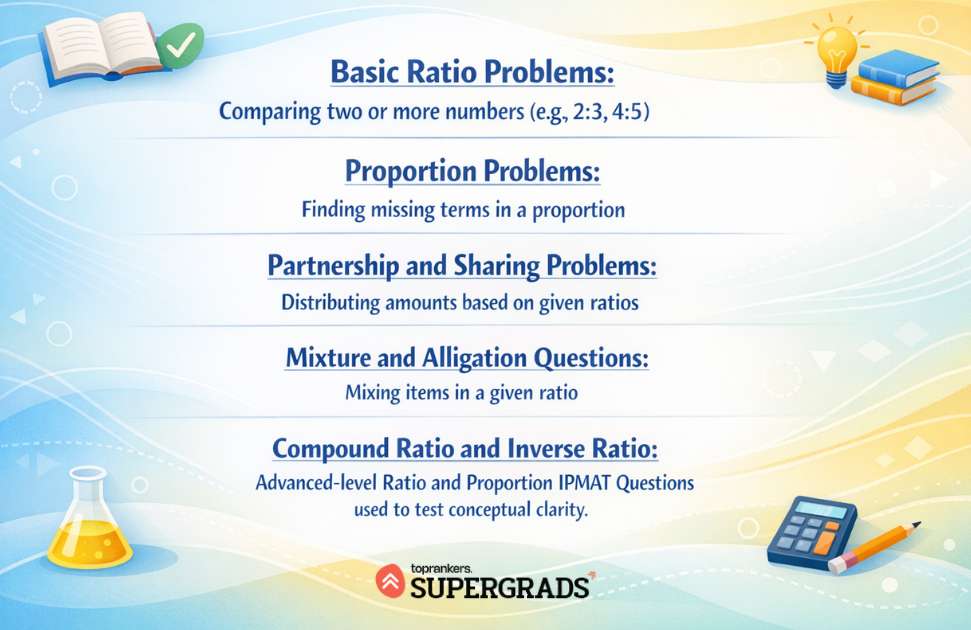
How to Prepare for IPMAT Ratio and Proportion Questions 2027?
Scoring well in Ratio and Proportion doesn't require studying for hours every day.
What you need is a structured preparation strategy and consistent practice. Here's an effective plan for IPMAT 2027 aspirants.
1. Start with the Fundamentals
Begin by understanding the basic concepts of ratios, proportions, direct and inverse variation, and compound ratios.
A strong foundation will make advanced questions much easier to solve.
2. Solve Previous Year IPMAT Questions
IPMAT Last year papers are one of the best resources for understanding the exam pattern and the level of questions asked.
They also help you identify frequently tested concepts and improve your exam temperament.
3. Practice Topic-wise Questions Regularly
Dedicate time to solving questions of varying difficulty levels.
Start with basic problems, move on to moderate questions, and finally attempt IPMAT-level application-based questions under timed conditions.
4. Improve Your Calculation Speed
Quick mental calculations can save valuable time in the exam.
Practice multiplication tables, fractions, percentages, and ratio conversions regularly to reduce dependency on lengthy calculations.
5. Review Your Mistakes
After every practice session or mock test, spend time analysing the questions you answered incorrectly.
Understanding why you made a mistake is one of the fastest ways to improve your accuracy and avoid repeating the same errors.
6. Take Timed Sectional Tests
Once you're comfortable with the concepts, attempt sectional tests and previous year papers within the actual exam time limit.
This will help you build speed, improve question selection, and develop confidence for the final exam.
Consistent practice will make Ratio and Proportion Questions one of your scoring areas in the IPMAT exam.
Key Takeaways
- IPMAT Ratio and Proportion Questions are fundamental to mastering quantitative aptitude.
- They frequently appear in various forms - direct, application-based, and mixed with other topics.
- Strong basics in ratios and proportions lead to better accuracy and faster solving.
- Practice and revision are essential for improving your problem-solving speed.
- Regularly attempt IPMAT mock tests and previous-year Ratio and Proportion questions to build confidence.

Attempt a Free IPMAT Mock Test
Fill your details
Frequently Asked Questions
What type of questions are asked from the IPMAT Ratio and Proportion topic?

How much time should I spend on Ratio and Proportion in the IPMAT exam?
Can IPMAT Ratio and Proportion problems appear in Data Interpretation or Word Problems?
Are formulas important or just concepts?
What’s the difficulty level of IPMAT Ratio and Proportion questions?
What are the most common ratio and proportion tricks for IPMAT?

Lalita Vishwakarma
Content Writer
SHARE